
Strait of Hormuz Disruption Halts 95% of Natural Gas Exports, Exposing Global Trade Vulnerability
A 100-day shutdown of the world's most critical maritime chokepoint halted 95% of its natural gas exports, revealing a fragile transmission mechanism where energy shocks rapidly cascade into fertilizer shortages and food price spikes.

- Trade & Development Economists
- Focus on the cascading bottleneck effects and how standard models underestimate the impact on developing nations.
- Energy Security Analysts
- Emphasize the fragility of relying on a single maritime chokepoint and the urgent need for supply diversification.
- Regional Suppliers & Shippers
- Focus on the logistical nightmare of the shutdown and the complex reality of unwinding the disruption.
Perspectives this story doesn't cover
- Farmers in developing nations facing immediate crop yield reductions
- Marine insurance underwriters pricing the ongoing risk of Gulf transit
In March 2026, the long-feared scenario for global energy markets materialized in real time: an escalation of regional conflict forced the total closure of the Strait of Hormuz. For over 100 days, the world's most critical maritime chokepoint saw commercial transit grind to a near halt, effectively shutting in the equivalent of 10 million barrels per day of oil and roughly 300 million cubic meters per day of liquefied natural gas (LNG). The sheer scale of the disruption was entirely unprecedented, instantly removing a fifth of the world's seaborne oil trade and a massive share of its LNG from the global market, sending immediate shockwaves through international supply chains.[3][7]
Early trade data captured the severe magnitude of the supply shock. According to comprehensive analysis by the International Trade Centre (ITC) and the United Nations, export volumes across twelve strategic energy and industrial products plummeted almost immediately, with LNG exports from Hormuz-dependent economies experiencing a staggering 95 percent decline. Asian markets, which traditionally absorb the vast majority of these exports, scrambled to secure replacement cargoes as European and Asian gas prices surged in the immediate aftermath of the shutdown.[1][4][5]
However, the crisis quickly revealed that the Strait of Hormuz is far more than just an energy artery. It is, in fact, a foundational pillar of the global agricultural supply chain. While policymakers, military strategists, and standard trade models have historically focused on the immediate macroeconomic impacts of crude oil shortages, the 2026 disruption exposed a fragile, hidden transmission mechanism. It highlighted the direct and unbreakable link between Persian Gulf natural gas extraction and the baseline viability of global food production, a vulnerability that had been largely ignored in previous energy security assessments.[2][6][8]
Natural gas is not merely a combustible fuel for heating homes and generating electricity; it is the primary chemical feedstock and energy input required to manufacture nitrogen-based fertilizers. When LNG production facilities in the region were forced offline or became unable to export their products, the supply of these critical agricultural inputs was immediately severed. The Persian Gulf accounts for more than a third of global urea exports and nearly 30 percent of global ammonia exports, making it the world's undisputed central fertilizer hub.[5][6]
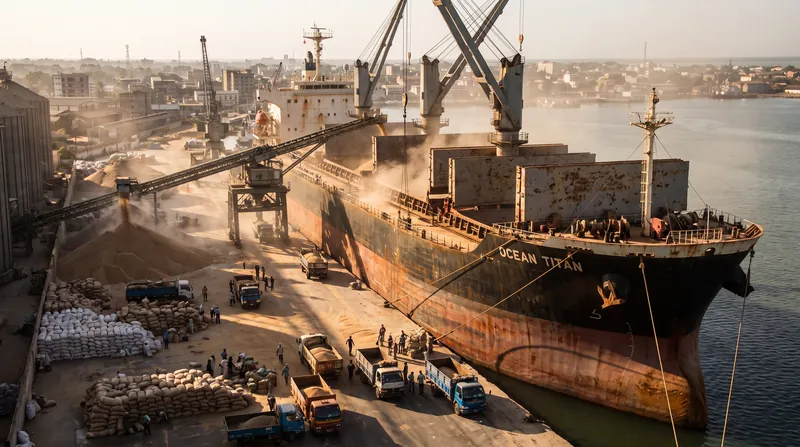
The resulting collapse in fertilizer shipments was nearly as severe as the drop in raw energy exports. The ITC reported an 83 percent decline in urea exports and a 75 percent drop in ammonia exports from the region during the height of the crisis. Because up to 30 percent of international commercial fertilizer shipments transit directly through the Strait of Hormuz, the blockage effectively cut off a third of the world's seaborne urea supply overnight, leaving farmers worldwide without the nutrients necessary to maintain crop yields.[1][6][8]
The market reaction was swift, punishing, and widespread. Global urea prices surged by approximately 40 percent, reaching elevated levels not seen since the height of the 2022 energy crisis. The situation was further exacerbated when major producers outside the Middle East, such as China, opted to retain their limited fertilizer stocks to prioritize their own domestic food security. This protectionist pivot effectively shifted the entire burden of the global shortage onto the international market, leaving import-dependent nations with few viable alternatives.[8]
Global urea prices surged by approximately 40 percent, reaching elevated levels not seen since the height of the 2022 energy crisis.
The economic fallout from this bottleneck mechanism was highly uneven across the globe. A major analysis published by the Kiel Institute for the World Economy found that standard trade models drastically underestimated the global impact because they failed to account for how energy disruptions cascade through chemical production directly into food prices. While the aggregate global economic costs appeared moderate on paper—with the United States projected to lose just 0.07 percent of its economic output—the burden fell disproportionately on the world's poorest and most vulnerable nations.[2]
Developing countries in South Asia, Sub-Saharan Africa, and the Middle East that rely heavily on imported energy and fertilizers faced welfare losses 10 to 20 times larger than those experienced in the West. The timing of the disruption, which unfortunately coincided with the critical peak planting season in the Northern Hemisphere, severely compounded the risk. It threatened to decimate upcoming crop yields and drive up fundamental food prices in the economies least equipped to absorb the inflationary shock, transforming a regional maritime dispute into a localized hunger crisis.[2][8]
Advanced economies faced their own acute vulnerabilities, though these manifested primarily in energy rather than agriculture. Japan and South Korea, which lack deep domestic energy reserves, were highly exposed to the sudden halt in shipments. Japan historically sourced 91 percent of its crude oil from Hormuz-dependent economies and recorded a massive 64 percent decline in total imports during the initial month of the crisis. With only enough LNG reserves to sustain a few weeks of normal demand, these industrialized nations were forced to dramatically and expensively alter their sourcing strategies.[1][4][6]
Despite the severity of the shock, the global LNG market demonstrated a surprising degree of structural resilience. The crisis did not trigger the apocalyptic collapse that some commentators initially feared when the strait first closed. Instead, the disruption accelerated the diversification of energy supply chains. Additional LNG flows from outside the Middle East, combined with rapid demand-side adjustments and the coordinated drawing down of strategic reserves, helped cushion the blow for major importers and prevented a total market freeze.[1][5]
Alternative suppliers stepped in where possible, increasing shipments for 10 of the 12 strategic products tracked by the UN. However, these alternative sources could only fully offset the lost imports for a few specific chemicals, such as ammonia and polymers of propylene. For foundational commodities like LNG and urea, the sheer volume of the shortfall meant that trade diversion could only partially replace the disrupted supplies, forcing markets to rely heavily on inventory drawdowns and mandated reductions in consumption.[4]
By mid-summer 2026, an interim peace agreement paved the way for commercial shipping to tentatively resume through the Strait, offering a glimmer of hope to strained global markets. Yet, unwinding a 100-day disruption of this unprecedented magnitude proved to be a highly complex logistical challenge. Traffic remained far below normal levels as shipping companies navigated lingering security concerns, significantly higher marine fuel costs, and elevated insurance premiums that made the route financially prohibitive for some smaller operators.[1][3][4]
The delayed shipments, depleted global inventories, and severely disrupted shipping schedules ensured that the adjustment process would remain uneven for months to come. The crisis has fundamentally altered how nations assess maritime risk, proving beyond a doubt that the economic effects of a chokepoint closure extend far beyond the physical cargoes trapped in the waterway. The ripple effects will continue to be felt in commodity pricing and supply chain planning well into the next decade.[4][8]
Ultimately, the 2026 Strait of Hormuz disruption serves as a stark, unavoidable lesson in the deep interconnectedness of modern global trade. It has forced policymakers to redefine the very concept of energy security, recognizing that a disruption in natural gas is simultaneously a disruption in the global food supply. Addressing energy dependency without simultaneously addressing fertilizer dependency leaves the world's agricultural supply chains exposed to the exact same catastrophic shocks, transmitted through a different, hidden path.[6][8]
Key points
- A 100-day closure of the Strait of Hormuz halted 95% of regional LNG exports and 83% of urea fertilizer exports.
- Standard trade models underestimated the crisis by missing the link between natural gas shortages and global food production.
- Global urea prices surged 40%, disproportionately threatening agricultural yields and food security in developing nations.
- While advanced economies faced severe energy crunches, alternative LNG supplies and strategic reserves prevented a total market collapse.
- Despite an interim peace agreement, resuming normal shipping remains hindered by high insurance costs and logistical backlogs.
Why this matters
While standard economic models predicted moderate global losses from the Hormuz closure, the disruption demonstrated how deeply natural gas is woven into the global food supply, disproportionately threatening agricultural yields and food prices in import-dependent developing nations.
Sources
Source coverage
8 outlets
3 viewpoints surfaced







- [1]International Trade CentreTrade & Development Economists
Strait of Hormuz disruption hits energy, fertilizer and industrial trade
Read on International Trade Centre → - [2]Kiel Institute for the World EconomyTrade & Development Economists
The Hidden Costs of the Hormuz Closure: How Energy Shocks Cascade into Food Crises
Read on Kiel Institute for the World Economy → - [3]Council on Foreign RelationsEnergy Security Analysts
Unwinding the Hormuz Disruption: The Complex Reality of Restarting Global Energy Flows
Read on Council on Foreign Relations → - [4]Oman ObserverRegional Suppliers & Shippers
Disruption in the Strait of Hormuz has exposed the vulnerability of global trade
Read on Oman Observer → - [5]GIS ReportsEnergy Security Analysts
The Hormuz crisis revealed LNG supply vulnerabilities, but global gas markets are poised for expansion
Read on GIS Reports → - [6]Atlas InstituteEnergy Security Analysts
The Strait of Hormuz: The Hidden Infrastructure of Global Food Production
Read on Atlas Institute → - [7]UNCTADTrade & Development Economists
Ship transits through the Strait of Hormuz have come to a near halt
Read on UNCTAD → - [8]Factlen Editorial TeamEnergy Security Analysts
Synthesis by Factlen editorial team
Read on Factlen Editorial Team →
Comments

More in Perspectives
See all →Global Trade
The Prebisch-Singer Hypothesis: Why Developing Nations Are Mathematically Locked Into Commodity Dependence
8 sources
Solid-State Cooling
HKUST's Zero-Degradation Elastocaloric Device Proves Material Science Is the Final Hurdle for Green Cooling
5 sources

Networked Control
The Sum Log2 Limit: Why an Unstable System's Poles Mathematically Dictate the Minimum Data Rate for Stability
3 sources

Signal Processing
The Time-Bandwidth Product: Why a Signal's Duration and Frequency Range Have a Fixed, Inverse Mathematical Relationship
7 sources

Every angle. Every day.
Get Perspectives stories with full source coverage and perspective breakdowns delivered to your inbox.