
SpaceX Raises Record $85.7 Billion in IPO as Valuation Tops $2 Trillion
SpaceX has completed the largest initial public offering in history, raising over $85 billion after underwriters exercised their options. The market debut pushed the aerospace and AI company's valuation past $2.2 trillion, making Elon Musk the world's first trillionaire.
By Factlen Editorial Team
- Retail & Growth Investors
- View the IPO as a rare chance to buy into a generational technology monopoly spanning space and AI.
- Value Analysts
- Caution that the $2.2 trillion valuation is disconnected from the company's current unprofitability.
- Corporate Leadership
- Projects exponential growth driven by the convergence of space infrastructure and artificial intelligence.
What's not represented
- · Competitors in the aerospace sector
- · Regulators monitoring the dual-class share structure
Why this matters
The sheer scale of SpaceX's public debut reshapes the global equity markets, injecting massive liquidity into the space and AI sectors while establishing a new benchmark for mega-cap technology valuations. For everyday investors, it opens direct access to a company that dominates global rocket launches, satellite internet, and increasingly, artificial intelligence infrastructure.
Key points
- SpaceX raised a record $85.7 billion after underwriters exercised their option to buy 83.3 million additional shares.
- The stock surged 19% on its first day, pushing the company's valuation to $2.2 trillion.
- The IPO made CEO Elon Musk the world's first trillionaire.
- Musk projects the company will hit $1 trillion in annual revenue by 2030, far exceeding Wall Street estimates.
- Despite growing revenue to $18.67 billion in 2025, SpaceX reported a net loss of $4.94 billion due to heavy infrastructure investments.
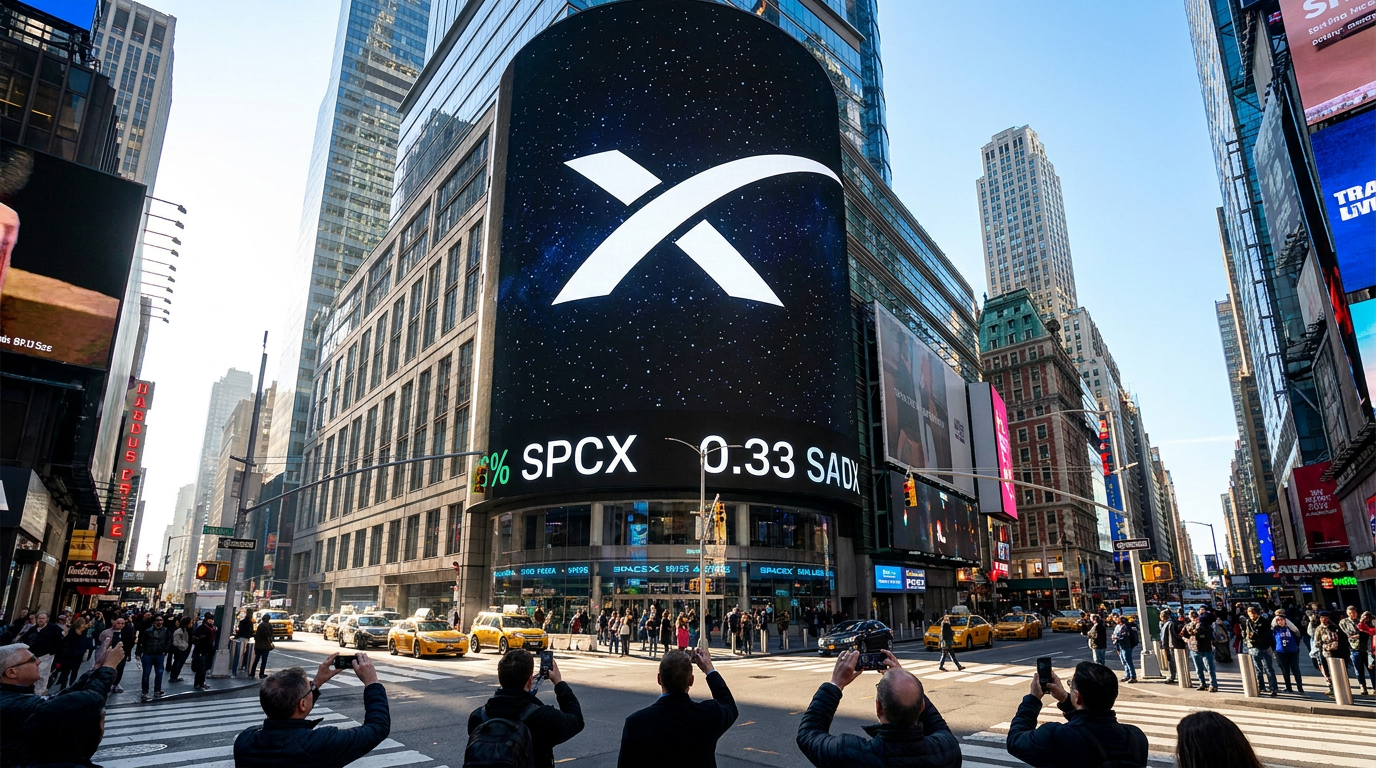
SpaceX has shattered global financial records with its initial public offering, raising an unprecedented $85.7 billion after underwriters fully exercised their options on Monday. The aerospace and artificial intelligence conglomerate, trading under the ticker SPCX, saw its shares surge 19% during its Friday debut on the Nasdaq, pushing its market capitalization past $2.2 trillion.[1][2]
The offering eclipses the previous high-water mark set by Saudi Aramco’s $29.4 billion debut in 2019. Initially, SpaceX sold 555.6 million shares at $135 each, securing $75 billion. However, immense demand prompted underwriters, led by Goldman Sachs and Morgan Stanley, to trigger their "greenshoe" option, purchasing an additional 83.3 million shares and injecting another $10.7 billion into the company's coffers.[1][3]

The historic listing immediately vaulted SpaceX into the upper echelon of the world's most valuable publicly traded companies, ranking it sixth globally—ahead of Meta and Tesla, though still trailing titans like Apple and Nvidia. The surge also cemented CEO Elon Musk's status as the world's first trillionaire, given his 42% equity stake and 82.4% voting control over the newly public entity.[2][5][8]
Retail investors played a massive role in the stock's early momentum. Everyday traders poured nearly $120 million into SpaceX shares on Friday alone, making it the most purchased stock of the session and breaking retail participation records previously set by Coinbase in 2021. Brokerage applications were reportedly overwhelmed by the sheer volume of order-matching activity, delaying the first official trades by several hours after the opening bell.[1][4][5]
Retail investors played a massive role in the stock's early momentum.
The capital raised will fuel a sprawling, capital-intensive roadmap. SpaceX plans to accelerate the development of its Starship rocket program, expand its Starlink satellite broadband network, and aggressively build out its artificial intelligence infrastructure. The company's recent acquisition and integration of xAI—the developer behind the Grok chatbot—has fundamentally shifted Wall Street's perception of SpaceX from a pure aerospace manufacturer to a diversified AI powerhouse.[2][7][8]
Over the weekend, Musk amplified the hype by projecting that SpaceX could generate $1 trillion in annual revenue by 2030. "I would be surprised if revenue is not greater than $1T in 2031," he posted on his social media platform X. This aggressive target relies heavily on the assumption that the company's AI division will experience exponential growth alongside its space operations.[4]

However, that trillion-dollar forecast sits far above consensus estimates from major financial institutions. Morgan Stanley projects SpaceX's 2030 revenue will reach approximately $330 billion, while Goldman Sachs offers a more optimistic $474 billion target. Both models assume massive growth in AI-related services, but neither approaches Musk's timeline.[6]
Skeptics also point to the company's current profitability metrics. While SpaceX grew its revenue by 33% to $18.67 billion in 2025, the heavy investments required for Starship and AI infrastructure caused the company to swing from a $791 million profit to a net loss of $4.94 billion. Value investors note that similarly valued tech giants, such as Alphabet and Amazon, produce tens of billions in annual after-tax profits.[4][6][8]

Despite the earnings gap, market enthusiasm remains undeterred. Index providers FTSE Russell and MSCI are scheduled to add SPCX to their benchmarks later in June, a move expected to trigger billions of dollars in automatic purchases from passive funds and exchange-traded products. For now, Wall Street appears willing to fund Musk's ultimate vision: a multi-planetary future underwritten by the world's most advanced artificial intelligence.[2][4][8]
How we got here
2002
Elon Musk founds Space Exploration Technologies Corp. (SpaceX) in El Segundo, California.
2008
The Falcon 1 rocket successfully reaches orbit, saving the company from bankruptcy and securing a vital NASA contract.
2019
Saudi Aramco sets the global IPO record by raising $29.4 billion.
2025
SpaceX revenue grows 33% to $18.67 billion, though the company posts a $4.94 billion net loss amid heavy AI and Starship investments.
June 11, 2026
SpaceX prices its IPO at $135 per share.
June 12, 2026
SPCX debuts on the Nasdaq, surging 19% and pushing the valuation to $2.2 trillion.
June 15, 2026
Underwriters exercise their greenshoe option, bringing the total capital raised to an unprecedented $85.7 billion.
Viewpoints in depth
Growth Investors & Technologists
View SpaceX as a generational monopoly spanning space and AI.
Bullish analysts and retail investors argue that traditional valuation metrics fail to capture SpaceX's total addressable market. By combining the world's only fully reusable heavy-lift rocket system (Starship), a global satellite internet monopoly (Starlink), and a rapidly scaling AI division (xAI), they believe the company is building the foundational infrastructure for the next century. From this perspective, the 2025 net loss of $4.94 billion is a necessary and expected capital expenditure phase, not a structural flaw.
Value Analysts & Skeptics
Question the $2.2 trillion valuation against current revenue and profitability.
More conservative financial analysts point out that a $2.2 trillion market capitalization demands massive, sustained cash flow that SpaceX does not yet produce. They highlight the stark contrast between SpaceX's $18.67 billion in revenue and the hundreds of billions generated annually by similarly valued peers like Apple and Alphabet. Furthermore, they caution that Musk's $1 trillion revenue target for 2030 is highly speculative, requiring flawless execution in the unproven and highly competitive AI infrastructure market.
What we don't know
- Whether the company's AI division can capture enough market share to justify the massive revenue projections.
- How the stock will perform once the initial retail frenzy subsides and early investor lock-up periods expire.
- If the Starship program will meet its aggressive launch and commercialization timelines to support the valuation.
Key terms
- Initial Public Offering (IPO)
- The process of offering shares of a private corporation to the public in a new stock issuance, allowing the company to raise capital from public investors.
- Greenshoe Option
- A provision in an underwriting agreement that allows the underwriters to sell more shares than originally planned if demand is higher than expected.
- Market Capitalization
- The total value of a publicly traded company's outstanding common shares owned by stockholders.
- Total Addressable Market (TAM)
- The overall revenue opportunity that is available to a product or service if 100% market share was achieved.
Frequently asked
How much did SpaceX raise in its IPO?
SpaceX raised a total of $85.7 billion. The initial offering brought in $75 billion, and underwriters subsequently purchased an additional $10.7 billion in shares due to high demand.
What is SpaceX's stock ticker symbol?
SpaceX trades on the Nasdaq Stock Exchange under the ticker symbol SPCX.
Is SpaceX currently profitable?
No. While the company generated $18.67 billion in revenue in 2025, it reported a net loss of $4.94 billion due to heavy investments in its Starship and AI programs.
Why is SpaceX considered an AI company?
SpaceX recently acquired xAI, the developer of the Grok chatbot, and is heavily investing in AI computing infrastructure. Wall Street projects that AI services will eventually make up a massive portion of SpaceX's future revenue.
Sources
Source coverage
8 outlets
3 viewpoints surfaced








[1]MarketWatchRetail & Growth Investors
SpaceX’s stock jumps as the company reveals its IPO has raised another $10.7 billion
Read on MarketWatch →[2]Los Angeles TimesCorporate Leadership
SpaceX shares jumped 19% in its Nasdaq debut, valuing Elon Musk's company at $2.2 trillion
Read on Los Angeles Times →[3]Financial TimesCorporate Leadership
SpaceX raised $75bn in a record-breaking initial public offering
Read on Financial Times →[4]BNN BloombergCorporate Leadership
Musk says SpaceX could bring $1 trillion in revenue by 2030
Read on BNN Bloomberg →[5]Business InsiderRetail & Growth Investors
SpaceX stock soars 19% on first day of trading following record-breaking $75 billion IPO
Read on Business Insider →[6]TradingKeyValue Analysts
SpaceX 2030 Revenue Target to Top $1 Trillion? Musk's Growth Expectations Far Ahead of Wall Street
Read on TradingKey →[7]The Spokesman-ReviewCorporate Leadership
SpaceX shares rise 18% in early trading during historic IPO
Read on The Spokesman-Review →[8]CBS NewsValue Analysts
SpaceX stock soars 19% on first day of trading following record-breaking $75 billion IPO
Read on CBS News →



Every angle. Every day.
Get finance stories with full source coverage and perspective breakdowns delivered to your inbox.