
Smart Rings vs. Smartwatches: The 2026 Health Tracking Trade-Off
As wearable technology bifurcates into active and passive devices, consumers face a choice between the real-time fitness coaching of a smartwatch and the invisible, continuous tracking of a smart ring.
By Factlen Editorial Team
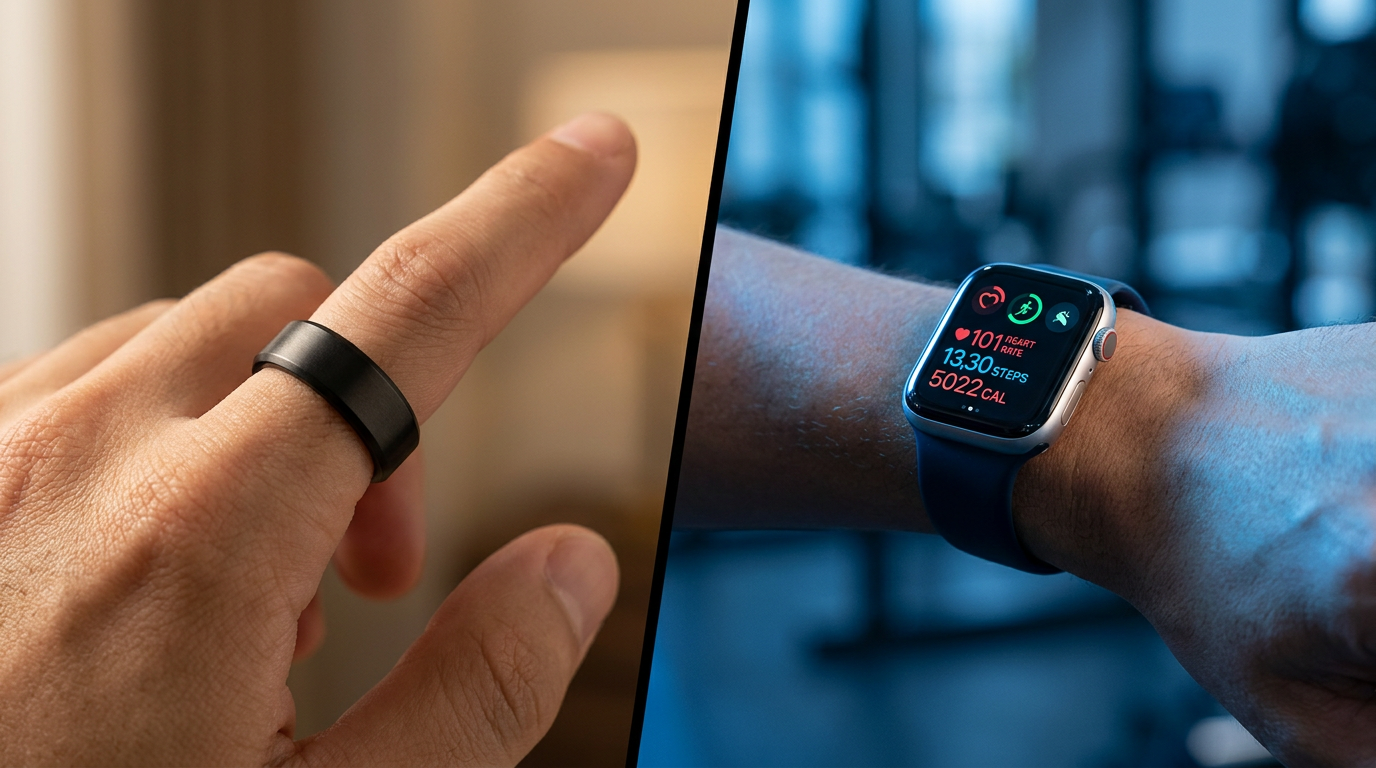
- Passive Trackers
- Users and analysts who prioritize sleep comfort, long battery life, and background data collection.
- Active Athletes
- Fitness enthusiasts who require real-time pacing, GPS routing, and immediate heart-rate zone feedback.
- Hybrid Users
- Consumers who wear both devices simultaneously to capture the best data from both form factors.
- Clinical Analysts
- Medical and technical reviewers focused strictly on sensor accuracy and user compliance rates.
What's not represented
- · Traditional watch enthusiasts who refuse to wear smartwatches
- · Budget-conscious consumers priced out of premium wearables
Why this matters
Choosing the wrong wearable form factor leads to a high abandonment rate, wasting hundreds of dollars. Understanding the specific trade-offs between active and passive tracking ensures you buy a device you will actually wear consistently.
Key points
- The wearable market has split into passive smart rings and active smartwatches.
- Smart rings offer superior comfort and a 98% overnight wear compliance rate.
- Smartwatches provide real-time workout feedback, GPS, and interactive apps.
- Rings struggle with high-intensity workout tracking due to movement interference.
- Smartwatches require daily charging, creating inevitable gaps in health data.
- The choice depends entirely on whether a user prioritizes sleep data or active fitness coaching.
The wearable technology market in 2026 has officially split into two distinct philosophies for health tracking. On one side is the smartwatch, an active digital companion that demands attention and provides real-time data. On the other side is the smart ring, a passive observer designed to disappear into the background while quietly collecting biometric data.[1][3]
Consumers are increasingly forced to choose between these two form factors, with flagship devices like the Apple Watch Series 11, the Oura Ring 4, and the Samsung Galaxy Ring dominating the landscape. Because these devices cost between two hundred and five hundred dollars, selecting the wrong form factor often leads to a high abandonment rate, turning an expensive health investment into a neglected desk ornament.[2][6]
In this side-by-side trade-off analysis, the argument for the smart ring centers entirely on passive tracking and physical comfort. Weighing just four to eight grams, a smart ring lacks a screen, notifications, and vibration motors. It is designed to be worn continuously without ever demanding the user's attention, making it an invisible health monitor.[3][5]

The evidence supporting the smart ring is most compelling in the realm of sleep tracking. Clinical data shows that ninety-eight percent of users wear their rings consistently overnight, compared to just sixty-seven percent for smartwatches. Furthermore, the dense capillary network in the finger provides photoplethysmography sensors with a highly accurate reading of resting heart rate, heart rate variability, and skin temperature.[3][5]
However, the argument against the smart ring focuses on its limitations during active, dynamic movement. Without a display, users cannot check their pacing, view real-time heart rate zones, or receive guided workout instructions. The device is strictly a retrospective tool, requiring users to open a smartphone app hours later to view their performance.[2][6]
The evidence against the smart ring's active tracking capabilities was highlighted in recent clinical trials. During a Stanford Health Care sleep and activity study, smart rings faltered during high-intensity workouts and bumpy outdoor bike rides. The sensors struggled to maintain a continuous optical lock on the finger during heavy gripping or rapid arm movements, leading to gaps in the exercise data.[8]

The evidence against the smart ring's active tracking capabilities was highlighted in recent clinical trials.
Turning to the smartwatch, the argument for the device is built on active engagement and comprehensive utility. A smartwatch serves as a real-time fitness coach, a GPS navigator, and a communication hub. It allows users to leave their phones at home during a run while still tracking their route, streaming music, and monitoring their exact cardiovascular output second by second.[3][7]
The evidence supporting the smartwatch is robust for athletic performance. In the same Stanford study, the Apple Watch Series 11 matched clinical lab results down to the minute for sleep duration and maintained a near-perfect heart rate lock during intense outdoor activity. The sheer processing power and advanced sensor arrays in modern watches make them the undisputed champions of active workout tracking.[8]
The argument against the smartwatch revolves around physical friction and battery anxiety. A typical smartwatch weighs between forty and eighty grams, making it bulky and prone to snagging on clothing. More importantly, the vibrant screens and continuous GPS tracking drain the battery rapidly, requiring users to charge the device every eighteen to thirty hours.[3][5]

The evidence against the smartwatch is reflected in its daily usage gaps. Because the device requires daily charging, users inevitably take it off—often in the morning or evening—creating blind spots in their health data. Additionally, the physical bulk and glowing screen disrupt sleep hygiene for many users, directly contributing to the thirty-three percent of owners who refuse to wear their watches to bed.[1][5]
A final, critical point of comparison is the hidden cost of ownership. Many smart rings, such as the Oura Ring, lock their most valuable health insights behind a monthly subscription fee of roughly six dollars, which significantly increases the total cost over several years. In contrast, smartwatches from Apple and Samsung generally include their comprehensive health software in the upfront purchase price, though newer ring competitors are beginning to drop subscription models to compete.[4][6][7]
Ultimately, the smart ring fits well when a user prioritizes sleep optimization, recovery tracking, and continuous passive data collection without digital distractions. It is the ideal choice for someone who wants to wear a traditional mechanical watch during the day while still gathering deep biometric insights. It does not fit when a user wants real-time pacing, GPS tracking, or interactive apps on their wrist.[3][6]

Conversely, the smartwatch fits well when a user is an active athlete who needs mid-workout feedback, route mapping, and a wrist-based communication hub. It is perfect for those who want to actively manage their training zones and receive immediate notifications. It does not fit when a user hates wearing bulky jewelry to bed, suffers from screen fatigue, or refuses to manage another daily charging routine.[1][7]
How we got here
2015
The Apple Watch launches, establishing the wrist as the primary location for mainstream health and fitness tracking.
2021
The Oura Ring Gen 3 introduces advanced sleep and recovery tracking, popularizing the smart ring form factor.
2024
Major tech companies begin entering the ring market, validating the finger as a viable alternative to the wrist.
2026
The market solidifies into a direct choice between feature-rich smartwatches and highly specialized, passive smart rings.
Viewpoints in depth
Passive Trackers
Advocates for minimal digital intrusion who prioritize sleep and recovery data over real-time workout metrics.
This camp argues that the best technology is invisible. By removing the screen, vibration motors, and daily charging requirements, smart rings ensure that health tracking happens continuously in the background. They point to the overwhelming 98% overnight compliance rate as proof that comfort is the most important metric in wearable design, arguing that a device is useless if it sits on a nightstand.
Active Athletes
Fitness enthusiasts who require real-time pacing, GPS routing, and immediate heart-rate zone feedback during training.
For active users, a wearable must be a coach, not just an observer. They argue that smart rings are fundamentally flawed for serious training because they cannot display heart rate zones mid-run or track a cycling route via GPS. This perspective values the processing power and interactive displays of smartwatches, accepting the trade-off of daily charging in exchange for actionable, real-time athletic data.
Hybrid Users
Consumers who wear both devices simultaneously, using a watch for daytime activity and a ring for overnight recovery.
Rather than choosing a side, this growing demographic argues that neither device is perfect on its own. They utilize the smartwatch during the day for notifications and workout tracking, then switch to the smart ring at night for comfortable, highly accurate sleep tracking while the watch charges. This approach maximizes data quality across all domains, though it requires a significantly higher financial investment.
What we don't know
- Whether future smart rings will be able to incorporate reliable GPS without destroying their multi-day battery life.
- How long-term subscription fatigue will impact the market share of premium smart rings that charge monthly fees.
- If smartwatch manufacturers can significantly reduce the weight and bulk of their devices to improve overnight sleep compliance.
Key terms
- Photoplethysmography (PPG)
- An optical sensor technology used in wearables to measure heart rate by illuminating the skin and measuring changes in light absorption.
- Heart Rate Variability (HRV)
- The variation in time between each heartbeat, used by wearables as a key indicator of physical recovery and stress.
- Sleep Compliance
- The rate at which users consistently wear their tracking device to bed every night.
- Passive Tracking
- Health monitoring that occurs automatically in the background without requiring the user to interact with a screen or manually start a workout.
Frequently asked
Do smart rings require a monthly subscription?
Some do, like the Oura Ring which charges around $6 per month, while others like the Samsung Galaxy Ring and RingConn do not.
Can a smart ring track my running pace?
No, smart rings lack GPS and a screen, meaning they cannot provide real-time pacing or distance feedback during a run.
Which device is more accurate for sleep tracking?
Both are highly accurate, but smart rings have a distinct advantage in user compliance and physical comfort, leading to more consistent overnight data collection.
Do I need my phone with me to use a smartwatch?
Most modern smartwatches have built-in GPS and optional cellular connectivity, allowing you to track workouts and receive calls without your phone.
Sources
Source coverage
8 outlets
4 viewpoints surfaced








[1]TechTimesPassive Trackers
Smart rings vs smartwatches has become one of the most discussed wearable tech comparison topics in 2026
Read on TechTimes →[2]ForbesActive Athletes
Oura Ring Vs. Apple Watch: Which Is The Better Health Tracker?
Read on Forbes →[3]AskVoraPassive Trackers
Smart ring vs smartwatch in 2026: Oura Ring, Apple Watch, Samsung Galaxy Ring and Garmin compared
Read on AskVora →[4]RingConnPassive Trackers
The wearable market has split into two clear camps: the smart ring and the smartwatch
Read on RingConn →[5]JointCorpClinical Analysts
Smart Ring vs Fitness Tracker vs Smartwatch: Ultimate Comparison 2026
Read on JointCorp →[6]WareableHybrid Users
Smart rings vs. smartwatches: Which is better?
Read on Wareable →[7]EsquireHybrid Users
The Apple Watch simply does more than the Oura Ring for a comparable price
Read on Esquire →[8]9to5MacActive Athletes
Here's how Apple Watch Series 11 stacks up against Oura, Fitbit, and Whoop
Read on 9to5Mac →


Every angle. Every day.
Get shopping stories with full source coverage and perspective breakdowns delivered to your inbox.