
Smart Bassinets vs. Traditional Bassinets: Are High-Tech Sleep Upgrades Worth the Cost?
As smart bassinets equipped with automated rocking and cry-detection become nursery staples, parents face a high-stakes choice. We break down the costs, safety evidence, and trade-offs between traditional simplicity and high-tech sleep assistance.
By Factlen Editorial Team
- Tech-Forward Parents
- Parents who view smart bassinets as an essential investment in their own sleep and mental health.
- Budget-Conscious Minimalists
- Parents who prefer traditional, low-tech baby gear that is affordable and highly portable.
- Pediatric Safety Experts
- Medical professionals focused entirely on adherence to safe sleep guidelines, regardless of the technology used.
What's not represented
- · Parents of multiples (twins/triplets) managing simultaneous sleep schedules
- · Second-hand market buyers navigating out-of-warranty smart tech
Why this matters
Newborn sleep deprivation takes a severe physical and mental toll on parents. Choosing the right bassinet is one of the most expensive and impactful decisions a family makes, directly affecting their daily functioning and their baby's safety during the critical fourth trimester.
Key points
- Traditional bassinets offer a simple, affordable, and highly portable sleep space, but require parents to manually soothe waking infants.
- Smart bassinets act as automated assistants, using sensors to detect crying and responding with motion and sound to extend sleep.
- The financial gap is significant, with traditional models costing around $150 compared to smart models that can exceed $1,700.
- Regardless of the technology used, the AAP mandates that all infants sleep on a firm, flat, and completely bare surface.
- Smart bassinets fit well for parents lacking overnight help, while traditional models suit budget-conscious families preferring a tech-free nursery.
Standing in the baby aisle or scrolling through endless online registries, modern parents face a high-stakes, high-cost dilemma: the traditional bassinet versus the smart bassinet. For decades, a standard bassinet was simply a cozy, flat basket on legs. Today, technology has transformed the nursery, introducing robotic assistants that listen, rock, and shush babies back to sleep. With traditional models costing around $100 and high-tech options soaring past $1,500, families must weigh the promise of extra sleep against a significant financial investment.[2][3]
The case for the traditional bassinet is rooted in simplicity, affordability, and portability. Parents value these models because they require no batteries, apps, or complicated setups, and they easily move from room to room. A standard bassinet provides the exact safe, flat sleeping surface mandated by pediatricians without any unnecessary frills. For families on a budget or those who prioritize a minimalist approach to baby gear, a traditional bassinet does exactly what it needs to do: it holds the baby safely while keeping them within arm's reach for nighttime feedings.[2][7]
The case against the traditional bassinet centers entirely on the physical toll it takes on parents. When a baby wakes at 2:00 AM, the parent becomes the sole engine for soothing. You must manually rock, pat, or shush the infant, often leaning awkwardly over the side of the bed. Traditional models lack the ability to intervene before a baby fully wakes, meaning parents must interrupt their own sleep cycles to manage every minor stir or fuss, which can rapidly lead to severe sleep deprivation.[2][4]

The evidence regarding traditional bassinets highlights their short lifespan and high safety profile. Because they lack moving parts and restrictive swaddles, they naturally encourage the uninhibited movement that pediatric physical therapists prefer for healthy hip development. However, usage data shows that babies typically outgrow these stationary beds by six months of age, or as soon as they begin to roll over, making them a strictly short-term furniture piece.[1][7]
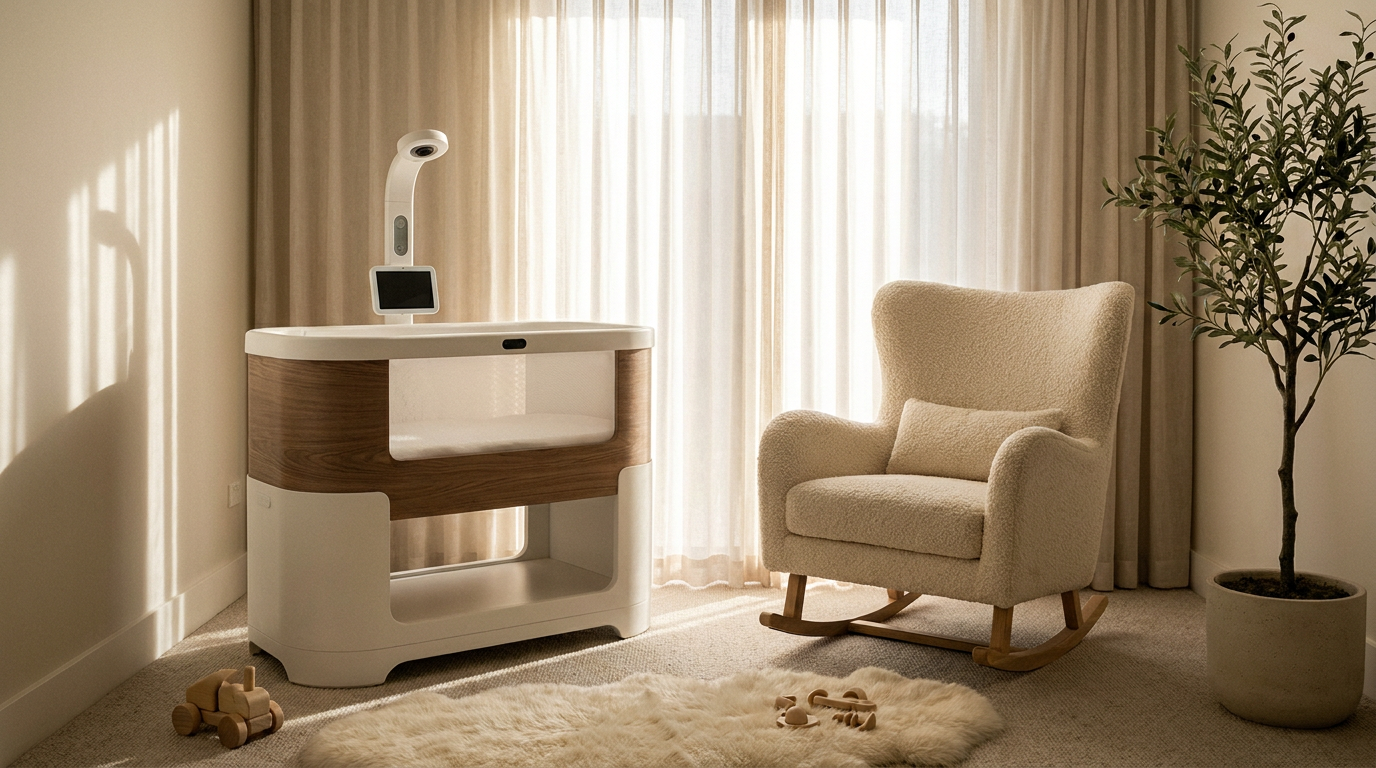
The case for the smart bassinet focuses on its role as an automated, secondary caregiver that buys parents precious hours of rest. Devices like the Snoo or Cradlewise utilize built-in microphones and sensors to detect crying, automatically responding with escalating levels of white noise and motion to mimic the womb. By catching a baby during the early stages of waking, smart bassinets can often soothe them back to sleep before a full meltdown occurs, allowing exhausted parents to stay in bed.[1][3][4]
The case for the smart bassinet focuses on its role as an automated, secondary caregiver that buys parents precious hours of rest.
The case against the smart bassinet is heavily tied to its exorbitant cost and the potential for technology dependency. A premium smart bassinet can cost between $1,500 and $2,800, a staggering price for an item with a limited shelf life. Furthermore, some parents worry that their child will become so reliant on continuous, automated motion that transitioning them to a standard, stationary crib later on will become a grueling, tear-filled ordeal.[3][4]

The evidence regarding smart bassinets points to measurable gains in parental sleep, though safety guidelines remain rigid. While sleep-tracking apps provide data showing longer stretches of infant rest, the American Academy of Pediatrics stresses that no smart device is proven to prevent Sudden Infant Death Syndrome (SIDS). The AAP mandates that regardless of the technology, the sleep surface must remain firm, flat, and completely free of loose bedding or weighted items.[3][8]
The transition period represents another critical point of comparison. With a traditional bassinet, the move to a full-size crib is often straightforward, as the baby is already accustomed to sleeping on a stationary surface. Parents simply move the child to a larger, flat mattress in another room. In contrast, transitioning out of a smart bassinet requires a weaning process. Most smart models feature a specific "weaning mode" that gradually reduces the automated rocking over several weeks, helping the infant adjust to a still environment before the final move to a crib.[3][6]
Regardless of the chosen path, the American Academy of Pediatrics (AAP) provides a universal equalizer: the "bare is best" rule. The 2026 safe sleep guidelines dictate that infants must sleep alone, on their backs, and on a firm, flat, non-inclined surface. The AAP explicitly warns against weighted swaddles, loose blankets, and inclined sleepers. Whether a family relies on a $100 mesh basket or a $2,000 robotic cradle, the sleep space must remain completely bare to reduce the risk of sleep-related incidents.[5][6][8]
Quantifying the financial trade-offs reveals a stark contrast in monthly utility. A traditional bassinet costs roughly $100 to $300, translating to about $16 to $50 per month over a typical six-month usage period. In contrast, a standard smart bassinet retails for around $1,700, costing nearly $283 per month for the same six months. Newer smart models that convert into full cribs cost up to $2,800 but extend their utility to 24 months, bringing the monthly cost down to approximately $116.[3]

Ultimately, the traditional bassinet fits well when families are on a tight budget, prefer a lightweight and mobile sleep space, or plan to transition their baby to a full crib very early. It is the ideal choice for parents who want a classic, tech-free nursery and do not mind manually soothing their infant. Conversely, the traditional route does not fit well when parents are managing the newborn phase without overnight help, or when a baby is highly sensitive to startle reflexes and requires constant motion to remain asleep.[2][7]
The smart bassinet fits well when parents are facing the newborn phase alone, have demanding work schedules that require maximum overnight rest, or are dealing with a particularly fussy sleeper who craves continuous movement. It serves as an invaluable extra set of hands for exhausted caregivers. However, the high-tech option does not fit well when families are strictly budget-conscious, when parents prefer to avoid wireless technology and screens in the nursery, or when the baby naturally sleeps well on a stationary surface.[2][4]
How we got here
1994
The 'Back to Sleep' campaign launches, dramatically reducing SIDS rates by encouraging parents to place babies on their backs.
2016
The AAP updates guidelines to recommend room-sharing (but not bed-sharing) for at least the first six months.
2016
The Snoo Smart Sleeper is introduced, pioneering the high-tech, responsive bassinet market.
2022
The AAP explicitly warns against inclined sleepers and weighted swaddles, reinforcing the 'firm and flat' rule.
2026
Smart bassinets evolve to include convertible crib models like Cradlewise, extending the lifespan of infant sleep tech.
Viewpoints in depth
Tech-Forward Parents
Parents who view smart bassinets as an essential investment in their own sleep and mental health.
For this camp, the exorbitant upfront cost of a smart bassinet is easily justified by the promise of extra sleep. They argue that in households where both parents work or lack overnight family support, a robotic assistant that can soothe a waking baby at 3:00 AM is invaluable. They point to the data-tracking capabilities and automated white noise as tools that remove the guesswork from newborn care, viewing the technology not as a luxury, but as a critical survival tool for the fourth trimester.
Budget-Conscious Minimalists
Parents who prefer traditional, low-tech baby gear that is affordable and highly portable.
This perspective emphasizes that babies have slept safely in simple, stationary baskets for generations. They argue that spending thousands of dollars on a bed the child will outgrow in six months is an unnecessary financial strain. Furthermore, they appreciate the lightweight nature of traditional bassinets, which can be easily moved from the bedroom to the living room. For these parents, manual soothing is a natural part of bonding, and they prefer to avoid introducing screens, apps, and EMFs into their newborn's sleep environment.
Pediatric Safety Experts
Medical professionals focused entirely on adherence to safe sleep guidelines, regardless of the technology used.
Pediatricians and safety advocates remain neutral on the 'smart versus traditional' debate, focusing instead on the strict mechanics of the sleep surface. Their primary concern is that the bassinet—whether it costs $100 or $2,000—must be firm, flat, and completely free of loose bedding, pillows, or weighted swaddles. They caution parents that while smart features can aid in soothing, no device is proven to prevent Sudden Infant Death Syndrome (SIDS), and technology should never replace safe sleep practices like back-sleeping and room-sharing.
What we don't know
- Whether the long-term use of automated motion in smart bassinets impacts a child's ability to self-soothe in later toddler years.
- How the secondary market for smart bassinets will hold up as internal motors and sensors age past their initial warranty periods.
- Whether future pediatric guidelines will eventually address the specific decibel levels of built-in white noise machines positioned close to an infant's head.
Key terms
- Smart Bassinet
- An infant bed equipped with technology like microphones, sensors, and motors to automatically detect crying and respond with soothing motion and sound.
- Traditional Bassinet
- A simple, stationary, and often portable infant bed designed for the first few months of life, requiring manual soothing from parents.
- AAP Safe Sleep Guidelines
- Evidence-based recommendations from the American Academy of Pediatrics designed to reduce the risk of sleep-related infant deaths.
- White Noise
- A consistent, ambient sound used to mask household noises and mimic the auditory environment of the womb to help babies sleep.
- SIDS (Sudden Infant Death Syndrome)
- The unexplained death, usually during sleep, of a seemingly healthy baby less than a year old.
Frequently asked
Are smart bassinets safe for newborns?
Yes, provided they meet federal safety standards and are used according to AAP guidelines. The sleep surface must remain firm, flat, and free of loose bedding.
How long can a baby use a bassinet?
Most traditional and smart bassinets are outgrown by six months, or whenever the baby begins to roll over or push up on their hands and knees.
Do smart bassinets prevent SIDS?
No. While some smart bassinets keep babies securely on their backs, no device is FDA-authorized or proven to prevent Sudden Infant Death Syndrome (SIDS).
Can I use a smart bassinet without the app?
Most smart bassinets can function as a traditional, stationary sleep space if unplugged or if the smart features are turned off via the app.
Sources
Source coverage
9 outlets
3 viewpoints surfaced






[1]Halo SleepBudget-Conscious Minimalists
What is a Smart Bassinet?
Read on Halo Sleep →[2]MaydollyBudget-Conscious Minimalists
Smart Bassinet vs. Traditional: Is the Upgrade Worth It?
Read on Maydolly →[3]BabylistTech-Forward Parents
Snoo vs Cradlewise: Which Smart Crib Is Right for You?
Read on Babylist →[4]baby enRouteTech-Forward Parents
Is a Smart Bassinet Worth It? A Sleep-Deprived Parent's Guide
Read on baby enRoute →[5]American Academy of PediatricsPediatric Safety Experts
Safe Sleep
Read on American Academy of Pediatrics →[6]MomcozyPediatric Safety Experts
Updated AAP Safe Sleep Guidelines: What Parents Should Know
Read on Momcozy →[7]NINI and LOLIBudget-Conscious Minimalists
Bassinet vs Crib: An Essential Guide for New Parents
Read on NINI and LOLI →[8]Happiest BabyTech-Forward Parents
AAP Updates Guidelines on Safe Sleep and SIDS Prevention
Read on Happiest Baby →[9]Factlen Editorial TeamPediatric Safety Experts
Synthesis by Factlen editorial team
Read on Factlen Editorial Team →

More in shopping
See all 5 stories →
Every angle. Every day.
Get shopping stories with full source coverage and perspective breakdowns delivered to your inbox.