
Smart Bassinets vs. Traditional Bassinets: A 2026 Trade-Off Analysis
As AI-powered smart bassinets become more advanced, parents face a choice between high-tech automated soothing and the simplicity of traditional infant sleep spaces.
By Factlen Editorial Team
- Tech-Assisted Parenting Advocates
- Value automated soothing, sleep tracking, and maximizing parent rest.
- Minimalist Sleep Purists
- Prefer traditional bassinets, emphasizing independent sleep skills and avoiding tech reliance.
- Pediatric Safety Experts
- Focus strictly on the ABCs of safe sleep regardless of the technology used.
What's not represented
- · Families with multiples (twins/triplets)
- · Second-hand market buyers
Why this matters
Choosing the right bassinet directly impacts a family's sleep quality and budget during the grueling newborn phase. Understanding the exact trade-offs between automated assistance and manual simplicity helps parents make a confident, safe, and financially sound decision.
Key points
- Traditional bassinets offer a simple, cost-effective sleep space that promotes independent sleep habits from birth.
- Smart bassinets act as an extra set of hands, using automated motion and sound to resettle fussing infants.
- Regardless of technology, all bassinets must adhere to strict pediatric guidelines requiring a firm, flat, and clear sleep surface.
- The choice depends entirely on a family's budget, nighttime support system, and willingness to manage potential sleep associations.
The modern nursery has become a hub of technological innovation, transforming the way parents approach the first few months of a newborn's life. At the center of this evolution is the sleep space, where families now face a fundamental choice between the traditional bassinet and the smart bassinet. While the basic goal remains unchanged—providing a safe, flat environment for an infant to rest—the methods for achieving and maintaining that sleep have diverged dramatically. The decision is no longer just about aesthetics or footprint; it is a calculation of budget, parenting philosophy, and the value of automated assistance during the most sleep-deprived months of early parenthood.[7]
Before evaluating the technological divide, it is crucial to understand the core function of any infant sleep product. Pediatric safety experts emphasize that regardless of the price tag or the software integrated into the frame, every bassinet must adhere to the strict guidelines established by the American Academy of Pediatrics. The foundational rules of safe sleep dictate that an infant must be placed alone, on their back, and on a firm, flat, non-inclined surface, free of any loose bedding, pillows, or toys. These baseline requirements serve as the great equalizer in the nursery, ensuring that a basic mesh sleeper and a robotic crib both meet the same rigorous safety standards before they ever reach a consumer's home.[4]
The traditional bassinet represents the time-tested approach to newborn sleep, offering a straightforward, manual solution. These models, such as the widely recommended Halo BassiNest or the Newton Essential Bassinet, typically range in price from $100 to $350. They are designed to be lightweight, portable, and easy to position directly next to a parent's bed, facilitating the room-sharing that pediatricians recommend for the first six months. Without motors, microphones, or Wi-Fi connectivity, the traditional bassinet relies entirely on its physical structure to provide a secure environment, often featuring breathable mesh walls for optimal airflow and visibility.[3][5]
When evaluating the traditional bassinet, the arguments in favor center heavily on simplicity, cost-effectiveness, and the promotion of independent sleep habits. Proponents argue that a non-motorized sleep space prevents the infant from developing a reliance on constant motion or artificial white noise to fall asleep. Furthermore, the lower price point makes the traditional bassinet an accessible option for most families, especially considering that the product will only be used for a brief window of four to six months. The lack of cords and electronic components also allows parents to move the bassinet effortlessly from room to room, adapting to the dynamic needs of daytime naps and nighttime routines.[3]

The primary argument against the traditional model is the physical and emotional toll it can take on caregivers. In a traditional setup, the parent is the sole engine of soothing; when a baby wakes at three in the morning, a caregiver must physically intervene to rock, shush, or bounce the infant back to sleep. The evidence supporting traditional bassinets rests on decades of pediatric consensus regarding safe sleep, but it does not account for the modern reality of fragmented parental rest. For families without extensive support networks, or for mothers recovering from severe physical trauma like a cesarean section, the manual labor required by a traditional bassinet can exacerbate the exhaustion of the newborn phase.[4][7]
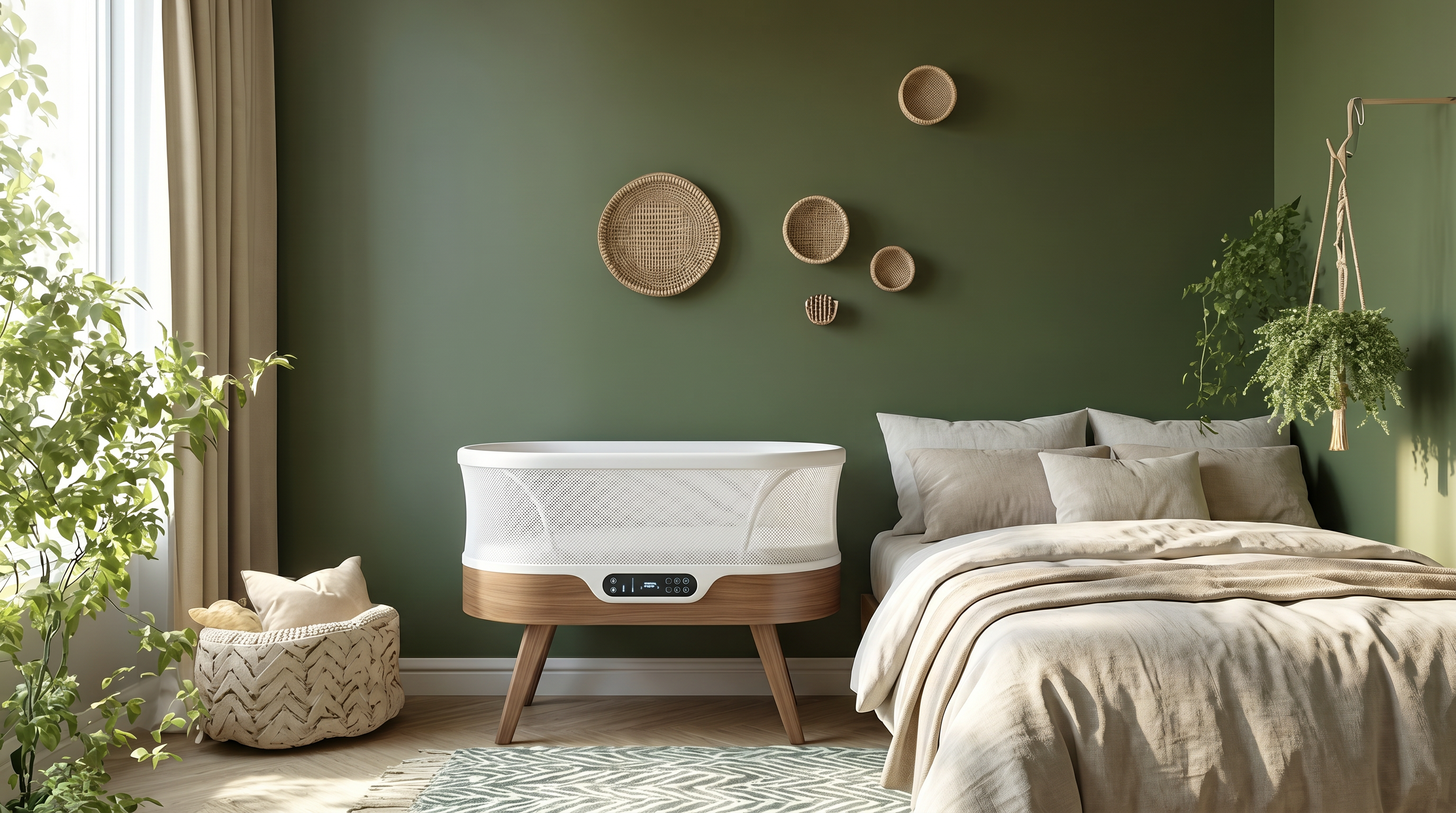
In stark contrast, the smart bassinet operates as an active participant in the soothing process, functioning as an extra set of hands in the nursery. These advanced models, which include the pioneering Happiest Baby Snoo, the convertible Cradlewise, and the budget-friendly Graco SmartSense, range significantly in price from $300 to upwards of $3,200. Equipped with built-in microphones, motion sensors, and motorized bases, smart bassinets are engineered to detect when an infant begins to fuss or cry. Upon detecting unrest, the bassinet automatically responds with a calibrated escalation of rocking motions and white noise, attempting to lull the baby back to sleep before a full awakening occurs.[1][2]
For the smart bassinet, the arguments in favor focus squarely on sleep preservation and automated intervention. Advocates highlight the technology's ability to mimic the rhythmic motion and sound of the womb, which naturally triggers a calming reflex in many newborns. By automatically responding to minor sleep disturbances, the smart bassinet can often resettle an infant without requiring the parent to leave their bed, effectively buying families precious extra hours of consolidated rest. The integration of companion applications also allows parents to track sleep patterns, customize motion settings, and gain insights into their baby's developing circadian rhythms.[1][6]
The evidence for smart bassinets is increasingly clinical, moving beyond mere convenience to measurable health outcomes. The most prominent example is the Snoo Smart Sleeper, which recently received De Novo authorization from the Food and Drug Administration for its ability to keep sleeping infants securely on their backs. This regulatory milestone was achieved through the bassinet's integrated swaddle system, which clips directly into the sides of the bed, physically preventing the baby from rolling into a potentially dangerous prone position. This level of engineered safety provides a profound sense of security for anxious new parents navigating the risks of sudden infant death syndrome.[6]
The evidence for smart bassinets is increasingly clinical, moving beyond mere convenience to measurable health outcomes.
However, the arguments against smart bassinets revolve around financial accessibility, the potential for sleep associations, and shifting business models. The high upfront cost is a significant barrier, and the value proposition has been further complicated by companies introducing subscription fees; for instance, accessing the premium sleep tracking and customization features of the Snoo now requires a monthly payment of roughly $20. Additionally, pediatric nurses caution that relying too heavily on automated motion can create a sleep association, making the inevitable transition to a stationary crib at six months a highly disruptive and challenging process for both the baby and the parents.[2][4][6]

To address the short lifespan of traditional smart bassinets, newer entrants like the Cradlewise have reimagined the product architecture. Priced at $3,200, the Cradlewise attempts to justify its premium cost by converting from a bassinet into a full-sized crib, extending its usable life from a mere six months to a full two years. Furthermore, it differentiates itself mechanically by utilizing an up-and-down bouncing motion rather than a side-to-side rock, which many parents find more closely mimics the natural movement of being held. This extended utility presents a compelling counterargument to the short-term rental models that have dominated the smart bassinet market.[2][6]
The technological landscape of smart bassinets continues to evolve rapidly, with artificial intelligence playing an increasingly central role in 2026. Models like the Maxi-Cosi Starling have introduced AI-driven cry translation, analyzing the specific acoustic frequencies of an infant's vocalizations to determine whether the baby is hungry, sleepy, or experiencing discomfort. This predictive technology aims to prevent the bassinet from fruitlessly rocking a baby who actually needs to be fed, thereby reducing frustration and streamlining the caregiver's response. As these algorithms become more sophisticated, the smart bassinet is transitioning from a reactive soothing device to a proactive diagnostic tool.[1]
Despite these advancements, pediatric safety experts maintain a crucial caveat: smart features are soothing tools, not safety features. The presence of artificial intelligence, sleep tracking, and automated rocking does not supersede the fundamental requirement of a firm, flat, and clear sleep environment. Nurses and pediatricians emphasize that parents must remain vigilant, ensuring that the use of technology does not lead to complacency regarding the ABCs of safe sleep. The bassinet, no matter how intelligent, is only as safe as the environment the parent creates within it.[4]
For families who choose the technological route, experts advise implementing a proactive transition plan to prevent long-term sleep associations. By the time an infant reaches three to four months of age, pediatricians recommend gradually weaning the baby off the automated motion, utilizing the bassinet's application to reduce the intensity and duration of the rocking. This deliberate reduction in mechanical assistance helps the infant develop independent self-soothing skills, ensuring that the eventual move to a stationary crib is a seamless progression rather than an abrupt and jarring loss of their primary sleep aid.[4]

Ultimately, the trade-off analysis between a traditional and a smart bassinet comes down to a calculation of upfront investment versus the potential for increased parental rest. The traditional bassinet requires a lower financial commitment and fosters independent sleep from day one, but it demands maximum physical effort from the caregiver during the night. The smart bassinet requires a substantial financial outlay and careful management of sleep associations, but it offers the unparalleled benefit of automated soothing and data-driven insights, potentially transforming the grueling newborn phase into a more manageable experience.[7]
A smart bassinet fits well when a family lacks extensive nighttime support, such as single parents or those whose partners work demanding night shifts. It is also an excellent fit when the household budget comfortably accommodates premium baby gear, or when parents are managing a particularly fussy newborn who struggles to settle without constant motion. For caregivers recovering from severe physical trauma, the automated assistance provided by a smart bassinet can be a critical component of their own postpartum healing, minimizing the need to repeatedly lift and rock the infant.[7]
Conversely, a smart bassinet does not fit well when the family budget is tight, as the high cost and potential subscription fees can create unnecessary financial stress. It is also a poor fit for parents who prefer a minimalist, low-tech approach to child-rearing, or those who experience heightened anxiety from constantly monitoring app data and sleep charts. Furthermore, if an infant naturally sleeps well without intervention, the complex mechanics of a smart bassinet may be entirely superfluous, offering no tangible benefit over a standard sleep space.[7]

A traditional bassinet fits well when parents want a straightforward, highly portable sleep space that can easily be moved around the home. It is the ideal choice for budget-conscious families who prefer to allocate their resources toward longer-lasting nursery furniture, such as a high-quality convertible crib. The traditional model also fits perfectly for parents who prioritize teaching independent sleep skills from birth, avoiding the need to eventually wean their child off of mechanical rocking or integrated white noise.[7]
It does not fit well when caregivers are facing extreme sleep deprivation and desperately need an automated intervention to help soothe a colicky or highly sensitive infant. In the end, there is no single winner in the debate between traditional and smart bassinets; the optimal choice is entirely conditional. By carefully weighing the quantified costs, the mechanical trade-offs, and their own unique household dynamics, parents can select the sleep space that best supports both their baby's safety and their own well-being.[7]
How we got here
1990s
The 'Back to Sleep' campaign establishes the firm, flat bassinet as the standard for newborn safety.
2016
Happiest Baby launches the Snoo, creating the premium smart bassinet category.
2023
The FDA grants De Novo authorization to the Snoo for its ability to keep infants sleeping on their backs.
2024
Happiest Baby introduces a premium subscription model, charging a monthly fee for advanced app features.
2026
New AI-driven models like the Maxi-Cosi Starling enter the market, offering real-time cry translation.
Viewpoints in depth
Tech-Assisted Parenting Advocates
Parents and technologists who view smart bassinets as essential tools for maternal recovery and family well-being.
This camp argues that the physical and mental toll of sleep deprivation is a public health issue that technology can help solve. They point to data showing that automated bassinets can add 1-2 hours of sleep per night for parents, which drastically improves postpartum recovery and mental health. For these advocates, the high cost of a smart bassinet is justified as an investment in the parents' well-being, functioning essentially as a digital night nurse.
Minimalist Sleep Purists
Caregivers and sleep consultants who advocate for low-tech environments to foster independent sleep skills.
Minimalists argue that introducing complex technology into the nursery creates unnecessary dependencies. They emphasize that babies naturally learn to self-soothe when given the opportunity in a stationary, quiet environment. This viewpoint warns that smart bassinets often delay the inevitable sleep training process, forcing parents to break deeply ingrained motion associations when the child transitions to a standard crib at six months.
Pediatric Safety Experts
Medical professionals focused strictly on adherence to safe sleep guidelines, regardless of the product's features.
For pediatricians and neonatal nurses, the debate between smart and traditional is secondary to the ABCs of safe sleep: Alone, Back, and Crib. They acknowledge that smart features can be helpful for soothing, but stress that these features do not make a bassinet inherently 'safer' than a standard model. Their primary concern is ensuring parents do not become complacent, reminding them that no amount of AI or automated rocking can replace a firm, flat mattress free of loose bedding.
What we don't know
- Whether the introduction of AI cry-translation will significantly alter long-term parental responsiveness and bonding.
- How the secondary market for smart bassinets will be impacted long-term by the introduction of mandatory software subscription fees.
Key terms
- Smart Bassinet
- An infant bed equipped with technology like automated rocking, white noise, and cry detection to help soothe a baby to sleep.
- Traditional Bassinet
- A standard, non-motorized infant bed designed to provide a safe, flat sleep surface for the first few months of life.
- FDA De Novo Authorization
- A regulatory classification for novel medical devices, granted to the Snoo for its swaddle system that keeps infants safely on their backs.
- Sleep Association
- A condition or object, such as rocking or white noise, that a baby becomes accustomed to and relies upon in order to fall asleep.
- CryAssist AI
- Advanced technology that analyzes the acoustic frequency of a baby's cry to determine if they are hungry, sleepy, or gassy.
Frequently asked
Do smart bassinets prevent SIDS?
No. While some models like the Snoo keep babies on their backs, no bassinet can claim to completely prevent Sudden Infant Death Syndrome. All bassinets must follow the same firm, flat safe-sleep guidelines.
How long can a baby use a bassinet?
Most traditional and smart bassinets are outgrown by 6 months of age, or whenever the baby begins to push up on their hands and knees. Convertible models like the Cradlewise can be used up to 24 months.
Is it hard to transition from a smart bassinet to a crib?
It can be challenging if the baby has developed a strong sleep association with constant motion. Pediatricians recommend utilizing the app to gradually wean the baby off the rocking feature around 3 to 4 months of age.
Do I have to pay a monthly subscription for a smart bassinet?
It depends on the brand. While traditional bassinets have no ongoing costs, some premium smart models, such as the Snoo, now require a monthly subscription fee to access advanced sleep tracking and customization features.
Sources
Source coverage
7 outlets
3 viewpoints surfaced







[1]Wholesome LinenTech-Assisted Parenting Advocates
2026 Best Smart Bassinets for Baby Sleep Safety
Read on Wholesome Linen →[2]BabylistPediatric Safety Experts
Snoo vs Cradlewise: Which Smart Crib Is Right for You?
Read on Babylist →[3]Good HousekeepingMinimalist Sleep Purists
9 Best Bassinets of 2025, Tested by Parents and Experts
Read on Good Housekeeping →[4]HarborPediatric Safety Experts
Smart Bassinets: What Parents Need to Know (From a Pediatric Nurse)
Read on Harbor →[5]Forbes VettedMinimalist Sleep Purists
Best Bassinets Tested 2025
Read on Forbes Vetted →[6]FathercraftTech-Assisted Parenting Advocates
SNOO review: I was a Cradlewise guy. Then my two-week-old rolled over.
Read on Fathercraft →[7]Factlen Editorial TeamTech-Assisted Parenting Advocates
Synthesis by Factlen editorial team
Read on Factlen Editorial Team →

More in shopping
See all 5 stories →

Every angle. Every day.
Get shopping stories with full source coverage and perspective breakdowns delivered to your inbox.