
Renewables Officially Overtake Coal as Global Solar and Wind Forecasts Accelerate
Driven by exponential learning curves and a record-breaking 2025 for solar installations, renewable energy has surpassed coal to become the world's primary source of electricity.

In short
- Renewables generated 33.8% of global electricity in 2025, surpassing coal for the first time.
- Solar and wind power met 99% of all new global electricity demand growth last year.
- Global fossil fuel generation fell by 0.2% in 2025, signaling a structural peak.
For the first time since the dawn of the industrial revolution, renewable energy has overtaken coal to become the world’s largest source of electricity. According to comprehensive 2025 data released by the energy think tank Ember, renewables captured 33.8% of the global electricity mix, edging past coal’s 33.0%. This milestone marks a structural shift in the global economy, driven by an exponential acceleration in solar and wind deployment that continues to outpace historical forecasts.[1][5]
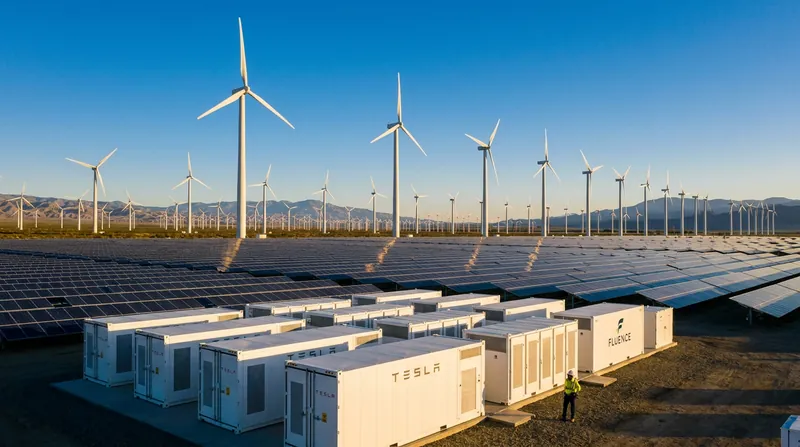
The sheer scale of the 2025 build-out has forced major energy agencies to rapidly revise their long-term models. Solar power alone added a record 647 gigawatts (GW) of capacity globally last year, representing an 11% year-over-year increase. To put that growth into perspective, the new solar generation added in a single year was sufficient to displace gas-fired electricity equivalent to all liquefied natural gas exports shipped through the Strait of Hormuz.[1]
Because clean power sources grew fast enough to meet 99% of all new global electricity demand, fossil fuel generation was effectively capped. Ember’s data reveals that global fossil generation actually fell by 0.2% in 2025. This represents only the fifth time this century—and the first time outside of a global economic crisis like the 2020 pandemic—that fossil fuel power generation did not increase.[1]
This tipping point is the result of a classic technological S-curve, a dynamic heavily documented by the Rocky Mountain Institute. Unlike fossil fuels, which are extracted commodities subject to geopolitical volatility, solar panels and wind turbines are manufactured technologies. They follow Wright's Law: for every cumulative doubling of production, costs fall by a predictable percentage. Solar and battery costs have plummeted by over 80% since 2012, rendering higher-cost hydrocarbons structurally uncompetitive in most global markets.[4][5]
Looking ahead to the rest of the decade, the International Energy Agency projects that the world will add a staggering 4,600 GW of new renewable capacity between 2025 and 2030. This expansion is roughly equivalent to adding the entire combined power generation capacity of China, the European Union, and Japan to the global grid in just five years. By 2030, the IEA expects renewables to supply 43% of all global power generation.[2]
Solar photovoltaics will be the undisputed engine of this growth. The IEA anticipates that solar will account for nearly 80% of all renewable electricity capacity expansion through 2030. This dominance is driven by rock-bottom module costs, increasingly efficient permitting processes in key markets, and broad social acceptance of distributed rooftop systems, which make up over 40% of the projected solar expansion.[2]
BloombergNEF’s long-term modeling extends this trajectory even further, projecting that solar energy will become the world’s largest single electricity generator by 2032. This growth is not just replacing old infrastructure; it is racing to meet a massive surge in new electricity demand. The electrification of transportation, the rise of heat pumps, and the explosive energy requirements of artificial intelligence data centers are fundamentally reshaping global load profiles.[3]
Data centers alone consumed roughly 500 terawatt-hours (TWh) in 2025, representing nearly 2% of global electricity demand. BloombergNEF expects this figure to more than double by 2050. While fossil fuel plants will likely operate longer than previously expected to provide baseload power for these facilities, least-cost economic modeling suggests that the vast majority of this new demand will be met by utility-scale solar paired with massive battery storage deployments.[3][5]
However, the sheer velocity of this transition is creating severe growing pains for regional power grids. In mature markets like California, Spain, and parts of China, the rapid buildout of solar capacity has led to increased curtailment—where solar farms are forced to shut down because they are producing more power than the grid can absorb. In 2025, Spain logged hundreds of hours of zero or negative wholesale power prices, a dynamic that suppresses new investment.[3]
Because of these grid saturation issues and policy shifts in major economies, BloombergNEF actually forecasts a slight near-term contraction in solar installations for 2026—projecting 649 GW of additions, down slightly from 2025. This represents the first slowdown in the industry's growth in two decades, signaling a transition from a chaotic gold rush phase into a more mature, infrastructure-constrained market.[3]
The definitive solution to grid saturation is energy storage, which is currently experiencing its own exponential growth curve. Global battery storage deployment jumped nearly 50% in 2025, and BloombergNEF forecasts it will scale 17-fold to reach 3.8 terawatts by 2050. As battery costs continue to fall, the combination of cheap daytime solar and overnight battery discharge is increasingly outcompeting natural gas peaker plants on pure economics.[3][5]
Ultimately, the data from 2025 and the forecasts for 2030 confirm that the global energy transition has moved past the realm of environmental policy and into the domain of pure industrial economics. The exponential deployment of clean energy is now an unstoppable macroeconomic force, promising greater energy security, long-term price deflation, and a realistic pathway to mitigating the worst impacts of climate change.[1][4][5]
Jargon, explained
- Wright's Law
- An economic principle stating that for every cumulative doubling of production of a manufactured good, its cost falls by a constant percentage.
- Curtailment
- The deliberate reduction of electricity generation below what a power source could produce, usually because the grid cannot safely absorb the excess power.
- S-Curve
- A pattern of technological adoption that starts slowly, accelerates rapidly as costs fall, and eventually levels off as the market saturates.
- Variable Renewable Energy (VRE)
- Energy sources like solar and wind whose output fluctuates depending on weather conditions and time of day.
- Gigawatt (GW)
- A unit of power equal to one billion watts, roughly the capacity of a large nuclear reactor or coal plant.
Common questions
Did renewables really generate more power than coal?
Yes. According to 2025 data from Ember, renewables accounted for 33.8% of global electricity generation, narrowly beating coal's 33.0%.
Why are solar prices dropping so fast?
Solar panels are a manufactured technology, meaning they benefit from economies of scale and learning curves. As global production increases, manufacturing becomes more efficient, driving down costs.
What happens when the sun isn't shining?
To maintain grid stability, energy systems are increasingly relying on massive battery storage deployments to save daytime solar for nighttime use, alongside baseload power from nuclear, hydro, or natural gas.
Will AI data centers reverse this progress?
While AI is driving a massive surge in electricity demand, least-cost economic models suggest the vast majority of this new demand will be met by utility-scale solar and batteries, though some fossil fuel plants may operate longer than previously expected.
Competing readings
Energy Transition Optimists
Focus on the unstoppable momentum of exponential technology learning curves.
Organizations like the Rocky Mountain Institute and Ember argue that the energy transition is fundamentally misunderstood by traditional linear models. They point out that solar, wind, and batteries are manufactured technologies that follow Wright's Law—becoming predictably cheaper as production scales. From this perspective, the 2025 milestone of renewables overtaking coal is just the beginning of an inevitable 'S-curve' that will rapidly price fossil fuels out of the market, regardless of short-term political headwinds.
Market Realists
Acknowledge the massive growth but highlight grid bottlenecks and near-term market corrections.
Analysts at BloombergNEF and the IEA recognize the long-term dominance of renewables but emphasize the severe friction points currently facing the industry. They note that mature markets are suffering from acute grid saturation, leading to negative power prices and forced curtailment of solar assets. This camp argues that without massive, immediate investments in transmission infrastructure and battery storage, the exponential growth of generation capacity will hit a hard physical ceiling, leading to boom-and-bust investment cycles.
- Energy Transition Optimists
- Focus on the unstoppable momentum of exponential technology learning curves.
- Market Realists
- Acknowledge the massive growth but highlight grid bottlenecks and near-term market corrections.
Perspectives this story doesn't cover
- Fossil Fuel Incumbents
- Grid Operators in Developing Nations
Sources
Source coverage
5 outlets
2 viewpoints surfaced





- [1]EmberEnergy Transition Optimists
Global Electricity Review 2026
Read on Ember → - [2]International Energy AgencyMarket Realists
Renewables 2025
Read on International Energy Agency → - [3]BloombergNEFMarket Realists
New Energy Outlook 2026
Read on BloombergNEF → - [4]Rocky Mountain InstituteEnergy Transition Optimists
X-Change: Electricity – On Track for Net Zero
Read on Rocky Mountain Institute → - [5]Factlen Editorial TeamMarket Realists
Synthesis by Factlen editorial team
Read on Factlen Editorial Team →

More in Data & Analysis
See all →Wastewater Surveillance
The Evidence Pack: How Wastewater Data and AI Models Are Forecasting Disease Outbreaks Weeks in Advance
6 sources

Grid Transition
Renewables Officially Overtake Coal as the World's Primary Source of Electricity
4 sources
Global Wealth Gap
The Evidence Pack: World Bank Data Shows Half of Developing Economies Failing to Narrow Income Gap Since 2019
5 sources

Forecast Metrics
Why Mean Absolute Percentage Error (MAPE) is Biased and How SMAPE Attempts to Correct It
6 sources

Comments
Every angle. Every day.
Get Data & Analysis stories with full source coverage and perspective breakdowns, free every day.