
Renewable Groups Sue Pentagon Over 'Total Halt' of Wind Farm Security Reviews
A coalition of clean energy developers has filed a federal lawsuit against the Department of Defense, alleging the military has frozen national security reviews for 106 onshore wind projects. The administrative logjam jeopardizes $47 billion in investments and threatens to starve the grid of 60 gigawatts of planned capacity.
By Factlen Editorial Team
- Renewable Energy Developers
- Argues the delays are an unlawful, politically motivated blockade threatening the grid and billions in investment.
- Defense & Security Officials
- Maintains that massive wind turbines pose inherent risks to military radar and aviation, requiring complex interagency security reviews.
- Grid & Economic Analysts
- Concerned that the bottleneck will starve power-hungry AI data centers and strain domestic electricity supplies.
- Political & Legal Watchdogs
- Views the administrative logjam as a continuation of the Trump administration's broader executive campaign against renewable energy infrastructure.
- Independent Evidence Synthesis
- Focuses on weighing the technical validity of radar interference claims against the timeline of political directives.
What's not represented
- · Local communities in the 21 affected states relying on wind farm tax revenue
- · Fossil fuel industry representatives who may benefit from reduced renewable competition
Why this matters
The Pentagon's review freeze directly threatens the deployment of 60 gigawatts of clean energy capacity, jeopardizing $47 billion in investments. If the logjam persists, it could severely strain the national power grid and create crippling energy bottlenecks for the rapidly expanding AI technology sector.
Key points
- A coalition of renewable energy groups is suing the Pentagon over a "de facto moratorium" on national security reviews for new onshore wind farms.
- The administrative freeze has stalled at least 106 wind projects across 21 states, jeopardizing an estimated $47 billion in capital investments.
- The Department of Defense maintains that massive wind turbines pose inherent risks to military radar and aviation, requiring complex interagency evaluations.
- The renewable industry argues that radar interference has been successfully mitigated for 15 years and claims the delays are politically motivated.
- The logjam threatens to withhold 60 gigawatts of planned capacity from the grid, creating severe power bottlenecks for the rapidly expanding AI tech sector.
A coalition of renewable energy groups has filed a federal lawsuit against the Department of Defense and Defense Secretary Pete Hegseth, alleging that the military has instituted a "de facto moratorium" on national security reviews for onshore wind farms. The legal action, filed in the U.S. District Court in Oregon, brings a simmering conflict between climate infrastructure and military readiness into the judicial spotlight.[1][2][4]
According to the complaint, the Pentagon's Siting Clearinghouse—the office responsible for ensuring energy projects do not interfere with military operations—has effectively frozen its approval process. The plaintiffs allege this administrative logjam has stalled at least 106 wind projects across 21 states, representing a massive bottleneck in the nation's energy pipeline.[2][4]
The economic stakes of the freeze are severe. An analysis by Charles River Associates, submitted alongside the court filings, estimates that the delayed projects jeopardize $47 billion in capital investments. If completed, these wind farms would add approximately 60 gigawatts of clean energy capacity to the domestic grid.[2][5][7]

The core of the dispute hinges on the intersection of military radar technology and executive authority. To understand the validity of the lawsuit, it is necessary to examine the primary claims, the underlying evidence regarding radar interference, and the areas of transparent uncertainty surrounding the Pentagon's classified risk assessments.[8]
The primary evidence supporting the existence of a systemic freeze stems from tracking data compiled by the American Clean Power Association and independent Federal Aviation Administration databases. According to industry communications with the Pentagon, the Department of Defense stopped countersigning final mitigation agreements in August 2025.[2][7]
By April 2026, developers reported that all stages of the review process had ground to a complete halt. The statistical evidence aligns with these reports: the first quarter of 2026 recorded the slowest start for new land-based wind installations since 2018. The Pentagon, however, maintains that it is still actively evaluating projects, attributing the extended timelines to the complex interagency coordination required to balance energy development against national security.[2][7]

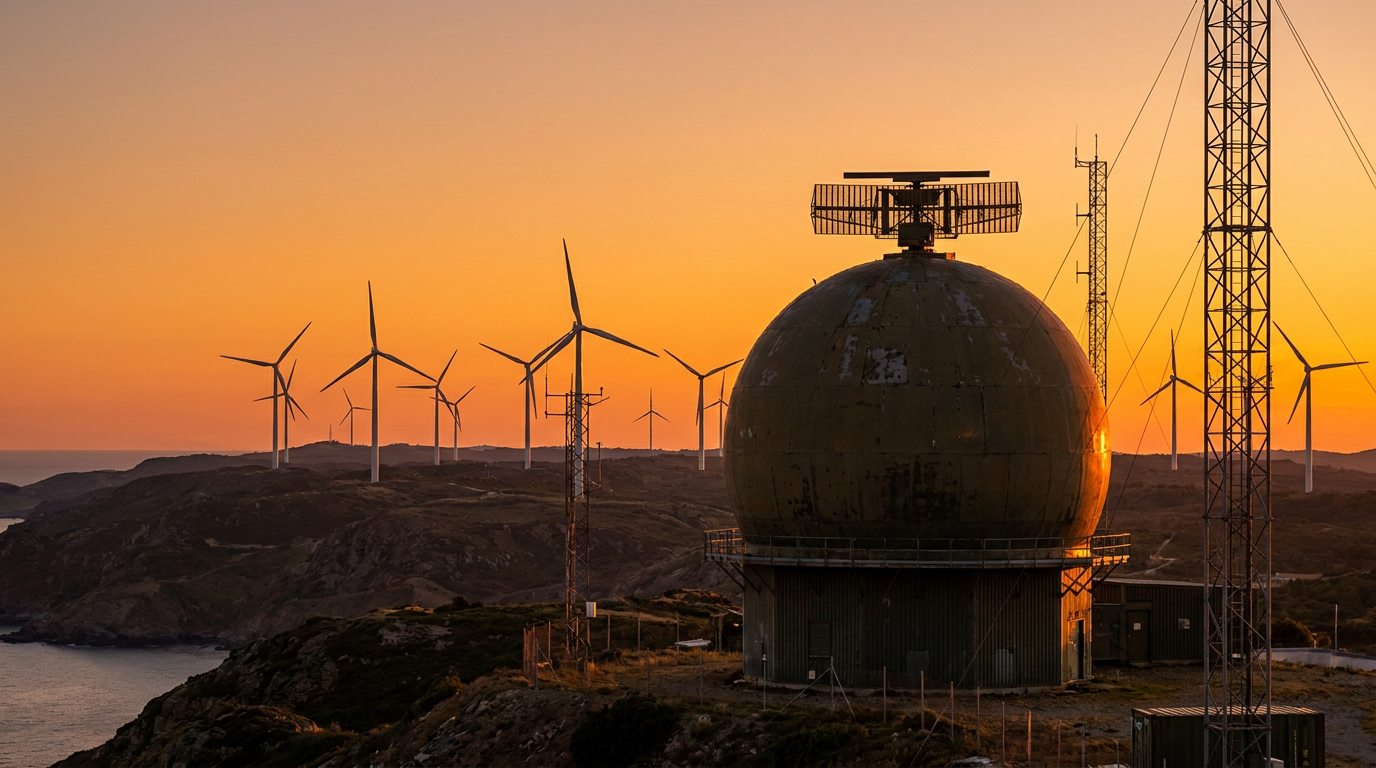
The military's stated justification for the delays centers on the genuine physical threat that wind turbines pose to radar capabilities. The scientific and military consensus confirms that turbines can interfere with surveillance systems, though the extent to which these risks remain unmitigated is highly contested by the energy sector.[6][8]
The military's stated justification for the delays centers on the genuine physical threat that wind turbines pose to radar capabilities.
A foundational 2006 Department of Defense report to Congress established the mechanics of this interference. The massive, fast-spinning blades of wind turbines can create "radar clutter." This phenomenon occurs when the rotating blades reflect radar waves, potentially masking the presence of military aircraft or generating false targets on air traffic control screens.[6]
The uncertainty lies in the current state of mitigation technology. For 15 years, the DoD's Siting Clearinghouse successfully processed wind farm applications by requiring developers to fund software patches, install supplementary sensors, or adjust turbine placements to eliminate radar blind spots. The renewable industry argues these established protocols remain sufficient.[6][7]

In contrast, recent classified Pentagon reports reportedly cite new, unspecified vulnerabilities that current mitigation strategies cannot address. Because these risk assessments are shielded from public view, independent researchers cannot independently verify whether the physics of newer, larger turbines have genuinely outpaced the military's radar filtering software.[1][8]
Beyond the immediate financial impact on developers, energy analysts present robust evidence that the stalled capacity has downstream effects on national grid reliability and the broader technology sector. The rapid expansion of artificial intelligence has triggered a surge in demand for power-hungry data centers across the United States.[3]
Tech companies, which rely heavily on new wind capacity to meet both their massive energy needs and their corporate climate commitments, are now facing severe procurement bottlenecks. Industry trackers warn that starving the grid of 60 gigawatts of planned capacity threatens to slow the broader AI infrastructure build-out and increase reliance on fossil fuels.[3]
Finally, the lawsuit alleges that the review halt is driven by political directives rather than newly discovered technical challenges. While the evidence for this claim relies on circumstantial timelines, it is heavily supported by the current administration's broader executive actions against renewable energy.[1][2][4]

The onshore wind delays closely mirror recent actions taken against offshore wind development. In late 2025, the Department of the Interior and the DoD paused multiple offshore projects, citing similar classified radar concerns, while the administration actively bought back leases to prevent coastal development.[1][2]
Plaintiffs point to President Trump's long-standing, vocal opposition to wind power as the catalyst for the sudden reversal of a permitting process that operated smoothly for over a decade. They argue the sudden discovery of insurmountable radar issues is a pretext for a broader anti-wind agenda.[1][2]
As the plaintiffs petition the federal court to order the Pentagon to resume its ordinary review process, the outcome will likely hinge on judicial deference. The courts must decide whether to heavily scrutinize the DoD's classified national security justifications or defer to the executive branch on matters of military readiness, leaving billions of dollars in energy infrastructure hanging in the balance.[4][8]
How we got here
2006
The Department of Defense publishes a foundational report acknowledging that wind turbines can interfere with military radar systems.
2010
The federal government establishes an interagency working group to develop mitigation strategies, allowing wind development to proceed alongside military readiness.
August 2025
The Pentagon reportedly stops countersigning final mitigation agreements for new onshore wind projects.
December 2025
The administration pauses multiple offshore wind projects, citing classified national security and radar concerns.
April 2026
Renewable energy developers report that all stages of the Pentagon's review process for onshore wind have ground to a complete halt.
June 12, 2026
A coalition of renewable energy groups files a federal lawsuit to force the Pentagon to resume its ordinary review process.
Viewpoints in depth
Renewable Energy Developers
Argues the delays are an unlawful, politically motivated blockade threatening the grid and billions in investment.
The clean energy sector views the Pentagon's sudden halt as a bad-faith weaponization of the permitting process. Industry leaders point out that for 15 years, developers have successfully collaborated with the military to mitigate radar interference through software patches and supplementary sensors. They argue that the sudden discovery of 'insurmountable' security risks—coinciding with the Trump administration's vocal opposition to wind power—is a pretext to kill the industry. By freezing reviews, they claim the government is unlawfully jeopardizing $47 billion in private investment and threatening the reliability of the national power grid.
Defense & Security Officials
Maintains that massive wind turbines pose inherent risks to military radar and aviation, requiring complex security reviews.
The Department of Defense emphasizes that its primary mandate is national security, not energy procurement. Military officials argue that as wind turbines grow larger and more numerous, their fast-spinning blades create increasingly complex 'radar clutter' that can mask incoming threats or generate false targets. The Pentagon maintains that the Siting Clearinghouse is actively evaluating projects, but insists that the interagency coordination required to safeguard domestic airspace cannot be rushed to meet corporate construction deadlines.
Grid & Tech Stakeholders
Concerned that the bottleneck will starve power-hungry AI data centers and strain domestic electricity supplies.
Economic analysts and technology executives are increasingly alarmed by the downstream effects of the permitting freeze. The rapid expansion of artificial intelligence requires massive new data centers, which in turn demand unprecedented amounts of electricity. Tech companies relying on the deployment of 60 gigawatts of planned wind capacity to power these facilities warn that the Pentagon's delays will create severe procurement bottlenecks, ultimately slowing US leadership in the global AI race and forcing a prolonged reliance on fossil fuels.
What we don't know
- The specific, classified technical vulnerabilities that the Pentagon claims current radar mitigation software cannot address.
- Whether the federal judiciary will compel the Department of Defense to resume reviews or defer to the executive branch on national security grounds.
- How the delays will ultimately impact the construction timelines and financial viability of the 106 stalled projects.
Key terms
- Siting Clearinghouse
- A Department of Defense office responsible for evaluating energy projects to ensure they do not compromise military readiness or national security.
- Radar Clutter
- Unwanted echoes on a radar screen caused by the reflection of radar waves off objects like wind turbine blades, which can obscure real targets.
- Gigawatt (GW)
- A unit of power equal to one billion watts, commonly used to measure the generating capacity of large-scale power plants and wind farms.
- Mitigation Agreement
- A formal contract between energy developers and the military outlining specific steps—such as software upgrades or sensor installations—to resolve security concerns.
Frequently asked
Why does the Pentagon review wind farms?
The Department of Defense reviews energy projects to ensure their physical structures, such as massive spinning turbine blades, do not interfere with military radar, flight paths, or national security surveillance.
How do wind turbines interfere with radar?
The rotating blades of a turbine can reflect radar waves, creating 'radar clutter.' This can mask the presence of real aircraft or generate false targets on military and air traffic control screens.
What is the economic impact of the delays?
An economic analysis estimates that the stalled reviews jeopardize $47 billion in capital investments and threaten thousands of jobs across 21 states.
How does this affect the tech industry?
Tech companies are racing to build power-hungry data centers for artificial intelligence. The freeze on 60 gigawatts of new wind capacity threatens to starve these facilities of the electricity they need to operate.
Sources
Source coverage
8 outlets
5 viewpoints surfaced








[1]The New York TimesPolitical & Legal Watchdogs
Renewable Groups Ask Courts to End Pentagon’s ‘Total Halt’ of Wind Power
Read on The New York Times →[2]Associated PressPolitical & Legal Watchdogs
Pentagon reviews are blocking wind farms, putting jobs at risk, lawsuit says
Read on Associated Press →[3]AxiosGrid & Economic Analysts
Exclusive: Wind projects pile up as Pentagon reviews stall
Read on Axios →[4]U.S. District Court, District of OregonRenewable Energy Developers
Complaint for Declaratory and Injunctive Relief: Renewable Northwest et al. v. Hegseth
Read on U.S. District Court, District of Oregon →[5]Charles River AssociatesGrid & Economic Analysts
Economic Impact Analysis of Delayed DoD Siting Clearinghouse Reviews
Read on Charles River Associates →[6]U.S. Department of DefenseDefense & Security Officials
Report to Congress on the Impacts of Wind Farms on Military Readiness and Radar Systems
Read on U.S. Department of Defense →[7]American Clean Power AssociationRenewable Energy Developers
ACP Demands Transparency on DoD Siting Clearinghouse Delays
Read on American Clean Power Association →[8]Factlen Editorial TeamIndependent Evidence Synthesis
Synthesis by Factlen editorial team
Read on Factlen Editorial Team →


Every angle. Every day.
Get science stories with full source coverage and perspective breakdowns delivered to your inbox.