
Panama Canal Imposes Proactive Transit Cuts and Surcharges Ahead of Forecasted El Niño
The Panama Canal Authority is reducing daily transits and lowering draft limits to conserve freshwater ahead of a severe El Niño, prompting new shipping surcharges.

The Panama Canal is one of the most critical arteries in global trade, handling roughly five percent of all maritime commerce. But unlike the sea-level Suez Canal, the Panamanian waterway operates on a vulnerability unique among major shipping corridors: it relies entirely on a massive supply of freshwater. As meteorologists forecast a severe El Niño climate pattern developing for late 2026, the Panama Canal Authority (ACP) is taking proactive, highly orchestrated steps to protect its water reserves and maintain global supply chain stability.[4][5]
Effective in late July and August 2026, the ACP has reduced available daily vessel transits from 36 to 34. Simultaneously, the authority is lowering the maximum authorized draft for the massive Neopanamax locks—the expanded lanes that accommodate the world's largest cargo ships—from a standard 50 feet down to 48.5 feet. These measures are designed to act as a controlled burn of the canal's water reserves, sacrificing a small margin of peak capacity today to prevent catastrophic bottlenecks tomorrow.[1][4]
The global shipping industry is already adjusting to the new operational reality. Major ocean carriers, including Mediterranean Shipping Co. (MSC), CMA CGM, and Hapag-Lloyd, have responded by implementing Panama Canal surcharges. These fees, ranging from $100 to $320 per twenty-foot equivalent unit (TEU), apply primarily to routes connecting Asia to the U.S. East and Gulf Coasts, reflecting the increased cost of navigating the restricted waterway.[1]
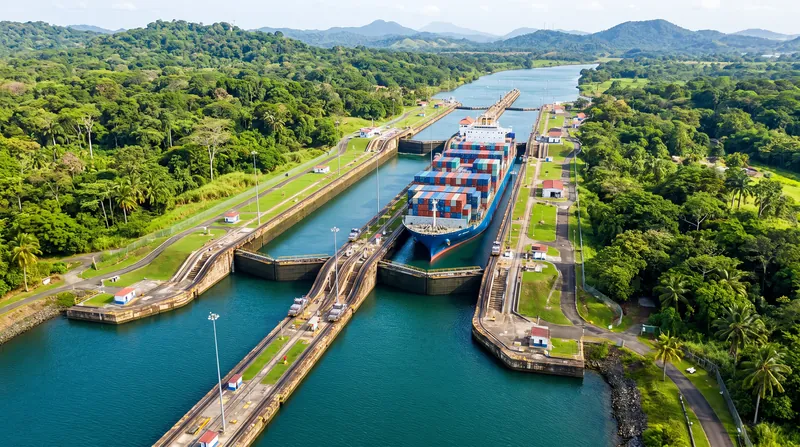
To understand why a weather forecast in the Pacific triggers global shipping surcharges, one must look at the canal's century-old engineering. The Panama Canal uses a tiered system of locks to lift ships 85 feet above sea level to Gatun Lake, a vast artificial freshwater reservoir that serves as the canal's operational heart.[6]
Every time a vessel transits the canal, millions of gallons of freshwater are used to fill the lock chambers and lift the ship. As the vessel descends on the opposite coast, that freshwater is flushed out into the ocean. When Panama's tropical rainfall is plentiful, Gatun Lake easily replenishes this massive daily outflow. But when the rains stop, the canal's operational capacity shrinks with the shoreline.[3][6]
This is where the El Niño weather phenomenon becomes a critical variable for global trade. By warming Pacific Ocean temperatures, El Niño shifts trade winds and typically causes severe, prolonged droughts across Central America. The U.S. National Oceanic and Atmospheric Administration (NOAA) recently confirmed that El Niño conditions are strengthening, with a 97% probability that the pattern will persist into early 2027.[5]
The ACP is applying hard-learned lessons from the recent 2023–2024 El Niño event. During that crisis, Gatun Lake dropped to historically low levels, forcing the canal to slash daily crossings to just 22 vessels. The resulting traffic jam left dozens of ships idling at anchor for weeks and sent spot freight rates soaring. This time, Administrator Ricaurte Vásquez and the ACP are acting preventatively while Gatun Lake levels are still relatively healthy.[4]
The authority's current strategy involves surgically targeting the most flexible parts of the schedule. By suspending "Period 3" last-minute transit auctions, the ACP effectively caps daily crossings at 34 without disrupting long-planned voyages. Behind the scenes, engineers are also utilizing cross-filling techniques between lock chambers to reuse water and optimizing daily schedules to minimize the number of lockages required.[2][3][4]
For the shipping industry, the draft restrictions are just as impactful as the transit caps. The "draft" of a ship is the vertical distance between the waterline and the bottom of its hull. Lowering the limit to 48.5 feet means heavily loaded Neopanamax vessels must sit higher in the water, which can only be achieved by shedding weight.[6]
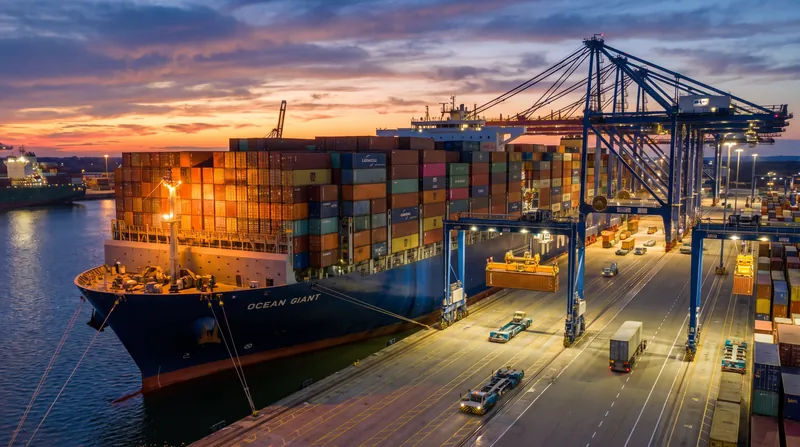
For a massive 15,000-TEU container ship, a draft reduction of this scale can mean leaving hundreds of containers behind in Asia or offloading them at the canal's entrance to transit the Panamanian isthmus by rail. This lost capacity directly drives up the operational cost per container, prompting the new carrier surcharges to offset the inefficiency.[1][6]
To adapt to this new era of climate-driven volatility, logistics managers are shifting their strategies from spot-market agility to long-term predictability. The ACP has introduced the LoTSA 2.5 program, an expanded reservation system that allows container lines to secure long-term transit slots and even defer them to following months, providing much-needed stability for complex global supply chains.[5]
While the new restrictions and fees add friction to international trade, the ACP's early intervention is widely viewed as a necessary stabilization measure. By proactively managing its freshwater reserves and giving the shipping industry clear, advance notice of capacity limits, the Panama Canal is building resilience against a changing climate, ensuring that this vital link in global commerce remains open and reliable.[3][4]
Where opinion splits
Panama Canal Authority
Prioritizing the long-term viability of the waterway over maximizing short-term transit volume.
For the canal's administrators, water is the ultimate limiting factor. The ACP views the early implementation of draft restrictions and transit caps not as a failure of capacity, but as a necessary, proactive defense mechanism. By sacrificing a small percentage of daily transits now, they aim to conserve enough of Gatun Lake's freshwater to prevent the catastrophic halving of capacity seen during the 2023 drought, ensuring the canal remains a reliable route year-round.
Ocean Carriers
Passing on the operational costs of reduced capacity to maintain service reliability.
Shipping lines face a direct mathematical problem: when draft limits are lowered, their massive Neopanamax vessels must carry less cargo to sit higher in the water. This lost capacity means the cost of operating the vessel is spread across fewer containers. Carriers argue that the new surcharges—ranging up to $320 per TEU—are a necessary mechanism to offset these inefficiencies and the higher costs of securing scarce transit slots, rather than a profit-taking measure.
Global Shippers
Seeking predictability and long-term booking stability amidst climate-driven volatility.
For the companies actually moving goods—from electronics to agricultural products—the primary concern is supply chain predictability. While the surcharges add unwanted costs, many shippers prefer the ACP's early, transparent restrictions over the sudden bottlenecks of previous years. They are increasingly utilizing long-term reservation programs like LoTSA 2.5 to lock in transit slots months in advance, trading the agility of the spot market for the security of guaranteed delivery timelines.
Key points
- The Panama Canal Authority has reduced daily transits from 36 to 34 to conserve freshwater.
- Draft limits for Neopanamax vessels are being cut to 48.5 feet, forcing ships to carry less cargo.
- Major ocean carriers are implementing surcharges of up to $320 per TEU on affected routes.
- The restrictions are a proactive measure ahead of a forecasted severe El Niño climate pattern.
Unanswered questions
- Exactly how severe the late-2026 El Niño will become, and whether it will reach 'Super El Niño' status.
- Whether the current draft restrictions will need to be tightened further if Panama's dry season is longer than expected.
- How much of the diverted global cargo will permanently shift to alternative routes like the Suez Canal or U.S. West Coast ports.
How we got here
2023–2024
A severe El Niño drought forces the canal to cut daily transits to 22, causing massive global bottlenecks.
Late 2025
The Panama Canal Authority begins implementing early water-saving measures to build up Gatun Lake reserves.
July 2026
Daily transits are reduced from 36 to 34, and draft limits are cut to 49.5 feet.
August 2026
Draft limits are further reduced to 48.5 feet, and major ocean carriers implement new surcharges.
Early 2027
The projected peak impact of the developing El Niño weather pattern on Panama's rainfall.
- Canal Authority
- Prioritizing the long-term viability of the waterway over maximizing short-term transit volume.
- Ocean Carriers
- Passing on the operational costs of reduced capacity to maintain service reliability.
- Global Shippers
- Seeking predictability and long-term booking stability amidst climate-driven volatility.
Perspectives this story doesn't cover
- Panamanian citizens reliant on Gatun Lake for municipal drinking water
- Alternative routing ports absorbing diverted cargo
Sources
Source coverage
6 outlets
3 viewpoints surfaced






- [1]SeaNews TurkeyOcean Carriers
Major container lines are imposing surcharges due to draft restrictions at the Panama Canal
Read on SeaNews Turkey → - [2]Supply Chain DiveOcean Carriers
Panama Canal draft restrictions build on water-saving measures for looming El Niño
Read on Supply Chain Dive → - [3]Nautilus ShippingCanal Authority
Panama Canal Draft Restrictions in 2026: Current Status and Key Dates
Read on Nautilus Shipping → - [4]The LoadstarCanal Authority
Panama Canal to reintroduce transit restrictions as it prepares for severe El Niño
Read on The Loadstar → - [5]Breakbulk NewsGlobal Shippers
Panama Canal Authority reduces available daily booking capacity from 36 to 34 vessels
Read on Breakbulk News → - [6]Argus MediaGlobal Shippers
Panama Canal Authority evaluates water-saving measures ahead of El Niño
Read on Argus Media →
More in Transportation
See all →Maritime Trade
Suez Canal Authority Declares Waterway Safe, Reports 57% Revenue Surge in August as Traffic Recovers
4 sources
Maritime Trade
Maersk Reverses Strategy With $5 Billion Order for 26 New Container Ships
7 sources
Marine Insurance
The Mechanics of Marine Insurance: Comparing Hull & Machinery and Protection & Indemnity Coverage
6 sources
Supply Chain Data
The Mechanics of Global Shipping Indices: How the SCFI and FBX Reflect Freight Costs and Economic Health
10 sources
Comments
Every angle. Every day.
Get Transportation stories with full source coverage and perspective breakdowns, free every day.