
Oura vs. Whoop vs. Apple Watch: The 2026 Longevity Tracker Comparison
As fitness wearables shift focus from step counts to healthspan, the Oura Ring 5, Whoop 5.0, and Apple Watch Series 11 offer distinct approaches to tracking recovery. This guide breaks down the clinical evidence, trade-offs, and ideal use cases for each device.
By Factlen Editorial Team
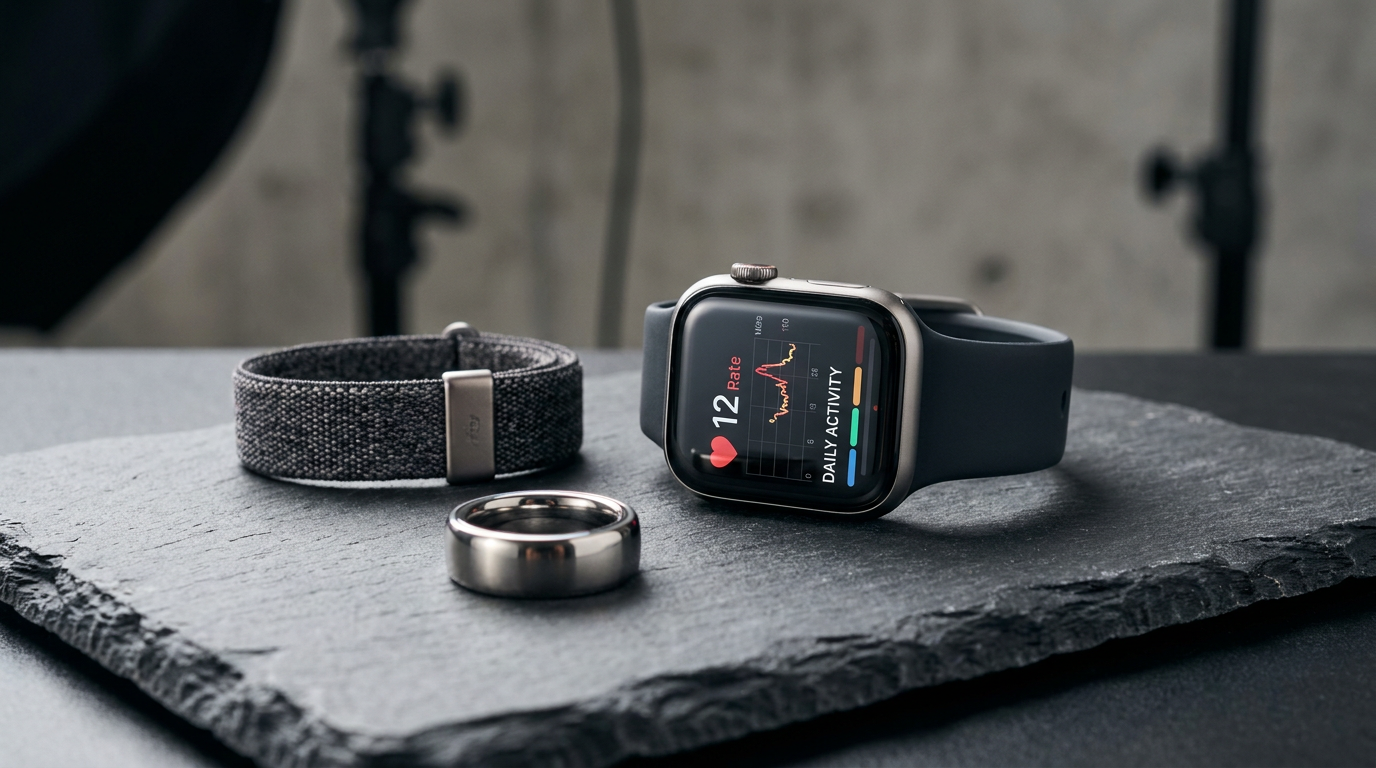
- Sleep Optimizers
- Prioritize passive overnight tracking and long-term healthspan trends.
- Ecosystem Generalists
- Value versatile, all-in-one devices that blend fitness with daily connectivity.
- Performance Athletes
- Focus on balancing daily cardiovascular strain with strict recovery coaching.
What's not represented
- · Budget-conscious consumers priced out of premium wearables
- · Users with medical conditions requiring FDA-approved continuous monitoring
Why this matters
Choosing the right wearable dictates whether you actually build a useful dataset for long-term health or just buy an expensive gadget that ends up in a drawer. Aligning the device's strengths with your daily habits is the single biggest factor in tracking your healthspan effectively.
Key points
- The wearable market has shifted from basic step counting to tracking longevity metrics like HRV and sleep architecture.
- The Oura Ring 5 excels at passive, comfortable overnight tracking but requires a monthly subscription.
- Whoop 5.0 acts as a strict 24/7 recovery coach for athletes, though it carries the highest long-term cost.
- The Apple Watch Series 11 offers the best live workout data and ecosystem integration, but requires daily charging.
- Independent validation studies show all three devices achieve near-medical-grade accuracy for resting heart rate.
The wearable technology landscape has fundamentally shifted in 2026. For years, the industry focused on counting daily steps and estimating calories burned. Today, the conversation has moved toward longevity and healthspan—optimizing sleep architecture, metabolic flexibility, and cardiovascular recovery. The market is now dominated by devices that monitor heart rate variability, respiratory rates, and overnight temperature trends to provide actionable insights into biological aging.[3][4]
Navigating this crowded market requires understanding that no single device is universally superior. The Oura Ring 5, Whoop 5.0, and Apple Watch Series 11 each engineer their hardware around a fundamentally different philosophy of behavior change. Choosing the right tool is less about finding the most sensors and more about matching the device's friction points to your personal lifestyle.[4][6]
The case for the Oura Ring 5 rests entirely on its passive, sleep-first architecture. Designed as a discreet titanium band, it excels at overnight tracking without the distraction of a glowing screen. The device measures resting heart rate, blood oxygen saturation, and skin temperature variations to generate daily readiness scores. Because it requires virtually no active input from the user and boasts a seven-to-eight-day battery life, it achieves incredibly high long-term compliance rates.[3][4]
The argument against the Oura Ring centers on its limitations during active workouts and its ongoing costs. While it tracks basic movement, it cannot provide real-time pacing or GPS data for runners, and its optical sensors can struggle to maintain a lock during heavy weightlifting. Furthermore, the $399 upfront hardware cost is paired with a mandatory $5.99 monthly subscription to access detailed insights, which can frustrate buyers looking for a one-time purchase.[3]

The clinical evidence supporting Oura's accuracy is robust. Independent validation studies, including peer-reviewed research published in the Sensors Journal, demonstrate that the ring achieves 99.9 percent reliability for resting heart rate measurements when compared to medical-grade electrocardiograms. Its sleep staging algorithms also consistently rank among the most accurate for consumer wearables.[5]
The Oura Ring fits well when a user wants comfortable, minimalist overnight tracking and prioritizes sleep optimization above all else. It does not fit when the primary goal is real-time workout coaching, live GPS tracking, or avoiding monthly software fees.[3][6]
The case for the Whoop 5.0 is built around athletic performance and the daily recovery loop. Operating as a screenless band that can be worn on the wrist or bicep, Whoop functions as a 24/7 coach. It balances a user's daily cardiovascular strain against their overnight recovery, using advanced metrics like the newly introduced "Whoop Age" to quantify long-term healthspan. Its 14-day battery life and on-wrist charging battery pack mean it never has to be removed.[2][4]
The case for the Whoop 5.0 is built around athletic performance and the daily recovery loop.
The argument against Whoop is primarily financial and functional. The device lacks any smartwatch capabilities—no timekeeping, no notifications, and no offline music. More significantly, it operates entirely on a subscription model costing $239 annually. Over a three-year horizon, Whoop becomes the most expensive option on the market, requiring users to genuinely engage with its behavioral coaching to justify the recurring expense.[2]
The evidence for Whoop's precision is similarly strong, particularly for athletes. Validation testing at the Australian Institute of Sport found that Whoop achieved 99.7 percent accuracy for heart rate measurement during sleep and an intraclass correlation of 0.99 for heart rate variability. Its algorithms are specifically validated for high-intensity strain, making it highly reliable for serious training regimens.[5]

The Whoop 5.0 fits well when a data-driven athlete wants strict accountability for their training load and recovery without the distraction of a smartwatch. It does not fit when a user wants a casual step counter, requires on-device notifications, or is averse to high ongoing subscription costs.[2][6]
The case for the Apple Watch Series 11 is its unmatched versatility as an all-in-one lifestyle tracker. It seamlessly blends clinical-grade health monitoring—including an FDA-cleared ECG and irregular rhythm notifications—with deep ecosystem integration. For live workout tracking, it remains the industry leader, offering precise GPS, real-time heart rate zones, and dynamic pacing without requiring a paid subscription to unlock the data.[1][2]
The argument against the Apple Watch is its battery life and form factor. Even with recent improvements, the Series 11 typically requires charging every 24 to 36 hours. Because most users charge their watch overnight, they frequently miss the critical sleep and recovery window that devices like Oura and Whoop capture effortlessly. Additionally, the constant barrage of notifications can increase screen time and daily stress.[1][4]

The evidence for the Apple Watch highlights its dynamic accuracy. In clinical sleep studies conducted by Stanford Health Care, the Series 11 clocked sleep duration down to the minute, aligning closely with laboratory polysomnography. Furthermore, during high-intensity outdoor activities with erratic arm movements, independent testing consistently shows the Apple Watch maintaining a more accurate heart rate lock than its optical competitors.[1]
The Apple Watch Series 11 fits well when a user wants a single, full-featured device that handles live workout metrics, safety features, and daily connectivity without a subscription. It does not fit when a user refuses to charge a device daily, dislikes wearing a watch to bed, or wants to disconnect from digital notifications.[1][6]
Ultimately, the best longevity wearable is the one that seamlessly integrates into a user's daily routine and actually changes their behavior. A technically inferior tracker worn consistently provides far more value than a clinical-grade sensor sitting on a charging dock. Buyers must honestly assess whether they need a gentle nudge to sleep better, a strict coach to manage athletic strain, or a versatile tool for an active lifestyle.[4][6]
Viewpoints in depth
The Sleep Optimizers
Users and researchers who prioritize overnight recovery and passive data collection.
This camp argues that sleep is the single most important lever for long-term healthspan. They favor devices like the Oura Ring because it removes the friction of daily charging and the distraction of screens. For these users, the value of a wearable lies in its ability to quietly monitor heart rate variability and temperature trends over months and years, providing a baseline for metabolic health without demanding active engagement during the day.
The Performance Athletes
Data-driven individuals focused on balancing cardiovascular strain with recovery.
Performance-focused users view wearables as active coaching tools rather than passive monitors. They rely on systems like Whoop to quantify exactly how much strain their body took during a workout and how much sleep debt they need to repay. This camp is willing to pay premium subscription fees because the behavioral loop—adjusting tomorrow's training based on today's recovery score—directly prevents overtraining and injury.
The Ecosystem Generalists
Everyday users who want health tracking integrated seamlessly into their digital lives.
This perspective values versatility over hyper-specialized metrics. Generalists prefer the Apple Watch because it consolidates connectivity, safety features (like fall detection and ECGs), and fitness tracking into one device. They argue that the best health tracker is the one that also lets you leave your phone at home during a run, even if it means accepting the trade-off of daily battery charging.
What we don't know
- Whether upcoming non-invasive continuous glucose monitoring (CGM) features will be integrated directly into these specific hardware models.
- How long-term software updates might alter the accuracy of sleep-staging algorithms across the three platforms.
Key terms
- Heart Rate Variability (HRV)
- The fluctuation in the time intervals between adjacent heartbeats, used as a key indicator of physical recovery and nervous system readiness.
- Healthspan
- The period of a person's life during which they are generally healthy and free from serious disease, as opposed to just total lifespan.
- Polysomnography
- A comprehensive, medical-grade sleep study used as the gold standard to measure brain waves, oxygen levels, and heart rate.
- Intraclass Correlation
- A statistical measure used to determine how closely a wearable device's readings match the results of medical-grade equipment.
Frequently asked
Do I have to pay a monthly fee for these trackers?
Whoop requires an ongoing annual subscription ($239/year), and Oura requires a $5.99 monthly fee for full data access. The Apple Watch does not require a subscription for its core health features.
Which device is best for tracking weightlifting?
The Apple Watch and Whoop are better suited for active workouts like weightlifting. The Oura Ring's optical sensors can sometimes struggle to maintain a lock during heavy gripping exercises.
Can these devices actually measure biological age?
While they cannot measure true biological age at a cellular level, devices like Whoop and Oura use long-term trends in HRV, resting heart rate, and sleep to estimate physiological age and cardiovascular efficiency.
Do I need to wear them in the shower?
All three devices are highly water-resistant and can be worn in the shower, though many users use shower time as a convenient window to charge their Apple Watch.
Sources
Source coverage
6 outlets
3 viewpoints surfaced






[1]The Wall Street JournalEcosystem Generalists
Health and Fitness Tracker Showdown: Apple Watch vs. Oura vs. Whoop
Read on The Wall Street Journal →[2]Business InsiderPerformance Athletes
The best fitness trackers in 2026, tested and reviewed
Read on Business Insider →[3]CNETEcosystem Generalists
Best Fitness Trackers for 2026
Read on CNET →[4]OneTwentySleep Optimizers
The best wearables for longevity and healthspan in 2026
Read on OneTwenty →[5]Sensors JournalSleep Optimizers
Validation of Six Wearable Devices for Estimating Sleep, Heart Rate and Heart Rate Variability
Read on Sensors Journal →[6]Factlen Editorial TeamEcosystem Generalists
Synthesis by Factlen editorial team
Read on Factlen Editorial Team →
Every angle. Every day.
Get guides stories with full source coverage and perspective breakdowns delivered to your inbox.