
OLED vs. Mini-LED TVs in 2026: The Complete Trade-off Analysis
The 2026 television market is dominated by a fierce rivalry between OLED and Mini-LED displays. While OLED offers perfect contrast for dark rooms, Mini-LED delivers overwhelming brightness and durability for sunlit spaces.
By Factlen Editorial Team
- Cinematic Purists
- Prioritize perfect black levels, infinite contrast, and pixel-level precision for dark-room movie viewing.
- Bright-Room & Value Buyers
- Focus on high peak brightness to combat glare, overall longevity, and affordability at massive screen sizes.
- Gamers & Power Users
- Evaluate displays based on motion clarity, refresh rates, and the risk of burn-in from static desktop elements.
What's not represented
- · Budget LCD Buyers
- · Projector Enthusiasts
Why this matters
Choosing the wrong TV technology for your living room can result in washed-out pictures during the day or distracting light-bleed at night. Understanding these trade-offs ensures you don't overpay for features that clash with your viewing habits.
Key points
- OLED delivers perfect black levels and infinite contrast via self-illuminating pixels.
- Mini-LED offers vastly superior brightness, making it ideal for sunlit living rooms.
- OLED carries a slight risk of permanent burn-in from static images.
- Mini-LED is immune to burn-in and scales more affordably at 75+ inch sizes.
- OLED provides near-instant pixel response times for blur-free competitive gaming.
Buying a premium television in 2026 has become a high-stakes decision between two dominant display technologies: OLED and Mini-LED. While both promise spectacular 4K and 8K visuals, they rely on fundamentally different engineering philosophies to light up the living room. The gap between them has never been narrower, yet the choice remains highly dependent on the specific environment and viewing habits of the buyer.[1][2]
The core architectural difference dictates every strength and weakness of these displays. OLED, or Organic Light-Emitting Diode, features self-illuminating pixels. In a standard 4K OLED panel, all 8.3 million pixels generate their own light and can turn off completely independently of one another. Conversely, Mini-LED relies on a traditional LCD panel illuminated by a backlight made of thousands of microscopic LEDs. These LEDs are grouped into local dimming zones that brighten or darken based on the scene.[1][4]
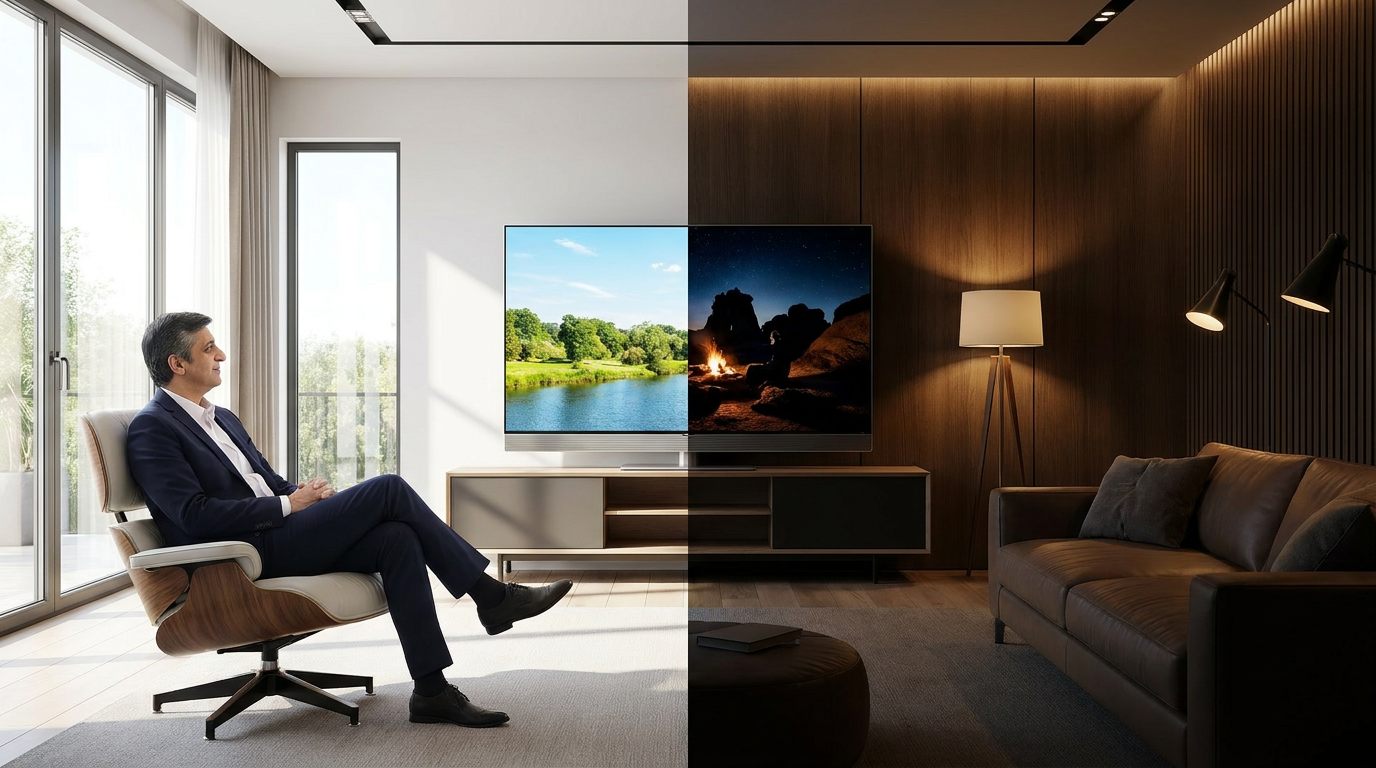
When it comes to absolute contrast and cinematic dark-room viewing, OLED remains the undisputed champion. Because its pixels can switch off entirely, an OLED display achieves an infinite contrast ratio and perfect black uniformity. There is no light bleed, meaning a bright starship against the blackness of space will look perfectly crisp. For home theater purists watching moody dramas or sci-fi films in controlled lighting, this pixel-level precision provides an unmatched sense of depth.[1][3][2][4]

Mini-LED has made massive strides in closing this contrast gap. Flagship 2026 models now feature thousands of independent dimming zones, guided by advanced AI processors that tightly control light output. Despite these improvements, Mini-LEDs still rely on a backlight shining through an LCD layer. This inherently leads to occasional blooming or a halo effect—a faint glow of light spilling into the dark areas surrounding bright objects, such as white subtitles on a black cinematic bar.[1][6][3]
However, Mini-LED strikes back with overwhelming force in the brightness category. Mid-range and high-end Mini-LED panels easily sustain 1,500 nits of brightness, with top-tier 2026 models pushing an astonishing 2,500 to 3,000 nits. This raw luminance allows Mini-LED TVs to cut through heavy glare in sun-drenched living rooms, making them the superior choice for daytime sports viewing and vibrant HDR showcases.[2][3][4]
OLED manufacturers have not ignored the brightness deficit. The introduction of QD-OLED (Quantum Dot OLED) and new Tandem OLED architectures—which stack light-emitting layers—has pushed peak OLED highlights to the 2,000-nit range. Yet, OLEDs still employ an Automatic Brightness Limiter (ABL) to prevent overheating and panel damage. This means that while a small explosion on screen can flash brilliantly, a full-screen bright image, like a hockey rink or a snowfield, will noticeably dim compared to a Mini-LED.[3][6][1]

The introduction of QD-OLED (Quantum Dot OLED) and new Tandem OLED architectures—which stack light-emitting layers—has pushed peak OLED highlights to the 2,000-nit range.
Viewing angles present another stark trade-off. Because OLED pixels emit light in all directions, the picture retains its color accuracy and contrast even when viewed from extreme off-center angles. Mini-LED displays, particularly those utilizing VA (Vertical Alignment) panels for better contrast, suffer from color degradation and increased blooming when viewers sit off to the side. For wide seating arrangements, OLED ensures every seat is the best in the house.[2][4][1]
Durability and longevity are critical factors for a multi-year investment, and here Mini-LED holds a distinct advantage. Because OLED relies on organic compounds, it carries a small but persistent risk of permanent image retention, or burn-in, if static elements are displayed for thousands of hours. News tickers, sports scoreboards, and video game HUDs are the primary culprits. While modern OLEDs use pixel-shifting and thermal management to mitigate this, the risk is never zero.[2][3][4][5]
Mini-LEDs, free from organic degradation, are effectively immune to burn-in. Industry standards rate the lifespan of a Mini-LED backlight at up to 100,000 hours—equating to over a decade of continuous use. Even if a few microscopic diodes fail over time, the sheer density of the backlight array ensures the loss is imperceptible to the viewer, making Mini-LED the safer long-term bet for mixed-use households.[5][6]
For gamers, the decision hinges on the type of play. OLED is heavily favored by competitive gamers due to its near-instantaneous pixel response time, often measuring around 0.03 milliseconds. This eliminates motion blur and ghosting during fast-paced action, providing a perfectly clear image during rapid camera pans. Combined with 144Hz to 240Hz refresh rates, OLED delivers a flawlessly smooth gaming experience.[3][6][4]
Conversely, Mini-LED is the preferred choice for PC gamers and power users who use their screens for productivity. The absolute immunity to burn-in means users can leave static taskbars, spreadsheets, and desktop icons on the screen all day without anxiety. Furthermore, Mini-LED's ability to sustain high full-screen brightness makes it ideal for well-lit home offices.[5][6]
Price scaling ultimately dictates many purchasing decisions in 2026. While 55-inch and 65-inch OLEDs have become highly competitive in price, manufacturing massive OLED panels remains incredibly expensive. For buyers seeking immersive 75-inch, 85-inch, or even 98-inch displays, Mini-LED offers a drastically better price-to-performance ratio, delivering massive, bright screens for a fraction of the cost of an equivalent OLED.[3][4][2]

Ultimately, neither technology is the objective winner; they simply serve different environments. OLED fits perfectly when the buyer has a light-controlled room, prioritizes cinematic contrast and perfect blacks, requires wide viewing angles for group movie nights, and wants the absolute fastest pixel response for competitive gaming.[2][4]
How we got here
2013
The first commercial OLED TVs hit the market, establishing a new benchmark for perfect black levels.
2019
Mini-LED technology begins appearing in premium consumer TVs as a brighter alternative to OLED.
2022
QD-OLED panels launch, combining quantum dots with OLED to improve color volume and brightness.
2026
Tandem OLED and 5,000-zone Mini-LEDs push both technologies to their highest performance peaks yet.
Viewpoints in depth
The OLED Advantage
Unmatched contrast and motion clarity for controlled lighting environments.
OLED's self-illuminating pixels provide a level of precision that backlit TVs cannot replicate. Because each pixel can turn off entirely, the display achieves perfect black levels without any light bleeding into dark areas. This makes OLED the definitive choice for home theater enthusiasts who watch movies in dark rooms. Additionally, the near-instantaneous pixel response time eliminates motion blur, making it highly sought after by competitive gamers.
The Mini-LED Advantage
Overwhelming brightness and durability for sunlit rooms and mixed usage.
Mini-LED technology uses thousands of microscopic backlight zones to push peak brightness levels well beyond what OLED can safely achieve. This raw luminance allows the picture to cut through heavy daytime glare, making it ideal for bright living rooms and daytime sports viewing. Furthermore, because Mini-LED does not use organic compounds, it is immune to permanent burn-in, making it the safer choice for PC users or households that leave news channels with static graphics running all day.
What we don't know
- Whether upcoming Micro-LED technology will become affordable enough to replace both OLED and Mini-LED in the consumer market.
- Exactly how long Tandem OLED panels will delay the onset of burn-in compared to previous generations.
Key terms
- Blooming (Halo Effect)
- A visual artifact where light bleeds into dark areas around bright objects, common on backlit screens.
- Nits
- A unit of measurement for brightness; higher numbers indicate a brighter display.
- Local Dimming Zones
- Specific areas of a Mini-LED backlight that can dim or turn off independently to improve contrast.
- Burn-in
- Permanent image retention caused by static elements degrading organic pixels over time.
- Response Time
- The speed at which a pixel can change from one color to another, crucial for motion clarity in gaming.
Frequently asked
Does OLED still suffer from burn-in in 2026?
While modern OLEDs use pixel-shifting and advanced cooling to mitigate the risk, permanent image retention remains a possibility if static elements are displayed for thousands of hours.
Which TV is better for a bright living room?
Mini-LED is the superior choice for bright rooms, as it can sustain much higher full-screen brightness to cut through glare and sunlight.
Are Mini-LEDs cheaper than OLEDs?
Generally, yes. While flagship Mini-LEDs can match OLED prices, Mini-LED technology scales much more affordably at larger sizes like 75 and 85 inches.
Which technology is better for gaming?
OLED offers near-instant pixel response times for blur-free motion, but Mini-LED is preferred by PC gamers who want to avoid burn-in from static HUDs and taskbars.
Sources
Source coverage
6 outlets
3 viewpoints surfaced






[1]RTINGSGamers & Power Users
Mini LED vs. OLED TVs: Which One Is The Best?
Read on RTINGS →[2]Tom's GuideCinematic Purists
OLED vs Mini-LED: What's the difference and is one actually better?
Read on Tom's Guide →[3]EcoPicksGoCinematic Purists
OLED vs Mini LED TVs (2026): LG G5 vs LG QNED9M
Read on EcoPicksGo →[4]CurrysBright-Room & Value Buyers
Mini LED vs OLED TVs: which should you buy in 2025?
Read on Currys →[5]BGRBright-Room & Value Buyers
Here's How Long You Can Expect Your Mini LED TV To Last
Read on BGR →[6]KTCGamers & Power Users
4K 240Hz OLED vs 5K Mini-LED: 2026 Buying Guide
Read on KTC →
Every angle. Every day.
Get shopping stories with full source coverage and perspective breakdowns delivered to your inbox.