
OLED vs. Mini-LED: The Definitive 2026 TV Comparison
As OLED pushes new brightness limits and Mini-LED refines its contrast, choosing the right premium TV in 2026 comes down to your living room environment.
By Factlen Editorial Team
- Home Theater Purists
- Advocates for absolute picture accuracy, perfect black levels, and cinematic fidelity.
- Bright-Room Viewers
- Prioritizes sheer luminance, glare reduction, and vibrant daytime viewing.
- Long-Term Value Buyers
- Focuses on the price-to-size ratio and maximizing screen real estate.
What's not represented
- · Budget consumers looking for sub-$500 standard LED options
- · Professional colorists who require reference-monitor accuracy
Why this matters
A premium television is a multi-year investment that dictates how you experience entertainment, sports, and gaming. Understanding the precise trade-offs between OLED and Mini-LED ensures you don't overpay for features that don't match your room's lighting or your viewing habits.
Key points
- The 2026 TV market is dominated by two premium technologies: OLED and Mini-LED.
- OLED panels control light at the individual pixel level, delivering perfect blacks and infinite contrast for dark rooms.
- Mini-LED panels use thousands of tiny backlights to achieve extreme brightness, making them ideal for sunlit living rooms.
- OLED carries a slight risk of permanent burn-in from static images, whereas Mini-LED is entirely immune.
- Mini-LED offers significantly better value at massive screen sizes (85 inches and above).
- The best choice depends entirely on your room's lighting, seating arrangement, and viewing habits.
The 2026 television market has crystallized into a two-horse race for premium living room supremacy: OLED and Mini-LED. While older, standard LED displays have been relegated to budget tiers, the battle between organic light-emitting diodes and miniaturized backlights has never been closer or more fiercely contested. For consumers, the choice is no longer about which technology is objectively superior in a vacuum, but rather which set of specific trade-offs best aligns with their viewing environment, daily habits, and budget. As manufacturers push the physical limits of brightness and contrast, the marketing jargon has become increasingly dense. However, stripping away the acronyms reveals a clear divergence in engineering philosophy.[1][6]
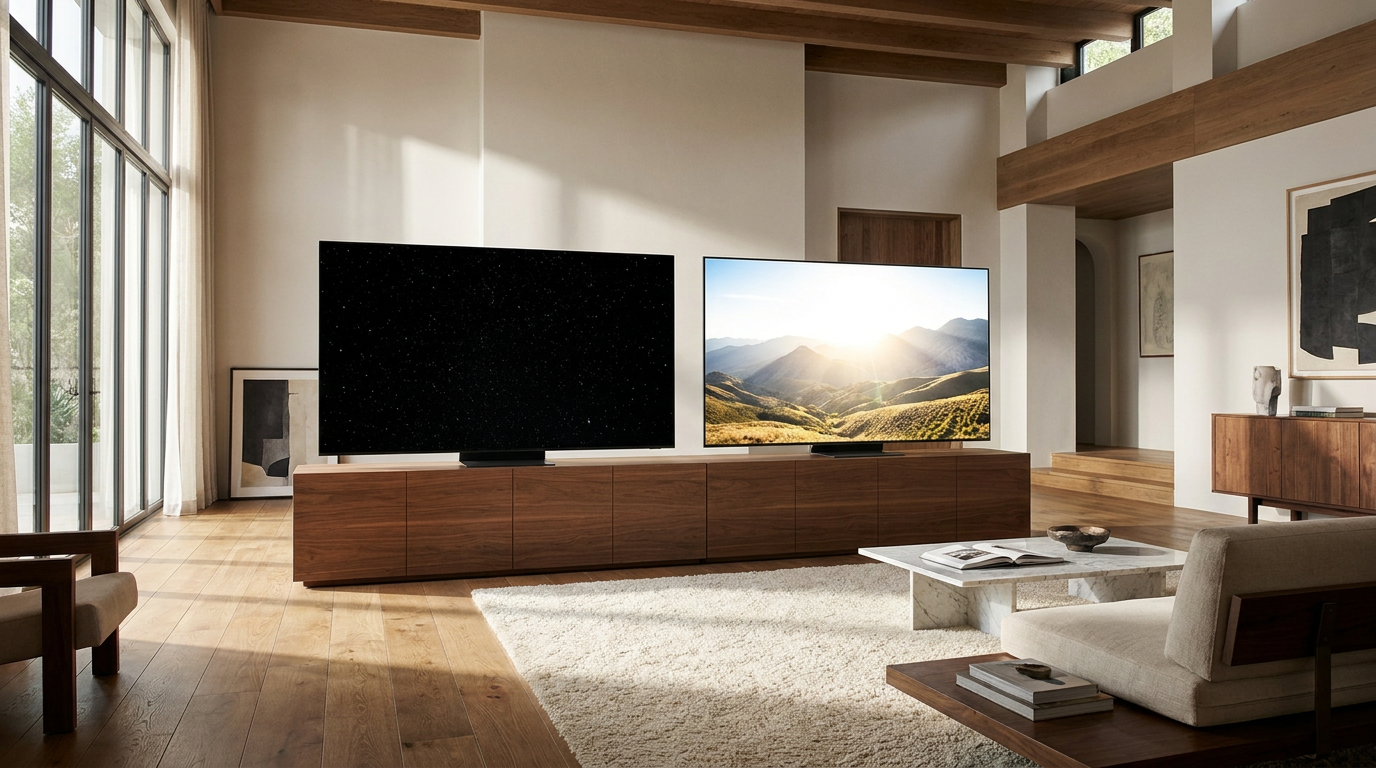
To understand the divide, one must look at the fundamental mechanism of how each panel generates light. OLED, which stands for Organic Light-Emitting Diode, is a self-emissive technology. This means that every single pixel on the screen—over eight million of them on a standard 4K display—produces its own light and can turn off completely independently of its neighbors. There is no backlight sitting behind the screen pushing light through a color filter. When an OLED television needs to display the color black, it simply cuts the power to those specific pixels, resulting in an absolute absence of light.[2][6]
The argument for OLED centers entirely on this unparalleled contrast. Because pixels can achieve a state of absolute zero light, OLED panels deliver what the industry calls "perfect blacks," without any light bleeding into the dark areas of the screen. Testing laboratories and professional calibrators consistently crown OLED as the undisputed king of dark-room viewing. The evidence shows that this pixel-level precision makes it the optimal choice for cinematic content, moody prestige television, and high-contrast HDR scenes where deep shadows and bright highlights share the screen simultaneously.[2][3]
Further evidence for OLED's visual supremacy can be seen in its screen uniformity and viewing angles. When watching a film featuring a starfield or bright white subtitles on a pitch-black background, an OLED screen displays crisp, sharply defined light with zero "haloing" or "blooming" around the edges. Additionally, because the light is generated at the surface of the pixel, the image does not degrade, wash out, or lose color saturation when viewed from off-center angles. Furthermore, OLED panels offer near-instantaneous pixel response times, virtually eliminating motion blur during fast-paced sports or competitive gaming.[3][6]

The argument against OLED focuses primarily on its brightness limitations and the lingering fear of panel degradation. While 2026 advancements like stacked Tandem OLED architectures have pushed peak HDR highlights past the 2,000-nit threshold, OLEDs still aggressively dim the entire screen when displaying large, uniformly bright scenes—such as a hockey rink or a snow-covered landscape—to prevent the organic compounds from overheating. Additionally, while modern pixel-shifting algorithms have drastically reduced the risk, permanent image retention, commonly known as "burn-in," remains a non-zero possibility for users who leave static news tickers or video game HUDs on the screen for thousands of consecutive hours.[1][4]
On the other side of the aisle sits Mini-LED, representing the ultimate, highly engineered evolution of traditional LCD technology. Instead of utilizing a few dozen large backlights to illuminate the screen, Mini-LED panels employ thousands of microscopic light-emitting diodes grouped into independent "local dimming zones." By algorithmically brightening and darkening these specific zones in real-time based on the content being displayed, the television attempts to mimic the localized, pinpoint contrast of an OLED panel while retaining the sheer, brute-force horsepower of a traditional LED backlight.[2][5]
On the other side of the aisle sits Mini-LED, representing the ultimate, highly engineered evolution of traditional LCD technology.
The strongest argument for Mini-LED is its blistering, room-filling luminance. Premium 2026 models from major manufacturers can push peak HDR highlights well beyond 3,000 nits, while simultaneously maintaining incredibly high full-screen brightness without triggering aggressive auto-dimming limiters. The evidence indicates that for living rooms bathed in natural sunlight, or spaces with large, uncurtained windows, Mini-LED provides a vibrant, punchy image that easily cuts through ambient glare. This makes it the vastly superior choice for daytime sports viewing or casual afternoon television watching.[1][5]
Beyond sheer brightness, evidence for Mini-LED's superiority lies in its durability and value proposition. Because the technology relies on inorganic diodes, it is entirely immune to permanent burn-in, making it a safer long-term investment for households that leave the television running all day as background noise. Furthermore, Mini-LED dominates the value equation at massive screen sizes. Manufacturing large OLED panels remains a prohibitively expensive endeavor, meaning consumers can often purchase a sprawling 85-inch or even 98-inch Mini-LED television for the exact same price as a much smaller 65-inch OLED model.[4][5]

The primary argument against Mini-LED is its reliance on dimming zones rather than individual pixels. Even with tens of thousands of zones, a Mini-LED television cannot perfectly isolate a bright object on a dark background. This physical limitation results in "blooming"—a faint, glowing halo around bright elements like streetlamps, moons, or subtitles in dark cinematic scenes. Additionally, many Mini-LED televisions utilize VA (Vertical Alignment) panels, which inherently suffer from color degradation and contrast loss when viewed from off-center angles, making them less ideal for wide, wrap-around seating arrangements.[2][3]
When evaluating gaming performance, the comparison yields a functional tie, though for entirely different reasons. Both technologies now universally support modern console features like 4K resolution at 120Hz or 144Hz, Variable Refresh Rate (VRR), and Auto Low Latency Mode (ALLM). OLED wins on motion clarity and input lag, offering a buttery-smooth, blur-free experience that competitive shooter fans demand. Mini-LED, conversely, provides blindingly bright HDR explosions and offers zero anxiety about burning a static minimap or health bar into the screen during marathon, all-weekend gaming sessions.[1][6]
Interestingly, the technological gap between the two formats is actively shrinking in 2026. OLED manufacturers are utilizing micro-lens arrays (MLA) and advanced heat-sinks to boost brightness without accelerating panel degradation. Simultaneously, Mini-LED manufacturers are exponentially increasing their zone counts and refining their local dimming algorithms with AI processors to suppress blooming to near-imperceptible levels. As both technologies borrow strengths from one another, the baseline for premium picture quality has never been higher.[3][6]

Ultimately, OLED fits well when the television is placed in a light-controlled room, a basement, or a dedicated home theater. It is the definitive, uncompromising choice for cinephiles who prioritize absolute contrast, perfect black levels, and wide seating arrangements where every viewer needs a perfect angle. If picture quality in a dark room is your sole metric, and you are willing to manage the slight risk of burn-in, OLED remains the undefeated champion of the premium television market.[2][6]
Mini-LED, by contrast, fits well when the television lives in a bright, sunlit family room. It is the ideal choice for consumers who want a massive 85-inch screen without spending a fortune, households that leave the TV on all day, or viewers who prefer their HDR content to be aggressively bright and punchy. In the modern living room, context is king, and both technologies offer a spectacular, deeply immersive viewing experience when properly matched to the right physical environment.[1][5]
How we got here
2013
The first consumer OLED televisions hit the market, establishing a new benchmark for black levels and contrast.
2019
Mini-LED technology begins appearing in premium consumer televisions, offering a brighter alternative to OLED.
2023
OLED manufacturers introduce Micro Lens Array (MLA) technology, significantly boosting peak brightness to compete with LEDs.
2025
Tandem OLED architecture is introduced to consumer TVs, stacking emissive layers to push brightness past 2,000 nits.
2026
Mini-LED zone counts reach the tens of thousands, narrowing the contrast gap with OLED to its slimmest margin yet.
Viewpoints in depth
Home Theater Purists
Advocates for absolute picture accuracy, perfect black levels, and cinematic fidelity.
For cinephiles and home theater enthusiasts, OLED remains the undisputed champion. This camp argues that peak brightness is a secondary metric compared to pixel-level contrast, noting that films are mastered in dark environments and intended to be viewed in similar conditions. They point to the perfect black uniformity and lack of blooming as essential for preserving the director's original vision, arguing that Mini-LED's extreme brightness often artificially over-brightens shadow details.
Bright-Room Viewers & Sports Fans
Prioritizes sheer luminance, glare reduction, and vibrant daytime viewing.
Consumers with sunlit living rooms and wide seating arrangements champion Mini-LED. This perspective emphasizes that perfect black levels are irrelevant if the screen is obscured by daytime glare. They cite Mini-LED's ability to sustain full-screen brightness during hockey games or winter sports without aggressive auto-dimming. Furthermore, this camp values the absolute immunity to burn-in, making Mini-LED the preferred choice for households where the television doubles as an all-day background display.
Value-Conscious Large-Screen Buyers
Focuses on the price-to-size ratio and maximizing screen real estate.
As the demand for 85-inch and 98-inch televisions surges, this camp argues that Mini-LED offers vastly superior value. They note that while 65-inch OLEDs have become affordable, the manufacturing costs for massive OLED panels remain astronomical. For these buyers, the slight trade-off in dark-room contrast is heavily outweighed by the immersive impact of a wall-sized Mini-LED display that costs half as much as its OLED equivalent.
What we don't know
- Whether emerging Micro-LED technology will become affordable enough to replace both OLED and Mini-LED in the consumer market before the end of the decade.
- Exactly how the long-term degradation curve of the new, ultra-bright 'Tandem OLED' panels will compare to traditional OLEDs after a decade of heavy use.
Key terms
- OLED (Organic Light-Emitting Diode)
- A display technology where each individual pixel generates its own light and can turn off completely, resulting in perfect black levels.
- Mini-LED
- An advanced backlight technology for LCD TVs that uses thousands of microscopic LEDs grouped into zones to precisely control brightness and contrast.
- Local Dimming Zones
- Specific areas of a TV's backlight that can independently dim or brighten to improve contrast and reduce light bleeding in dark scenes.
- Blooming (or Haloing)
- A visual artifact where light bleeds from a bright object into surrounding dark areas of the screen, commonly seen on LED TVs.
- Nits
- A unit of measurement for screen brightness. A higher number of nits means the television can display brighter highlights and combat room glare more effectively.
- Burn-in
- Permanent image retention on a screen caused by displaying a static image (like a news ticker or video game HUD) for thousands of hours.
Frequently asked
Will an OLED TV suffer from burn-in in 2026?
While the risk is not zero, modern OLEDs use advanced pixel-shifting and panel-refresh algorithms that make burn-in highly unlikely under normal varied viewing. However, it remains a risk if you exclusively watch news channels with static banners for hours every day.
Is Mini-LED the same as Micro-LED?
No. Mini-LED uses thousands of tiny backlights behind an LCD panel. Micro-LED is a completely different, highly expensive technology where each microscopic pixel is its own LED, combining the brightness of LED with the perfect blacks of OLED.
Which TV is better for PlayStation 5 or Xbox Series X?
Both are excellent, supporting 4K at 120Hz. OLED offers slightly better motion clarity and instant response times, while Mini-LED provides brighter HDR highlights and zero risk of burning in static game HUDs during long sessions.
Do I need to worry about viewing angles?
If you have a wide seating arrangement where people sit far off to the side, OLED is superior as its picture remains perfect from any angle. Many Mini-LEDs use VA panels, which can lose color saturation and contrast when viewed off-center.
Sources
Source coverage
6 outlets
3 viewpoints surfaced






[1]CNETBright-Room Viewers
Mini-LED vs. OLED: Which TV Tech Should You Get?
Read on CNET →[2]RTINGSHome Theater Purists
Mini LED vs. OLED TVs: Which One Is The Best?
Read on RTINGS →[3]TechRadarHome Theater Purists
I compared mid-range mini-LED and OLED TVs, and while it's closer than you might think, OLED wins in one vital area
Read on TechRadar →[4]BGRLong-Term Value Buyers
Here's How Long You Can Expect Your Mini LED TV To Last
Read on BGR →[5]CurrysBright-Room Viewers
Mini LED vs OLED TVs: which should you buy in 2025?
Read on Currys →[6]Factlen Editorial TeamLong-Term Value Buyers
Synthesis by Factlen editorial team
Read on Factlen Editorial Team →

More in shopping
See all 5 stories →


Every angle. Every day.
Get shopping stories with full source coverage and perspective breakdowns delivered to your inbox.