
OLED vs. Mini-LED: The 2026 TV Technology Comparison
As Mini-LED panels push past 5,000 dimming zones and OLEDs adopt brighter tandem structures, the gap between the two premier TV technologies has narrowed. Choosing the right display in 2026 comes down to room lighting, screen size, and viewing habits.
By Factlen Editorial Team
- OLED Enthusiasts
- Prioritizes perfect black levels, infinite contrast, and pixel-level precision for cinematic viewing.
- Mini-LED Advocates
- Prioritizes sustained full-screen brightness, zero burn-in risk, and daytime visibility.
- Large-Format Maximizers
- Prioritizes massive screen real estate (85 to 115 inches) without exponential price scaling.
What's not represented
- · Budget-conscious buyers looking at standard LED options
- · Projector enthusiasts who prioritize wall-sized cinematic scale over panel tech
Why this matters
Televisions are long-term investments that dictate how you experience movies, sports, and games for years. Understanding the exact trade-offs between OLED's perfect contrast and Mini-LED's sustained brightness ensures you don't overpay for the wrong technology for your specific living room.
Key points
- OLED delivers infinite contrast and perfect blacks by turning off individual pixels.
- Mini-LED offers massive sustained brightness and zero burn-in risk for bright rooms.
- 2026 OLEDs use Tandem and QD architectures to boost peak brightness up to 1,500 nits.
- Premium Mini-LEDs now feature over 5,000 dimming zones to minimize blooming artifacts.
- Mini-LED provides significantly better value at massive screen sizes of 85 inches and above.
The era of standard LCD televisions is effectively over for premium buyers, leaving a fiercely competitive two-horse race between OLED and Mini-LED. Both technologies have reached spectacular heights in 2026, making the choice less about which is objectively superior and more about which fits a specific environment. As manufacturers push the boundaries of brightness and contrast, the trade-offs between the two have become highly specialized.[1][2]
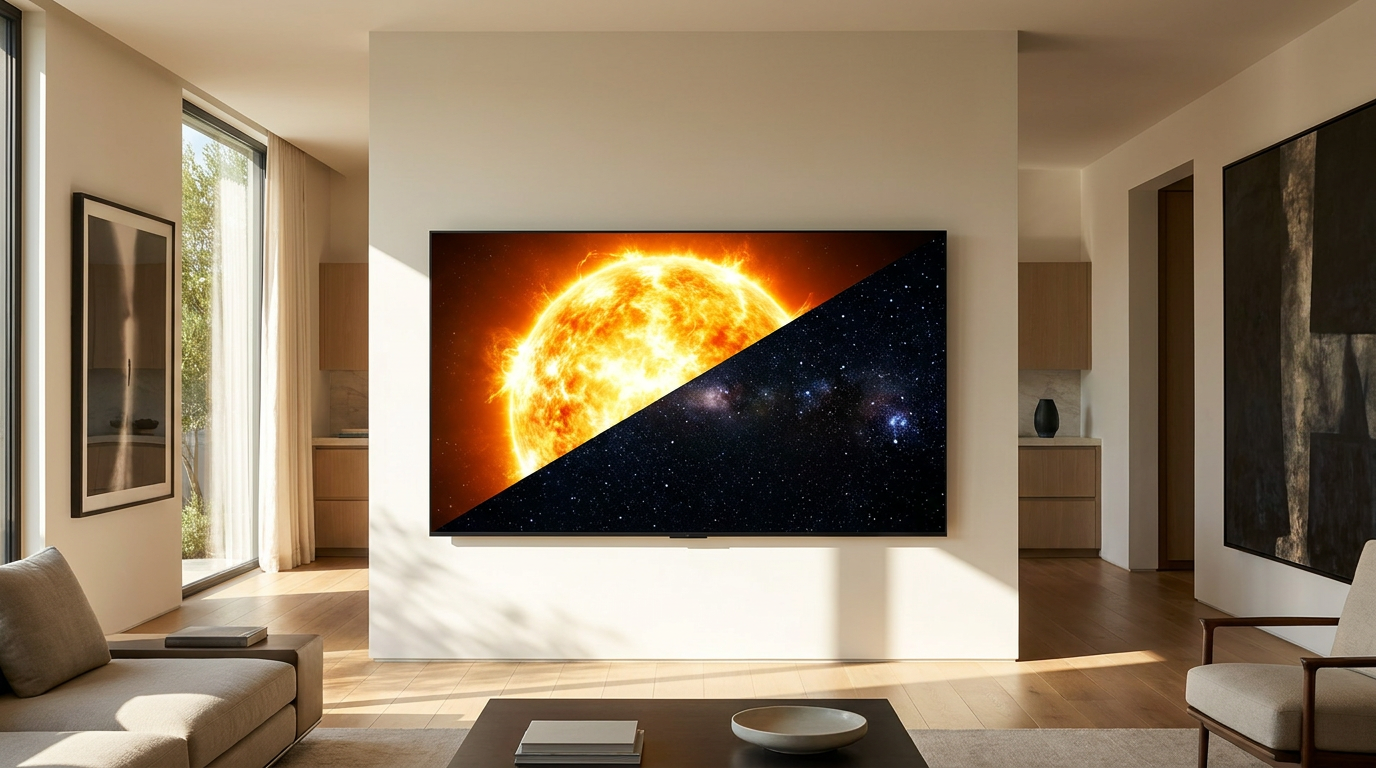
The argument for OLED centers entirely on its self-emissive nature. Because every single pixel generates its own light and can turn off completely, OLED panels deliver an infinite contrast ratio and perfect, inky blacks. There is zero light bleed, meaning a bright star in a dark sky is rendered with absolute pixel-level precision. This creates a depth and three-dimensionality to the image that backlit televisions struggle to replicate.[1][2][5]
The argument against OLED remains its limitation on sustained, full-screen brightness and the lingering, albeit reduced, risk of burn-in. To protect the organic materials from overheating, OLEDs employ an Auto Brightness Limiter (ABL) that aggressively dims the screen when a large white element—like a hockey rink, a snow-covered landscape, or a bright web browser—fills the display. Furthermore, static elements left on the screen for hours can still cause permanent image retention over years of heavy use.[6]

The evidence for OLED's dominance in dark environments is overwhelming. Testing confirms that in light-controlled rooms, OLED's ability to hit true black levels below 0.0005 nits creates a more convincing and immersive high-dynamic-range (HDR) image than any competing technology. For cinematic viewing and fast-paced gaming, its near-instantaneous pixel response time remains undefeated, completely eliminating motion blur during rapid camera pans.[1][2][4]
Conversely, the argument for Mini-LED is built on raw, unadulterated power and durability. By placing thousands of microscopic light-emitting diodes behind an LCD layer, Mini-LED TVs can sustain massive brightness levels across the entire screen without triggering an ABL. Furthermore, because they do not use organic compounds, they are entirely immune to permanent burn-in, making them ideal for static interfaces, news tickers, and all-day productivity.[3][5][6]
Conversely, the argument for Mini-LED is built on raw, unadulterated power and durability.
The argument against Mini-LED focuses on algorithmic haloing, commonly known as blooming. Because the backlight is divided into zones rather than individual pixels, a bright object on a dark background can cause light to spill into adjacent dark areas. While a 4K TV has over eight million pixels, even the best Mini-LEDs only have a few thousand dimming zones to share among them, meaning pitch-black scenes can sometimes look slightly washed out around bright highlights.[2][4]

The evidence for Mini-LED's bright-room supremacy is clear in 2026 testing. Industry benchmarks show that modern Mini-LEDs easily push past 2,000 to 3,600 nits of peak brightness, allowing them to overpower sun-drenched living rooms and heavy glare. Furthermore, the jump to 5,000-plus local dimming zones in premium models has reduced blooming to levels that most viewers will never notice outside of extreme stress tests.[3][7]
The technological gap has narrowed significantly thanks to 2026 innovations. OLED manufacturers have introduced QD-OLED and Tandem OLED architectures, which stack emissive layers to boost peak highlight brightness up to 1,500 nits while extending panel lifespan. These advancements make modern OLEDs much more forgiving in daytime viewing than their predecessors, challenging Mini-LED's traditional stronghold.[7][8]
At the same time, Mini-LED processing algorithms have become remarkably sophisticated. The software controlling the backlight zones is now just as important as the zone count itself. The latest processors can predict and suppress blooming in real-time, allowing Mini-LEDs to mimic OLED-like contrast in all but the most challenging cinematic scenes, such as white subtitles over black letterbox bars.[2][4]

Beyond pure picture quality, the evidence points to a massive divergence in price-to-performance ratios at extreme screen sizes. While OLED pricing remains relatively competitive up to 77 inches, it scales exponentially higher beyond that. For buyers seeking 85-inch, 98-inch, or even 115-inch displays, Mini-LED offers overwhelming cinematic scale for thousands of dollars less than a comparable OLED.[5][8]
Ultimately, the 2026 television landscape offers no single objective winner, only the best technology for a specific use case. Buyers must weigh their room lighting, their sensitivity to blooming versus their sensitivity to screen dimming, and their budget for massive screen sizes to make the right choice for their home.[1][3]
How we got here
2013
The first large-format OLED TVs hit the consumer market, establishing a new benchmark for perfect black levels.
2019
Mini-LED technology begins appearing in premium consumer televisions, offering a brighter alternative to OLED.
2022
QD-OLED panels are introduced, combining quantum dots with OLED to increase color saturation and peak brightness.
2024
Mini-LED zone counts cross the 5,000 mark in flagship models, drastically reducing blooming artifacts.
2026
Tandem OLED architectures arrive in consumer displays, stacking emissive layers to boost brightness and longevity.
Viewpoints in depth
The Dark-Room Cinephiles (OLED)
Prioritizes perfect black levels, infinite contrast, and pixel-level precision.
This technology fits well when the display lives in a light-controlled room, basement theater, or bedroom, and the primary content is HDR movies, prestige television, or dark, atmospheric gaming. Because every pixel can turn off completely, it delivers an unmatched cinematic experience. It does not fit well when the room features unshaded windows, direct sunlight, or when the user plans to leave static interfaces—like news tickers or PC taskbars—on screen for eight hours a day, which risks image retention.
The Bright-Room Pragmatists (Mini-LED)
Prioritizes sustained full-screen brightness, zero burn-in risk, and daytime visibility.
This technology fits well when the television sits in a sun-drenched living room with open blinds, or when it doubles as a productivity monitor displaying static elements all day. It excels at rendering bright sports broadcasts and vibrant daytime gaming without triggering auto-dimming safety features. It does not fit well when the user is highly sensitive to 'blooming'—the faint halo of light around bright objects on dark backgrounds—which can still appear during starfield scenes or movie subtitles in pitch-black rooms.
The Large-Format Maximizers
Prioritizes massive screen real estate (85 to 115 inches) without exponential price scaling.
This approach fits well when the goal is to fill a massive wall with a 98-inch or 115-inch display on a reasonable budget. Because Mini-LED manufacturing scales more cost-effectively at extreme sizes, it delivers overwhelming cinematic scale for thousands of dollars less than a comparable OLED. It does not fit well when absolute pixel-level perfection is demanded regardless of cost, as the largest OLED panels still carry a severe premium that places them out of reach for most consumers.
What we don't know
- Whether MicroLED technology will become affordable enough to replace both OLED and Mini-LED before the end of the decade.
- How the long-term degradation of Tandem OLED panels will compare to traditional single-layer OLEDs after a decade of heavy use.
Key terms
- OLED (Organic Light-Emitting Diode)
- A display technology where each individual pixel generates its own light and can turn off completely to create perfect blacks.
- Mini-LED
- An LCD display that uses thousands of microscopic LED lights divided into dimming zones to provide highly controlled backlighting.
- ABL (Auto Brightness Limiter)
- A protective feature in OLED TVs that automatically dims the screen when a large, bright image is displayed to prevent overheating and burn-in.
- Nits
- A unit of measurement for screen brightness; higher numbers indicate a display can produce brighter highlights and better combat room glare.
- Blooming / Haloing
- A visual artifact on backlit TVs where light from a bright object spills into adjacent dark areas of the screen.
- Local Dimming Zones
- Specific sections of a Mini-LED backlight that can independently dim or brighten to improve contrast.
Frequently asked
Does OLED still suffer from burn-in in 2026?
While the risk of permanent image retention exists for organic panels, 2026 technologies like Tandem OLED and aggressive pixel-shifting algorithms have made burn-in exceedingly rare for normal television viewing.
What is blooming on a Mini-LED TV?
Blooming, or haloing, occurs when the backlight behind a bright object bleeds into the surrounding dark pixels, creating a faint glow around things like white subtitles on a black background.
Which TV is better for a bright living room?
Mini-LED is the superior choice for sun-drenched rooms, as its sustained full-screen brightness can overpower glare and reflections without triggering an auto-dimming safety feature.
Are OLED TVs good for gaming?
Yes, OLEDs are widely considered the gold standard for gaming due to their near-instantaneous pixel response times, which eliminate motion blur during fast-paced action.
Sources
Source coverage
8 outlets
3 viewpoints surfaced








[1]CNETOLED Enthusiasts
The two TV technologies that dominate our picks
Read on CNET →[2]RTINGSOLED Enthusiasts
Mini LED vs OLED TVs
Read on RTINGS →[3]PCWorldMini-LED Advocates
Mini-LED wins on brightness
Read on PCWorld →[4]What Hi-Fi?OLED Enthusiasts
Mini LED vs OLED gaming performance
Read on What Hi-Fi? →[5]SamsungLarge-Format Maximizers
Mini LED vs. OLED: Picture Quality
Read on Samsung →[6]Ordinary TechMini-LED Advocates
Workflow Friction Comparison: OLED vs Mini-LED
Read on Ordinary Tech →[7]KTC PlayMini-LED Advocates
5000-Zone Mini-LED: The 2026 HDR Peak Brightness Battle
Read on KTC Play →[8]Data Wire SolutionsLarge-Format Maximizers
Tandem OLED vs QD-OLED vs Mini-LED
Read on Data Wire Solutions →
Every angle. Every day.
Get shopping stories with full source coverage and perspective breakdowns delivered to your inbox.