
OLED vs. Mini-LED in 2026: Which Premium TV Technology Wins?
The 2026 TV landscape is defined by a clash between two major display breakthroughs: Tandem OLED and RGB Mini-LED. While OLED remains the undisputed king of cinematic contrast, next-generation Mini-LEDs have closed the gap with unprecedented brightness and color volume.
By Factlen Editorial Team
- Cinematic Purists
- Advocate for OLED's perfect blacks and pixel-level precision.
- Bright-Room Maximizers
- Champion Mini-LED for its sustained brightness and glare resistance.
- Productivity & PC Gamers
- Prioritize burn-in immunity and high refresh rates for static content.
What's not represented
- · Budget-conscious consumers who are priced out of both flagship technologies.
- · Professional colorists who require reference-monitor accuracy over consumer-grade brightness enhancements.
Why this matters
Choosing the wrong TV technology for your living room's lighting conditions can result in washed-out images or unnecessary eye strain. Understanding the 2026 advancements in both OLED and Mini-LED ensures you invest in a display that actually matches your daily viewing habits.
Key points
- The 2026 TV market is dominated by two advanced panel technologies: Tandem OLED and RGB Mini-LED.
- Tandem OLED stacks organic layers to increase brightness while maintaining perfect, pixel-level black levels.
- RGB Mini-LED uses discrete red, green, and blue diodes to achieve massive brightness and superior color volume.
- Mini-LED remains the superior choice for bright, sunlit rooms and static-heavy PC usage due to its burn-in immunity.
- OLED continues to be the definitive choice for dark-room cinematic viewing and competitive gaming.
The 2026 TV market has crystallized into a two-horse race between two remarkable display technologies: Tandem OLED and RGB Mini-LED. For years, consumers have been forced to choose between the perfect black levels of organic light-emitting diodes and the sheer brightness of traditional LCDs. Today, both technologies have evolved dramatically, addressing their historical weaknesses and pushing the boundaries of home entertainment.[1][7]
The most significant shift this year is the introduction of new architectures that redefine what these panels can do. Manufacturers have moved beyond incremental updates, deploying stacked organic layers and discrete colored diodes to fundamentally alter how light and color are produced. This has resulted in the brightest OLEDs and the most color-accurate Mini-LEDs ever brought to market.[1][5]
On one side of the aisle sits Tandem OLED. Historically, OLED panels relied on a single emissive layer, which limited their peak brightness and made them susceptible to burn-in if driven too hard. The new Tandem architecture stacks multiple organic light-emitting layers on top of each other. This allows the panel to achieve much higher brightness levels while distributing the electrical load, significantly reducing the risk of permanent image retention.[4][6]
On the opposing side is RGB Mini-LED, the latest evolution of LCD backlighting. Traditional Mini-LEDs used blue LEDs coated with a quantum dot layer to produce white light, which was then filtered into colors. The 2026 RGB Mini-LED models replace this system with thousands of discrete red, green, and blue diodes. This direct approach to color generation drastically improves color volume and purity, allowing the TV to maintain heavily saturated colors even at blindingly high brightness levels.[1][3]

When comparing the two, the most immediate trade-off centers on brightness and room lighting. For bright, sunlit environments, the argument for Mini-LED presents an overwhelming advantage. These panels act as veritable light cannons, capable of sustaining massive full-screen brightness that easily overpowers daytime glare and reflections.[2][4]
The evidence for Mini-LED's dominance in bright rooms is easily quantified. Flagship 2026 models routinely hit peak brightness levels of 3,000 nits or more, with some ultra-premium sets pushing even higher. More importantly, they can sustain high brightness across the entire screen, making them ideal for watching bright content like ice hockey or daytime football in a room with open windows.[3][4]
OLED technology has made impressive strides in brightness, with Tandem OLEDs now capable of reaching 2,000 nits in small highlight windows. However, the argument against OLED in bright rooms remains its Automatic Brightness Limiter. To protect the organic materials from overheating, the TV aggressively throttles its light output when a bright image fills the entire screen, sometimes dropping to 250–400 nits.[4][6]
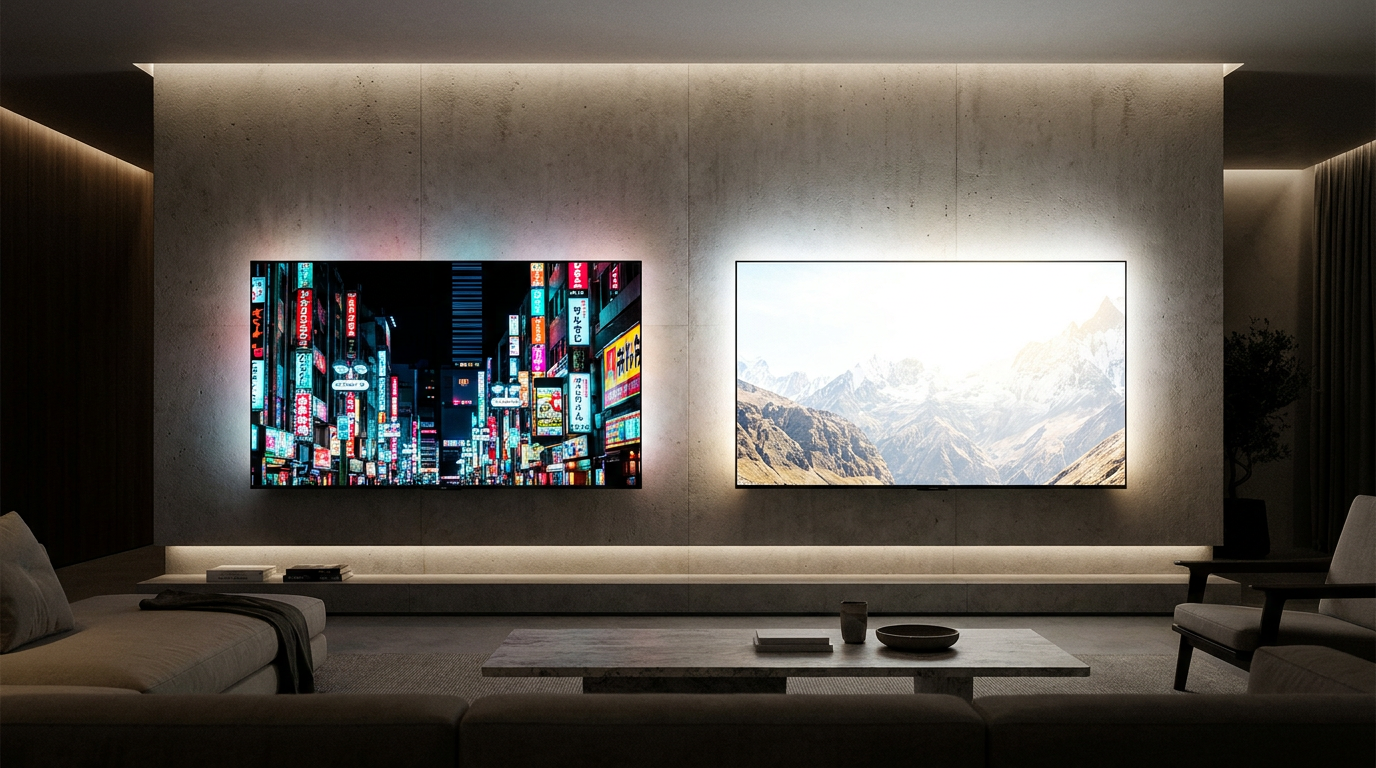
Conversely, when the lights go down, the trade-off flips entirely in favor of OLED. In dark-room performance and absolute contrast, the argument for OLED remains undisputed. Because each of its over eight million pixels generates its own light, they can be turned off completely independently of one another.[1][6]
The evidence for OLED's contrast superiority is visible in any cinematic scene featuring bright highlights against a black background, such as a starfield or neon signs in a night cityscape. The contrast ratio is mathematically infinite, resulting in an image with incredible depth and zero light bleed, preserving the director's exact intent.[6][7]
The contrast ratio is mathematically infinite, resulting in an image with incredible depth and zero light bleed, preserving the director's exact intent.
The argument against Mini-LED in dark rooms is the phenomenon known as blooming or haloing. Even with advanced 2026 models featuring upwards of 10,000 local dimming zones, the backlight zones are still larger than individual pixels. When a bright object appears on a dark background—like white subtitles on a black letterbox bar—some light inevitably bleeds into the surrounding dark areas, slightly compromising the cinematic illusion.[1][6]

Color volume and accuracy present another fascinating battleground. For the past few years, QD-OLED (Quantum Dot OLED) has held the crown for delivering the most vibrant, saturated colors at high brightness levels, making HDR content look incredibly lifelike and punchy.[3]
However, the introduction of RGB Mini-LED has mounted a serious challenge to OLED's color supremacy. By utilizing pure red, green, and blue diodes, manufacturers claim these new Mini-LEDs can cover up to 110 percent of the BT.2020 color space. While this is primarily a future-proofing measure, it means Mini-LED can now deliver deeply saturated colors at brightness levels where older LCDs would wash out.[1][7]
Gaming performance is another critical factor where both technologies excel, but with distinct trade-offs. In 2026, premium models from both camps routinely offer HDMI 2.1 ports, Variable Refresh Rate, Auto Low Latency Mode, and native refresh rates ranging from 144Hz to 165Hz.[3][6]
The argument for OLED in gaming centers on motion clarity. OLED pixels can transition from one color to another almost instantaneously, resulting in near-zero response times. This eliminates motion blur behind fast-moving objects, making it the preferred choice for competitive first-person shooters and fast-paced action games.[6][7]
The argument against OLED for certain users is the lingering, albeit reduced, risk of burn-in. While Tandem OLED mitigates this significantly, users who play games with static Heads-Up Displays for eight hours a day, or use their TV as a massive PC monitor with static taskbars, still face a non-zero risk of permanent image retention over several years.[4][6]

This is where Mini-LED presents its strongest case for heavy productivity and static-content users. Because the technology relies entirely on inorganic materials, it carries absolutely zero risk of burn-in. Gamers and PC users can leave static elements on the screen indefinitely without anxiety, making it the safer long-term investment for those specific use cases.[4][6]
Synthesizing these trade-offs, Tandem OLED fits well when you have a dedicated home theater or a light-controlled living room. It is the definitive choice for cinephiles who prioritize perfect black levels, infinite contrast, and pixel-level precision, as well as competitive gamers who demand the absolute fastest pixel response times available.[3][7]
However, OLED does not fit well when your primary viewing area features massive, uncovered windows with direct sunlight, or if your daily habits involve leaving news channels with static tickers running in the background all day. In these scenarios, the panel's protective dimming and slight burn-in risks become tangible drawbacks.[4][7]
On the other hand, RGB Mini-LED fits well when you have a bright, sunlit living room and frequently watch daytime sports or HDR content that benefits from massive, sustained brightness. It is also the ideal choice for heavy PC users and gamers who want a massive screen without the anxiety of static-element burn-in.[3][7]
Conversely, Mini-LED does not fit well when you are a home theater purist who watches letterboxed movies in pitch-black rooms and cannot tolerate any light blooming around bright objects. Ultimately, the 2026 TV landscape proves that there is no single best technology—only the perfect match for your specific environment and viewing habits.[1][7]
How we got here
Mid-2010s
OLED emerges as the premium standard for home theater enthusiasts, offering perfect blacks but struggling with peak brightness.
2021
Mini-LED technology enters the mainstream market, shrinking backlight diodes to dramatically increase dimming zones and brightness.
2024
QD-OLED and MLA (Micro Lens Array) technologies push OLED brightness past the 1,000-nit barrier for the first time.
January 2026
Manufacturers unveil Tandem OLED and RGB Mini-LED at CES, setting new benchmarks for brightness, color volume, and durability.
Viewpoints in depth
Home Theater Purists
Prioritize perfect black levels and pixel-level contrast for cinematic viewing.
For cinephiles and home theater enthusiasts, OLED remains the undisputed champion. This camp argues that the infinite contrast ratio and perfect black uniformity—achieved because each pixel emits its own light and can turn off completely—are essential for watching movies as the director intended. They point out that even the most advanced Mini-LEDs with thousands of dimming zones still exhibit minor 'blooming' or haloing around bright objects in dark scenes, such as white subtitles on a black letterbox bar.
Bright-Room Viewers & Sports Fans
Value sustained full-screen brightness and glare reduction for daytime viewing.
Consumers with sunlit living rooms or those who frequently host daytime sports viewing parties heavily favor Mini-LED. This camp emphasizes that OLED's Automatic Brightness Limiter (ABL) aggressively dims the screen during bright, full-screen scenes (like a hockey rink or a bright football field) to protect the organic panel. Mini-LEDs, acting as 'light cannons' that can sustain 3,000+ nits of brightness, punch through heavy ambient light and reflections, ensuring the picture remains vibrant and visible regardless of the time of day.
Heavy Gamers & PC Users
Focus on refresh rates, response times, and longevity against static elements.
The gaming community is split based on use case. Competitive gamers lean toward OLED for its near-instantaneous pixel response times, which eliminate motion blur during fast-paced action. However, PC users and gamers who play titles with static Heads-Up Displays (HUDs) for hours on end often champion Mini-LED. Because Mini-LED relies on inorganic materials, it carries zero risk of permanent image retention or burn-in, making it the safer long-term investment for heavy, static-heavy usage.
What we don't know
- It remains unclear how effectively first-generation RGB Mini-LEDs will manage color haloing between adjacent, differently colored dimming zones.
- Long-term data on the exact lifespan improvements of Tandem OLED compared to traditional OLED panels is still being gathered.
Key terms
- Blooming (Haloing)
- A visual artifact where light from a bright object bleeds into surrounding dark areas of the screen, common on LED/Mini-LED TVs.
- Local Dimming Zones
- Specific areas of a TV's backlight that can dim or turn off independently to improve contrast and black levels.
- Automatic Brightness Limiter (ABL)
- A protective feature in OLED TVs that automatically dims the screen when a large portion of the image gets too bright, preventing overheating and burn-in.
- Burn-in
- Permanent image retention caused by leaving static elements (like news tickers or game HUDs) on an emissive screen for extended periods.
- Color Volume
- A measurement of how well a TV can display accurate, saturated colors across all levels of brightness.
Frequently asked
What is Tandem OLED?
Tandem OLED is a new architecture that stacks multiple organic light-emitting layers. This allows the panel to achieve higher peak brightness and reduces the risk of burn-in compared to older single-layer OLEDs.
What is RGB Mini-LED?
RGB Mini-LED replaces traditional blue backlights and quantum dots with separate red, green, and blue diodes. This improves color purity and allows the TV to display a wider volume of colors at extreme brightness levels.
Does Mini-LED suffer from burn-in?
No. Because Mini-LED displays use inorganic materials for their backlighting and LCD panels, they are immune to the permanent image retention (burn-in) that can occasionally affect OLED screens.
Which TV is better for a bright, sunlit room?
Mini-LED is significantly better for bright rooms. It can sustain much higher full-screen brightness levels to overpower ambient sunlight, whereas OLEDs will dim to protect their panels.
Sources
Source coverage
7 outlets
3 viewpoints surfaced







[1]RTINGSProductivity & PC Gamers
2026 TV Lineup: The Year Of RGB Mini LED
Read on RTINGS →[2]What Hi-Fi?Bright-Room Maximizers
The best Mini LED TVs 2026
Read on What Hi-Fi? →[3]Data Wire SolutionsCinematic Purists
Best TVs for 2026: 10 OLED and Mini-LED Picks by Room, Brightness, and Install Reality
Read on Data Wire Solutions →[4]KTC BlogsProductivity & PC Gamers
Tandem OLED vs. Mini-LED: Choosing the Best HDR Panel in 2026
Read on KTC Blogs →[5]AVForumsCinematic Purists
The BEST TVs of CES 2026: OLED, RGB MicroLED, RGB MiniLED and MicroLED
Read on AVForums →[6]EcoPicksGoBright-Room Maximizers
LG G5 OLED vs LG QNED9M Mini LED Comparison (2026 Buyer's Guide)
Read on EcoPicksGo →[7]Factlen Editorial TeamProductivity & PC Gamers
Synthesis by Factlen editorial team
Read on Factlen Editorial Team →

More in shopping
See all 5 stories →

Every angle. Every day.
Get shopping stories with full source coverage and perspective breakdowns delivered to your inbox.