
OLED vs. Mini-LED in 2026: The Complete Trade-Off Analysis
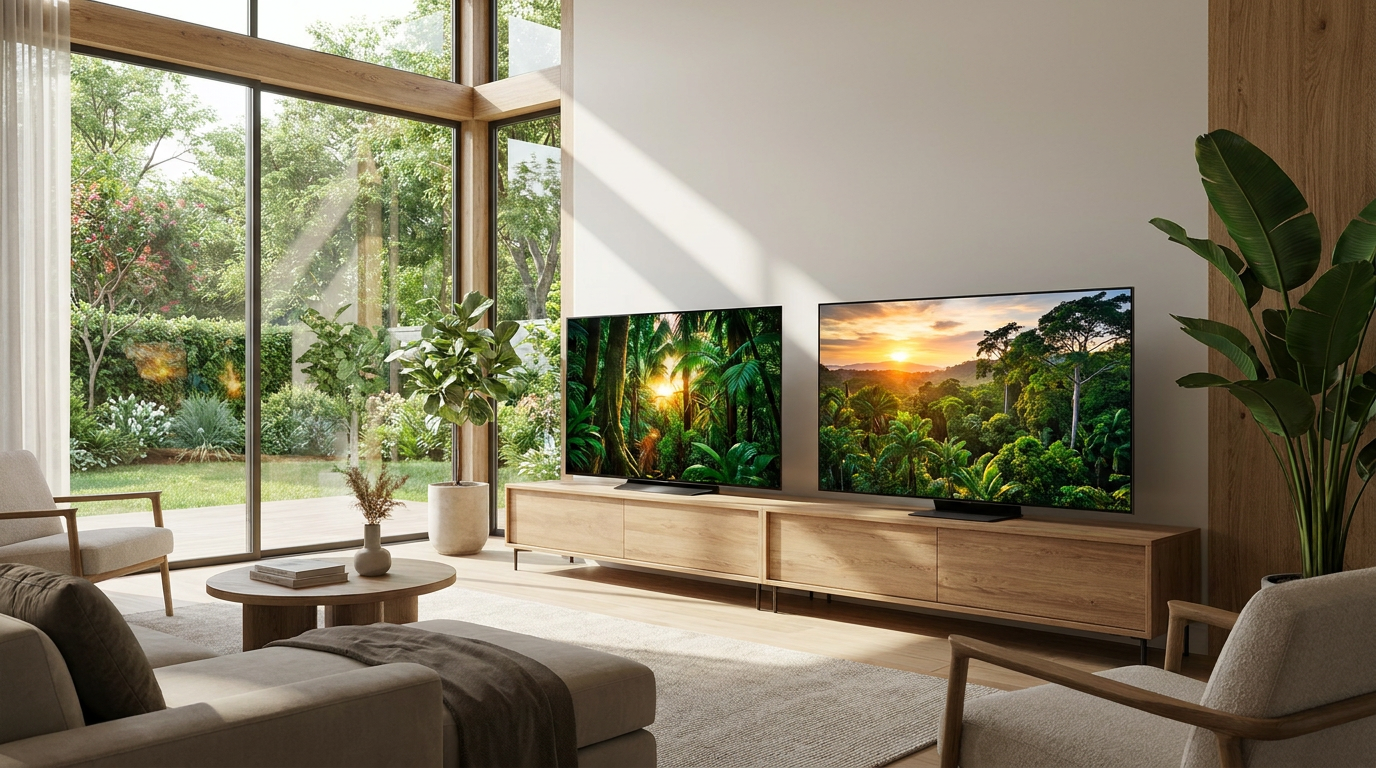
As Tandem OLED and RGB Mini-LED technologies mature, the gap between the two premium display formats has shifted from raw picture quality to environmental suitability. A side-by-side analysis reveals exactly which panel architecture fits specific viewing habits and lighting conditions.
By Factlen Editorial Team
- Home Theater Purists
- Viewers who prioritize perfect black levels and cinematic accuracy in light-controlled rooms.
- Bright-Room Viewers
- Consumers dealing with sunlit spaces who need maximum sustained brightness to overcome glare.
- Productivity Power Users
- PC users and developers who require static UI longevity without the anxiety of burn-in.
What's not represented
- · Budget-conscious buyers looking for sub-$500 standard LED options
Why this matters
Choosing the wrong premium TV technology in 2026 can mean spending upwards of $2,000 on a display that either washes out in your sunlit living room or risks permanent burn-in from your daily workflow. Understanding the exact trade-offs between Tandem OLED and RGB Mini-LED ensures your investment matches your actual environment.
Key points
- RGB Mini-LED panels now sustain 1,800 to 2,200 nits of full-screen brightness without dimming.
- Tandem OLED technology stacks organic layers to boost peak highlights while maintaining perfect black levels.
- OLED remains the superior choice for dark rooms, offering infinite contrast and near-instant pixel response.
- Mini-LED carries zero burn-in risk, making it the safer option for heavy productivity and static interfaces.
- At 800 nits of brightness, Mini-LED is more energy-efficient than OLED, which redlines and thermal throttles.
The 2026 premium television market has officially crystallized into a two-horse race. After years of confusing acronyms and incremental updates, the choice for high-end buyers now comes down to two distinct panel architectures: Tandem OLED and RGB Mini-LED. Both technologies have evolved significantly, effectively eliminating the idea that one is universally superior to the other. Instead, the decision hinges entirely on environmental factors, viewing habits, and specific use cases.[2][3]
The core mechanism of each technology dictates its strengths. OLED panels are self-emissive, meaning every single pixel generates its own light and can turn off completely to create perfect, infinite black. Mini-LED, conversely, relies on an inorganic backlight divided into thousands of microscopic dimming zones that shine through an LCD layer. In 2026, the introduction of RGB Mini-LED—which replaces traditional blue LEDs and color filters with dedicated red, green, and blue diodes—has dramatically improved color purity and volume.[3][4]
The case for Mini-LED centers on raw, sustained luminance. Because it relies on an inorganic backlight, a premium 2026 Mini-LED panel can sustain 1,800 to 2,200 nits of brightness across the entire screen without triggering any protective dimming mechanisms. This makes it a veritable light cannon capable of overpowering direct sunlight, rendering HDR highlights with intense, real-world vibrancy that self-emissive panels simply cannot match.[1][5]
The case against Mini-LED remains its inability to control light at the individual pixel level. Even with advanced algorithms and upwards of 2,000 local dimming zones, the backlight must illuminate clusters of pixels simultaneously. When a bright object, like a white subtitle or a streetlamp, appears against a pitch-black background, some light inevitably bleeds into the surrounding dark areas, creating a faint halo or blooming effect that can distract viewers in a dark room.[4][7]

The evidence for this dynamic comes from field tests in high-ambient environments. In a July 2026 commercial deployment test across sunlit corporate lobbies, Mini-LED units averaged 1,940 nits at noon, maintaining a functional contrast ratio against heavy glare. Under identical lighting, OLED units averaged just 580 nits, becoming functionally washed out. For daytime viewing or rooms with uncontrolled ambient light, Mini-LED provides a demonstrably superior experience.[1][5]
The case for OLED rests on absolute precision and micro-contrast. Because each of its over eight million pixels operates independently, an OLED panel can place a blindingly bright pinpoint of light directly adjacent to a perfectly black pixel with zero light bleed. This pixel-level control creates an unparalleled sense of depth and three-dimensionality, making it the undisputed champion for cinematic, dark-room viewing.[2][7]
The case against OLED is its thermal limitation, which forces the use of an Automatic Brightness Limiter (ABL). Organic materials degrade rapidly when pushed to extreme temperatures. To protect the panel, the ABL aggressively dims the entire screen when a scene demands high brightness across a large area—such as a hockey rink or a snow-covered landscape. While 2026 Tandem OLEDs can hit 2,000 nits in tiny windows, their full-screen brightness often drops to between 250 and 400 nits.[1][5]
The evidence supporting OLED's perceived superiority in dark rooms lies in its black floor. VESA DisplayHDR True Black 600 certification requires a black level of 0.0005 nits. Because the baseline is absolute darkness, a 600-nit highlight on an OLED often looks punchier and more vibrant to the human eye than a 1,400-nit highlight floating on the slightly elevated gray floor of an LCD panel.[5]
The evidence supporting OLED's perceived superiority in dark rooms lies in its black floor.
The case for Mini-LED in longevity is absolute. Inorganic backlights do not suffer from differential wear. A user can leave a static news ticker, a video game heads-up display, or a bright software interface on the screen for 12 hours a day without any fear of permanent image retention. Commercial testing shows Mini-LED panels experiencing less than a 3 percent brightness drift even after 10,000 hours of heavy, sustained use.[1][5]
The case against OLED's longevity persists despite 2026 advancements like Tandem architectures and Micro Lens Array 3.0. These innovations stack organic layers and improve heat dissipation, significantly slowing the rate of wear. However, they do not eliminate the underlying chemical limits of organic emitters. Prolonged exposure to static, high-contrast UI elements will eventually cause uneven pixel aging, commonly known as burn-in.[5]

The evidence from 10,000-hour stress tests reveals that while outright hardware failure rates for modern OLEDs are remarkably low, cumulative organic wear remains a reality for heavy productivity users. For those utilizing their display as a PC monitor with static taskbars, or for commercial signage, the sustained high-brightness requirement makes OLED a poorer fit, leaving Mini-LED as the only zero-risk option.[5]
The power consumption debate between the two technologies is highly nuanced. At equivalent indoor luminance—say, both panels calibrated to 500 nits for a conference room—OLED is actually marginally more efficient, drawing around 138 watts compared to Mini-LED's 148 watts, because OLED does not require a constant backlight.[1]
However, the moment a user demands 800 nits or more to combat daytime glare, the OLED power curve steepens dramatically. At 800 nits, a 55-inch OLED draws 195 watts and engages thermal protection within minutes. The equivalent Mini-LED panel delivers that same 800 nits at just 165 watts and holds that output indefinitely without redlining, making it the more energy-efficient choice for high-ambient installations.[1]
When evaluating motion clarity and gaming performance, OLED maintains a distinct advantage. The self-emissive pixels boast near-instantaneous response times, virtually eliminating motion blur in fast-paced action. While 2026 Mini-LEDs have improved their overdrive algorithms to support 144Hz and even 240Hz refresh rates, they still exhibit slight smearing in dark transitions compared to the pristine motion handling of an OLED.[4][6]

Ultimately, the decision requires an honest assessment of the viewing environment. Tandem OLED fits well when the room is light-controlled, the primary use is cinematic movie watching or dark-mode gaming, and absolute micro-contrast is the priority. It delivers the most accurate, immersive picture possible when the lights go down.[2][5]
Conversely, Tandem OLED does not fit when the room features floor-to-ceiling windows, uncontrolled sunlight, or when the display will be used for eight-hour stretches of static productivity interfaces and news broadcasts.[5]
How we got here
2024
Mini-LED begins closing the premium gap with OLED by introducing thousands of local dimming zones.
Late 2025
Tandem OLED panels enter the consumer market, stacking organic layers to increase peak brightness.
Jan 2026
Major manufacturers unveil RGB Mini-LED at CES, removing color filters for purer color volume.
June 2026
Both technologies reach price parity in the 65-inch segment, shifting the buying decision entirely to use-case.
Viewpoints in depth
Home Theater Purists
Advocates for absolute micro-contrast and perfect black levels.
This camp argues that VESA DisplayHDR True Black 600 certification, which requires a black level of 0.0005 nits, is the only metric that matters for cinematic immersion. Because the baseline is absolute darkness, a 600-nit highlight on an OLED often looks punchier and more vibrant to the human eye than a 1,400-nit highlight floating on the slightly elevated gray floor of an LCD panel. They maintain that any blooming or haloing around bright objects breaks the cinematic illusion.
Bright-Room Viewers & Sports Fans
Prioritizes sustained full-screen brightness and glare reduction.
This perspective emphasizes real-world viewing conditions over pitch-black lab tests. They point to field data showing that in sunlit rooms, OLED panels can drop to 580 nits and become functionally washed out. By contrast, RGB Mini-LED can sustain 2,000 nits without ABL throttling, easily overpowering floor-to-ceiling windows and rendering sports broadcasts with intense, uniform brightness that self-emissive panels cannot match.
Productivity & PC Users
Focuses on static UI longevity and text clarity.
For developers, traders, and heavy PC users, the primary concern is hardware longevity. This camp highlights that despite OLED's 2026 advancements like Tandem architectures and MLA 3.0, organic emitters still face cumulative wear from static taskbars and bright software interfaces. They advocate exclusively for Mini-LED, citing 10,000-hour stress tests that show inorganic backlights experiencing less than a 3 percent brightness drift with zero risk of permanent image retention.
What we don't know
- How quickly the new RGB Mini-LED architectures will experience color haloing degradation over a decade of use.
- Whether Tandem OLED's stacked layers will truly prevent burn-in over 50,000 hours of heavy static use.
Key terms
- Tandem OLED
- A display architecture that stacks multiple organic light-emitting layers to increase brightness and lifespan.
- RGB Mini-LED
- A backlight system that uses separate red, green, and blue diodes instead of blue LEDs with a color filter, improving color purity.
- Automatic Brightness Limiter (ABL)
- A protective feature in OLED TVs that automatically dims the entire screen when a large portion of the image becomes very bright, preventing overheating.
- Blooming / Haloing
- A visual artifact on LED TVs where light bleeds from a bright object into the surrounding dark areas of the screen.
- Micro-contrast
- The ability of a display to show a perfectly black pixel directly next to a brightly lit pixel without any light bleed.
Frequently asked
Does OLED still suffer from burn-in in 2026?
While Tandem architectures and improved cooling have significantly reduced the risk, OLED can still experience uneven wear if displaying static elements for 8+ hours daily.
Which TV is better for a bright living room?
Mini-LED is the clear winner for bright rooms, as it can sustain over 1,800 nits of brightness to cut through glare without automatically dimming.
Is Mini-LED or OLED better for gaming?
Both are excellent, but OLED offers near-instant pixel response times for competitive gaming, while Mini-LED provides brighter HDR highlights for immersive open-world games.
Sources
Source coverage
7 outlets
3 viewpoints surfaced







[1]SunulBright-Room Viewers
Mini LED Display vs OLED: Which mini led screen triumphs?
Read on Sunul →[2]Data Wire SolutionsBright-Room Viewers
Best TVs for 2026: 10 OLED and Mini-LED Picks by Room, Brightness, and Install Reality
Read on Data Wire Solutions →[3]RTINGSProductivity Power Users
2026 TV Lineup: The Year Of RGB Mini LED
Read on RTINGS →[4]OrdinaryTechProductivity Power Users
OLED vs. RGB Mini-LED: Which Monitor Tech Should You Choose in 2026
Read on OrdinaryTech →[5]KTCProductivity Power Users
Tandem OLED vs. Mini-LED: Choosing the Best HDR Panel in 2026
Read on KTC →[6]What Hi-Fi?Home Theater Purists
Best TV 2026: flagship OLEDs and budget Mini LED sets tried and tested
Read on What Hi-Fi? →[7]EcoPicksGoHome Theater Purists
OLED vs Mini LED TVs (2026): LG G5 vs LG QNED9M
Read on EcoPicksGo →
Every angle. Every day.
Get shopping stories with full source coverage and perspective breakdowns delivered to your inbox.