
OLED and Mini-LED Premium TVs: A Comprehensive 2026 Buyer's Guide
As display technologies mature in 2026, the choice between OLED and Mini-LED comes down to viewing environment, usage habits, and budget rather than a clear overall winner.
By Factlen Editorial Team
- Bright-Room Pragmatists
- Advocates prioritizing sustained brightness, glare reduction, and long-term durability.
- Home Theater Purists
- Advocates prioritizing absolute black levels and cinematic accuracy over raw brightness.
- Hybrid Prosumers
- Users weighing motion clarity against workspace density for dual-use displays.
What's not represented
- · Budget-conscious buyers looking at standard LED displays
- · Projector enthusiasts for dedicated home cinemas
Why this matters
Choosing the wrong premium TV technology in 2026 can mean spending thousands of dollars on a display that either washes out in your bright living room or suffers permanent burn-in from your daily habits. Understanding the specific trade-offs between OLED and Mini-LED ensures your investment actually matches your viewing environment.
Key points
- OLED delivers perfect black levels and infinite contrast by turning off individual pixels, making it ideal for dark-room cinematic viewing.
- Mini-LED utilizes thousands of backlight zones to achieve massive sustained brightness, overpowering glare in sun-drenched rooms.
- While OLED peak highlights can reach 2,000 nits, sustained full-screen brightness is thermally capped between 600 and 850 nits.
- Mini-LED panels are effectively immune to permanent image retention, making them safer for static content like news tickers and PC monitors.
- The choice between the two technologies no longer hinges on absolute quality, but on matching the display to the room's lighting conditions.
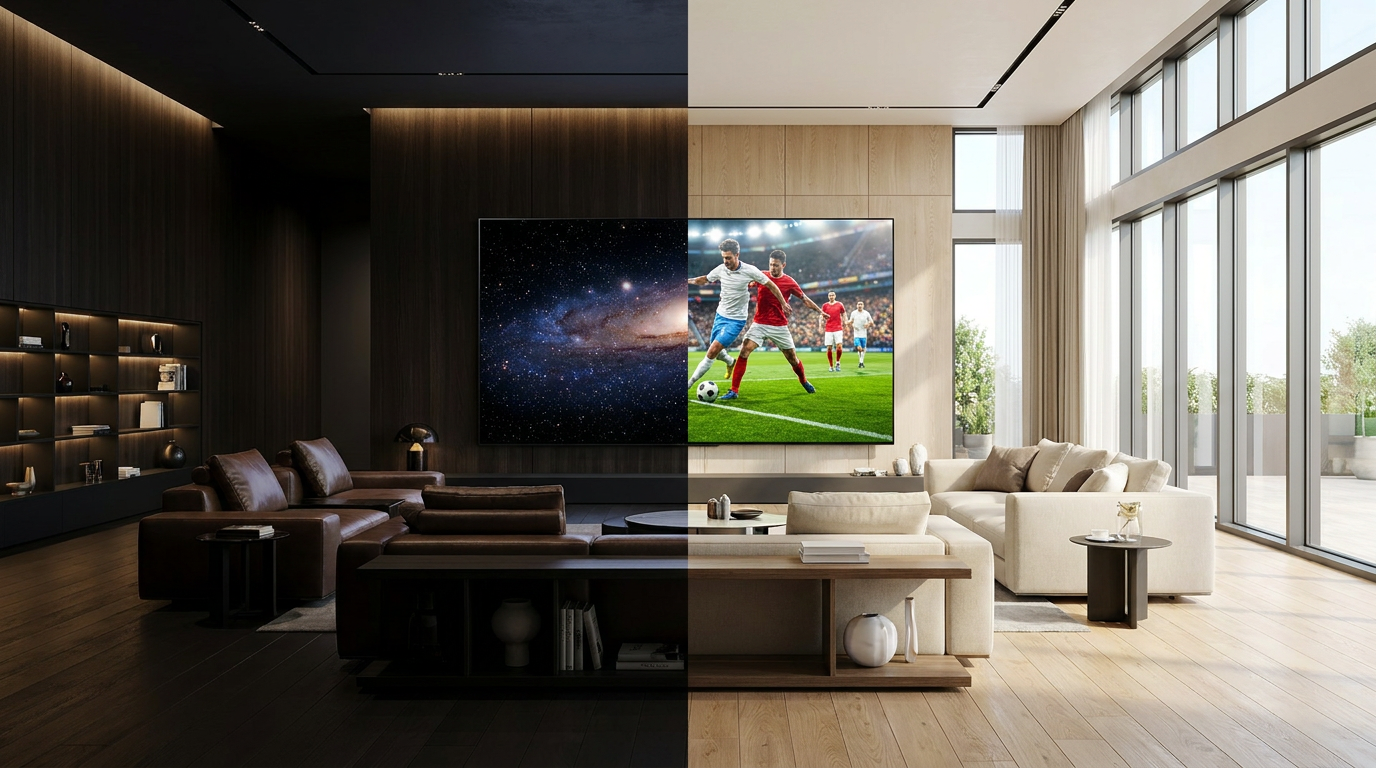
The era of confusing television acronyms has largely distilled into a two-horse race for the premium market in 2026: OLED and Mini-LED. As both technologies have matured, the gap in absolute picture quality has narrowed, shifting the buying decision away from a search for an objective winner. Instead, choosing the right display has become an exercise in matching the hardware to the specific realities of a room's lighting and a household's viewing habits.[1][2]
Understanding the trade-offs requires looking at the core mechanism of each panel. OLED, or Organic Light Emitting Diode, features self-illuminating pixels. Every microscopic dot on the screen generates its own light and can turn off completely independently of its neighbors. Mini-LED, conversely, is an advanced evolution of traditional LCD technology. It relies on an inorganic backlight made of thousands of microscopic LEDs grouped into dimming zones behind the color panel.[1][6]
For OLED, the primary argument centers on absolute image precision and infinite contrast. Because individual pixels can power down entirely, the display achieves perfect black levels. This creates a cinematic depth and a three-dimensional pop that backlight-driven displays fundamentally cannot replicate, as there is zero light bleed between a bright pixel and an adjacent dark one.[2][6]

Against OLED, the main drawbacks are full-screen brightness limitations and the lingering vulnerability to permanent image retention. While 2026 models utilizing tandem architectures can push peak highlights to 2,000 nits in small windows, sustained full-screen brightness is typically capped between 600 and 850 nits. This limitation is hardcoded into the thermal constraints of organic materials, which degrade if pushed too hard.[3][4]
The evidence for OLED's dominance is strongest in controlled lighting environments. Testing of flagship 2026 models demonstrates that in dark or dimly lit rooms, the pixel-level light control delivers unmatched high-dynamic-range (HDR) impact. Shadow details remain perfectly preserved, and the lack of backlight blooming ensures that starfields or dark cinematic sequences render flawlessly.[2][4]
For Mini-LED, the case is built on sheer luminance, environmental versatility, and long-term durability. Modern panels from tier-one manufacturers have brute-forced their way past OLED's thermal limits, capable of sustaining 1,800 to 2,200 nits across the entire screen without triggering automatic brightness limiters. Furthermore, the inorganic backlight removes the anxiety of pixel degradation.[3][8]
For Mini-LED, the case is built on sheer luminance, environmental versatility, and long-term durability.
Against Mini-LED, the technology still wrestles with "blooming" or halo effects around bright objects on dark backgrounds. Because it relies on dimming zones rather than individual pixels, a bright element—like a white subtitle on a black letterbox bar—will inevitably illuminate the surrounding dark space to some degree, subtly compromising the contrast.[4][8]

The evidence for Mini-LED's superiority emerges in bright environments and static-content applications. Commercial testing in 2026 reveals that in rooms with floor-to-ceiling windows, OLED screens can become functionally washed out by mid-morning. Mini-LED units, however, maintain contrast integrity through the entire daylight cycle. Additionally, stress tests show Mini-LED panels exhibiting zero image retention even after 7,000 hours of static content display.[3][8]
The intersection of gaming and productivity adds another layer to the trade-off analysis. For OLED, the argument hinges on motion clarity. With near-instantaneous response times of 0.1 to 1 millisecond, OLED remains the gold standard for fast-paced competitive gaming, virtually eliminating motion blur during high-speed camera pans.[1][5]
Against that, Mini-LED counters with superior workspace density and zero anxiety over static user interface elements. For PC users and hybrid prosumers who leave taskbars, spreadsheets, and game HUDs open for 12 hours a day, the burn-in anxiety that still shadows OLED use makes Mini-LED the more practical daily driver.[5][7]

Cost dynamics have also shifted the value proposition in 2026. While OLED prices have steadily decreased as manufacturing scales, Mini-LED continues to command a lower entry price for massive, large-format screens. Buyers looking to fill a wall with an 85-inch or 100-inch display will find Mini-LED options at a fraction of the cost of equivalent OLED panels.[6]
Ultimately, the decision requires abandoning the search for a single perfect technology and instead applying a strict environmental filter. The right choice is the one that aligns with the operational realities of the specific deployment.[1][2]
OLED fits well when the primary viewing happens in the evening, the room features controlled lighting or blackout curtains, and the content leans heavily toward cinematic movies or high-end console gaming. It does not fit well in sun-drenched living rooms, or for households that leave news channels with static tickers running all day.[2][6]

Mini-LED fits well when the display sits in a bright, open-concept space, the household watches a lot of daytime sports, or the screen doubles as a permanent productivity monitor. It does not fit well for dedicated, light-controlled home theater rooms where absolute black levels and pixel-perfect precision are the top priorities.[2][8]
How we got here
Early 2010s
OLED enters the consumer market, establishing a new standard for perfect black levels but struggling with low brightness and high costs.
2019–2021
Mini-LED technology emerges as a premium alternative to standard LCDs, dramatically increasing the number of dimming zones.
2024
Tandem OLED and QD-OLED architectures are introduced, significantly boosting OLED's peak brightness capabilities.
2026
Mini-LED achieves sustained full-screen brightness over 2,000 nits, cementing the divide between dark-room and bright-room display dominance.
Viewpoints in depth
Home Theater Purists
Advocates prioritizing absolute black levels and cinematic accuracy over raw brightness.
For this camp, the conversation begins and ends with infinite contrast. They argue that in a properly treated room with controlled lighting, OLED's ability to turn off individual pixels creates a three-dimensional depth that no backlight technology can match. They point to the elimination of blooming around subtitles and starfields as the ultimate proof that OLED remains the only true choice for film enthusiasts and cinematic gaming.
Bright-Room Pragmatists
Advocates prioritizing sustained brightness, glare reduction, and long-term durability.
This perspective focuses on the realities of modern, open-concept living spaces. They argue that perfect black levels are irrelevant if the screen washes out during a Sunday afternoon sports broadcast. By highlighting Mini-LED's ability to sustain over 1,800 nits and its complete immunity to permanent image retention, this camp views Mini-LED not as a compromise, but as the superior technology for real-world, mixed-use environments.
Hybrid Prosumers
Users weighing motion clarity against workspace density for dual-use displays.
Sitting at the intersection of gaming and productivity, this camp evaluates displays based on versatility. They acknowledge OLED's unmatched 0.1-millisecond response times for competitive gaming, but often lean toward Mini-LED for its lack of burn-in risk when displaying static UI elements like taskbars and spreadsheets for 12 hours a day. For them, the choice is a calculated compromise between motion precision and static-content durability.
What we don't know
- How quickly emerging Micro-LED technology will drop in price to eventually replace both OLED and Mini-LED in the consumer market.
- Whether future iterations of tandem OLED architectures can fully overcome the thermal limits of organic materials without degrading lifespan.
Key terms
- Nits
- A unit of measurement for screen brightness; higher numbers indicate a brighter display capable of overpowering ambient room light.
- Local Dimming Zones
- Specific areas of a Mini-LED backlight that can independently dim or brighten to improve contrast, though they lack the precision of individual pixels.
- Image Retention (Burn-in)
- Permanent ghosting on a screen caused by displaying static images, such as news tickers or game HUDs, for prolonged periods.
- Blooming
- A visual artifact where light from a bright object on screen bleeds into surrounding dark areas, common in displays that use backlight zones.
Frequently asked
Does OLED still suffer from burn-in in 2026?
While mitigation technologies like pixel-shifting have improved, OLED still carries a risk of permanent image retention if static elements are displayed for thousands of hours.
What is Mini-LED blooming?
Blooming is a halo effect where light bleeds into dark areas of the screen, occurring because Mini-LED dims in zones rather than at the individual pixel level.
Which technology is better for gaming?
OLED is preferred for fast-paced competitive gaming due to its near-instant response time, while Mini-LED is favored for PC gamers who also use their screens for productivity with static UI elements.
Are Mini-LED TVs cheaper than OLED?
Generally, Mini-LED offers a lower entry price, especially at massive screen sizes like 85 or 100 inches, though premium Mini-LED models can match OLED pricing.
Sources
Source coverage
8 outlets
3 viewpoints surfaced








[1]Easy CompareHybrid Prosumers
Mini-LED vs OLED: Pros, Cons & Which to Buy (2026)
Read on Easy Compare →[2]Data Wire SolutionsHybrid Prosumers
Best Smart TVs in 2026: OLED, Mini-LED, QLED & What Actually Matters Before You Buy
Read on Data Wire Solutions →[3]SunulBright-Room Pragmatists
Mini LED Display vs OLED: Which mini led screen triumphs?
Read on Sunul →[4]ecopicksgoHome Theater Purists
OLED vs Mini LED TVs (2026): LG G5 vs LG QNED9M
Read on ecopicksgo →[5]KTCHybrid Prosumers
4K 240Hz OLED vs 5K Mini-LED: 2026 Buying Guide
Read on KTC →[6]CNETHome Theater Purists
Mini-LED vs. OLED: Which TV Tech Should You Get?
Read on CNET →[7]PaklapBright-Room Pragmatists
OLED vs Mini-LED Displays in 2026: Are They Worth It?
Read on Paklap →[8]PCWorldBright-Room Pragmatists
OLED is old news. Mini-LED is the future
Read on PCWorld →
Every angle. Every day.
Get shopping stories with full source coverage and perspective breakdowns delivered to your inbox.