
NHTSA Grants First Commercial Robotaxi Exemption to Zoox, Launches Effort for National AV Safety Standard
Federal regulators have cleared Amazon-owned Zoox to deploy purpose-built robotaxis without steering wheels for paid rides, marking a historic shift in U.S. autonomous vehicle policy.
By Noor Saidi

On July 30, 2026, the National Highway Traffic Safety Administration (NHTSA) shattered a 59-year-old regulatory barrier. For the first time in U.S. history, federal regulators granted a commercial exemption to a passenger vehicle built entirely without human driving controls. The recipient is Amazon-owned Zoox, whose purpose-built robotaxi can now transition from offering free demonstration rides to operating as a paid ride-hailing service.[2]
Until now, the autonomous vehicle (AV) industry has largely relied on retrofitting conventional cars—like Waymo's modified electric SUVs—because federal laws mandate the presence of steering wheels, brake pedals, and mirrors. Zoox took a different, riskier path, designing a carriage-style pod from the ground up. By securing this exemption, Zoox has validated the commercial viability of the purpose-built robotaxi, fundamentally shifting the goalposts for the entire mobility sector.[2]
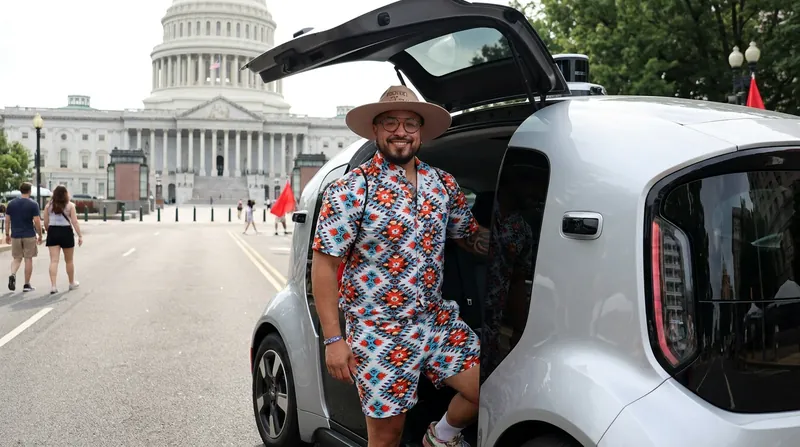
The Zoox robotaxi is a radical departure from traditional automotive architecture. It is completely symmetrical, meaning it lacks a defined front or back and can drive in either direction with equal agility. Inside, the cabin features inward-facing bench seating for four passengers, with no driver's seat or manual controls of any kind. Capable of reaching speeds up to 75 mph, the electric pod is designed exclusively for urban ride-hailing.[2]
To get this vehicle on the road legally, Zoox had to navigate the Federal Motor Vehicle Safety Standards (FMVSS)—a comprehensive set of rules drafted under the assumption that a human being would always be behind the wheel. Zoox applied for temporary exemptions from portions of eight specific standards, including rules governing windshield defrosting, rearview mirrors, and manual brake controls.
Under 49 C.F.R. § 555, the NHTSA can grant exemptions if a manufacturer proves its non-compliant vehicle provides an "equivalent level of safety" to a fully compliant one. Zoox successfully argued that its suite of sensors, redundant systems, and remote oversight capabilities vastly exceed the safety performance of traditional human-driven cars. The agency agreed, concluding that forcing the company to install vestigial steering wheels would not enhance passenger safety.
This is not a blanket authorization for unlimited deployment. The NHTSA's exemption is temporary, lasting two years through July 31, 2028, and strictly caps production at 2,500 vehicles per 12-month period. Furthermore, Zoox is prohibited from selling these vehicles to private consumers; the company must retain ownership and operate the fleet itself.
To ensure public safety during this rollout, the NHTSA has placed Zoox under an "enhanced oversight" structure. The company is required to submit detailed reports on any crashes or unexpected roadway stops. Additionally, all remote vehicle operators—personnel who monitor the fleet and can provide high-level routing guidance or low-speed manual control if a pod gets stuck—must be based strictly within the United States.[2]
The Zoox exemption is just one piece of a sweeping policy package announced by the Department of Transportation aimed at accelerating AV innovation. For years, the autonomous vehicle industry has been stifled by a patchwork of state-by-state regulations, forcing companies to navigate conflicting rules across different jurisdictions. Now, the federal government is stepping in to establish a unified framework.[1][4]
As part of this initiative, the NHTSA has officially launched an effort to develop the first-ever national performance standards for autonomous vehicles. The agency is partnering with the SAE Industry Technologies Consortia, backing the collaboration with a $5 million, three-year grant. The goal is to create objective, enforceable benchmarks that will eventually replace the need for individual, company-by-company exemptions.[1][3][4]
While the national standard is being drafted, the NHTSA is also modernizing its existing exemption pathways. The agency published an interim final rule that allows vehicles manufactured prior to the effective date of an exemption to still qualify for commercial deployment. This administrative tweak removes a significant bottleneck, allowing AV developers to build their fleets while waiting for regulatory paperwork to clear.[1][4]
The approval of Zoox's purpose-built pod puts immediate pressure on competitors. While Waymo currently dominates the commercial robotaxi market with its retrofitted fleet, the long-term economics of autonomous ride-hailing heavily favor vehicles designed specifically for passengers. Industry analysts suggest that the NHTSA's willingness to accommodate radical new architectures will force other players to accelerate their own custom-cabin designs.[4]
With federal clearance secured, Zoox is preparing to launch its paid service. The company has already provided hundreds of thousands of miles of free demonstration rides in Las Vegas and San Francisco. Paid operations are expected to begin in Las Vegas first, though the company still needs to secure final state and local permits—such as approval from the California Public Utilities Commission—before it can charge riders in other markets.
Despite the breakthrough, significant questions loom over the AV sector. The 2,500-vehicle cap limits Zoox's ability to achieve massive scale in the near term. Furthermore, recent incidents involving driverless vehicles interfering with first responders have prompted the NHTSA to issue warnings and demand new coordination protocols. How the industry balances rapid innovation with the complex realities of urban emergency management will define the success of this next phase.[4]
Key points
- The NHTSA granted Zoox the first commercial exemption for a passenger vehicle without a steering wheel or pedals.
- The exemption allows Zoox to deploy up to 2,500 purpose-built robotaxis annually for two years.
- Zoox proved its vehicle offers an 'equivalent level of safety' to traditional cars.
- The NHTSA also launched an initiative to develop a single national safety standard for autonomous vehicles.
What we don’t know
- How quickly Zoox will be able to scale its operations beyond the 2,500-vehicle annual cap once the temporary exemption expires in 2028.
- When the NHTSA will finalize and implement the single national AV safety standard currently being developed with the SAE.
- How state regulators, such as the California Public Utilities Commission, will align their permitting processes with the new federal exemptions.
How we got here
August 2025
Zoox receives its initial demonstration exemption from the NHTSA, allowing free rides but prohibiting commercial fares.
June 2026
The NHTSA proposes significant updates to federal brake standards to accommodate vehicles without manual pedals.
July 30, 2026
The NHTSA grants Zoox the first-ever commercial exemption for a purpose-built robotaxi and announces a push for a national AV standard.
August 2026
Zoox is expected to begin its first paid commercial operations in Las Vegas.
- Autonomous Vehicle Developers
- Argue that purpose-built vehicles are safer and more efficient, requiring regulatory flexibility to bypass outdated rules meant for human drivers.
- Federal Regulators
- Focus on balancing rapid technological innovation with strict oversight, utilizing deployment caps and enhanced reporting to ensure public safety.
- Legal & Policy Analysts
- View the exemption as a critical stepping stone toward a unified national framework that will eventually replace the fragmented state-by-state approach.
Perspectives this story doesn't cover
- First Responders
- Municipal Transit Authorities
Sources
Source coverage
4 outlets
3 viewpoints surfaced




- [1]NHTSAFederal Regulators
Trump's Transportation Department Cuts Red Tape to Safely Fast-Track Automated Vehicle Innovation
Read on NHTSA → - [2]AutoblogAutonomous Vehicle Developers
Amazon's Zoox has received a historic NHTSA exemption to deploy vehicles without steering wheels for commercial ride-hailing services
Read on Autoblog → - [3]Briefs.coLegal & Policy Analysts
NHTSA Grants Zoox Permission to Begin Paid Robotaxi Services
Read on Briefs.co → - [4]Holland & KnightLegal & Policy Analysts
Green Lights and Red Flags: Autonomous Vehicles Rule the Roads in Summer 2026
Read on Holland & Knight →
More in Automotive & Transportation
See all →Supply Chain Shift
Chinese Automakers Pivot From Export Volume to Global After-Sales and Local Supply Chain Integration
5 sources
Fleet Electrification
Mobile Megawatt Charging vs. Fixed Infrastructure: The Economics of Class 8 EV Fleet Power
7 sources
Automotive AI
Porsche Outsourcing: TCS Acquires MHP, Forms AI Mobility Center in Major Software Pivot
6 sources
NEVI Program
U.S. DOT Overhauls NEVI Guidance to Slash Red Tape After 84% of $5 Billion EV Charging Funds Go Unspent
6 sources
Comments
Every angle. Every day.
Get Automotive & Transportation stories with full source coverage and perspective breakdowns, free every day.