
New Research Finds 'Barbell Effect' Crushing Furniture's Middle Market as Single Households Buy Both Premium and Value
Consumers are increasingly mixing luxury investments with budget-friendly flat-pack items on the same shopping trip, hollowing out the traditional mid-tier furniture market.

In short
- The 'barbell effect' is hollowing out the middle market in furniture retail as demand shifts to premium and value extremes.
- A single household will now frequently buy both luxury investments and budget flat-pack items on the same shopping trip.
- Consumers are prioritizing 'situational value,' splurging on high-use items like sofas while saving on functional pieces like bookshelves.
For decades, the retail industry has relied on a simple, demographic-driven assumption: young people buy cheap starter furniture, middle-aged professionals buy mid-tier sets, and the wealthy buy luxury pieces. But walk into a modern single-family home today, and that model instantly shatters. You might find a custom Italian leather sofa sitting directly across from a flat-pack coffee table. The homeowner did not trade down because they were broke, nor did they trade up because they were rich. They simply made two entirely different calculations on the same shopping trip.
This behavioral shift is creating what economists and market researchers call the "barbell effect." Demand is rapidly concentrating at the extreme ends of the pricing spectrum—premium and value—while the traditional middle market is hollowed out. According to a landmark 2026 report by NielsenIQ and World Data Lab, this polarization is no longer driven by generational divides or strict income brackets. Instead, it runs straight through the middle of individual households.
The tension lies in how the furniture industry is reacting. Legacy mid-tier brands are panicking, assuming that consumers are abandoning them due to economic austerity. But the data reveals a different reality: consumers have not stopped spending; they have simply become ruthlessly selective. They are willing to pay a premium when a product earns its keep through durability, design, or convenience, and they are equally willing to buy the cheapest acceptable option when a product is viewed as purely functional.[2]
To understand the mechanics of the barbell effect, one must look at the concept of "situational value." Value is no longer determined by affordability alone. It is shaped by situational constraints, personal needs, and what the consumer is trying to solve in that exact moment. A buyer furnishing a new home office might splurge on an ergonomic, high-end chair because they work from home forty hours a week, but they will happily purchase a budget-tier bookcase because it only needs to hold paperbacks.
This selective prioritization is devastating the middle of the market. Products that are positioned as "good quality for a fair price" are suddenly finding themselves in a dangerous no-man's-land. The low-income consumer finds them too expensive, and the affluent or selectively upgrading consumer finds them too generic. If a piece of furniture is neither cheap enough to be a disposable bargain nor distinctive enough to be a heritage investment, it fails to trigger a purchase.
The ready-to-assemble (RTA) furniture sector illustrates this dynamic perfectly. According to market analysis by Mordor Intelligence, the global RTA market is projected to reach $25.24 billion by 2031. While mid-range RTA products still hold a significant share, the growth is increasingly bifurcated. Value-tier flat-pack furniture dominates among renters and transient urbanites, while premium RTA brands—offering modular expandability, superior laminates, and tool-free assembly—are capturing the upgrade market.
The middle-market squeeze is further exacerbated by the sheer spending power of the affluent class, which has reached a historic tipping point. World Data Lab projections indicate that affluent consumers—representing just eight percent of the global population—spent $35.9 trillion in 2025, outspending the much larger core middle-class population. When one affluent consumer outspends seven core consumers combined, the gravitational pull toward the premium end of the barbell becomes irresistible for manufacturers.
Yet, the barbell effect is not just a story of the rich getting richer. It is about the core consumer adopting a "splurge and save" mentality. NielsenIQ's research highlights that shoppers across Gen Z, Millennials, Gen X, and Boomers are exhibiting identical purchasing patterns. A Gen Z renter might save for months to buy a premium mattress for health reasons, while outfitting the rest of their bedroom with discount-store finds.
For the everyday buyer, this market shift means that the days of buying a matching, mid-tier, seven-piece bedroom set are largely over. The modern consumer curates their space piece by piece, mixing high and low. This approach requires more effort and research, but it allows buyers to allocate their budgets toward the items they interact with most frequently, such as sofas and beds, while cutting costs on peripheral items like end tables and media consoles.[2]
The supply chain is also adapting to this new reality. Value-oriented retailers are optimizing for massive scale, flat-pack logistics, and extreme operational efficiency to keep prices rock-bottom. Meanwhile, premium brands are investing heavily in augmented reality visualization tools, white-glove delivery, and sustainable materials to justify their higher price tags. The middle-market brands, burdened by legacy supply chains and undifferentiated designs, are struggling to compete on either front.[1]
There is, however, a degree of uncertainty in how long this barbell dynamic will hold. If inflation cools and raw material costs normalize, there is a possibility that the middle market could experience a modest revival. Some industry analysts argue that as Millennials and Gen Z age into homeownership and start families, their need for durable, mid-priced furniture will naturally increase, potentially softening the extreme polarization.[2]
Furthermore, the rise of the circular economy and secondary marketplaces could disrupt the barbell entirely. Consumers who want premium quality but are constrained by budget are increasingly turning to refurbished or gently used high-end furniture. This creates a "shadow middle market" that does not show up in traditional retail sales data but heavily influences consumer behavior and extends the lifecycle of premium goods.[2]
Ultimately, the barbell effect forces a reckoning for both buyers and builders. For the consumer, it demands a clear understanding of what they truly value in their home. For the manufacturer, it requires a definitive choice: justify the premium, win the value occasion, or risk being forgotten in the middle. The brands that survive the next decade will be those that understand that the modern household is not defined by a single price point, but by a complex, highly personal equation of worth.[2]
Terms to know
- Barbell Effect
- A market phenomenon where growth and demand concentrate at the highest and lowest price points, hollowing out the middle.
- Situational Value
- The concept that a product's worth is determined by the consumer's specific context, needs, and usage at a given moment, rather than just its price tag.
- Ready-to-Assemble (RTA)
- Furniture that is shipped in flat packs and requires the buyer to construct it at home, traditionally associated with value but now expanding into premium tiers.
- Core Consumer
- The broad middle-class demographic that historically drove the majority of retail spending, but is now being outspent by the affluent class.
- Circular Economy
- An economic system aimed at eliminating waste and the continual use of resources, often seen in furniture through the resale and refurbishment of high-quality used pieces.
Questions readers ask
What exactly is the barbell effect in retail?
The barbell effect is a market trend where consumer demand concentrates at the extreme ends of the pricing spectrum—premium and value—leaving mid-tier products struggling for sales.
Are only wealthy people buying premium furniture?
No. Recent research shows that consumers across all income levels and generations are selectively buying premium items for high-use categories while choosing budget options for functional pieces.
Why is the middle market struggling so much?
Middle-market products often fail to justify a premium price through exceptional quality, yet they are too expensive to compete with extreme value options, leaving them without a clear target audience.
How is the ready-to-assemble furniture market adapting?
The RTA market is splitting, with value brands focusing on extreme logistics efficiency and premium RTA brands offering modular expandability, better materials, and tool-free assembly.
Different angles
Consumer Behavior Analysts
Researchers tracking the psychological shift toward situational spending.
Analysts argue that the traditional demographic models of retail are fundamentally broken. They point to data showing that a single household will routinely buy both luxury and discount items on the same shopping trip. This perspective emphasizes that consumers have not stopped spending, but have instead become highly selective, allocating their budgets based on the situational value of each specific item rather than a uniform lifestyle bracket.
Retail Strategists
Industry experts focused on the operational survival of furniture brands.
For retail strategists, the barbell effect is a stark warning: brands must choose a lane or face extinction. They argue that surviving in the value tier requires ruthless supply chain efficiency and massive scale, while succeeding in the premium tier demands high-touch service, superior materials, and advanced visualization tools. In their view, the middle market is a dangerous 'no-man's-land' where products are neither cheap enough to be bargains nor distinct enough to be investments.
Everyday Homebuyers
The actual consumers navigating a polarized furniture market.
From the perspective of the buyer, the barbell effect is less of an economic crisis and more of a practical curation strategy. Homeowners and renters value the ability to mix high and low pieces—splurging on a high-quality mattress or an ergonomic office chair, while saving money with flat-pack shelving. This approach allows them to stretch their budgets and personalize their spaces without being locked into the aesthetic or price point of a single, mid-tier matching set.
- Consumer Behavior Analysts
- Researchers tracking the psychological shift toward situational spending.
- Retail Strategists
- Industry experts focused on the operational survival of furniture brands.
- Furniture Manufacturers
- Producers adapting supply chains and designs to meet polarized demand.
- Everyday Homebuyers
- Consumers navigating a polarized market by mixing high and low pieces.
Perspectives this story doesn't cover
- Independent Furniture Makers
- Interior Designers
- Secondary Market Resellers
Sources
Source coverage
2 outlets
4 viewpoints surfaced


- [1]Industry ResearchFurniture Manufacturers
RTA (Ready-to-assemble) Furniture Market Latest Trends
Read on Industry Research → - [2]Factlen Editorial TeamEveryday Homebuyers
Synthesis by Factlen editorial team
Read on Factlen Editorial Team →
More in Home
See all →Furniture Construction
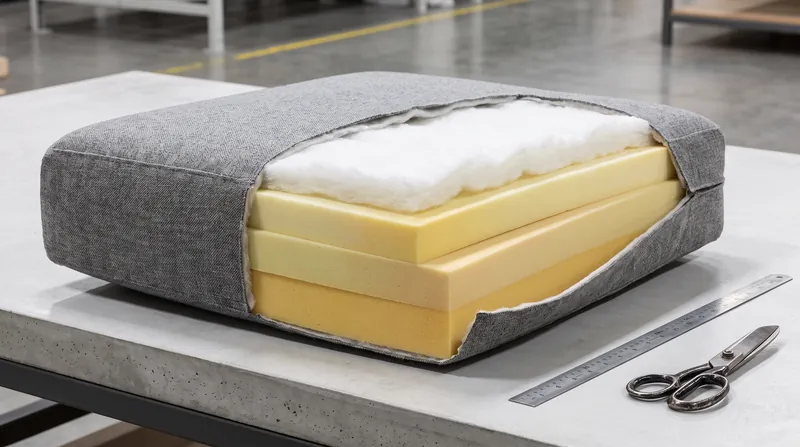
The Mechanics of Polyurethane Foam: How Density and ILD Ratings Actually Dictate Sofa Lifespan
4 sources
Paint Chemistry
Oxidation vs. Coalescence: How Alkyd and Acrylic Resins Actually Dictate Paint Hardness and Cure Time
5 sources

Performance Fabric
Molecular Encapsulation and Solution-Dyeing: How Modern Upholstery Actually Repels Stains Without PFAS
8 sources

Wood Dynamics
Dimensional Stability in Hardwoods: How Tangential, Radial, and Longitudinal Movement Dictate Furniture Survival
4 sources
Comments
Every angle. Every day.
Get Home stories with full source coverage and perspective breakdowns, free every day.