
New Research Finds Atlantic Ocean Current Collapse Is Significantly More Likely and Closer Than Previously Thought
A convergence of new observational data and constrained climate models projects the Atlantic Meridional Overturning Circulation will weaken by roughly 50% by 2100, pushing the critical system toward an irreversible tipping point.
By Harper Lane

- Climate System Modelers
- Focus on refining predictive models and reducing uncertainty through statistical constraints.
- Earth System Risk Analysts
- Focus on tipping points, bistability, and the irreversible cascading impacts on the global carbon cycle.
- Observational Oceanographers
- Prioritize direct physical measurements and long-term seafloor data to track the current's actual momentum.
The Atlantic Meridional Overturning Circulation (AMOC) is the engine of the global climate. This vast oceanic conveyor belt transports more than a million billion watts of heat from the tropics to the North Atlantic, keeping Europe temperate and anchoring tropical rainfall belts. For decades, climate scientists have warned that global warming could slow this system down. Now, a convergence of new observational data and refined modeling in the spring of 2026 has delivered a stark update: the AMOC is weakening faster than anticipated, and a full collapse is significantly more likely than previously thought.[1][4]
The shift in scientific consensus stems from a breakthrough in how climate models are evaluated. Historically, the dozens of computer models used by the Intergovernmental Panel on Climate Change (IPCC) produced widely varying projections for the AMOC's future, ranging from a mild slowdown to a 65% deceleration by 2100. In April 2026, researchers published a landmark study in Science Advances that applied a statistical method called ridge-regularized linear regression to constrain these models using real-world ocean observations.[1][2]
By filtering out the models that failed to match historical sea surface temperature and salinity data, the researchers drastically reduced the spread of uncertainty. The constrained models project that the AMOC will weaken by 42% to 58% by the end of the century, even under moderate emissions scenarios. The IPCC previously defined a 50% slowdown as a "substantial weakening," but lead researchers now warn that a decline of this magnitude places the circulation dangerously close to a total collapse.[1][2]
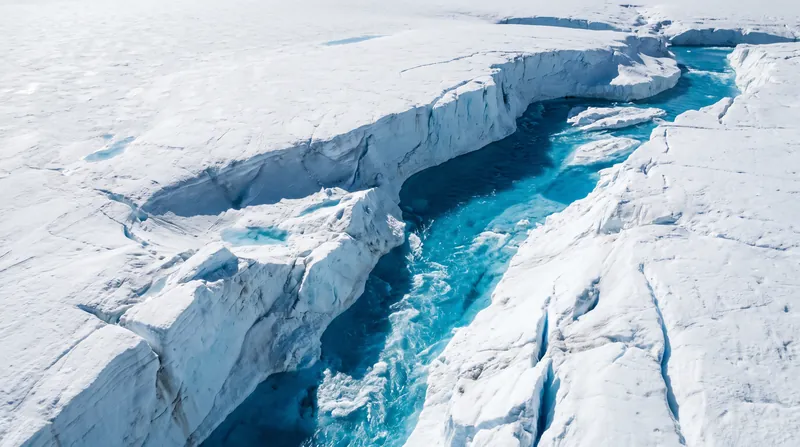
The physical mechanism driving this slowdown is rooted in the Arctic. The AMOC functions because warm, salty water travels north, cools, becomes dense, and sinks to the ocean floor, flowing back south. However, rapid Arctic warming and the accelerated melting of the Greenland ice sheet are dumping massive volumes of fresh water into the North Atlantic. Because fresh water is less dense than salty water, it disrupts the sinking process, effectively jamming the gears of the global conveyor belt.[1]
This theoretical vulnerability is now backed by robust, long-term physical evidence. In May 2026, researchers from the University of Miami published the results of a 20-year observational study utilizing seafloor-anchored instruments along the western boundary of the Atlantic. These arrays continuously monitored pressure, temperature, density, and current speeds from the tropics to the mid-latitudes.
The Miami data revealed a steady, basin-wide decline in the AMOC's strength, rather than a localized or short-term fluctuation. The researchers described these deep-ocean measurements as a "canary in a coal mine," providing the strongest direct observational evidence to date that the circulation is fundamentally losing momentum across a vast stretch of the ocean.
The Miami data revealed a steady, basin-wide decline in the AMOC's strength, rather than a localized or short-term fluctuation.
The implications of a collapse are severe, but a second major study published in Communications Earth & Environment by the Potsdam Institute for Climate Impact Research (PIK) highlighted an even more alarming reality: irreversibility. The PIK researchers simulated how the AMOC would respond to a shutdown under various atmospheric carbon dioxide levels.[3]
They found that if the AMOC collapses while atmospheric CO2 is at pre-industrial levels (280 parts per million), the circulation eventually recovers once the freshwater influx stops. However, if the collapse occurs when CO2 levels are at 350 ppm or higher, the system enters a "bistable regime" and stays permanently in the "off" state. Given that global CO2 levels currently exceed 425 ppm, the research confirms that if the AMOC crosses its tipping point, the shutdown will be permanent on any timescale relevant to human civilization.[3][4]
A permanent shutdown would trigger a cascade of secondary climate catastrophes. The PIK study revealed that an AMOC collapse would flip the Southern Ocean from a vital carbon sink into a massive carbon source. The enhanced mixing of deep, carbon-rich waters would release vast amounts of stored CO2 into the atmosphere, adding an estimated 0.17°C to 0.27°C of extra global warming entirely independent of human emissions.[3]
The direct weather impacts of a collapsed AMOC would radically redraw the global map. Without the northward transport of tropical heat, northern Europe would plunge into extreme cold winters and severe summer droughts, devastating agricultural yields. Conversely, the heat that fails to move north would accumulate in the Southern Hemisphere, accelerating warming there.[1]
Ocean dynamics would also shift dramatically. The collapse of the deep return current would cause sea levels along the eastern coast of North America to surge by an estimated 50 to 100 centimeters, overwhelming current coastal defense infrastructure. Perhaps most devastatingly, the tropical rainfall belt would shift southward, disrupting the monsoon systems that provide water for agriculture across South America and West Africa, threatening the food security of hundreds of millions of people.[1]
Despite the tightening consensus, transparent uncertainties remain. While the 50% slowdown by 2100 is now constrained by data, the exact threshold at which the weakened current snaps into a full collapse is still unknown. Natural decadal variability in the ocean makes it difficult to pinpoint the exact year a tipping point might be crossed, and some researchers caution that the transition could be gradual rather than abrupt.[1][4]
The stakes are so high that scientists are now evaluating radical geoengineering interventions. A separate April 2026 paper proposed constructing an 80-kilometer-long series of dams across the Bering Strait between Russia and Alaska. By cutting off the flow of relatively fresh Pacific water into the Arctic, researchers theorize they could alter the salinity balance of the North Atlantic and artificially stabilize the AMOC.
The 2026 research marks a definitive shift in how the scientific community views the Atlantic Meridional Overturning Circulation. What was once considered a low-likelihood, high-impact tail risk for the 22nd century is now understood to be a highly probable event approaching on a much shorter timeline. As the observational data aligns with the most pessimistic climate models, the focus is rapidly shifting from predicting the collapse to preparing for its irreversible consequences.[1][4]
- 42–58%
- Projected AMOC slowdown by 2100
- 350 ppm
- CO2 threshold for irreversible collapse
- 0.2°C
- Added warming from Southern Ocean carbon release
- 50–100 cm
- Projected US East Coast sea-level surge
What we don’t know
- The exact year or decade the AMOC will cross the tipping point into a full collapse.
- Whether the transition from a weakened state to a collapsed state will be abrupt or unfold gradually over several decades.
- The precise localized impacts on specific agricultural regions in the Global South.
Key points
- New statistical constraints on climate models project the AMOC will weaken by 42% to 58% by 2100.
- 20 years of deep-ocean observations confirm the current is already losing momentum across the Atlantic basin.
- If the AMOC collapses at current CO2 levels, the shutdown will be permanent and irreversible.
- A collapse would flip the Southern Ocean into a carbon source, adding up to 0.27°C of extra global warming.
- Consequences include extreme European cooling, US East Coast sea-level rise, and disrupted tropical monsoons.
Key terms
- Atlantic Meridional Overturning Circulation (AMOC)
- A massive system of ocean currents that transports warm water north and cold water south, acting as a global climate regulator.
- Bistability
- A system state where two different stable conditions can exist; for the AMOC, it means the current can be either functioning or permanently 'off'.
- Ridge-regularized linear regression
- A statistical method used by researchers to reduce prediction errors by combining real-world ocean observations with computer climate models.
- Tipping Point
- A critical threshold where a small change pushes a system into a completely new, often irreversible, state.
Sources
Source coverage
4 outlets
3 viewpoints surfaced




- [1]The GuardianClimate System Modelers
Critical Atlantic current significantly more likely to collapse than thought
Read on The Guardian → - [2]Science AdvancesClimate System Modelers
Observational constraints project a ~50% AMOC weakening by the end of this century
Read on Science Advances → - [3]Communications Earth & EnvironmentEarth System Risk Analysts
First pig liver and kidneys transplanted into a person — could ease organ shortages
Read on Communications Earth & Environment → - [4]Factlen Editorial TeamEarth System Risk Analysts
Synthesis by Factlen editorial team
Read on Factlen Editorial Team →
Comments

Every angle. Every day.
Get science stories with full source coverage and perspective breakdowns delivered to your inbox.