
How Tesla and Sunrun's 16.8 GW Virtual Power Plant Aims to Stabilize the US Grid
Tesla, Sunrun, and Renew Home have partnered to aggregate millions of home batteries and smart thermostats into a massive virtual power plant, offering a rapid solution to the surging electricity demands of AI data centers.
By Factlen Editorial Team
- Distributed Energy Providers
- Argue that aggregating existing home devices is the fastest and most cost-effective way to solve the grid crisis.
- Industry Skeptics
- Caution that theoretical peak capacity from home batteries cannot replace the firm, 24/7 baseload generation required by data centers.
- Grid Operators
- Welcome the flexible capacity but focus on the complex regulatory and verification hurdles required to integrate it safely.
What's not represented
- · Hyperscale data center operators (Google, Microsoft, AWS)
- · Residential customers participating in the VPP programs
Why this matters
As artificial intelligence drives unprecedented electricity demand, traditional grid infrastructure is buckling under the strain. By turning millions of everyday homes into a unified, dispatchable power source, this framework offers a blueprint for preventing blackouts without waiting years for new gas plants or transmission lines to be built.
Key points
- Tesla, Sunrun, and Renew Home are aggregating home energy devices to create a 16.8 GW virtual power plant.
- The network utilizes home batteries for power injection and smart thermostats for load shifting.
- The initiative targets the surging electricity demands of AI data centers, which face years-long interconnection delays.
- Over 300 MW of capacity is already deployable in Virginia's 'Data Center Alley.'
- The system can be deployed in months without requiring new transmission lines or centralized power plants.
- Homeowners who participate receive financial compensation or utility bill reductions.
The rapid expansion of artificial intelligence has triggered an unprecedented energy crunch across the United States, pushing aging electrical grids to their absolute limits. With US data center power demand projected to hit 41 gigawatts in 2026 and 66 gigawatts by 2027, utility companies are scrambling to find electricity in a system where new transmission lines and power plants take years to permit and build. In response, three of the largest players in residential energy have proposed a massive, decentralized solution that bypasses traditional infrastructure entirely.[1][2]
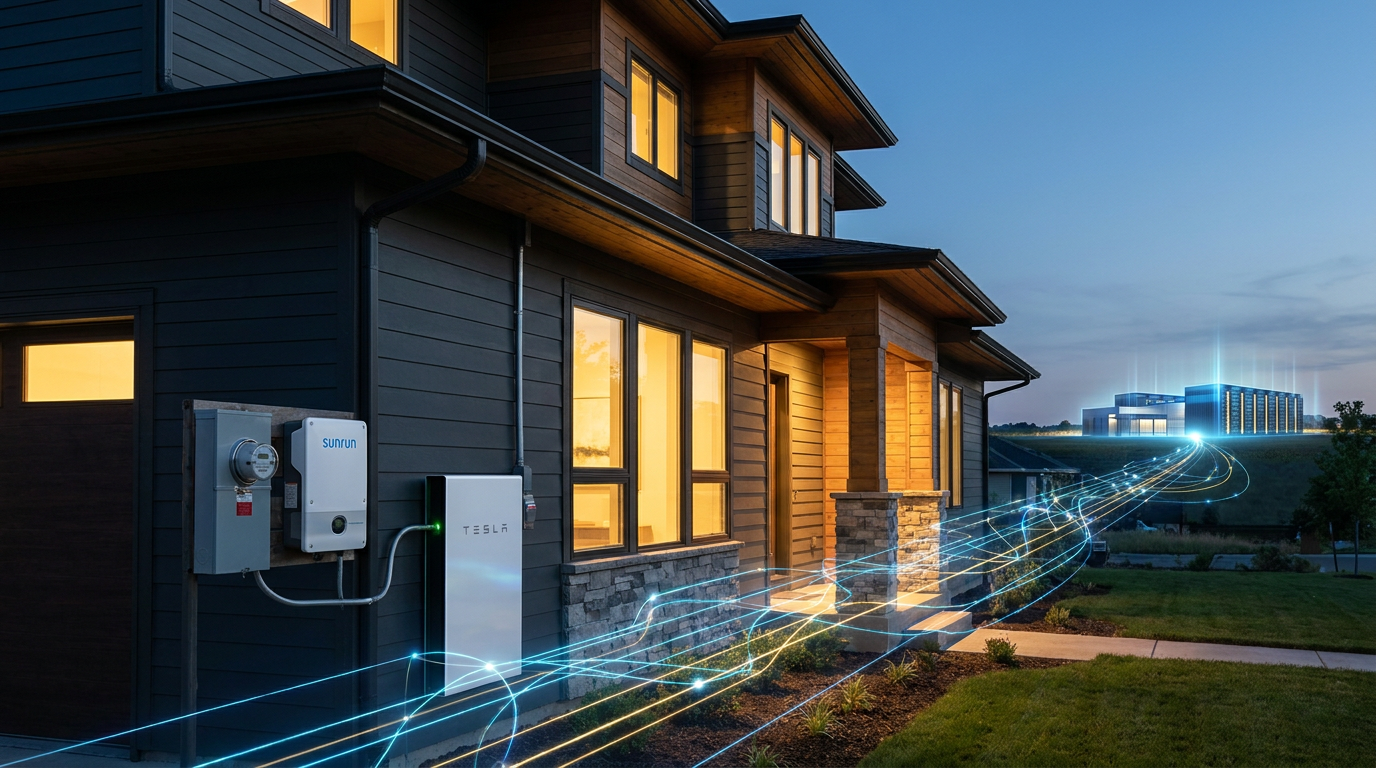
Tesla, residential solar giant Sunrun, and Google-backed energy management firm Renew Home have announced a framework to aggregate millions of household devices into the largest distributed power plant in the country. The partnership aims to orchestrate up to 16.8 gigawatts of flexible energy capacity, drawing from home battery systems, electric vehicles, and smart thermostats. Rather than pouring concrete for a new centralized facility, the companies are pitching a 'capacity-as-a-solution' model that treats millions of individual homes as a single, highly responsive power plant.[1][3][4]
To understand the scale of this ambition, 16.8 gigawatts is roughly equivalent to the output of more than a dozen large nuclear reactors. While traditional power plants generate electricity in one location and push it outward, a virtual power plant (VPP) operates in reverse. It uses advanced software to coordinate distributed energy resources—like rooftop solar panels, wall-mounted batteries, and smart HVAC systems—across a vast geographic area. When the grid experiences a surge in demand, the VPP software can instantaneously command these devices to discharge stored power or reduce their consumption.[1][5]

The mechanism relies on two distinct types of energy flexibility: injection and load shifting. The injection side is powered by hundreds of thousands of home battery systems operated by Tesla and Sunrun. During peak hours, when electricity is most expensive and the grid is most stressed, these batteries can seamlessly feed stored solar energy back into the network. This injects net new electrons precisely where and when they are needed, easing congestion on local distribution lines without requiring any new utility-scale hardware.[3][4]
The load-shifting side of the equation is managed by Renew Home, which controls more than 8 million smart thermostats and connected devices. Instead of adding power to the grid, this system temporarily reduces demand. By pre-cooling homes before a peak event or making imperceptible, degree-level adjustments to millions of air conditioners simultaneously, the network can shed massive amounts of electrical load. Combined with the battery injection, this dual approach creates a powerful buffer against grid instability.[1][5][6]
The primary target for this massive energy reserve is the hyperscale data center industry. Tech giants racing to build out AI compute infrastructure are finding that their expansion is bottlenecked not by a lack of microchips, but by a lack of electricity. Interconnection queues—the waiting lists to plug new facilities into the grid—are currently stretching for years. Sunrun CEO Mary Powell highlighted this friction, noting that the grid of the 1800s simply cannot power the innovation of 2026.[1][2][4]

The primary target for this massive energy reserve is the hyperscale data center industry.
The core selling point of the Tesla-Sunrun-Renew Home framework is speed. While a new natural gas peaker plant or high-voltage transmission line might take half a decade to navigate environmental reviews and construction, distributed resources are already sitting in people's garages and living rooms. The companies assert that this capacity can be switched on in a matter of months, providing immediate relief to strained networks and offering data centers a faster path to securing operational power.[1][6]
The rollout is beginning where the need is most acute: Virginia. Known as 'Data Center Alley,' Northern Virginia is the densest hub of internet infrastructure on the planet, and local utilities have struggled to keep pace with the sector's voracious energy appetite. The VPP consortium says it already has more than 300 megawatts of capacity ready for immediate deployment in the state, with expectations to grow that figure to at least 500 megawatts by 2030 as more residents install home batteries and smart thermostats.[1][2][3]
For homeowners, participating in a virtual power plant is not an act of charity; it is a financial arrangement. Customers who enroll their devices in grid-supporting programs receive compensation, which can take the form of upfront hardware discounts, ongoing monthly credits, or direct payments for the energy their batteries supply during peak events. The companies argue that this model protects American families from footing the bill for costly new utility infrastructure, while actively lowering the energy costs of those who participate.[2][3][4]

However, energy analysts and grid operators maintain a healthy degree of skepticism regarding the headline figures. The 16.8 gigawatt number represents a theoretical aggregate of rated battery capacity combined with the one-hour peak load-shift potential of millions of thermostats. It is not equivalent to 16.8 gigawatts of firm, around-the-clock generation that a traditional power plant provides. The actual deployable capacity depends heavily on customer enrollment rates, the state of charge of individual batteries at any given moment, and the willingness of residents to let third parties control their thermostats.[1][5]
Furthermore, the regulatory landscape remains a significant hurdle. The framework depends on utility program approvals and the acceptance of this distributed capacity by regional transmission organizations. The companies have committed capacity to the proposed Reliability Backstop Process of PJM—the grid operator for 13 states and the District of Columbia—which they claim could unlock over a gigawatt of capacity today if accepted. But navigating the complex, highly localized rules of US electricity markets is notoriously difficult.[1][3][6]
Despite these challenges, the concept of the virtual power plant has already been proven at a smaller scale. Sunrun and Tesla have successfully operated VPPs in California and Texas, demonstrating that distributed networks can reliably respond to dispatch signals. In Puerto Rico, where the grid is notoriously fragile, the local operator LUMA Energy has called upon Sunrun's local VPP at least six times in a single month to prevent load-shedding events during periods of extreme heat.[1][5]

As the electrification of transportation accelerates, the potential scale of virtual power plants will only grow. Millions of electric vehicles represent massive, rolling batteries that can theoretically plug into the grid and discharge power when parked. By integrating vehicle-to-grid (V2G) capabilities into this framework, the consortium could tap into a reservoir of energy that dwarfs traditional home storage systems, further blurring the line between energy consumers and energy producers.[4][6]
Ultimately, the 16.8 gigawatt agreement represents a fundamental shift in how the energy industry views the electrical grid. Instead of treating homes merely as endpoints that consume power, this model reimagines them as active, intelligent nodes capable of stabilizing the entire network. If successful, it could provide the critical bridge needed to power the AI revolution while accelerating the transition to a more resilient, decentralized energy future.[2][3][4]
How we got here
2021–2025
Early virtual power plant pilots in California, Texas, and Puerto Rico prove the concept can reliably support the grid at a megawatt scale.
December 2025
Sunrun launches a major Texas VPP in partnership with NRG, expanding the commercial viability of distributed residential energy.
June 24, 2026
Tesla, Sunrun, and Renew Home announce the 16.8 GW national VPP framework aimed at hyperscale data centers.
2027
US data center power demand is projected to hit 66 GW, intensifying the urgency for rapid grid stabilization solutions.
Viewpoints in depth
Distributed Energy Providers
Companies building the VPP argue it is the fastest, most efficient way to solve the grid crisis.
Firms like Sunrun, Tesla, and Renew Home view the traditional model of building massive, centralized power plants as obsolete and too slow for the AI era. They argue that the hardware required to stabilize the grid already exists in millions of American homes. By utilizing software to orchestrate these distributed assets, they believe they can provide 'capacity-as-a-solution' in a matter of months, rather than the years it takes to permit and construct new gas peaker plants or high-voltage transmission lines. This approach, they contend, not only serves hyperscalers but actively lowers energy costs for participating homeowners.
Industry Skeptics
Analysts caution that theoretical peak capacity does not equal reliable, around-the-clock generation.
While Wall Street reacted positively to the announcement, energy analysts and grid experts point out that a 16.8 GW virtual power plant is fundamentally different from a 16.8 GW nuclear or natural gas facility. The VPP's figure is a theoretical maximum that combines rated battery output with the one-hour load-shifting potential of smart thermostats. Skeptics note that this capacity is highly variable; it depends on consumer opt-in rates, the current charge level of home batteries, and weather conditions. They argue that while VPPs are excellent for 'peak shaving' during specific high-stress hours, they cannot provide the firm, 24/7 baseload power that hyperscale data centers require for continuous operation.
Grid Operators
Regional transmission organizations must figure out how to safely integrate and verify these decentralized resources.
For entities like PJM Interconnection, the prospect of a massive VPP is both a lifeline and a logistical challenge. Grid operators are desperate for new capacity to offset the surging demand from data centers, and they welcome the flexibility that home batteries and load-shifting can provide. However, their primary mandate is reliability. Operators must develop complex new rules and verification processes to ensure that when they send a dispatch signal to a VPP, the promised megawatts actually materialize. They are currently navigating how to fairly compensate these distributed resources while maintaining the strict stability requirements of the bulk power system.
What we don't know
- How many of the 8 million eligible households will actually opt into the third-party control required for the VPP.
- Whether regional grid operators like PJM will approve the regulatory frameworks needed to fully monetize this capacity.
- How the system will perform during extended, multi-day grid emergencies where home battery reserves are depleted.
Key terms
- Virtual Power Plant (VPP)
- A cloud-based network that aggregates decentralized energy resources—like home batteries and solar panels—to operate as a single, dispatchable power plant.
- Hyperscaler
- Massive technology companies, such as Google, Amazon, and Microsoft, that operate vast networks of data centers to provide cloud computing and AI services.
- Distributed Energy Resources (DERs)
- Small-scale power generation or storage technologies located close to where electricity is used, such as rooftop solar, home batteries, and electric vehicles.
- Peak Shaving
- The practice of reducing electrical power consumption during periods of maximum demand to prevent grid overload and avoid using expensive, highly polluting backup power plants.
- Load Shifting
- Moving electricity consumption from times when demand and prices are high to times when they are lower, often managed automatically by smart thermostats.
Frequently asked
What exactly is a virtual power plant?
A virtual power plant uses software to connect thousands of individual home batteries, solar panels, and smart thermostats. When the grid needs extra power, the software commands these devices to either supply stored energy or reduce consumption, acting together like a traditional power plant.
Do homeowners get paid for participating?
Yes. Customers who enroll their devices in these grid-supporting programs receive compensation, which can include upfront discounts on hardware, ongoing monthly credits, or direct payments for the energy they supply.
Will this drain my home battery when I need it?
VPP programs are designed with safeguards so homeowners can set reserve limits. This ensures the battery retains enough charge to power the home in the event of an actual local blackout.
Why are data centers driving this demand?
The rapid growth of artificial intelligence requires massive amounts of computing power, which in turn requires enormous amounts of electricity. Data centers are expanding faster than traditional utilities can build new power plants and transmission lines to supply them.
Sources
Source coverage
6 outlets
3 viewpoints surfaced






[1]ElectrekIndustry Skeptics
Tesla, Sunrun team up on 16 GW virtual power plant for data centers
Read on Electrek →[2]Energy-Storage.newsDistributed Energy Providers
Sunrun, Renew Home and Tesla target 16GW VPP capacity for US data centres
Read on Energy-Storage.news →[3]ESG TodayDistributed Energy Providers
Tesla, Sunrun, Renew Home to Turn U.S. Homes into Massive Distributed Power Plant
Read on ESG Today →[4]CleanTechnicaDistributed Energy Providers
Sunrun, Renew Home, and Tesla Team Up to Deliver More Than 16 Gigawatts of Fast, Flexible Power for Data Centers and Large Loads
Read on CleanTechnica →[5]ESG DiveGrid Operators
3 home energy providers offer 16.8 GW of distributed capacity to utilities, hyperscalers
Read on ESG Dive →[6]Insider FinanceIndustry Skeptics
Sunrun Tesla deal aggregates home batteries into a virtual power plant for data centers
Read on Insider Finance →
Every angle. Every day.
Get automotive stories with full source coverage and perspective breakdowns delivered to your inbox.