
New Construction vs. Existing Homes: The 2026 Cost and Trade-Off Analysis
With the historic price gap between new builds and existing homes virtually erased in 2026, buyers face a complex choice between predictable warranty-backed costs and the immediate convenience of established neighborhoods.
By Factlen Editorial Team
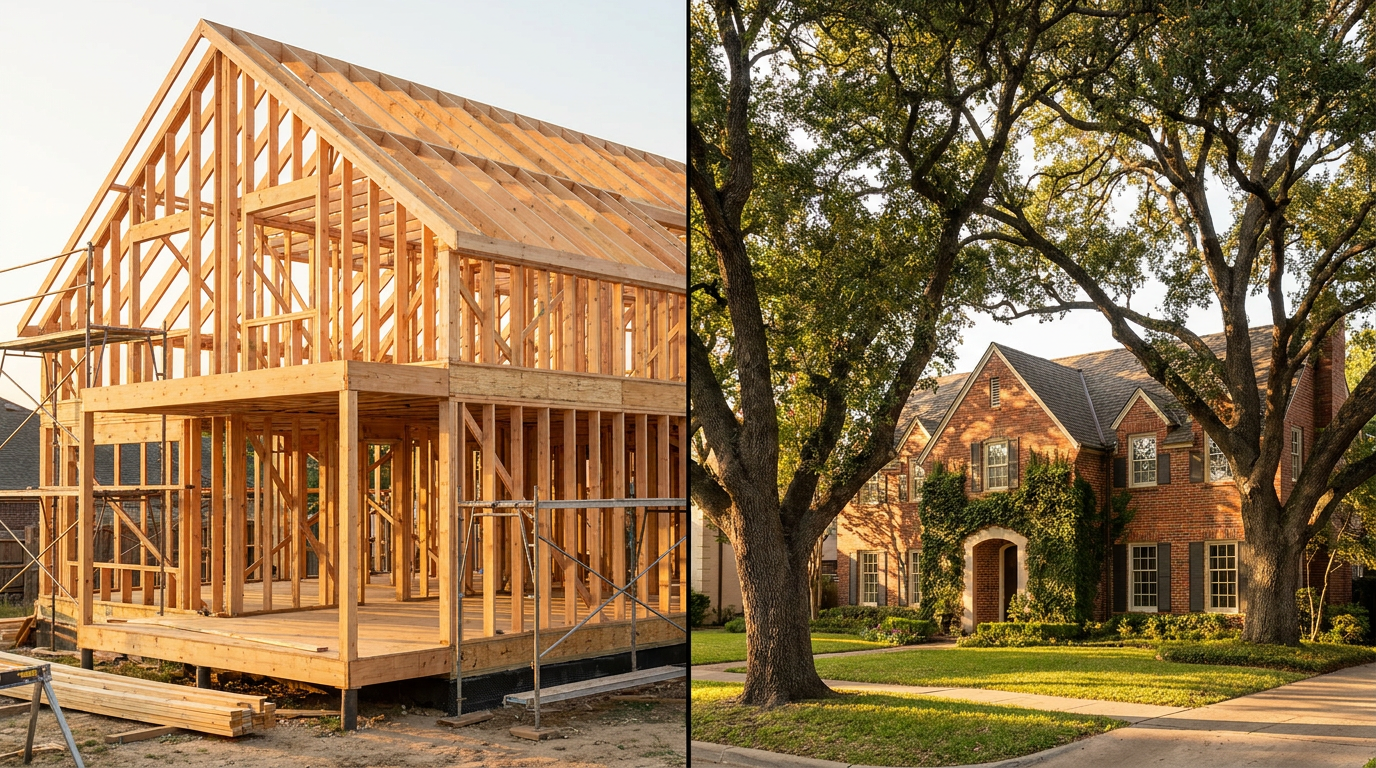
- Production Builders
- Emphasize energy efficiency, warranties, and rate buydown incentives to offset higher base prices.
- Resale Market Advocates
- Value established neighborhoods, mature landscaping, immediate move-in, and the ability to negotiate.
- Total-Cost Analysts
- Focus on the long-term math, weighing utility savings against design center markups and deferred maintenance.
What's not represented
- · Custom home architects
- · Local zoning board officials
Why this matters
For the first time in modern history, buying a brand-new home costs roughly the same upfront as buying an older one. Understanding the hidden long-term costs of both paths ensures buyers do not drain their savings on unexpected repairs or overpriced builder upgrades.
Key points
- The historical price premium for new construction has vanished, with median prices for new and existing homes nearly identical in 2026.
- New construction offers predictable costs through 1-2-10 builder warranties and high energy efficiency.
- Existing homes provide immediate occupancy, established neighborhoods, and mature landscaping.
- Builders are using aggressive mortgage rate buydowns to make new homes more affordable on a monthly basis.
- Buyers must weigh the hidden costs of new builds against the deferred maintenance risks of older homes.
For decades, the real estate market operated on a simple, unbreakable rule: brand-new homes cost significantly more than used ones. Buyers paid a steep premium for the privilege of being the first to walk on the carpets, use the appliances, and enjoy modern layouts. But in 2026, that fundamental law of housing economics has fractured, creating a unique window of opportunity for informed buyers.
According to data from the U.S. Census Bureau and the National Association of Home Builders, the median price for a new single-family home in the first quarter of 2026 sat at $403,200. In a historic inversion of traditional market dynamics, the median price for an existing home was actually higher, clocking in at $404,600. In certain regions, like the Midwest, the gap is even wider, with existing homes carrying a noticeable premium over new builds.[2]
This vanishing price gap has fundamentally changed how buyers approach the market. With the upfront entry costs nearly identical, the decision between building new and buying existing is no longer a simple question of budget. Instead, it has become a complex trade-off analysis between predictable long-term costs and immediate lifestyle needs.

The financial case for new construction in 2026 relies heavily on builder incentives rather than just the sticker price. To keep inventory moving in a high-interest-rate environment, production builders have deployed aggressive financial levers that individual sellers simply cannot match.[1][6]
The most potent of these levers is the mortgage rate buydown. Builders frequently partner with preferred lenders to offer introductory rates in the 3% to 4% range, or permanent rate reductions that sit well below the national average. For a buyer stretching their monthly budget, a builder-subsidized mortgage can make a $450,000 new build cheaper month-to-month than a $400,000 existing home.[1][6]
Beyond financing, the evidence for new construction shines brightest in energy efficiency. Building codes and material sciences have advanced rapidly. According to industry data, homes built to 2026 standards are roughly 30% more energy-efficient than those constructed just five to seven years prior.[3][5]
Features that were once luxury upgrades—such as high-performance low-E windows, radiant barrier decking, and tightly sealed building envelopes—are now standard. This translates to a quantifiable advantage: buyers of new construction typically see utility bills that are 15% to 30% lower than those of comparable older homes, providing a vital hedge against rising energy costs.[5]

Maintenance predictability forms the third pillar of the new-build argument. New homes come shielded by the industry-standard 1-2-10 warranty: one year of coverage for general workmanship, two years for mechanical systems like plumbing and HVAC, and ten years for structural integrity.[5]
For the first decade of ownership, a new construction buyer is largely insulated from catastrophic repair bills. There is no aging roof waiting to fail, no 15-year-old water heater threatening to flood the basement, and no outdated electrical panel requiring a costly heavy-up.[5]
For the first decade of ownership, a new construction buyer is largely insulated from catastrophic repair bills.
However, the case against new construction is anchored in hidden costs and delayed gratification. While the base price might look appealing, the final number rarely stays there. Buyers frequently face steep design center markups for aesthetic upgrades, premium lot fees to avoid backing up to a busy road, and special assessment taxes that fund the new community's infrastructure.[4][5]
Furthermore, the timeline for new construction requires immense flexibility. A new build typically takes between six and eighteen months from contract to closing. Supply chain hiccups, labor shortages, and weather delays can push move-in dates back repeatedly, creating logistical nightmares for buyers with expiring leases or firm relocation dates.[1][6]

This is where the case for existing homes becomes undeniable. The primary advantage of the resale market is immediate occupancy. A traditional real estate transaction closes in 30 to 60 days, offering a concrete timeline and a locked-in moving date.[1][6]
The evidence for existing homes is also deeply rooted in location and community maturity. Because American cities developed outward, older homes monopolize the most desirable, established neighborhoods. They offer walkable proximity to urban centers, mature tree canopies, and proven, highly-rated school districts.[4][5]
New construction, by necessity, is often pushed to the suburban fringes where land is still cheap and available. Buyers of new homes must often trade shorter commutes and neighborhood charm for their modern floor plans, while also enduring two to five years of active construction noise and dust as the rest of their subdivision is completed.[5]
Yet, the financial risk of an existing home lies in deferred maintenance. A 20-year-old home might boast a beautiful, established garden, but it also carries the invisible ticking clocks of aging infrastructure. Replacing an HVAC system, updating insulation to modern standards, or repairing a foundation can instantly wipe out any upfront savings the buyer thought they achieved.[4]

Individual sellers are also more flexible on the purchase price itself. While corporate builders will fiercely defend their base prices to protect the neighborhood's comparable sales data, a motivated homeowner is often willing to negotiate on price, offer repair credits after an inspection, or adjust the closing timeline to secure a deal.[4]
Ultimately, deciding between the two paths requires analyzing the total cost of ownership rather than just the listing price. New construction fits well when buyers have strict monthly budget caps, value the peace of mind of a warranty, and have the flexibility to wait six to twelve months for their home to be finished. It is the path of predictable, fixed costs.[7]
Conversely, new construction does not fit when buyers need to relocate immediately, demand a walkable urban lifestyle, or want to build sweat equity by renovating a property themselves.[7]
Existing homes fit well when location is the absolute highest priority, when buyers need to move in within two months, and when they have the cash reserves to handle unexpected repairs. It is the path of immediate gratification and established community.[7]
Existing homes do not fit when buyers are stretching every dollar just to make the down payment, leaving them dangerously exposed to the sudden, inevitable costs of replacing aging home systems. In the 2026 market, buyers must choose which kind of cost they prefer: the premium of the new, or the unpredictability of the old.[7]
How we got here
Late 2022
The price gap between new and existing homes peaks, with new builds commanding a massive $64,000 premium.
Mid 2024
Existing home prices surpass new construction prices for the first time in recent history due to severe inventory shortages.
Early 2025
Builders aggressively introduce mortgage rate buydowns to attract buyers squeezed by high interest rates.
Q1 2026
The median price of an existing home ($404,600) remains slightly higher than a new build ($403,200), cementing a new market reality.
Viewpoints in depth
Production Builders' View
Emphasizes that modern energy codes and comprehensive warranties make new homes the safer financial bet.
Builders argue that the true cost of a home isn't the purchase price, but the monthly carrying cost. By offering aggressive mortgage rate buydowns and delivering homes that cost 20% less to heat and cool, they position new construction as the ultimate hedge against inflation. They view the 1-2-10 warranty as a financial shield that older homes simply cannot offer, protecting buyers from sudden, catastrophic repair bills during their first decade of ownership.
Resale Market Advocates' View
Argues that the location, character, and immediate availability of existing homes outweigh the shine of new construction.
Real estate agents specializing in existing homes point out that new builds are increasingly pushed to the suburban fringes, forcing buyers into longer commutes and car-dependent lifestyles. They emphasize that older homes sit in mature neighborhoods with proven school districts, established tree canopies, and no active construction noise. Furthermore, they note that individual sellers are far more willing to negotiate on price and repairs than corporate builders.
Total-Cost Analysts' View
Focuses purely on the long-term math, warning buyers about the hidden costs on both sides of the transaction.
Financial analysts warn that buyers often fall into traps on both sides. New construction buyers frequently blow their budgets on design center markups and get hit with unexpected special assessment taxes. Conversely, existing home buyers often underestimate the devastating cost of deferred maintenance, failing to budget for the inevitable $15,000 HVAC replacement or $20,000 roof repair. They advocate for a strict 'total cost of ownership' calculation before any offer is made.
What we don't know
- How long production builders will continue offering aggressive mortgage rate buydowns if federal interest rates drop significantly.
- Whether the price parity between new and existing homes is a permanent market shift or a temporary anomaly caused by locked-in inventory.
- The exact long-term durability of some newer, rapidly deployed eco-friendly building materials compared to traditional lumber and brick.
Key terms
- Rate Buydown
- A financing incentive where the builder or seller pays a lump sum upfront to lower the buyer's mortgage interest rate for the first few years or the life of the loan.
- Deferred Maintenance
- Necessary repairs or upgrades on an existing home that previous owners postponed, which the new buyer will eventually have to fund.
- 1-2-10 Warranty
- A standard new-home guarantee covering workmanship for one year, mechanical systems for two, and structural integrity for ten.
- Design Center Markup
- The premium builders charge for aesthetic upgrades—like premium flooring or custom cabinets—selected by the buyer before construction.
- Total Cost of Ownership
- The comprehensive financial picture of a home, combining the mortgage payment with utilities, maintenance, taxes, and repair risks over time.
Frequently asked
Are new construction homes actually cheaper than existing homes in 2026?
In a historic anomaly, the median price for new homes briefly dipped below existing homes in early 2026, though new builds often carry hidden costs in upgrades and lot premiums.
How much can I save on utilities with a new build?
Homes built to 2026 standards are roughly 30% more energy-efficient than those built just 5 to 7 years ago, typically reducing monthly utility bills by 15% to 30%.
What is a 1-2-10 builder warranty?
It is the industry standard for new homes, covering general workmanship for one year, mechanical systems (plumbing, electrical, HVAC) for two years, and major structural defects for ten years.
Can I negotiate the price of a new construction home?
Builders rarely lower the base purchase price to protect the neighborhood's comparable sales, but they frequently negotiate by offering mortgage rate buydowns or closing cost credits.
Sources
Source coverage
7 outlets
3 viewpoints surfaced







[1]OpendoorTotal-Cost Analysts
Is It Cheaper to Build or Buy a House? (2026)
Read on Opendoor →[2]Eye On HousingProduction Builders
New Home vs. Existing Home Prices in Q1 2026
Read on Eye On Housing →[3]ZillowResale Market Advocates
New Construction vs Existing Homes: The Pros and Cons of Both
Read on Zillow →[4]Trueblood Real EstateResale Market Advocates
New Construction vs. Existing Homes: How to Actually Decide
Read on Trueblood Real Estate →[5]Own Luxury HomesProduction Builders
New Construction vs Existing Home: 2026
Read on Own Luxury Homes →[6]AmeriSaveTotal-Cost Analysts
Building vs. Buying a House in 2026: 7 Essential Cost Comparisons
Read on AmeriSave →[7]Factlen Editorial TeamTotal-Cost Analysts
Synthesis by Factlen editorial team
Read on Factlen Editorial Team →
Every angle. Every day.
Get real estate stories with full source coverage and perspective breakdowns delivered to your inbox.