
NASA Details Artemis III Crew and Shifts Mission to Orbital Docking Test
NASA has announced the four-person crew for Artemis III and confirmed the late 2027 mission will focus on testing commercial lunar landers in Low Earth Orbit rather than landing on the Moon.
By Factlen Editorial Team
- NASA Leadership
- Focuses on risk reduction, testing critical systems in Low Earth Orbit, and maintaining momentum toward a 2028 lunar landing.
- Aerospace Analysts
- Views the 2027 timeline as highly ambitious given the unproven status of the commercial landers and recent testing setbacks.
- Commercial Partners & Media
- Emphasizes the progress of SpaceX and Blue Origin in delivering the Human Landing Systems despite development hurdles.
What's not represented
- · International Space Agencies competing in the lunar race
- · Taxpayers funding the accelerated commercial development
Why this matters
By rigorously testing the commercial landers in Earth orbit before attempting a lunar landing, NASA is prioritizing astronaut safety and ensuring the foundational technology is reliable. This calculated step reduces the risk of catastrophic failure when humanity finally returns to the lunar surface in 2028.
Key points
- NASA has finalized the four-person crew for the Artemis III mission, targeting a late 2027 launch.
- The mission architecture has shifted from a lunar landing to a complex docking test in Low Earth Orbit.
- Astronauts will rendezvous with test versions of the Human Landing Systems built by SpaceX and Blue Origin.
- The orbital tests are designed to reduce risk and ensure systems are safe before the Artemis IV lunar landing in 2028.
- Aerospace experts warn the 2027 timeline is highly ambitious due to ongoing commercial hardware delays.
In a major update to its lunar exploration roadmap, NASA has finalized the crew and mission architecture for Artemis III, a high-stakes spaceflight officially scheduled for late 2027. The announcement marks a critical pivot in the agency's strategy to return humans to the Moon, shifting the mission from a direct lunar landing to a complex orbital dress rehearsal. Rather than touching down on the lunar surface, the mission will focus on testing the critical hardware required for deep space exploration while remaining relatively close to home. This represents a calculated recalibration of America's deep space ambitions, prioritizing rigorous testing over a rushed return to the lunar surface. The evidence-based approach acknowledges the immense technological hurdles of modern spaceflight, ensuring that the foundational systems are fully operational before committing astronauts to the 240,000-mile journey to the Moon.[1][2]
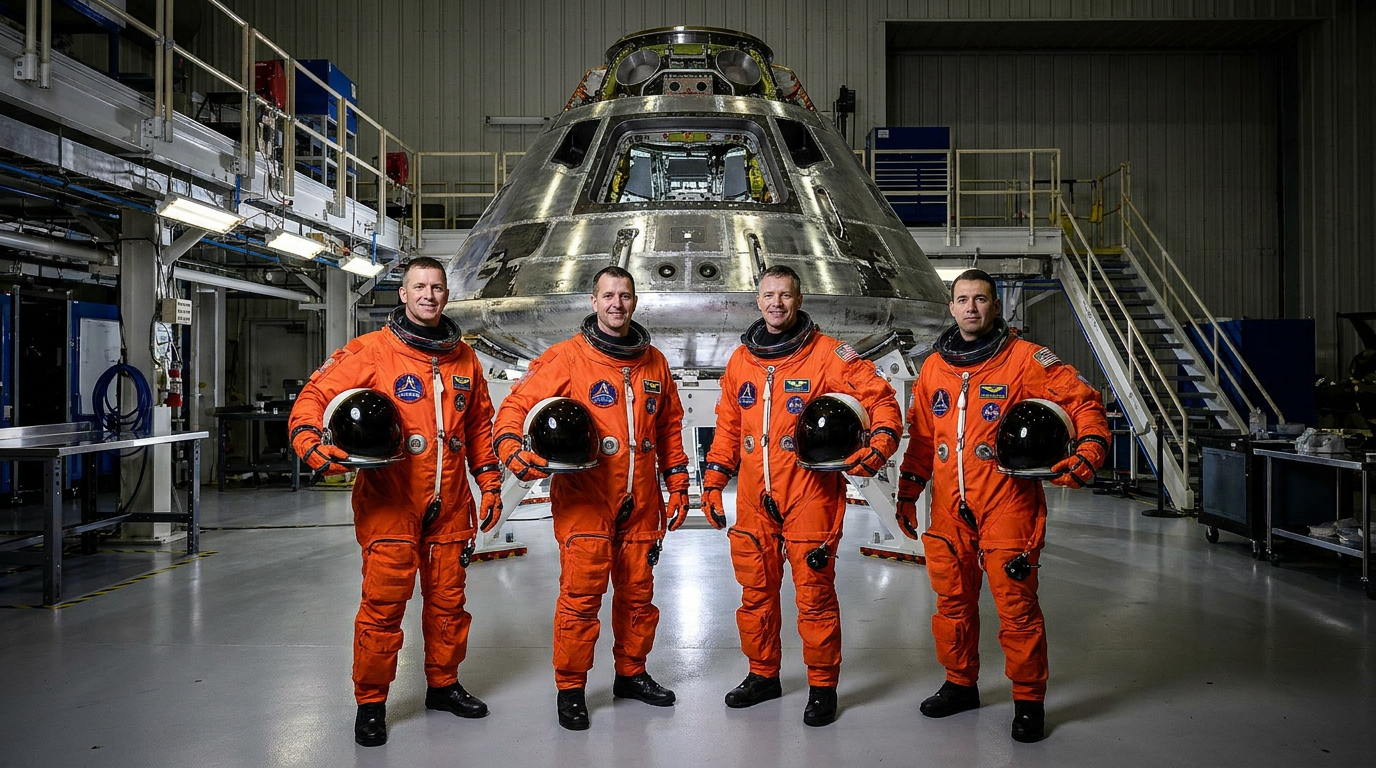
The four-person crew tasked with executing this unprecedented orbital test will be led by NASA commander Randy Bresnik, a veteran astronaut with extensive experience in spacecraft development. He will be joined by European Space Agency pilot Luca Parmitano, and NASA mission specialists Andre Douglas and Frank Rubio. Douglas, an engineer making his first spaceflight, will become one of the few African American astronauts to travel into deep space, bringing his expertise in fault management and planetary defense to the mission. Rubio brings recent long-duration spaceflight experience, while veteran test pilot Bob Hines will serve as the backup crew member, ready to substitute into any role. The diverse crew composition reflects a broad range of engineering and piloting expertise necessary to evaluate multiple unproven spacecraft systems simultaneously, though the selection of an all-male prime crew has drawn some public scrutiny.[1][3][4][6]
The primary claim driving the revised Artemis III architecture is that a Low Earth Orbit docking test is a necessary prerequisite for a safe lunar landing. According to NASA's official mission profile, the Space Launch System rocket will carry the Orion spacecraft into Earth orbit, but it will not proceed to the Moon. Unlike previous missions, Artemis III will utilize a non-propulsive structural "spacer" rather than a traditional upper stage. Because of this spacer, Orion's European-built service module will handle the heavy lifting required to maneuver the crew in orbit. This configuration allows NASA to thoroughly evaluate Orion's life support and propulsion systems during an extended stay in space, gathering vital telemetry data without the immediate risks associated with deep space navigation.[1][3]

Once established in Low Earth Orbit, the astronauts will perform rendezvous and docking operations with test versions of the Human Landing Systems being developed by commercial partners SpaceX and Blue Origin. The mission plan requires Orion to dock with the commercial landers, allowing the crew to physically enter the vehicles and spend approximately two days evaluating their internal systems. The astronauts will test the landers' software, communication arrays, and life support mechanisms in the vacuum of space. By conducting these tests in Earth orbit, the crew remains within a safe abort distance, ensuring a rapid return trajectory if any of the experimental lander systems experience a critical failure during the docking procedures.[1][3][8]
The evidence supporting this risk-reduction strategy draws heavily on historical precedent from the Apollo era. By testing the commercial landers in the relatively forgiving environment of Low Earth Orbit, NASA is echoing the successful playbook of Apollo 9, which conducted a similar orbital test run of the lunar module in 1969 before Apollo 11 attempted the historic surface landing. Agency officials emphasize that this deliberate testing phase will expose critical vulnerabilities in the spacecraft interfaces before they are deployed in lunar orbit. The data collected during these orbital maneuvers will provide the empirical foundation necessary to certify the landers for Artemis IV, which is slated to carry astronauts to the lunar South Pole in 2028.[1][4][7]
The evidence supporting this risk-reduction strategy draws heavily on historical precedent from the Apollo era.
However, the transparent uncertainty in this plan lies in the sheer logistical complexity of the operation. The mission requires coordinating three separate heavy-lift rocket launches within a tight orbital window. First, Blue Origin’s lander pathfinder must launch and remain in orbit for several weeks. Next, NASA will launch the Orion spacecraft carrying the crew. Finally, after Orion completes its tests with the Blue Origin vehicle, it must separate and await the arrival of SpaceX’s Starship pathfinder. If any of these three distinct launch vehicles experience delays, or if either commercial lander fails to reach orbit on schedule, the mission's primary docking objectives could be severely compromised, forcing NASA to alter the flight plan in real-time.[3][7][8]
A second major claim surrounding Artemis III is the timeline itself, with NASA and its commercial contractors maintaining that the hardware will be ready for a late 2027 launch window. The evidence for this target rests on recent manufacturing and testing milestones achieved by the commercial partners. SpaceX recently test-launched an upgraded version of its Starship rocket with modifications specifically designed for lunar missions, demonstrating tangible progress on its super-heavy lift capabilities. Simultaneously, Blue Origin continues the fabrication of its Blue Moon lander prototype. Both companies have assured lawmakers and NASA leadership that their respective Human Landing Systems will be operational for the orbital rendezvous, pointing to accelerated development schedules and increased federal funding.[1][8]

Despite these assurances, aerospace experts and industry analysts widely view the 2027 timeline as highly ambitious, pointing to a weak evidentiary basis for such a rapid turnaround. Both SpaceX and Blue Origin have faced years of development delays, and neither has yet demonstrated an uncrewed flight with all the capabilities required for a crewed docking mission. The uncertainty is compounded by the fact that the lunar variants of these spacecraft are significantly more complex than their standard launch vehicles. Critics argue that the historical pace of aerospace development suggests that integrating multiple unproven systems from competing contractors rarely adheres to initial schedule projections, making a 2027 launch a best-case scenario rather than a guaranteed milestone.[2][5][7]
The schedule uncertainty is further exacerbated by recent hardware setbacks. A launchpad explosion involving Blue Origin's New Glenn rocket—the massive vehicle required to lift the Blue Moon lander into orbit—has grounded the system until the launchpad can be rebuilt and the root cause identified. Since the Blue Moon lander is entirely dependent on the New Glenn rocket for orbital insertion, this incident introduces a significant variable into the Artemis III timeline. Furthermore, Axiom Space is still finalizing the design and manufacturing of the next-generation spacesuits required for the mission. While progress is being made, the concurrent development of rockets, landers, and life-support suits creates a fragile critical path where a delay in any single component could push the entire mission into 2028.[4][7]

If the orbital tests are successful, the evidence gathered during Artemis III will directly inform the architecture of Artemis IV, ensuring that the systems are robust enough to sustain human life on the lunar surface. The broader stakes of the mission extend far beyond engineering milestones. The orbital tests are designed to ensure the United States maintains its momentum in the modern space race, establishing a sustainable lunar presence ahead of international competitors like China. NASA leadership has explicitly stated that these calculated risks in Low Earth Orbit are necessary to guarantee that future crews will be safer and ultimately successful when they finally put boots on the lunar surface.[1][4]
Ultimately, while the timeline remains fluid and the technological hurdles are immense, the Artemis III architecture represents a pragmatic maturation of NASA's deep space ambitions. By prioritizing rigorous orbital testing and transparently acknowledging the risks of commercial lander development, the agency is laying a safer, more resilient foundation for humanity's eventual journey to Mars. The mission underscores a fundamental shift in space exploration: relying on a collaborative ecosystem of public and private entities to achieve what no single organization could accomplish alone. As the 2027 launch window approaches, the aerospace community will be closely monitoring the testing milestones of Starship and Blue Moon, waiting to see if the ambitious claims can be backed by flight-proven evidence.[1][2][7]
How we got here
Nov 2022
Artemis I successfully completes an uncrewed flight test around the Moon.
Apr 2026
Artemis II crew successfully flies a crewed loop around the Moon and returns to Earth.
Jun 2026
NASA announces the Artemis III crew and confirms the shift to a Low Earth Orbit docking test.
Late 2027
Target launch window for the Artemis III orbital rendezvous mission.
2028
Target launch window for Artemis IV, planned to land astronauts at the lunar South Pole.
Viewpoints in depth
NASA's Strategic View
Prioritizing crew safety through rigorous orbital testing before attempting a lunar landing.
NASA leadership argues that the shift to an orbital test for Artemis III is a necessary risk-reduction measure. By validating the life support, software, and docking mechanisms of the commercial landers in Low Earth Orbit, the agency can ensure that any critical failures occur within a safe abort distance. This pragmatic approach mirrors the successful Apollo 9 mission and is designed to guarantee that the subsequent Artemis IV mission can safely land astronauts at the lunar South Pole in 2028.
Aerospace Analysts' View
Skepticism regarding the feasibility of the late 2027 launch timeline.
Independent aerospace experts and industry analysts point to the immense logistical complexity of coordinating three separate heavy-lift launches. They argue that both SpaceX and Blue Origin have a history of development delays, and neither has yet demonstrated an uncrewed flight with the full capabilities required for a crewed docking mission. Recent setbacks, such as the explosion of Blue Origin's New Glenn rocket on the launchpad, further compound these concerns, leading many to view the 2027 target as highly ambitious and likely to slip into 2028.
Commercial Partners' View
Confidence in accelerating the development of the Human Landing Systems.
SpaceX and Blue Origin maintain that their respective lunar landers will be operational in time for the Artemis III orbital rendezvous. They highlight recent testing milestones, such as SpaceX's upgraded Starship test flights and Blue Origin's ongoing fabrication of the Blue Moon prototype. The commercial partners emphasize that increased federal funding and hands-on support from NASA engineers are accelerating their development pipelines, allowing them to overcome hardware setbacks and deliver the necessary spacecraft for the mission.
What we don't know
- Whether SpaceX and Blue Origin can complete uncrewed flight tests of their lunar landers in time for the 2027 launch window.
- How the recent launchpad explosion of Blue Origin's New Glenn rocket will impact the overall mission schedule.
- If Axiom Space will finish the next-generation spacesuits required for the mission without further delays.
Key terms
- Artemis Program
- NASA's initiative to return humans to the Moon and establish a sustainable presence to prepare for future missions to Mars.
- Orion Spacecraft
- The exploration vehicle designed to carry astronauts from Earth to lunar orbit and sustain them during the journey.
- Space Launch System (SLS)
- NASA's super heavy-lift expendable launch vehicle, used to propel the Orion spacecraft into space.
- Human Landing System (HLS)
- The commercial spacecraft built by SpaceX and Blue Origin that will transport astronauts from lunar orbit to the Moon's surface.
- Low Earth Orbit (LEO)
- An Earth-centered orbit with an altitude of 2,000 kilometers or less, where the Artemis III docking tests will take place.
Frequently asked
Will Artemis III land on the Moon?
No. The mission profile was changed to a Low Earth Orbit test flight to practice docking with lunar landers, ensuring systems are safe before a future landing attempt.
Who is on the Artemis III crew?
The crew consists of NASA astronauts Randy Bresnik, Andre Douglas, and Frank Rubio, alongside European Space Agency astronaut Luca Parmitano.
When will astronauts actually land on the Moon?
NASA is currently targeting 2028 for the Artemis IV mission, which is planned to land astronauts at the lunar South Pole.
Why are SpaceX and Blue Origin involved?
Both companies were contracted by NASA to build the Human Landing Systems (HLS) that will ferry astronauts from lunar orbit down to the Moon's surface.
Sources
Source coverage
8 outlets
3 viewpoints surfaced








[1]NASANASA Leadership
NASA Marches Toward Artemis III Mission in 2027, Names Crew Members
Read on NASA →[2]The New York TimesAerospace Analysts
What NASA Needs to Stay on Track for the Moon
Read on The New York Times →[3]BBC Sky at Night MagazineCommercial Partners & Media
NASA has announced the Artemis III crew. Here's what we know about the next stage in America's return to the Moon
Read on BBC Sky at Night Magazine →[4]Al JazeeraCommercial Partners & Media
NASA announces astronauts for Artemis III spaceflight, scheduled for 2027
Read on Al Jazeera →[5]SpaceNewsAerospace Analysts
Revised Artemis lunar lander plans take shape
Read on SpaceNews →[6]NBC NewsCommercial Partners & Media
NASA addresses criticism over all-male crew selected for Artemis III test mission
Read on NBC News →[7]The Planetary SocietyAerospace Analysts
What we know about Artemis III: NASA announces crew
Read on The Planetary Society →[8]ReutersCommercial Partners & Media
Artemis III will test spacecraft dockings in Earth orbit; mission is due to launch late next year.
Read on Reuters →
Every angle. Every day.
Get science stories with full source coverage and perspective breakdowns delivered to your inbox.