
Micro-Budget Sci-Fi Film Powered by Generative AI Wins Top Prize at Tribeca Festival
A small-team independent film that used advanced AI video models for blockbuster-level visual effects has won the top narrative award at the Tribeca Festival, signaling a new era of accessible filmmaking.
By Factlen Editorial Team
- Independent Creators
- View AI as a democratizing tool that breaks down financial barriers to ambitious storytelling.
- Industry Establishment
- Acknowledge the breakthrough while integrating it into traditional cinematic standards.
- Tech Optimists
- Celebrate the film as proof that AI enhances human creativity rather than replacing it.
What's not represented
- · Major Studio Executives who may view this democratization as a threat to their monopoly on spectacle.
- · Traditional VFX House Owners facing potential shifts in client demand and business models.
Why this matters
For decades, high-concept science fiction was restricted to major studios with massive visual effects budgets. The success of an AI-assisted indie film proves that small creators can now execute blockbuster-scale visions from their laptops, fundamentally democratizing who gets to tell visually ambitious stories.
Key points
- 'Echoes of Titan', a $45,000 indie sci-fi film, won the top narrative prize at the 2026 Tribeca Festival.
- The three-person crew used advanced generative AI models to create 85% of the film's visual effects.
- The victory proves that high-concept, visually ambitious storytelling is now accessible to micro-budget creators.
- Industry veterans praised the film for using technology to enhance a deeply human, emotional narrative.
- The film is currently at the center of a multi-million dollar bidding war among major streaming platforms.
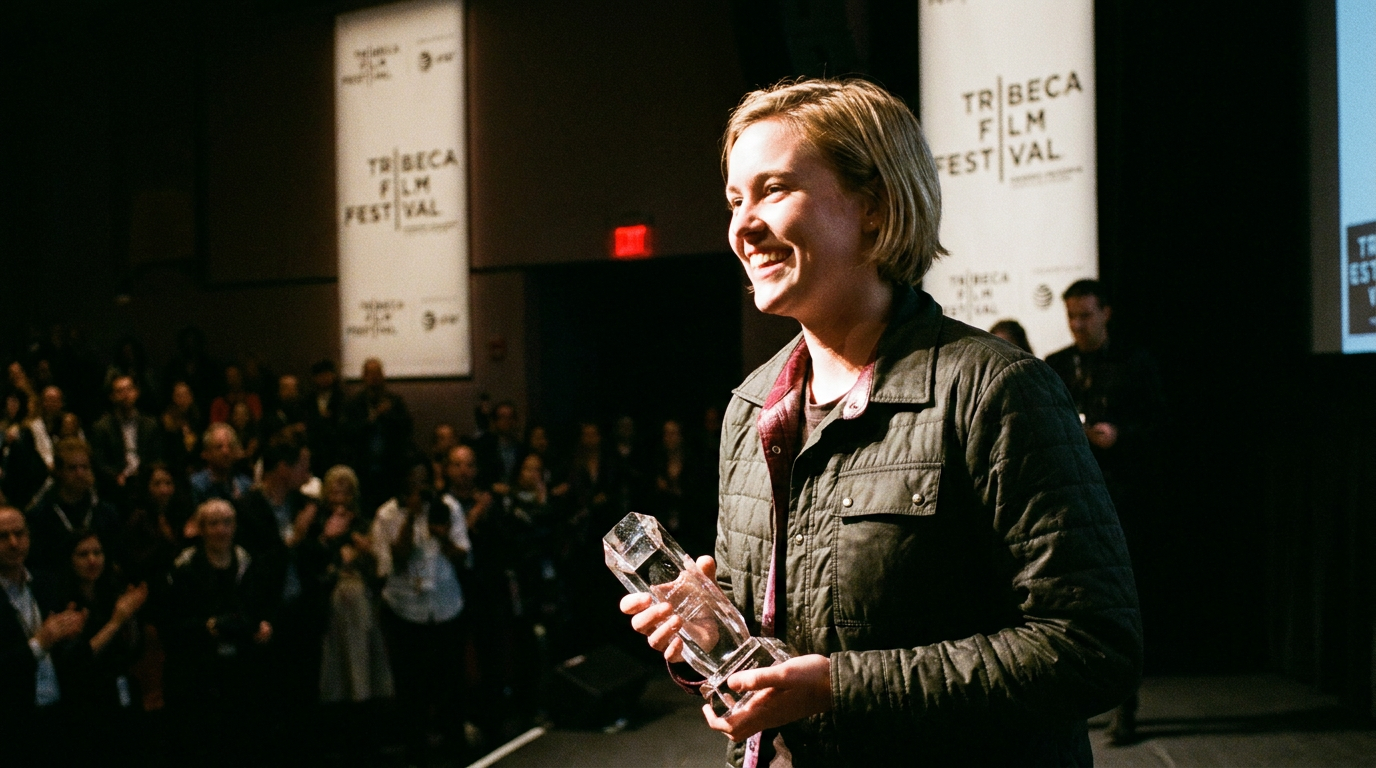
The Tribeca Festival has long been a launchpad for independent cinema, but this year's top prize winner has fundamentally rewritten the rules of what a micro-budget film can look like. On Thursday evening, the festival's Founders Award for Best U.S. Narrative Feature went to 'Echoes of Titan', a sweeping science-fiction epic produced for just $45,000.[1][6]
What makes the victory historic is not just the film's shoestring budget, but its methodology. Directed by first-time filmmaker Maya Lin, the project utilized advanced generative AI video models to create visual effects that rival those of a $150 million studio tentpole.[2][4]
The film tells the story of a lone terraformer stranded on a distant moon, featuring sprawling alien landscapes, complex zero-gravity sequences, and hyper-realistic synthetic environments. Traditionally, these elements would require hundreds of VFX artists and months of rendering. Lin's team consisted of just three people working out of a Brooklyn apartment.[3][5]

"We didn't have the resources to build practical sets or hire a massive post-production house," Lin explained during her acceptance speech. "Instead, we used AI as a collaborative partner, feeding it our concept art and directing the generations until they matched our exact vision."[1][4]
The breakthrough relies on the latest generation of text-to-video and image-to-video models, which have matured significantly over the past two years. Tools from companies like OpenAI, Runway, and Luma AI now offer unprecedented temporal consistency, allowing filmmakers to generate stable, high-resolution clips that seamlessly integrate with live-action footage.[4][5]
For 'Echoes of Titan', the actors were filmed entirely against green screens with minimal practical props. The backgrounds, atmospheric effects, and even some non-human background characters were entirely synthesized.[3]

Industry veterans at the festival were visibly stunned by the results. The jury, which included established Hollywood directors and cinematographers, praised the film not for its novelty, but for its genuine emotional resonance and visual poetry.[1][2]
"The technology is impressive, but what won us over was how the tools were used to serve a deeply human story," the jury noted in their official citation. "This isn't a tech demo; it's a triumph of independent storytelling that just happens to use a new kind of paintbrush."[6][7]
"The technology is impressive, but what won us over was how the tools were used to serve a deeply human story," the jury noted in their official citation.
The implications for the broader entertainment industry are staggering. For decades, the barrier to entry for high-concept genres like sci-fi and fantasy has been purely financial. Independent filmmakers were largely restricted to contemporary dramas or contained thrillers.[2][5]
Now, the democratization of high-end visual effects means that a creator's imagination is no longer bottlenecked by their funding. "It completely levels the playing field," noted IndieWire's chief film critic. "If a $45,000 movie can look like a summer blockbuster, the studios no longer have a monopoly on spectacle."[3]

However, the production process was not without its unique challenges. Lin's team spent months mastering the specific prompting techniques required to maintain visual continuity across different scenes.[4]
"It's not a magic button," the film's lead visual designer emphasized during a Tribeca panel. "You don't just type 'make a cool spaceship' and get a finished movie. It requires a deep understanding of cinematography, lighting, and composition to guide the AI toward a usable result. It's a new discipline entirely."[4][5]
The film's success also arrives at a complex moment for Hollywood's labor landscape. Following the strikes of recent years, the integration of AI in filmmaking has been a highly sensitive topic, with unions fighting to protect traditional jobs.[2][5]
Yet, 'Echoes of Titan' represents a different paradigm: AI not as a tool for studios to cut costs and replace workers, but as an enabler for creators who never had those budgets to begin with.[3][5]
"We didn't take jobs away from a VFX house, because we couldn't have afforded one anyway," Lin pointed out. "This technology allowed a movie to exist that otherwise would have stayed locked in a script drawer forever."[2][4]
Distributors are already circling the film, with several major streaming platforms reportedly engaged in a bidding war for the global rights. The acquisition price is expected to be in the multi-millions, representing an astronomical return on investment for the indie crew.[1][6]

Beyond the financial success, the true legacy of 'Echoes of Titan' will likely be its inspiration to the next generation of filmmakers. Film schools are already scrambling to update their curricula to include generative AI workflows alongside traditional editing.[5]
How we got here
Early 2024
Advanced text-to-video models capable of high-resolution generation are introduced to the public.
Late 2024
Director Maya Lin begins conceptualizing a sci-fi feature tailored to the strengths of AI generation.
Summer 2025
The three-person crew shoots the live-action elements against green screens in a Brooklyn apartment.
Fall 2025
Post-production and AI generation of the film's synthetic environments and VFX are completed.
June 2026
The film premieres at the Tribeca Festival and wins the Founders Award for Best U.S. Narrative Feature.
Viewpoints in depth
Independent Filmmakers
Viewing AI as a democratizing force that unlocks new genres.
For micro-budget creators, generative AI is being hailed as the ultimate equalizer. Independent directors argue that for decades, their storytelling was artificially constrained by budget limitations, forcing them into contained dramas or 'mumblecore' aesthetics. By drastically reducing the cost of visual effects, set extensions, and crowd generation, these tools allow indie filmmakers to compete on visual spectacle. They view the technology not as a shortcut, but as a new instrument that requires its own distinct mastery of prompting, curation, and digital compositing.
Traditional VFX Artists
Expressing cautious optimism mixed with concerns about industry standards.
While acknowledging the impressive results of films like 'Echoes of Titan', traditional visual effects professionals maintain a complex relationship with the technology. Many argue that while AI is perfect for indie creators who couldn't afford traditional VFX anyway, its adoption by major studios could lead to a devaluation of human artistry and technical labor. However, a growing subset of VFX artists are actively embracing these tools, pivoting their roles from manual animators to 'AI art directors' who guide and refine generated outputs to meet exacting cinematic standards.
Film Festival Juries
Focusing on narrative resonance over technical novelty.
The critical establishment and festival programmers are increasingly evaluating AI-assisted films based on traditional cinematic merits rather than their production methods. Juries emphasize that a film cannot win on spectacle alone; the technology must serve the emotional core of the story. The consensus emerging from festivals like Tribeca is that AI is simply a new lens. If the script is weak or the performances are flat, no amount of synthetic world-building will save the picture. The focus remains squarely on human storytelling.
What we don't know
- Which streaming platform will ultimately acquire the film and for how much.
- How traditional Hollywood guilds will regulate AI usage for union-backed independent productions moving forward.
- Whether the film's success will translate to mainstream box office or viewership numbers upon wide release.
Key terms
- Generative AI Video Models
- Artificial intelligence systems capable of creating highly realistic, high-resolution video clips from text descriptions or reference images.
- Temporal Consistency
- The ability of an AI video generator to keep characters, lighting, and objects stable and unchanged from one frame to the next.
- Micro-budget
- A film production made with extremely limited funding, typically under $50,000, relying on small crews and creative problem-solving.
- Green Screen Compositing
- A technique where actors are filmed in front of a solid green backdrop, which is later replaced with digital environments during post-production.
Frequently asked
Did AI write the script or direct the movie?
No. The film was written, directed, and acted by humans. AI was used exclusively as a post-production tool to generate the visual effects and background environments.
How much did the movie cost to make?
The total production budget was approximately $45,000, a fraction of the cost typically required for a science fiction feature.
Is the film available to watch right now?
Not yet. The film is currently seeking distribution following its festival premiere, with major streaming platforms reportedly bidding for the rights.
Sources
Source coverage
7 outlets
3 viewpoints surfaced







[1]VarietyIndustry Establishment
Tribeca Festival 2026: AI-Assisted Sci-Fi Feature 'Echoes of Titan' Takes Founders Award
Read on Variety →[2]The Hollywood ReporterIndustry Establishment
'Echoes of Titan' Wins Big at Tribeca, Proving AI's Potential for Indie Filmmakers
Read on The Hollywood Reporter →[3]IndieWireIndependent Creators
A $45,000 Movie Just Won Tribeca With $50 Million Looks, Thanks to AI
Read on IndieWire →[4]The VergeIndependent Creators
How a three-person crew used AI to build a cinematic universe and win Tribeca
Read on The Verge →[5]WiredTech Optimists
The AI Filmmaking Revolution Has Officially Arrived at Tribeca
Read on Wired →[6]DeadlineTech Optimists
Tribeca Festival Awards: 'Echoes Of Titan' Takes Best US Narrative Feature
Read on Deadline →[7]Tribeca Film FestivalIndustry Establishment
2026 Tribeca Festival Announces Award Winners
Read on Tribeca Film Festival →
More in entertainment
See all 59 stories →Pop Music
Olivia Rodrigo Releases Highly Anticipated Third Album 'You Seem Pretty Sad For A Girl So In Love'
6 sources

Music Economy
Global Music Revenues Hit Record $31.7 Billion as Vinyl Boom Meets 'Green Note' Sustainability
7 sources

Early Literacy
Dolly Parton's Imagination Library Surpasses 314 Million Books as Landmark Study Proves Literacy Impact
7 sources

Handheld PCs
Steam Deck OLED vs. ROG Ally X: Which Handheld Gaming PC Wins in 2026?
7 sources
Every angle. Every day.
Get entertainment stories with full source coverage and perspective breakdowns delivered to your inbox.