
Major League Cricket Launches Season 4 as US Infrastructure Boom Accelerates
Backed by over $150 million in capital, Major League Cricket's fourth season marks a turning point as the sport transitions from temporary pitches to permanent American stadiums.
By Factlen Editorial Team
- League Organizers & Investors
- Focuses on the financial upside, infrastructure growth, and establishing a premium broadcast product in the American market.
- Global Cricket Establishment
- Views the United States as the final untapped mega-market for the sport's worldwide expansion.
- Local American Communities
- Sees the league as a cultural bridge for immigrant families and a vital new professional pathway for domestic youth.
What's not represented
- · Traditional American sports executives analyzing the threat to domestic market share
- · Grassroots amateur players navigating the transition to professional contracts
Why this matters
The successful scaling of a new professional sports league in the United States is a rare phenomenon. MLC's growth is creating a lucrative new career pathway for American athletes and establishing the infrastructure necessary for the 2028 Los Angeles Olympics.
Key points
- Major League Cricket's fourth season launched on June 18, 2026, featuring six franchises and 34 matches.
- American Cricket Enterprises has invested over $150 million to build the sport's US infrastructure.
- The league is expanding its West Coast footprint with matches at the Oakland Coliseum and a new stadium in Pomona.
- A strict domestic quota ensures US-based players develop alongside imported international superstars.
- Ticket sales grew by 53% year-over-year, with 84% of purchasers being first-time buyers.
- The infrastructure boom serves as a direct runway for cricket's return at the 2028 Los Angeles Olympics.
For decades, cricket in the United States existed quietly on the margins, played on uneven public park pitches by immigrant communities while mainstream American sports culture looked the other way. It was often treated as a cultural curiosity rather than a viable commercial enterprise. That reality is rapidly dissolving. As Major League Cricket (MLC) launches its fourth season in the summer of 2026, the sport has firmly established a multi-million dollar professional foothold in the world’s most lucrative sports market. Moving far beyond its initial proof-of-concept phase, the league has transformed from an ambitious startup into a cornerstone of the global cricket calendar. The narrative has shifted from whether cricket can survive in America to how quickly it can scale, backed by heavy-hitting investors and a strategic vision that extends well beyond the boundary ropes.[4][8]
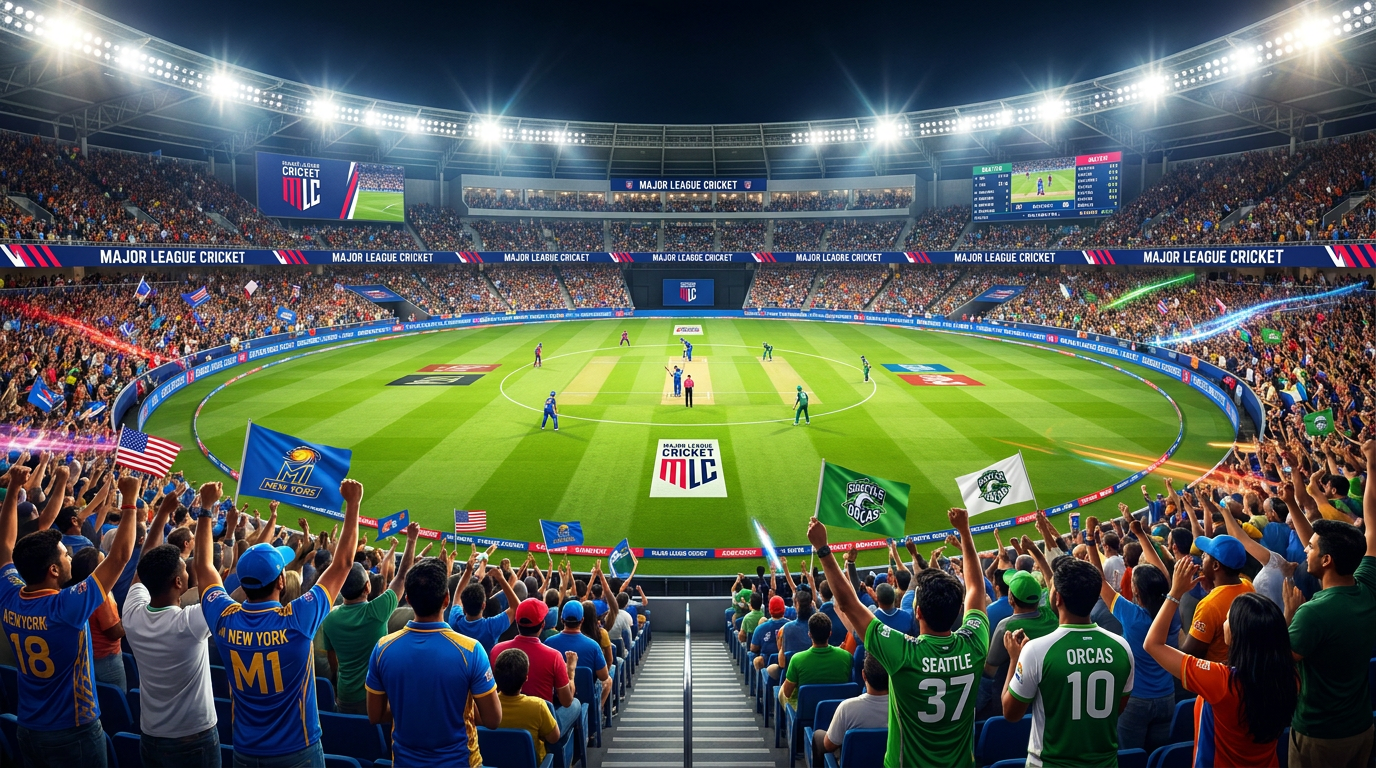
The 2026 season, which officially commenced on June 18, represents the league's most expansive iteration to date. Featuring six city-based franchises—the Texas Super Kings, Seattle Orcas, Los Angeles Knight Riders, MI New York, San Francisco Unicorns, and Washington Freedom—the tournament spans 34 matches over a packed four-week schedule. Opening night at Grand Prairie Stadium in Texas saw veteran South African batsman Faf du Plessis strike a blistering 45-ball century at age 41, signaling that the on-field product remains highly competitive. But while the six-week spectacle provides the immediate entertainment, the true significance of the 2026 season lies in the structural foundation being poured beneath it.[2][5]
The engine driving this transformation is American Cricket Enterprises (ACE), the commercial entity and strategic partner that holds the exclusive rights to develop the US professional T20 league. By the start of the current season, ACE’s cumulative capital investment in American cricket surpassed $150 million. This sustained financial injection is unprecedented in the history of US cricket, shifting the sport's domestic paradigm from amateur passion projects to corporate sports entertainment. The capital is not merely funding player salaries and marketing campaigns; it is being aggressively deployed to solve the single biggest historical barrier to the sport's growth in North America: a severe lack of purpose-built infrastructure.[1][3]

To execute this capital-intensive vision, MLC relies on a franchise ownership model heavily subsidized by the global cricket establishment. Several of the league's six teams are backed by ownership groups from the Indian Premier League (IPL)—the undisputed financial juggernaut of global cricket. Franchises like MI New York and the Texas Super Kings bring not only deep pockets but also decades of operational expertise, scouting networks, and baked-in global fanbases. They are joined by consortiums of Silicon Valley tech executives and venture capitalists who view American cricket as an undervalued asset with massive upside. This hybrid ownership structure bridges the gap between international cricket royalty and American corporate strategy.[6][8]
The most visible manifestation of this investment is the ongoing stadium boom. For years, the lack of international-standard turf wickets forced American national teams to play in substandard conditions or travel abroad. MLC changed that equation by renovating a former minor league baseball park in Texas into Grand Prairie Stadium, a dedicated cricket venue that served as the league's primary hub. Now, the infrastructure footprint is expanding rapidly. ACE and MLC have publicly stated a target of developing ten international-standard cricket venues across the United States by 2030, a goal that would fundamentally rewrite the geographic possibilities for the sport in the Western Hemisphere.[1][4]
This geographic expansion is already highly visible in the 2026 tournament structure. While Grand Prairie remains a vital hub, the league has aggressively pushed onto the West Coast. The historic Oakland Coliseum—formerly the long-time home of Major League Baseball's Athletics and the NFL's Raiders—has been temporarily retrofitted to host top-tier cricket. The Coliseum is slated to host a significant portion of the regular season and will take center stage for the knockout rounds, culminating in the championship final on July 18. Placing a cricket pitch inside a cavernous, 50,000-seat American stadium is a powerful visual statement of the league's mainstream ambitions.[6][7]

An even more consequential infrastructure project is unfolding further south in California. The Knight Riders Group, which owns the Los Angeles franchise, is constructing a brand-new, dedicated cricket ground at the Fairplex in Pomona. Unlike retrofitted baseball stadiums, the Pomona facility is being designed from the ground up specifically for cricket, complete with hospitality suites and elite training environments. Once completed, it will serve as the permanent home for the Los Angeles Knight Riders, providing the sprawling Southern California cricket community with a state-of-the-art focal point that has been demanded for decades.[4][6]
An even more consequential infrastructure project is unfolding further south in California.
The Pomona stadium project is inextricably linked to a much larger global event looming on the horizon: the 2028 Summer Olympics in Los Angeles. After an absence of more than a century, cricket will make its historic return to the Olympic program in 2028. The International Olympic Committee's decision to include the sport was heavily influenced by the untapped commercial potential of the American market. MLC's infrastructure development, particularly in the Los Angeles area, is effectively serving as the runway for the Olympic tournament. The league is building the physical and operational capacity that will be required when the eyes of the sporting world turn to California in two years.[1][4]
Building stadiums is only half the battle; filling them requires a compelling on-field product. To ensure immediate credibility and high-quality play, MLC has aggressively imported some of the biggest names in the sport. The 2026 rosters feature a constellation of global superstars, including Australian luminaries Steve Smith and Glenn Maxwell, alongside West Indian powerhouse Nicholas Pooran and Indian spin maestro Ravichandran Ashwin. These international marquee players serve a dual purpose: they guarantee a world-class standard of play that appeals to global television audiences, and they provide an invaluable learning environment for the domestic players sharing their locker rooms.[2][4]
However, league organizers are acutely aware that a purely imported exhibition league will not sustainably grow the American game. To counter this, MLC enforces a strict domestic quota system. Every starting XI must include a minimum number of US-based players. This mechanism forces franchises to actively scout, draft, and develop local talent rather than relying entirely on overseas mercenaries. It ensures that American players are facing down world-class fast bowlers and batting alongside international legends in high-pressure, broadcasted matches—experience that is critical for elevating the standard of the United States national team.[8]
Feeding this domestic requirement is Minor League Cricket (MiLC), a sprawling developmental system that launched prior to the major league. Featuring 26 teams spread across the country, MiLC serves as the grassroots engine of the American professional pathway. It provides amateur and semi-professional players with regular, structured competition on turf wickets. For the first time in US history, a talented young cricketer in Chicago or Seattle has a clear, visible pathway from local club cricket, through the Minor League system, and ultimately to a professional contract in Major League Cricket.[6][8]

The ultimate test of this massive financial and structural undertaking is consumer demand, and the early metrics are overwhelmingly positive. Following its third season, MLC reported a staggering 53 percent year-over-year increase in ticket sales, resulting in an all-time high in attendance and a third consecutive sold-out championship final. These figures suggest that the novelty of the league's inaugural season has successfully transitioned into sustained, growing interest. The demand for top-tier cricket in the United States is proving to be real and accelerating, validating the aggressive expansion strategies of the ownership groups.[1][3]
Perhaps the most encouraging statistic for the league's long-term viability is the makeup of its audience. According to official league data, 84 percent of ticket purchasers for recent games were first-time buyers. This metric is crucial because it indicates that MLC is successfully breaking out of the established diaspora bubble. While South Asian and Caribbean immigrant communities provided the essential foundational fanbase, the league's marketing and match-day experience are beginning to attract mainstream American sports fans who are discovering the fast-paced, three-hour T20 format for the first time.[3]
Simultaneously, the league is proving its worth as a global media property. The tournament is now broadcast in over 90 countries, reaching an estimated 54 million homes worldwide. This global carriage demonstrates that international cricket fans are willing to tune in to watch matches played in Texas and California, provided the production quality and player caliber meet their expectations. The broadcast revenue and international visibility create a sustainable financial loop, allowing the league to continue attracting top talent and investing in domestic infrastructure.[3][6]

As the 2026 season unfolds across the United States, Major League Cricket stands as a testament to strategic investment and long-term vision. It has taken a sport that was historically marginalized in America and built a thriving, professional ecosystem around it. By combining global star power with grassroots development, and temporary stadium retrofits with permanent infrastructure projects, MLC is doing more than just hosting a summer tournament. It is actively rewiring the global cricket economy and ensuring that when the Olympics arrive in 2028, American cricket will be ready for its moment on the world stage.[4][8]
How we got here
2019
American Cricket Enterprises (ACE) is established to build a professional T20 league in the United States.
2021
Minor League Cricket launches as a developmental pathway with 26 teams across the country.
July 2023
Major League Cricket plays its inaugural season at the newly renovated Grand Prairie Stadium in Texas.
2025
The league expands its footprint to the West Coast, hosting matches at the Oakland Coliseum.
June 2026
Season 4 launches with record ticket sales and a new dedicated stadium project in Pomona, California.
2028
Cricket will make its historic return to the Summer Olympics in Los Angeles, utilizing MLC infrastructure.
Viewpoints in depth
The Commercial Investors' View
Focuses on the financial upside and infrastructure growth of the American market.
For the IPL franchises and Silicon Valley venture capitalists backing the league, the United States represents the final untapped frontier for global cricket. They view the $150 million capital injection not as a sunk cost, but as a strategic land grab in a market with immense media rights potential. Their primary focus is rapidly scaling infrastructure to support a premium broadcast product, believing that the fast-paced T20 format perfectly aligns with American sports consumption habits.
The Grassroots Development View
Prioritizes the creation of professional pathways for domestic American talent.
Local cricket administrators and community leaders celebrate the league's arrival but remain hyper-focused on the domestic quota system and Minor League Cricket. From this perspective, the imported global superstars are merely a means to an end. The true measure of MLC's success will be whether it can consistently produce homegrown American players capable of competing on the international stage, transforming the sport from an immigrant pastime into a multi-generational American pursuit.
What we don't know
- Whether the league can sustain its rapid ticket sales growth once the novelty of the initial seasons wears off.
- How quickly the new Pomona stadium will be completed ahead of the 2028 Los Angeles Olympics.
- If the domestic talent pipeline will produce a breakout American star capable of drawing mainstream national media attention.
Key terms
- T20 (Twenty20)
- A shortened, fast-paced format of cricket where each team bats for a maximum of 20 overs, usually completed in about three hours.
- American Cricket Enterprises (ACE)
- The commercial entity and strategic partner backing Major League Cricket with over $150 million in investments.
- Domestic Quota
- A league rule requiring a minimum number of US-based players in each team's starting lineup to foster local talent.
- Minor League Cricket (MiLC)
- The 26-team developmental feeder league that provides a pathway for amateur American players to reach the professional level.
Frequently asked
When does the 2026 MLC season take place?
The fourth season runs from June 18 to July 18, 2026, featuring 34 matches.
Where are the matches being played?
Games are split between Grand Prairie Stadium in Texas, the Oakland Coliseum in California, and the new Knight Riders Cricket Field in Pomona.
Are there famous players in the league?
Yes, international stars like Steve Smith, Glenn Maxwell, and Faf du Plessis compete alongside domestic American talent.
How does this connect to the Olympics?
Cricket is returning to the Olympics at the 2028 Los Angeles Games, and MLC's infrastructure—particularly the new Pomona stadium—is being built to support that event.
Sources
Source coverage
8 outlets
3 viewpoints surfaced








[1]ForbesLeague Organizers & Investors
ACE investment in U.S. cricket passes $150 million
Read on Forbes →[2]WisdenGlobal Cricket Establishment
MLC 2026 squads: Full teams lists, injury news and replacement updates
Read on Wisden →[3]Major League CricketLeague Organizers & Investors
Season 4 to be held 18 June to 18 July 2026
Read on Major League Cricket →[4]American BazaarLocal American Communities
Major League Cricket returns amid America's Olympic push
Read on American Bazaar →[5]NDTV ProfitLeague Organizers & Investors
MLC Season 4 returns on June 18
Read on NDTV Profit →[6]WikipediaGlobal Cricket Establishment
2026 Major League Cricket season
Read on Wikipedia →[7]Visit OaklandLocal American Communities
Major League Cricket Comes to Oakland
Read on Visit Oakland →[8]Heega SportsLocal American Communities
How Major League Cricket is Transforming Cricket in the USA
Read on Heega Sports →

More in sports
See all 6 stories →NWSL Expansion
NWSL Shatters Attendance Records as Utah Royals Mount Historic 10-Game Unbeaten Streak
7 sources
Injury
Ilia Topuria Avoids Surgery for Orbital Fractures Following UFC Freedom 250 Title Bout
9 sources
Standings
UFC Championship Picture: Gaethje and Gane Claim Gold as Standings Reshuffle
8 sources
Injury
June 2026 Golf Injury Report: Morikawa Contends Through Pain as Day, Thompson, and Koepka Face Setbacks
9 sources

Every angle. Every day.
Get sports stories with full source coverage and perspective breakdowns delivered to your inbox.