
Lab-Grown vs. Natural Diamonds: The 2026 Guide to Prices, Resale, and Eco-Impact
As lab-grown diamonds capture the majority of the engagement ring market, the price gap with natural stones has widened to 85 percent. We break down the trade-offs in cost, environmental impact, and long-term value to help buyers navigate the new jewelry landscape.
By Factlen Editorial Team
- Lab-Grown Pragmatists
- View diamonds purely for their aesthetic and material properties, prioritizing cost-efficiency.
- Natural Diamond Traditionalists
- Argue that true luxury requires geological rarity and a billion-year backstory.
- Eco-Conscious Consumers
- Focus entirely on the environmental and human impact of the diamond's origin.
What's not represented
- · Diamond Mine Workers
- · Pawn Shop Appraisers
Why this matters
Choosing a diamond is one of the most expensive emotional purchases a consumer makes. Understanding the hidden environmental costs and the collapsing resale value of lab-grown stones ensures buyers align their budget with their actual priorities, avoiding costly regrets.
Key points
- Lab-grown diamonds now account for up to 61% of center stones in U.S. engagement rings.
- A 1-carat lab-grown diamond costs 75% to 90% less than an identical natural diamond.
- Natural diamonds retain 20% to 60% of their value on resale, while lab-grown stones retain only 10% to 40%.
- Lab-grown diamonds produced with fossil fuels emit more CO2 than mined diamonds, but renewable-powered labs emit far less.
- De Beers has closed its lab-grown brand Lightbox to refocus entirely on the rarity of natural stones.
The diamond market has fundamentally fractured. In 2026, lab-grown stones account for up to 61 percent of all center stones in U.S. engagement rings, a staggering rise driven by economic pragmatism and shifting consumer values.[1]
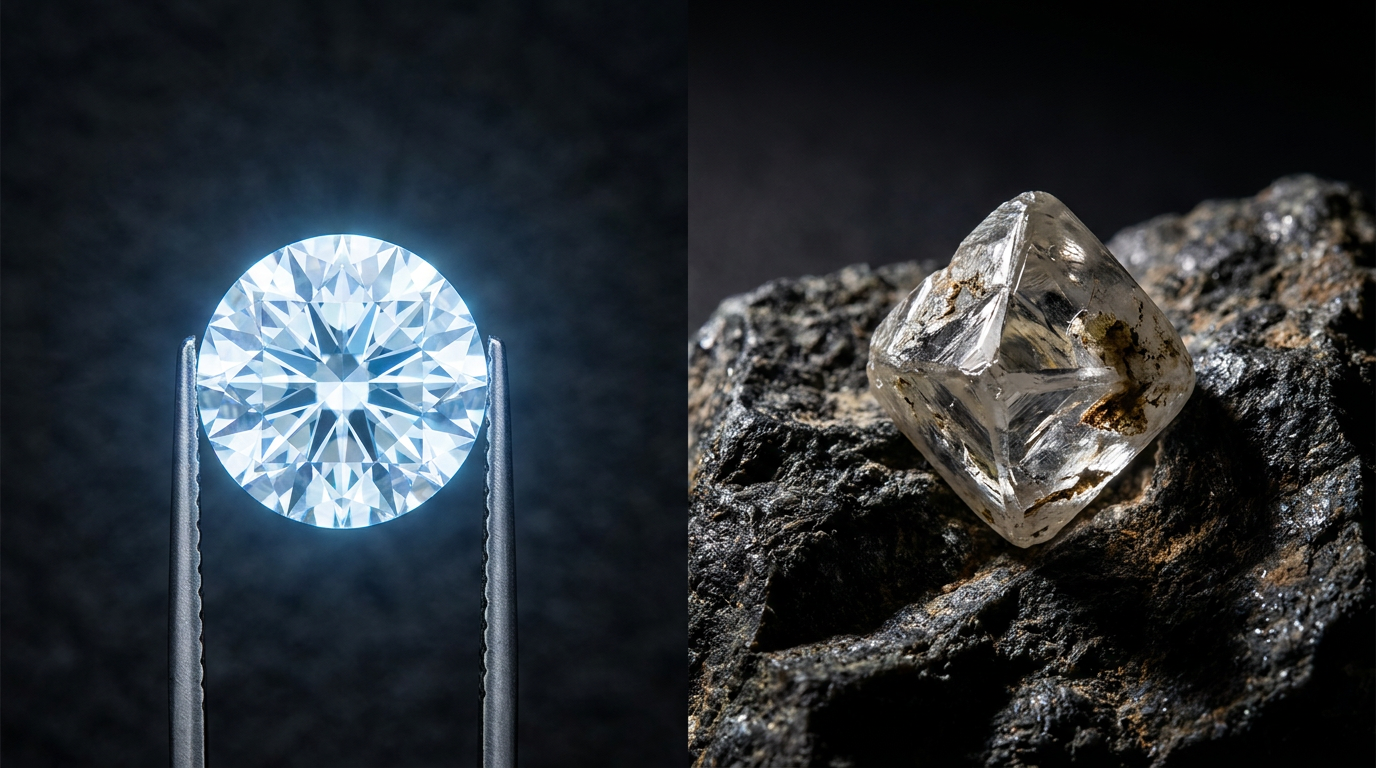
To the naked eye—and even to a trained jeweler without specialized spectroscopic equipment—a lab-grown diamond and a natural diamond are indistinguishable. Both are pure carbon arranged in a cubic crystal structure, both score a perfect 10 on the Mohs hardness scale, and both deliver the exact same optical brilliance.[5][6]
Yet, beneath this identical surface lies a complex web of trade-offs regarding price, environmental footprint, and long-term financial value. The decision between the two is no longer just a matter of preference; it is a calculation of what a buyer truly values in a luxury purchase.
The most immediate trade-off for consumers is the upfront cost. The argument for lab-grown diamonds is anchored in massive savings, allowing buyers to upgrade their carat size or simply keep cash in the bank.
The argument against them is that this cheapness strips away the traditional scarcity premium that defined fine jewelry. The evidence is stark: as of 2026, lab-grown diamonds retail for 75 to 90 percent less than their natural counterparts.[6]
A 1-carat natural diamond of excellent cut and clarity averages between $4,200 and $6,800, while an identical lab-grown stone can be purchased for $800 to $1,500. This price gap has widened consistently as laboratory production capacity has scaled globally, fundamentally resetting consumer expectations around size and budget.[5][7]

However, the upfront savings of lab-grown stones come with a severe penalty on the secondary market. The argument for natural diamonds centers on their historical ability to act as a store of value, while the argument against lab-grown stones highlights their rapid depreciation.
The evidence shows that natural diamonds typically retain 20 to 60 percent of their original retail price upon resale. In contrast, lab-grown diamonds currently hold only 10 to 40 percent of their purchase price, and the wholesale market for used lab stones is exceptionally thin.[5][10]
Because new production continues to push wholesale prices down—with some lab stones trading for under $150 per carat—jewelers are increasingly reluctant to offer buy-back programs for synthetic gems. Buyers must accept that money spent on a lab-grown diamond is entirely sunk.[7][10]

Buyers must accept that money spent on a lab-grown diamond is entirely sunk.
The environmental comparison presents the most nuanced trade-off. The argument for lab-grown diamonds is that they eliminate the need for destructive open-pit mining, which displaces wildlife and disrupts local ecosystems.
The argument against them is their hidden carbon footprint, as the high-pressure, high-temperature processes require immense amounts of electricity. The evidence reveals a split reality depending entirely on the laboratory's energy source.
Extracting a natural diamond emits approximately 160 kilograms of carbon dioxide per carat. If a lab-grown diamond is produced in a facility powered by fossil fuels—as is common in major manufacturing hubs like China and India—its emissions can soar to 511 kilograms per carat.[8][9]
Conversely, laboratories running on 100 percent renewable energy can produce a diamond with a footprint of less than 20 kilograms of carbon dioxide. This makes origin tracing just as critical for synthetic stones as it is for mined ones.[9]

This shifting landscape has forced a historic reckoning for legacy institutions. De Beers, the company that effectively built the modern diamond market, has faced billions in write-downs and recently closed its own lab-grown brand, Lightbox, to refocus entirely on the rarity of natural stones.[3]
Parent company Anglo American is actively attempting to sell or spin off the De Beers business by the first half of 2026. To survive, the natural diamond industry is pivoting its marketing away from mere sparkle and toward the emotional weight of a billion-year-old geological creation.[3][4]
Navigating these trade-offs requires buyers to clarify their primary motivations. A lab-grown diamond fits well when the consumer prioritizes maximum visual impact and carat size on a strict budget. It is the ideal choice for buyers who view an engagement ring as a beautiful piece of wearable art rather than a financial asset.

It also fits perfectly for eco-conscious shoppers who take the extra step to verify that their specific diamond was synthesized using certified renewable energy, thereby guaranteeing a genuinely low-impact, conflict-free origin.
Conversely, a lab-grown diamond does not fit when the buyer expects the jewelry to serve as a financial safety net or an heirloom that retains monetary value for future generations. It is also a poor fit for consumers who are uncomfortable with the idea that their luxury purchase is essentially a manufactured technology product.
A natural diamond fits well when the buyer places a high premium on geological rarity, legacy, and the romantic notion of a stone forged deep within the Earth billions of years ago. It is the right choice for those who want a stable store of relative value.
A natural diamond does not fit when the buyer is operating on a tight budget but still desires a large, flawless center stone. Finally, it does not fit when the consumer holds strict zero-extraction environmental principles, as even the most responsible mining operations inevitably leave lasting physical scars on the planet's surface.
How we got here
2018
Lab-grown diamonds begin gaining mainstream traction, costing roughly 30-40% less than natural stones.
2021
The price gap widens to 60%, and lab-grown stones start capturing significant market share in the bridal sector.
2024
Lab-grown diamonds surpass 50% market share for center stones in U.S. engagement rings.
2025
De Beers closes its lab-grown brand, Lightbox, citing a collapse in wholesale prices and a strategic pivot back to natural rarity.
2026
Lab-grown diamonds retail for up to 90% less than natural stones, prompting legacy miners to restructure and sell off major assets.
Viewpoints in depth
Natural Diamond Traditionalists
Argue that true luxury requires geological rarity and a billion-year backstory.
This camp, heavily supported by legacy miners like De Beers, emphasizes that a diamond's value comes from its finite supply and natural creation. They point to the collapsing wholesale prices of lab-grown stones as proof that manufactured gems are closer to consumer electronics than fine jewelry, arguing that only natural stones can serve as meaningful, value-retaining heirlooms.
Lab-Grown Pragmatists
View diamonds purely for their aesthetic and material properties, prioritizing cost-efficiency.
This perspective argues that since lab-grown and natural diamonds are chemically and optically identical, paying a 500 percent premium for a "dirt-mined" stone is irrational. They advocate using the massive savings to buy a larger center stone, invest in a higher-quality setting, or simply save the money for a house down payment, dismissing resale value concerns by noting that engagement rings are rarely sold anyway.
Eco-Conscious Consumers
Focus entirely on the environmental and human impact of the diamond's origin.
This camp rejects natural diamonds due to the unavoidable land destruction and historical human rights issues associated with open-pit mining. However, they are increasingly critical of cheap lab-grown diamonds produced in coal-heavy regions. They advocate exclusively for lab-grown stones certified under standards like SCS-007, which guarantee the use of 100 percent renewable energy and a net-zero carbon footprint.
What we don't know
- Whether the wholesale price of lab-grown diamonds has finally reached a permanent production-cost floor, or if further technological leaps will drive prices even lower.
- How the potential sale of De Beers in 2026 will restructure the global supply chain and marketing efforts for natural diamonds.
- Whether secondary markets will eventually emerge for premium, renewable-certified lab-grown diamonds, or if they will remain entirely depreciative assets.
Key terms
- Chemical Vapor Deposition (CVD)
- A method of growing diamonds in a lab by placing a diamond seed in a chamber filled with carbon-rich gas, which bonds to the seed layer by layer.
- High-Pressure High-Temperature (HPHT)
- A lab-grown diamond creation process that mimics the extreme heat and pressure found deep within the Earth's mantle.
- Mohs Hardness Scale
- A scientific scale used to measure the scratch resistance of minerals. Both natural and lab-grown diamonds score a perfect 10, making them the hardest known minerals.
- Scarcity Premium
- The additional financial value attached to an item—like a natural diamond—simply because it is rare and finite in supply.
Frequently asked
Can a jeweler tell the difference between lab-grown and natural diamonds?
Not with the naked eye or a standard jeweler's loupe. Identifying a lab-grown diamond requires specialized spectroscopic equipment to detect microscopic crystal growth patterns.
Are lab-grown diamonds fake or cubic zirconia?
No. Lab-grown diamonds are pure carbon and are chemically, physically, and optically identical to natural diamonds. Cubic zirconia is a different, much softer material.
Will a lab-grown diamond get cloudy over time?
No. Because they share the exact same physical properties as natural diamonds, lab-grown diamonds will not fade, cloud, or change color over time.
Why are lab-grown diamond prices dropping so fast?
As laboratory technology improves and global manufacturing capacity expands, the cost to produce each carat drops. This infinite supply model continuously pushes retail and wholesale prices down.
Sources
Source coverage
10 outlets
3 viewpoints surfaced









[1]National JewelerEco-Conscious Consumers
The State of Diamonds: Repositioning Natural Stones Amid Lab-Grown Dominance
Read on National Jeweler →[2]CaratXEco-Conscious Consumers
De Beers Strategic Price Cut & The 2026 Diamond Market: A Survival Guide for Jewellers
Read on CaratX →[3]Draco DiamondNatural Diamond Traditionalists
The Sale Nobody Wants to Buy: Anglo American's Exit from De Beers
Read on Draco Diamond →[4]De Beers GroupNatural Diamond Traditionalists
US Diamond Acquisition Study 2026: Natural Diamonds Remain Top Luxury Preference
Read on De Beers Group →[5]Tashvi AILab-Grown Pragmatists
Lab Grown vs Natural Diamonds 2026: What Jewelers Skip
Read on Tashvi AI →[6]Vanhess JewelleryLab-Grown Pragmatists
Lab-Grown vs Natural Diamonds: The Price Gap and Why It's Getting Bigger
Read on Vanhess Jewellery →[7]GoodstoneEco-Conscious Consumers
What Happens to Lab-Grown Diamond Prices Over Time?
Read on Goodstone →[8]Robbins BrothersEco-Conscious Consumers
Understanding the Environmental Impact of Natural and Lab-Grown Diamonds
Read on Robbins Brothers →[9]LaurediEco-Conscious Consumers
The Environmental Impact of Naturally Mined Diamonds vs. Lab-Grown Alternatives
Read on Lauredi →[10]Liori DiamondsLab-Grown Pragmatists
The Real Resale Value of Lab Grown Diamonds in 2026
Read on Liori Diamonds →

Every angle. Every day.
Get shopping stories with full source coverage and perspective breakdowns delivered to your inbox.