
Inside Africa's Great Green Wall: The Evolution of the World's Most Ambitious Climate Project
Launched to halt the Sahara's expansion, the Great Green Wall has evolved from a literal line of trees into a continent-wide mosaic of sustainable agriculture. As the 2030 deadline approaches, the initiative is transforming Sahelian economies despite severe funding and security hurdles.
By Factlen Editorial Team
- Pan-African Agencies & UN
- Focuses on the macro vision, international funding mobilization, and the ambitious 2030 targets.
- Ecological Researchers
- Focuses on the scientific realities of land restoration, survival rates, and the shift to a mosaic approach.
- Local Sahelian Communities
- Focuses on immediate economic benefits, food security, and localized agricultural success.
- Editorial Synthesis
- Provides a comprehensive overview bridging the macro targets with on-the-ground realities.
What's not represented
- · Nomadic pastoralists whose traditional grazing routes are altered by the new agricultural zones
- · Private sector carbon market investors evaluating the financial viability of the restored land
Why this matters
The Great Green Wall is the primary defense mechanism for millions of people living on the front lines of climate change. Its success or failure will dictate the food security, economic stability, and migration patterns of the entire African continent for decades to come.
Key points
- The Great Green Wall aims to restore 100 million hectares of degraded land across the Sahel by 2030.
- The strategy shifted in 2013 from planting a literal wall of trees to creating a mosaic of sustainable agriculture.
- Senegal has successfully utilized the project to empower women's cooperatives through market gardens and forage banks.
- Despite $19 billion in international pledges, bureaucratic bottlenecks have slowed the disbursement of funds to local communities.
- Security challenges in the central Sahel continue to hinder implementation in conflict-heavy regions.
Stretching 8,000 kilometers across the breadth of the African continent, the Great Green Wall is arguably the most ambitious environmental restoration project in human history. Conceived to span from the Atlantic coast of Senegal to the Red Sea coast of Djibouti, the initiative targets the Sahel—the vast, semi-arid transitional zone separating the Sahara Desert from the tropical savannas to the south. Launched by the African Union in 2007, the project was born out of an urgent need to halt the encroaching desertification that threatened to swallow millions of hectares of arable land. Today, it involves 22 African countries and aims to fundamentally transform the ecological and economic trajectory of one of the world's most climate-vulnerable regions.[1][8]
The stakes in the Sahel are existential. The United Nations estimates that temperatures in the region are rising faster than almost anywhere else on Earth, with projections suggesting increases of up to 3 to 5 degrees Celsius by 2050. This rapid warming, combined with irregular rainfall and historical overgrazing, has severely degraded the soil, driving food insecurity and forcing millions into climate-induced migration. For the communities living along this fragile belt, land degradation is not merely an environmental issue; it is a direct threat to their livelihoods, peace, and survival. The Great Green Wall was designed as a continent-wide defense mechanism against these converging crises.[1][7]
In its original 2007 iteration, the Great Green Wall was envisioned quite literally: a continuous, 15-kilometer-wide barrier of drought-resistant trees planted across the continent. The idea provided a powerful, easily digestible symbol of pan-African unity and environmental defiance. However, early implementation efforts quickly revealed the limitations of this simplistic approach. Planting millions of non-native saplings in a harsh, arid environment without adequate water infrastructure or community buy-in resulted in high mortality rates. In many early trial zones, newly planted trees simply withered in the dry season or were quickly consumed by roaming herds of livestock.[4][6]

Recognizing these failures, the initiative underwent a profound strategic pivot around 2013. Scientists and development agencies realized that combating desertification required more than just dropping seeds into the sand; it required a holistic approach to rural development. The vision evolved from a literal wall of trees into a "mosaic" of green and productive landscapes. This modern approach prioritizes sustainable land management, water harvesting techniques, the protection of existing indigenous flora, and the development of community-led agroforestry. By focusing on creating localized green basins rather than a continuous forest, the project became far more adaptable to the diverse ecological realities of the Sahel.[5][6][8]
The updated strategy also explicitly tied ecological restoration to immediate economic benefits for local populations. The initiative's official 2030 targets are staggering in their ambition: restore 100 million hectares of degraded land, sequester 250 million tons of carbon, and create 10 million green jobs. By integrating agriculture and livestock management into the restoration process, the Great Green Wall ensures that local farmers and pastoralists are the primary beneficiaries. When communities see tangible improvements in crop yields and livestock fodder, they become the natural stewards of the restored land, ensuring the project's long-term survival.[1][8]
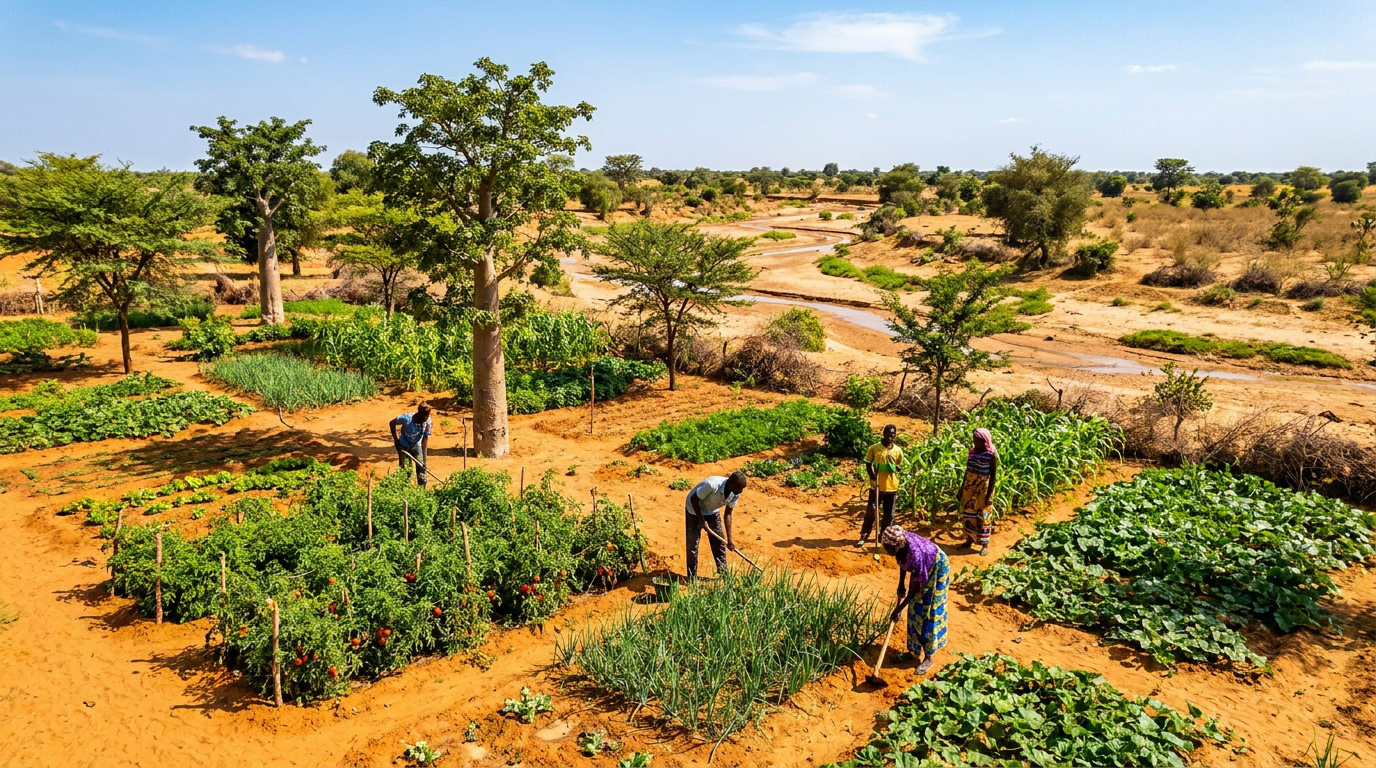
Senegal has emerged as one of the most prominent success stories of this community-centric model. In the country's northern Louga region, the Great Green Wall has catalyzed the creation of women-led agricultural cooperatives. These groups manage multipurpose gardens that produce drought-resistant crops alongside fruit-bearing trees like baobab and citrus. The restored land provides a reliable source of income and nutrition during the lean season, allowing families to keep their children in school and pay for medical care. Furthermore, the cultivation of forage banks has reduced the need for nomadic herders to migrate long distances, easing local resource conflicts.[3][4]

Senegal has emerged as one of the most prominent success stories of this community-centric model.
On the eastern edge of the continent, Ethiopia has taken a different but equally massive approach to the initiative. Leveraging a deep-rooted cultural reverence for trees, the Ethiopian government has integrated Great Green Wall objectives into its national natural resource management programs. Between 2019 and 2022, the country reported planting an astonishing 25 billion seedlings. While ecological researchers note that some of these efforts fall outside the official geographic boundaries of the Great Green Wall, the sheer scale of Ethiopia's mobilization has resulted in the restoration of millions of hectares of degraded land, making it the largest single contributor to the initiative's overall acreage.[5]
Despite these localized triumphs, the continent-wide progress of the Great Green Wall has been uneven. A comprehensive review commissioned by the United Nations Convention to Combat Desertification revealed that by the early 2020s, only a fraction of the 100-million-hectare target had been officially met—with estimates ranging from 4% to 15% completion. Researchers point out that while the social and economic impacts in active zones are highly encouraging, the ecological restoration is lagging behind the initial timeline. The sheer logistical complexity of coordinating across a dozen national governments, each with varying levels of institutional capacity, has slowed the pace of implementation.[3][6]
Funding remains the most critical bottleneck. In 2021, French President Emmanuel Macron hosted the One Planet Summit, which launched the Great Green Wall Accelerator and secured approximately $19 billion in international pledges to revitalize the project. The African Development Bank emerged as a leading partner, committing $6.5 billion to support Sahelian countries through various agricultural and climate resilience programs. However, African officials and project managers frequently note a frustrating disconnect between high-level international pledges and the actual disbursement of funds to grassroots organizations. Complex bureaucratic requirements often prevent the money from reaching the communities doing the physical work of land restoration.[2][3][7]

The financial architecture of the initiative took center stage at the 30th United Nations Climate Change Conference (COP30) in Belém, Brazil, in late 2025. During the summit, the African Development Bank and the Pan-African Agency of the Great Green Wall urged the global community to scale up financing to meet the looming 2030 deadline. Leaders emphasized that relying solely on traditional public grants is no longer sufficient. To bridge the funding gap, the initiative is increasingly looking toward innovative financial mechanisms, including blended finance, green bonds, and the burgeoning African carbon market, which could theoretically unlock billions in revenue by monetizing the carbon sequestered by the newly restored landscapes.[2][8]
Beyond finance, the Great Green Wall faces severe geopolitical headwinds. The central Sahel—particularly the tri-border region between Mali, Burkina Faso, and Niger—has been engulfed by a deadly militant insurgency for years. Armed conflict and political instability make it nearly impossible to execute long-term environmental projects in these areas. Development agencies are forced to suspend operations when the safety of their workers cannot be guaranteed, leaving massive geographic gaps in the "wall." Navigating this security crisis is essential, as the environmental degradation and poverty that the initiative seeks to cure are the very same factors that drive recruitment for extremist groups.[7][8]
To improve transparency and coordination, the United Nations recently launched the Great Green Wall Observatory, an online platform designed to track funding and monitor the progress of over 350 active projects across the Sahel. This data-driven approach aims to reassure international donors that their investments are yielding measurable results. By utilizing satellite imagery and participatory community mapping, the Observatory provides a clearer picture of where the mosaic is thriving and where interventions are failing, allowing agencies to dynamically adjust their strategies based on real-time ecological feedback.[1][8]

As the 2030 deadline approaches, it is increasingly clear that the Great Green Wall will not be "completed" in the traditional sense within the next four years. The 100-million-hectare target was always an aspirational north star rather than a strict construction schedule. However, the initiative has already succeeded in fundamentally changing how African nations, international donors, and local communities approach land management in dryland ecosystems. The shift away from isolated tree-planting toward integrated, community-owned ecological restoration represents a permanent evolution in climate adaptation strategy.[6][8]
Ultimately, the legacy of the Great Green Wall will not be measured by a continuous line of trees visible from space, but by the resilience of the communities living within its shade. Every hectare of restored land represents a family that can feed itself during a drought, a well that retains water through the dry season, and a local economy that can withstand the shocks of a warming planet. Whether it takes until 2030 or 2050, the ongoing effort to regreen the Sahel stands as a testament to human ingenuity and the necessity of collaborative survival in the face of the climate crisis.[4][8]
How we got here
2007
The African Union officially launches the Great Green Wall initiative to combat desertification.
2013
The project strategy pivots from planting a literal wall of trees to a holistic 'mosaic' of sustainable land management.
Jan 2021
The One Planet Summit secures $19 billion in international pledges and launches the GGW Accelerator.
Dec 2025
At COP30 in Brazil, leaders push for innovative financing and carbon markets to bridge funding gaps.
2030
The target deadline to restore 100 million hectares, sequester 250 million tons of carbon, and create 10 million jobs.
Viewpoints in depth
Pan-African Agencies & UN
Focuses on the macro vision, international funding mobilization, and the ambitious 2030 targets.
Organizations like the UNCCD and the African Development Bank view the Great Green Wall as a continent-wide economic and environmental engine. They emphasize the necessity of massive capital mobilization—such as the $19 billion pledged in 2021—and argue that the initiative is the ultimate defense against climate-induced migration and poverty. For these agencies, the primary hurdles are coordinating 22 national governments and unlocking private-sector blended finance to supplement public grants.
Ecological Researchers
Focuses on the scientific realities of land restoration, survival rates, and the shift to a mosaic approach.
Scientists and geographers emphasize that simply planting trees in a desert is a doomed strategy. They championed the 2013 pivot away from a literal 'wall' toward a mosaic of agroforestry and water harvesting. This camp frequently points out the discrepancy between political claims and ecological reality, noting that while millions of seedlings are planted, survival rates can be low if local communities aren't engaged. They measure success by soil health and biodiversity rather than raw acreage.
Local Sahelian Communities
Focuses on immediate economic benefits, food security, and localized agricultural success.
For the farmers, pastoralists, and women's cooperatives living along the Sahel, the Great Green Wall is primarily a rural development project. Their support hinges on tangible, near-term benefits: forage banks that feed their cattle during the dry season, and market gardens that provide income and nutrition. From this perspective, the initiative is successful when it provides green jobs and prevents the need to migrate, regardless of whether the continent-wide 2030 targets are met.
What we don't know
- Whether the international community will fully disburse the $19 billion pledged during the 2021 One Planet Summit.
- How the burgeoning African carbon market will practically monetize the carbon sequestered by the restored landscapes.
- The exact percentage of the 100-million-hectare target that has been ecologically verified, due to varying national reporting standards.
Key terms
- Sahel
- A vast, semi-arid geographic region in Africa that serves as a transitional zone between the Sahara Desert to the north and the tropical savannas to the south.
- Desertification
- The process by which fertile land becomes desert, typically as a result of drought, deforestation, or inappropriate agriculture.
- Agroforestry
- A land management system where trees or shrubs are grown around or among crops and pastureland to improve biodiversity and soil health.
- Blended finance
- The strategic use of public or philanthropic development capital to mobilize additional private commercial investment for sustainable projects.
- Forage banks
- Designated areas where fast-growing, drought-resistant plants are cultivated specifically to provide reliable food for livestock during dry seasons.
Frequently asked
Is the Great Green Wall an actual wall of trees?
No. While originally conceived as a literal 15-kilometer-wide line of trees, the project evolved into a 'mosaic' of sustainable farming, water harvesting, and protected natural landscapes.
Which countries are involved in the project?
The initiative spans 22 African countries, with primary interventions focused on the 11 nations traversing the Sahel from Senegal in the west to Djibouti in the east.
Will the project be finished by 2030?
It is highly unlikely. Current estimates suggest only 4% to 15% of the 100-million-hectare target has been met, though the project has permanently improved regional land management strategies.
Who is funding the Great Green Wall?
Funding comes from a mix of international donors, including the African Development Bank, the World Bank, the European Union, and various UN agencies, totaling billions in pledges.
Sources
Source coverage
8 outlets
4 viewpoints surfaced







[1]United Nations Convention to Combat DesertificationPan-African Agencies & UN
The Great Green Wall Initiative
Read on United Nations Convention to Combat Desertification →[2]African Development BankPan-African Agencies & UN
At COP30, AfDB, development partners call for major new financing to accelerate Africa's Great Green Wall initiative
Read on African Development Bank →[3]MongabayEcological Researchers
Progress is slow on Africa's Great Green Wall, but some bright spots bloom
Read on Mongabay →[4]TIMELocal Sahelian Communities
The Great Green Wall: Africa's Audacious Plan to Hold Back the Sahara
Read on TIME →[5]American ScientistEcological Researchers
The Great Green Wall
Read on American Scientist →[6]EnabelPan-African Agencies & UN
What progress has been made on the Great Green Wall in the Sahel?
Read on Enabel →[7]AfricanewsLocal Sahelian Communities
AfDB pledges $6.5bn to help Sahel countries fight desertification
Read on Africanews →[8]Factlen Editorial TeamEditorial Synthesis
Synthesis by Factlen editorial team
Read on Factlen Editorial Team →
Every angle. Every day.
Get world stories with full source coverage and perspective breakdowns delivered to your inbox.