
Induction vs. Gas Cooktops: The 2026 Upgrade Guide
As induction technology reaches price parity and health concerns over gas emissions grow, the debate over the best home cooktop has shifted. We break down the performance, costs, and trade-offs of upgrading your kitchen in 2026.
By Factlen Editorial Team
- Health & Environmental Advocates
- Prioritize the phase-out of gas appliances to improve indoor air quality and reduce fossil fuel reliance.
- Practical Upgraders
- Focus on the total cost of ownership, ease of maintenance, and daily convenience.
- Culinary Traditionalists
- Value the tactile feedback, visual cues, and cookware versatility of traditional gas ranges.
What's not represented
- · Renters who cannot choose their appliances
- · Off-grid homeowners reliant on propane
Why this matters
Choosing between induction and gas directly impacts your home's indoor air quality, energy bills, and renovation budget. Understanding the trade-offs ensures a kitchen upgrade that fits your cooking style and health priorities.
Key points
- Induction cooktops use magnetic fields to heat pans directly, achieving 90% energy efficiency compared to gas's 40%.
- Boiling water on an induction stove takes roughly half the time of a high-output gas burner.
- Health concerns over indoor nitrogen dioxide emissions have accelerated the shift away from residential gas stoves.
- Switching to induction requires magnetic cookware, meaning pure copper and aluminum pans will not work.
- While appliance costs have reached parity, necessary electrical panel upgrades can make retrofitting induction expensive.
For decades, the hierarchy of home cooking appliances was universally understood: gas was the undisputed king of the serious kitchen, while electric coils were the budget fallback. But as we navigate 2026, the landscape has fundamentally shifted. Induction technology has rapidly matured, transforming from a pricey, misunderstood niche into the standard-bearer for modern kitchen upgrades. This shift isn't just about culinary trends; it sits at the intersection of public health, energy efficiency, and home economics.[1][3]
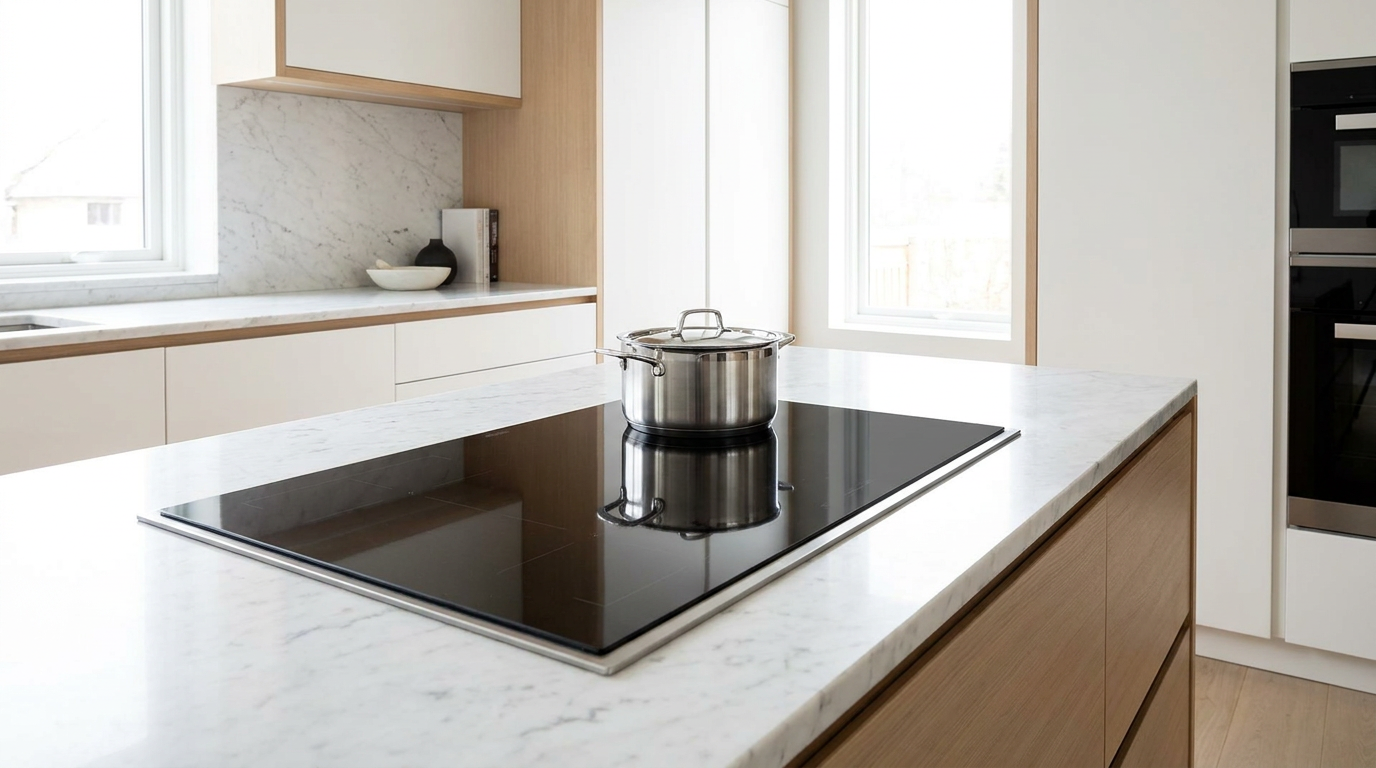
The core of the debate lies in the mechanism of heat transfer. Gas stoves rely on combustion, igniting a fossil fuel to create an open flame that heats the air, the grates, and eventually the pan. Induction, by contrast, uses copper coils beneath a glass surface to generate an alternating magnetic field. This field induces an electrical current directly inside the cookware itself. The pan becomes the heater, while the cooktop surface remains relatively cool. This fundamental difference in physics drives all the downstream trade-offs in speed, safety, and efficiency.[2][6]
When it comes to raw speed and power, induction possesses a distinct advantage. Boiling a large pot of pasta water—the classic benchmark of stove performance—takes roughly three to four minutes on a high-end induction cooktop. Achieving the same rolling boil on a high-output gas burner takes nearly double that time. Because induction bypasses the thermal bottleneck of heating the surrounding air, it delivers energy to the water with startling rapidity.[2][3]

Precision and control offer a more nuanced comparison. Gas has long been praised for its intuitive visual feedback; cooks can instantly gauge the heat level by looking at the height of the flame. However, modern induction offers digital precision that gas simply cannot match. An induction cooktop can hold a perfect, barely-there simmer for hours without the need for a double boiler, a feat gas struggles with due to ambient heat loss and the risk of the flame blowing out.[5]
Historically, professional kitchens relied entirely on gas, cementing its reputation as the chef's choice. But a wave of high-profile restaurateurs and culinary professionals have transitioned to induction in recent years. They cite dramatically cooler kitchen environments, easier end-of-night cleanup, and highly consistent results across different stations. While some old-school chefs resist the change, the culinary consensus is rapidly shifting toward magnetic cooking.[1][5]
The physics of induction also make it incredibly efficient. Approximately 90 percent of the energy consumed by an induction element goes directly into heating the food. Gas, by contrast, is notoriously wasteful; it loses about 60 percent of its heat to the surrounding air. This not only wastes energy but also forces home air conditioning systems to work harder to cool the kitchen during summer months.[6][7]
Beyond energy bills, indoor air quality has become the most significant driver of the shift away from gas. Gas stoves emit nitrogen dioxide, carbon monoxide, and fine particulate matter, sometimes even when turned off. The Environmental Protection Agency and various public health organizations have increasingly flagged these emissions as significant contributors to poor indoor air quality and respiratory issues, particularly childhood asthma.[1][4]

Because of these emissions, gas stoves strictly require powerful, externally vented range hoods to maintain a safe indoor environment. While induction cooktops still require ventilation to clear cooking odors, smoke from searing meat, and aerosolized grease, they do not produce toxic combustion byproducts. This lowers the barrier for safe installation, especially in older homes or apartments where routing a new exhaust duct to the exterior is structurally impossible.[4][7]
Because of these emissions, gas stoves strictly require powerful, externally vented range hoods to maintain a safe indoor environment.
Safety features further differentiate the two technologies. Induction cooktops remain relatively cool to the touch; the glass surface only gets warm from the residual heat transferring back from the hot pan. There is no open flame to catch a stray dish towel, no risk of a gas leak if a dial is accidentally bumped, and the burners automatically shut off when the pan is removed. For households with young children or aging adults, this peace of mind is a major selling point.[2][3]
The most common hurdle for new induction users is cookware compatibility. Because the technology relies entirely on magnetic fields, pots and pans must contain a sufficient amount of ferrous metal. Cast iron, enameled cast iron, and most modern stainless steel work perfectly. However, pure copper, aluminum, and glass cookware will not heat up at all. Upgrading to induction often requires a partial or total replacement of a kitchen's cookware arsenal.[3][7]

The initial cost of entry also remains a factor. While prices have fallen significantly over the last five years, induction ranges still carry a premium over basic gas or radiant electric models. A quality freestanding induction range typically costs between $1,000 and $2,500. However, federal and state electrification rebates have softened this blow for many consumers, sometimes offsetting the premium entirely for lower- and middle-income households.[1][6]
Furthermore, switching from gas to induction isn't always a simple plug-and-play swap. Homes equipped only for gas ranges may require an electrician to install a dedicated 240-volt, 40- or 50-amp circuit. This electrical work can add hundreds or even thousands of dollars to the total installation cost, depending on the home's existing panel capacity and the distance from the kitchen to the breaker box.[2][3]
When it comes to daily maintenance, the flat, glass-ceramic surface of an induction cooktop is famously easy to clean. Because the surface itself doesn't get screaming hot, accidental spills rarely bake onto the glass. A quick wipe with a damp cloth usually suffices. This is a stark contrast to the tedious disassembly, soaking, and scrubbing required to maintain heavy cast-iron gas grates and intricate burner caps.[5][7]
Reliability and long-term repair costs present a mixed picture. Gas stoves are mechanically simple devices, meaning they can often last decades with minimal maintenance. Induction cooktops, conversely, are complex electronics packed with cooling fans, inverters, and control boards. While generally reliable, when an induction component fails out of warranty, the repair can be costly, leading some consumers to prefer the analog durability of gas.[2][3]

Aesthetically, design trends heavily favor the sleek, minimalist look of induction. Integrated cooktops that blend seamlessly into stone counters are becoming the hallmark of high-end kitchen remodels. They offer a clean, unbroken visual line that makes kitchens feel larger and more modern, gradually replacing the bulky, industrial look of commercial-style gas ranges that dominated the early 2000s.[7]
Grid resilience remains a common argument in favor of gas. The ability to cook during a power outage is a genuine benefit. However, it is worth noting that many modern gas ranges feature electronic safety valves that prevent the burners from lighting without electricity. Still, for those living entirely off-grid or in regions plagued by highly unstable power infrastructure, gas or propane retains a strong utilitarian appeal.[1][2]
Making the choice ultimately hinges on a household's infrastructure, budget, and priorities. For those prioritizing health, boiling speed, and climate impact—and who have the electrical capacity to support it—induction is the clear winner. For those who frequently use traditional round-bottom woks, cherish their copper cookware, or live in areas with frequent power disruptions, gas retains a compelling use case.[1][3][7]

As the market matures in 2026, induction is no longer viewed as a futuristic alternative; it has firmly established itself as the new standard for premium home cooking. While gas appliances will not disappear overnight, their era as the unquestioned default choice for serious home cooks has definitively ended, making way for a faster, cleaner, and more efficient magnetic future.[1][5]
How we got here
1970s
First modern induction cooktops are introduced by Westinghouse, but fail to gain traction due to high cost.
2010s
Induction technology matures in Europe and Asia, becoming the standard for energy-efficient homes.
2022
Major health studies link gas stove emissions to childhood asthma, sparking widespread debate on indoor air quality.
2026
Induction achieves price parity in the premium market, heavily subsidized by federal electrification rebates.
Viewpoints in depth
Health & Environmental Advocates
Prioritize the phase-out of gas appliances to improve indoor air quality and reduce fossil fuel reliance.
This camp, heavily supported by public health organizations and environmental agencies, views the transition to induction as a necessary public health intervention. They point to mounting evidence linking gas stove emissions—particularly nitrogen dioxide—to childhood asthma and respiratory issues. For these advocates, the superior energy efficiency of induction (90% vs 40%) is a secondary, albeit crucial, benefit in the broader push to electrify homes and decarbonize the residential sector.
Culinary Traditionalists
Value the tactile feedback, visual cues, and cookware versatility of traditional gas ranges.
Traditionalists argue that cooking is a sensory experience, and the visual feedback of a live flame is irreplaceable. They highlight the ability to char peppers directly on the grates, the seamless use of round-bottom woks, and the freedom to use pure copper or aluminum cookware. While acknowledging induction's speed, they often express skepticism about the longevity of complex electronic touch-panels in the harsh, high-heat environment of a busy kitchen.
Practical Upgraders
Focus on the total cost of ownership, ease of maintenance, and daily convenience.
This pragmatic group weighs the pros and cons purely on lifestyle impact. They are drawn to induction for its incredibly easy cleanup—a flat glass surface that doesn't bake on spills—and the safety of a cool-to-the-touch cooktop. However, they are highly sensitive to the hidden costs of upgrading, particularly the need for expensive 240-volt electrical panel upgrades and the potential necessity of replacing an entire set of non-magnetic cookware.
What we don't know
- The long-term lifespan of modern induction control boards compared to the decades-long durability of mechanical gas valves.
- Exactly how future local regulations banning new gas hookups will impact the resale value of homes with existing gas infrastructure.
Key terms
- Induction heating
- A process that uses electromagnetic fields to directly heat the ferrous metal in cookware, rather than heating the surface of the stove.
- Ferrous metal
- Metal that contains iron and is therefore magnetic, a strict requirement for induction cookware.
- Nitrogen dioxide (NO2)
- A gaseous byproduct of combustion from gas stoves that can irritate airways and exacerbate respiratory conditions.
- Radiant electric
- Traditional electric stoves that use heated coils under a glass surface to transfer heat via thermal conduction.
Frequently asked
Do I need to replace all my pots and pans?
Only if they aren't magnetic. A simple magnet test on the bottom of your current cookware will tell you if it works with induction.
Can I use a wok on an induction stove?
Traditional round-bottom woks don't work well on flat induction glass, but flat-bottom woks work perfectly. Some high-end units also offer specialized wok-bowl indentations.
Does induction cooking emit radiation?
Induction uses low-frequency electromagnetic fields, similar to those from a Wi-Fi router. There is no evidence of health risks from these fields for the general public.
Will my food taste different?
No, heat is heat. However, because induction offers more precise temperature control, you may find it easier to avoid burning delicate sauces.
Sources
Source coverage
7 outlets
3 viewpoints surfaced







[1]Factlen Editorial TeamHealth & Environmental Advocates
Synthesis by Factlen editorial team
Read on Factlen Editorial Team →[2]Consumer ReportsPractical Upgraders
Induction vs. Gas vs. Electric: Which Cooktop is Best?
Read on Consumer Reports →[3]WirecutterPractical Upgraders
The Best Induction Cooktops
Read on Wirecutter →[4]U.S. Environmental Protection AgencyHealth & Environmental Advocates
Indoor Air Quality and Gas Stoves
Read on U.S. Environmental Protection Agency →[5]EpicuriousCulinary Traditionalists
Why Pro Chefs Are Finally Embracing Induction
Read on Epicurious →[6]Energy StarHealth & Environmental Advocates
Energy Efficient Cooking Products
Read on Energy Star →[7]Homes & GardensCulinary Traditionalists
Induction vs gas cooktops: which is best for your kitchen?
Read on Homes & Gardens →

More in shopping
See all 5 stories →


Every angle. Every day.
Get shopping stories with full source coverage and perspective breakdowns delivered to your inbox.