
Induction vs. Gas Cooktops: The 2026 Efficiency and Performance Comparison
As induction technology reaches price parity with gas, homeowners face a complex choice between thermodynamic efficiency and culinary tradition. Here is how the two dominant cooking technologies compare on speed, safety, and total cost of ownership.
By Factlen Editorial Team
- Public Health & Efficiency Advocates
- Argues that the transition to induction is an urgent public health and climate necessity due to zero indoor emissions and vastly superior thermodynamic efficiency.
- Consumer & Lifestyle Evaluators
- Focuses on the practical daily trade-offs, highlighting induction's speed and easy cleanup against its steeper learning curve and cookware requirements.
- Market & Trade-off Analysts
- Emphasizes that the 'best' choice is highly conditional, depending heavily on a home's existing electrical infrastructure and local utility rates.
What's not represented
- · Professional Restaurant Chefs
- · Electrical Grid Operators
Why this matters
Choosing a cooktop is a decade-long infrastructure commitment that directly impacts your home's energy bills, indoor air quality, and daily cooking experience. Understanding the precise trade-offs between gas and induction ensures you invest in the technology that best fits your household's needs and budget.
Key points
- Induction cooktops transfer 85-90% of energy directly to the pan, compared to 32-40% for gas.
- Gas stoves emit nitrogen dioxide and benzene, contributing to indoor air pollution and respiratory issues.
- Induction boils water 20-40% faster than gas and offers a cooler, safer glass surface.
- Switching to induction requires a 240-volt electrical outlet and magnetic cookware.
- Federal rebates up to $840 are available to help offset the upfront costs of upgrading to induction.
The American kitchen is undergoing a generational technological shift. For decades, the gold standard for serious home cooks was the gas range, prized for its visual flame and instant feedback. However, in 2026, induction technology has matured from a premium niche into a mainstream powerhouse, fundamentally altering the appliance landscape. The debate between induction and gas cooktops is no longer just a matter of culinary preference; it has expanded into a complex calculation involving thermodynamics, indoor air quality, and home economics. As homeowners weigh kitchen upgrades, understanding the precise trade-offs between these two dominant technologies is essential.[7]
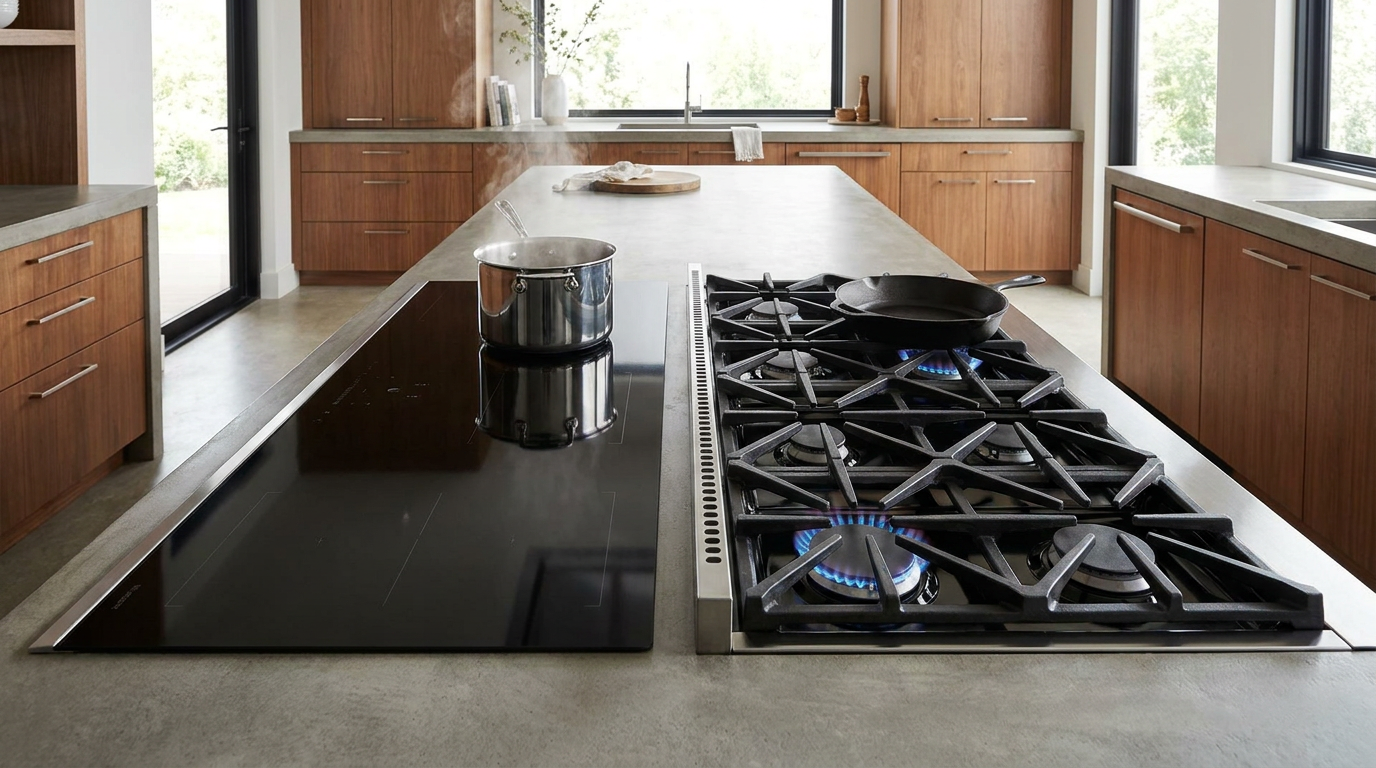
To understand the performance gap, one must look at how each technology generates heat. Gas cooktops rely on combustion, igniting natural gas or propane to create an open flame that heats the bottom of a pan. By the laws of physics, a significant portion of this thermal energy escapes around the sides of the cookware and into the surrounding air. Induction, conversely, uses copper coils beneath a glass surface to generate an alternating electromagnetic field. This field interacts directly with the iron molecules in magnetic cookware, causing the pan itself to become the heat source.[1][2]
The evidence for induction's efficiency advantage is overwhelming and heavily quantified. According to the Department of Energy and Energy Star data, induction cooktops transfer approximately eighty-five to ninety percent of their electromagnetic energy directly into the food. In stark contrast, traditional gas burners operate at roughly thirty-two to forty percent efficiency, with the majority of the heat lost to the kitchen environment. This massive efficiency gap translates directly into speed: consumer testing consistently shows that induction can boil a pot of water twenty to forty percent faster than a high-output gas burner.[1][2][3]

The case against gas has increasingly centered on newly understood health and safety metrics. Recent peer-reviewed studies have demonstrated that gas stoves emit significant levels of nitrogen dioxide, carbon monoxide, and benzene—a known carcinogen—even when turned off. Public health data now attributes nearly thirteen percent of childhood asthma cases in the United States to the indoor air pollution generated by gas cooking. Induction eliminates these point-source emissions entirely. Furthermore, because the induction surface only heats the magnetic pan, the glass itself remains relatively cool to the touch, drastically reducing the risk of accidental burns for households with young children.[4][6]
The case against gas has increasingly centered on newly understood health and safety metrics.
However, the argument for retaining or choosing gas rests heavily on infrastructure, upfront costs, and culinary tradition. Gas cooktops generally carry a lower initial purchase price. More importantly, switching from gas to induction requires a dedicated 240-volt electrical circuit. For older homes, upgrading the electrical panel and running new wiring can add hundreds or even thousands of dollars to the installation cost. Additionally, induction requires ferromagnetic cookware; aluminum, copper, and standard glass pots will not work, forcing some homeowners to replace their entire culinary arsenal.[3][5]

For culinary traditionalists, the tactile experience of gas remains a strong selling point. The visual feedback of a flickering flame allows cooks to intuitively gauge heat levels without looking at a digital display. Certain cooking techniques, such as charring peppers directly on the grate or aggressively tossing a round-bottomed wok, are inherently designed for the enveloping heat of an open gas flame. While modern induction ranges offer precise, instant temperature adjustments that rival or exceed gas responsiveness, they demand a different physical rhythm that requires a learning curve for veteran cooks.[5][7]
To tip the financial scales, 2026 buyers must factor in federal and state incentives designed to encourage electrification. Under the Inflation Reduction Act, low- and moderate-income households can qualify for up to eight hundred and forty dollars in rebates for upgrading to an Energy Star-certified induction range. When combined with the long-term savings from reduced energy waste and lower summer air-conditioning burdens—since induction does not needlessly heat the kitchen—the total cost of ownership for induction often undercuts gas over a ten-year lifespan, provided the initial electrical retrofit is not prohibitively expensive.[1][2]

Ultimately, there is no single universal winner; the right choice depends entirely on a household's specific conditions. Induction fits well when a home already has a 240-volt outlet, when indoor air quality and child safety are top priorities, and when the cook values rapid heating and effortless cleanup over traditional techniques. It is the definitive choice for energy-conscious buyers looking to future-proof their kitchens, offering a cleaner, faster, and vastly more efficient cooking experience.[7]
Conversely, gas fits well when a home is already plumbed for gas but lacks the electrical capacity for a high-amperage appliance upgrade. It remains the practical choice for homeowners in regions with exceptionally high electricity rates compared to natural gas, or for culinary traditionalists who rely heavily on non-magnetic specialty cookware, wok cooking, and the intuitive visual feedback of an open flame. For these users, the immediate control and lower upfront installation costs often outweigh the long-term efficiency gains of induction.[7]
How we got here
1970s
Early induction cooktops are introduced but fail to gain widespread consumer traction due to high costs and low reliability.
2010s
Induction technology matures, becoming the standard in many European and Asian markets due to high energy costs.
2022
Peer-reviewed studies link gas stove usage to elevated risks of childhood asthma, sparking widespread public debate.
2023
The US Inflation Reduction Act introduces substantial point-of-sale rebates for households upgrading to induction.
2026
Induction ranges achieve price parity with premium gas models, accelerating adoption in standard American kitchen remodels.
Viewpoints in depth
Public Health & Efficiency Advocates
Views the transition away from gas as a critical step for respiratory health and climate goals.
This perspective emphasizes that indoor air quality should be the primary driver of appliance choices. Advocates point to mounting clinical evidence linking the nitrogen dioxide and benzene emitted by gas stoves to childhood asthma and cardiovascular issues. Furthermore, they argue that the massive thermodynamic advantage of induction—wasting almost no heat to the surrounding air—makes it an essential technology for reducing overall residential energy consumption and lowering the strain on summer air conditioning.
Culinary Traditionalists
Values the tactile control, visual feedback, and versatility of cooking over an open flame.
For many veteran cooks, the appeal of gas lies in its intuitive nature. The ability to see the flame size provides immediate visual confirmation of the heat level, without relying on digital interfaces. Traditionalists also highlight that gas accommodates all cookware materials, including copper and aluminum, and allows for specialized techniques like charring vegetables directly on the grates or using a round-bottomed wok. They argue that while induction is fast, it forces cooks to abandon ingrained physical rhythms.
Cost-Conscious Homeowners
Focuses on the total cost of ownership, including hidden installation and retrofitting expenses.
This camp acknowledges the long-term efficiency benefits of induction but points out the steep upfront barriers. Upgrading an older home's electrical panel to support a new 240-volt circuit can cost thousands of dollars, easily eclipsing the price of the appliance itself. Additionally, the requirement to replace non-magnetic cookware adds a hidden tax to the transition. For these homeowners, the decision often hinges on whether federal rebates and long-term energy savings can realistically offset the immediate financial shock of the upgrade.
What we don't know
- Whether the cost of electrical panel upgrades will decrease as new load-sharing technologies enter the market.
- How quickly the secondary market for used gas ranges will depreciate as induction adoption accelerates.
Key terms
- Electromagnetic Induction
- The process of using a magnetic field to generate electrical currents within a ferromagnetic material, creating direct heat.
- Ferromagnetic Cookware
- Pots and pans containing iron, such as cast iron or magnetic stainless steel, which are required for induction cooking.
- Point-Source Emissions
- Pollutants released directly into the immediate environment from a specific localized source, such as a gas burner in a kitchen.
- Primary Energy
- The raw energy consumed to generate the electricity or gas used by the appliance, accounting for losses in generation and transmission.
Frequently asked
Do I need to buy all new pots and pans for an induction stove?
Only if your current cookware is not magnetic. Cast iron and most stainless steel work perfectly; aluminum, copper, and glass will not.
Will an induction cooktop work during a power outage?
No. Unlike older gas stoves that can sometimes be lit manually with a match during an outage, induction cooktops require electricity to function.
Does induction cooking emit radiation?
Induction uses low-frequency electromagnetic fields to heat the pan. These fields are tightly contained within the cooking zone and operate well within established safety standards for home appliances.
How much does it cost to switch from gas to induction?
Beyond the cost of the stove itself, switching often requires installing a 240-volt electrical circuit, which can cost anywhere from a few hundred to over a thousand dollars depending on your home's wiring.
Sources
Source coverage
7 outlets
3 viewpoints surfaced







[1]U.S. Department of EnergyPublic Health & Efficiency Advocates
Making the Switch to Induction Stoves or Cooktops
Read on U.S. Department of Energy →[2]ENERGY STARPublic Health & Efficiency Advocates
Residential Induction Cooking Tops
Read on ENERGY STAR →[3]Consumer ReportsConsumer & Lifestyle Evaluators
Pros and Cons of Induction Cooktops and Ranges
Read on Consumer Reports →[4]Rewiring AmericaPublic Health & Efficiency Advocates
Induction stoves are better than gas stoves in every category
Read on Rewiring America →[5]LeafScoreConsumer & Lifestyle Evaluators
Pros and cons of induction stovetops
Read on LeafScore →[6]Energy SolutionsPublic Health & Efficiency Advocates
Induction vs Gas Cooktops: The Definitive Health, Efficiency & Economic Analysis
Read on Energy Solutions →[7]Factlen Editorial TeamMarket & Trade-off Analysts
Synthesis by Factlen editorial team
Read on Factlen Editorial Team →

More in shopping
See all 5 stories →


Every angle. Every day.
Get shopping stories with full source coverage and perspective breakdowns delivered to your inbox.