
How Wildlife Crossings Are Reconnecting North America's Fragmented Ecosystems
A massive expansion of wildlife overpasses and underpasses is successfully reducing highway collisions and restoring genetic diversity across the continent.
By Factlen Editorial Team
- Conservation Biologists
- Focus on restoring genetic diversity, connecting fragmented habitats, and ensuring species can migrate as the climate changes.
- Transportation & Safety Officials
- Prioritize reducing fatal wildlife-vehicle collisions, lowering insurance costs, and improving highway safety for motorists.
- Public Land Managers & Policy Advocates
- Emphasize multi-agency cooperation and integrating wildlife corridors into broader public land use and recreation strategies.
What's not represented
- · Auto insurance companies, who directly benefit financially from reduced collision claims.
- · Local hunting and outfitter communities, whose livelihoods depend on robust, migrating game populations.
Why this matters
Wildlife-vehicle collisions cost taxpayers billions of dollars and claim hundreds of human lives annually. By engineering safe passages, communities are simultaneously solving a major public safety crisis and ensuring the survival of iconic North American species.
Key points
- Wildlife crossings, including landscaped overpasses and underpasses, are rapidly expanding across North America to connect fragmented habitats.
- The structures have proven highly effective, with Banff National Park documenting an 80 percent overall reduction in wildlife-vehicle collisions.
- Colorado recently completed the largest wildlife overpass in North America, spanning 209 feet across Interstate 25.
- While crossings require significant upfront investment, they typically pay for themselves within 12 years by eliminating costly highway accidents.
For decades, the ribbons of asphalt connecting North American cities have served as a deadly barrier to the continent's ecosystems. Highways like the Trans-Canada and the U.S. Interstate system effectively carved vast, continuous wilderness into isolated islands. Every year, wildlife-vehicle collisions kill between one and two million large animals in the United States alone, causing hundreds of human fatalities and costing taxpayers upwards of $8 billion. Conservationists once referred to these high-speed corridors as the "Berlin Wall of Biodiversity," a seemingly insurmountable obstacle that severed ancient migration routes and trapped animals in shrinking territories.[2]
In 1993, a coalition of scientists and conservationists launched the Yellowstone to Yukon (Y2Y) Conservation Initiative, an ambitious vision to reconnect 2,100 miles of mountainous habitat from Wyoming to the Canadian Arctic. The goal was not just to protect isolated parks, but to ensure that the spaces between them remained navigable for wildlife. Over the past three decades, this initiative has championed one of the most effective, yet structurally simple, solutions in modern conservation: the engineered wildlife crossing.[1]
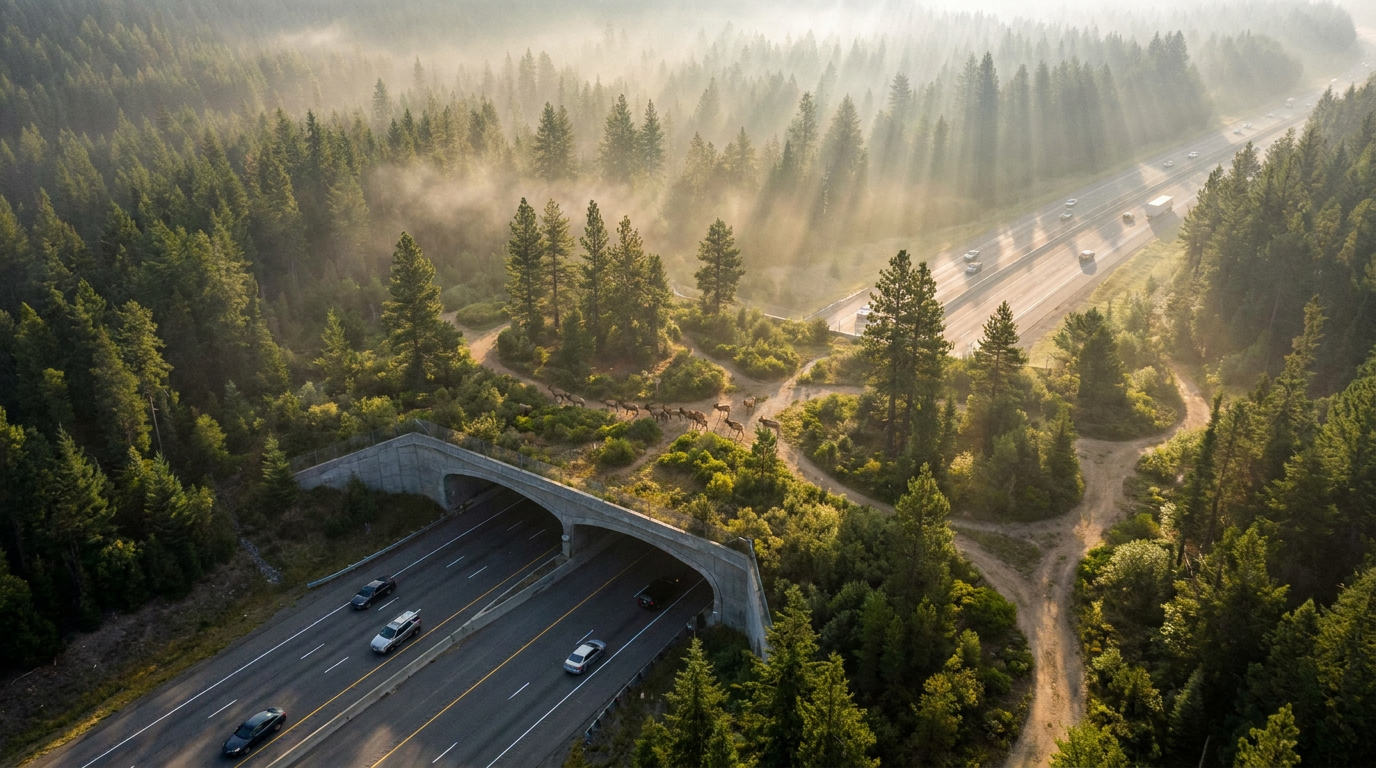
Wildlife crossings are specially designed infrastructure projects that allow animals to bypass deadly traffic. They generally fall into two categories: overpasses that bridge the highway, and underpasses that tunnel beneath it. These structures are not merely concrete walkways; they are meticulously landscaped extensions of the surrounding forest. Engineers cover the bridges with native soil, plant local vegetation, and design the sightlines to mimic the natural topography, tricking the animals into feeling they have never left the woods.[1]
The architectural choices cater to the distinct psychological needs of different species. Overpasses are typically wide, open, and relatively short, allowing animals to see the habitat on the other side. This design is heavily favored by prey animals like elk and moose, as well as apex predators like grizzly bears, who rely on clear lines of sight to feel secure. Conversely, underpasses are lower, darker, and more enclosed, providing the stealthy, protected cover instinctively sought by ambush predators and cautious species such as cougars, bobcats, and black bears.[1]

The secret ingredient that makes these multimillion-dollar structures work is directional fencing. Miles of high-tensile wire mesh run along both sides of the highway, physically blocking wildlife from stepping onto the asphalt. When an animal encounters the fence, it naturally walks along the barrier looking for a break. The fencing acts as a massive funnel, gently guiding wandering herds and solitary predators directly toward the safe passage of the overpass or underpass.[1]
The most compelling proof of this concept lies in Banff National Park, home to the world’s longest-running wildlife crossing research program. Decades ago, the Trans-Canada Highway was a slaughterhouse for local fauna. Today, a system of 44 structures and 82 kilometers of fencing has transformed the landscape. Since monitoring began, motion-activated cameras have documented more than 250,000 safe wildlife crossings, proving that animals can and will adapt to human engineering.[1]
The safety data emerging from the Banff experiment is staggering. The crossing network has reduced wildlife-vehicle collisions by more than 80 percent overall across the monitored zone. For specific prey species like elk and deer, the reduction is an astounding 96 percent. Researchers note that while elk adapt to the structures almost immediately—sometimes famously using them while they are still under active construction—more cautious species like wolves and grizzly bears may take up to five years to fully trust the artificial bridges.[1]

The safety data emerging from the Banff experiment is staggering.
The success in the Canadian Rockies has catalyzed a boom in wildlife infrastructure across the United States. In late 2025, Colorado completed the I-25 Greenland overpass, which now holds the title of the largest wildlife bridge in North America. Spanning six lanes of interstate traffic south of Castle Rock, the massive structure measures 209 feet by 200 feet, providing a vital link for herds navigating the heavily trafficked corridor between Denver and Colorado Springs.[3]
Strategically located to close a 3.7-mile gap in existing protections, the Greenland overpass connects 39,000 acres of prime habitat. Prior to its construction, this specific stretch of highway saw an average of one severe wildlife collision every single day during the spring and fall migration seasons. By providing a dedicated, wide-open route for elk and pronghorn, state transportation officials expect to reduce crashes in the corridor by 90 percent.[3]
Beyond preventing immediate roadside fatalities, these crossings solve a slower, more invisible crisis: genetic bottlenecking. When highways trap animals in small, isolated pockets, populations are forced to inbreed. This lack of genetic diversity makes them highly susceptible to disease, environmental changes, and localized extinction. By physically linking these islands of habitat, overpasses allow young males to disperse, find new mates, and keep the regional gene pool robust and resilient.[1]
The impact on the threatened grizzly bear population illustrates this genetic victory perfectly. In 1993, the various grizzly populations in the lower 48 states and southern Canada were separated by 150 miles of hostile, fragmented terrain. Today, thanks to the construction of 204 wildlife crossings across the Y2Y region and targeted land acquisitions, that gap has shrunk to just 45 miles, bringing the species closer to a fully connected, sustainable population than it has been in a century.[1]

Despite the overwhelming biological success, the primary hurdle to building more crossings remains financial. A single overpass can cost anywhere from $5 million to over $15 million, requiring complex, multi-year funding partnerships between federal highway agencies, state governments, and private conservation groups. Retrofitting existing, heavily used highways is a logistical nightmare that involves diverting high-speed traffic, securing heavy machinery, and pouring concrete in remote, mountainous terrain where construction seasons are incredibly short. These steep upfront costs often make politicians hesitate.[4]
However, economists and transportation officials argue that the structures are actually a long-term bargain. Research consistently shows that wildlife crossings pay for themselves within 10 to 12 years. When factoring in the elimination of vehicle repair costs, reduced insurance premiums, lower emergency medical response expenses, and the avoided costs of human injuries and fatalities, the math becomes clear. The societal price of doing nothing and allowing collisions to continue far exceeds the upfront capital required to build a bridge.[2]
The urgency to build these corridors is accelerating rapidly due to climate change. As global temperatures rise, snowpacks melt earlier, and precipitation patterns shift, historical habitats are rapidly transforming. Species are being forced to migrate to higher elevations or cooler northern latitudes just to find suitable food and breeding grounds. If their escape routes are blocked by impenetrable highways and concrete barriers, entire localized populations could face collapse, unable to adapt to the shifting ecological realities. This makes connectivity a matter of basic survival.[5]

Wildlife crossings provide the critical adaptive capacity necessary for ecosystems to weather a warming world. By ensuring that landscapes remain permeable, conservationists are giving flora and fauna the physical space they need to shift their ranges. Federal agencies are increasingly factoring this climate resilience into infrastructure bills, recognizing that a bridge built for an elk today may serve as a lifeline for dozens of migrating species tomorrow.[5][6]
Yet, as the infrastructure scales globally, scientists are identifying critical areas for improvement. A recent comprehensive study from the University of British Columbia analyzed 120 wildlife overpasses around the world and found that a significant portion are actually built too narrow. While wildlife experts recommend a width of at least 50 meters to comfortably accommodate large, cautious mammals like grizzly mothers with cubs, the global average sits at just 34 meters. This cost-saving compromise potentially limits the ecological effectiveness of older structures.[4]
Addressing these design flaws and expanding the network will require sustained political will, public funding, and innovative engineering. But the fundamental blueprint is now undeniably proven. From the pioneering tunnels of Banff National Park to the sprawling new arches of Colorado's interstate system, North America has demonstrated that human infrastructure does not have to come at the expense of the natural world. By simply giving wildlife a safe, dedicated path over the pavement, conservationists are successfully stitching a fragmented continent back together.[7]
How we got here
1993
The Yellowstone to Yukon (Y2Y) Conservation Initiative is launched to connect 2,100 miles of habitat.
1996
Banff National Park begins extensive monitoring of its new Trans-Canada Highway wildlife crossings.
2012
Oregon completes the Lava Butte underpass, reducing local wildlife collisions by over 85 percent.
2022
Colorado installs five wildlife underpasses and fencing along the I-25 South Gap project.
2025
Colorado opens the I-25 Greenland overpass, the largest wildlife bridge in North America.
Viewpoints in depth
Conservation Biologists' view
Focuses on the long-term ecological benefits of habitat connectivity and genetic diversity.
For ecologists and wildlife biologists, the primary value of these crossings extends far beyond preventing immediate roadkill. Their focus is on the invisible threat of genetic bottlenecking. When highways isolate populations, animals are forced to inbreed, making them highly vulnerable to disease and climate shifts. Biologists argue that by shrinking the gaps between isolated groups—such as reducing the distance between grizzly populations from 150 miles to 45 miles—these structures ensure the long-term evolutionary resilience of entire species.
Transportation Officials' view
Prioritizes human safety, infrastructure economics, and reducing the billions spent on highway collisions.
State departments of transportation approach wildlife crossings as a critical public safety and economic investment. With wildlife-vehicle collisions costing Americans upwards of $8 billion annually in medical expenses, vehicle repairs, and emergency response, officials view the $5 million to $15 million upfront cost of an overpass as a highly efficient expenditure. Their data consistently shows that these structures pay for themselves within a decade, transforming a persistent highway hazard into a solved engineering problem.
Climate Adaptation Advocates' view
Views wildlife corridors as essential infrastructure for species migrating in response to global warming.
As climate change rapidly alters historical habitats, environmental advocates emphasize that wildlife crossings are no longer just about maintaining the status quo—they are about facilitating mass migration. With shifting precipitation and rising temperatures forcing species to move to higher elevations or northern latitudes, advocates argue that permeable highways are the only way to prevent localized extinctions. In this view, a wildlife bridge is a vital climate-resilience tool, giving ecosystems the physical space required to adapt to a warming world.
What we don't know
- Whether future federal infrastructure budgets will prioritize the high upfront costs of retrofitting existing highways.
- How quickly more cautious apex predators, like wolverines and lynx, will adapt to newly constructed crossings.
- If the current standard width of global overpasses (34 meters) will prove sufficient for long-term genetic dispersal, or if wider, more expensive bridges will become mandatory.
Key terms
- Habitat Fragmentation
- The process by which large, continuous natural environments are divided into smaller, isolated patches, often by human infrastructure like highways.
- Wildlife Corridor
- A continuous strip of natural habitat that connects isolated populations, allowing animals to migrate, mate, and find food safely.
- Directional Fencing
- Specialized high-tensile fencing installed along highways that prevents animals from crossing the asphalt and funnels them toward safe overpasses or underpasses.
- Genetic Bottleneck
- A sharp reduction in the size and genetic diversity of a population, often caused by habitat isolation, which increases the risk of extinction.
Frequently asked
How much does a wildlife crossing cost?
A single overpass typically costs between $5 million and $15 million, depending on its width and the complexity of retrofitting the existing highway.
Do animals actually know how to use them?
Yes. Research shows that prey species like elk adapt almost immediately, while more cautious predators like grizzly bears may take up to five years to feel comfortable using the structures.
What is the difference between an overpass and an underpass?
Overpasses are wide, open bridges favored by species that rely on clear sightlines, like elk and grizzlies. Underpasses are darker tunnels that provide cover for stealthy species like cougars and black bears.
Why is genetic diversity important for wildlife?
When highways isolate animal populations, they are forced to inbreed. This lack of genetic diversity makes them highly vulnerable to disease, environmental changes, and localized extinction.
Sources
Source coverage
7 outlets
3 viewpoints surfaced






[1]Yellowstone to Yukon Conservation InitiativeConservation Biologists
One big tent: Y2Y's 2025 impact report is here
Read on Yellowstone to Yukon Conservation Initiative →[2]Center for Large Landscape ConservationTransportation & Safety Officials
Wildlife Crossing Success Stories in the Western States
Read on Center for Large Landscape Conservation →[3]CBS NewsTransportation & Safety Officials
Largest wildlife overpass in North America opens in Colorado
Read on CBS News →[4]Biodiversity and ConservationConservation Biologists
Most wildlife highway crossings too narrow, finds B.C. researchers
Read on Biodiversity and Conservation →[5]The Pew Charitable TrustsConservation Biologists
Wildlife Crossings Along U.S. Roads Can Help Animals and Habitat Adapt to Climate Change
Read on The Pew Charitable Trusts →[6]U.S. Fish & Wildlife ServicePublic Land Managers & Policy Advocates
Wildlife Corridors
Read on U.S. Fish & Wildlife Service →[7]Factlen Editorial TeamPublic Land Managers & Policy Advocates
Synthesis by Factlen editorial team
Read on Factlen Editorial Team →
Every angle. Every day.
Get world stories with full source coverage and perspective breakdowns delivered to your inbox.