
How Virtual Production and Real-Time AI Are Democratizing Indie Filmmaking
The technology behind massive blockbusters has rapidly scaled down to independent budgets, allowing creators to shoot studio-quality visual effects on modular LED stages.
By Factlen Editorial Team
- Independent Creators
- Advocates for using accessible technology to bypass traditional studio gatekeepers.
- Technology Innovators
- Focuses on developing real-time tools that streamline the production pipeline.
- Global Production Markets
- Views virtual production as a way to leapfrog traditional infrastructure and compete globally.
What's not represented
- · Traditional post-production VFX artists facing shrinking margins
- · Location scouts and local economies that rely on physical film shoots
Why this matters
By collapsing the cost of high-end visual effects, virtual production is leveling the playing field for independent creators and international markets. This shift ensures that spectacular, imaginative storytelling is no longer gatekept by massive studio budgets.
Key points
- Virtual production uses LED screens and game engines to render digital environments live on set.
- The technology eliminates the need for green screens and drastically reduces post-production costs.
- AI tools are automating complex VFX tasks, making them accessible to small independent teams.
- Global markets like Nigeria's Nollywood are using the tech to bypass traditional studio infrastructure.
- Directors must make all visual decisions in pre-production rather than fixing mistakes in the editing room.
The era of the "micro-blockbuster" has arrived, fundamentally reshaping the independent film landscape. For decades, ambitious science fiction, fantasy, or historical scripts were considered dead on arrival for independent directors. The astronomical cost of visual effects, massive set builds, and international location shooting created an insurmountable barrier to entry. Independent cinema was largely confined to contemporary dramas shot in single locations. But by 2026, a profound technological shift has democratized the tools of spectacle. The same cutting-edge technology that powered massive studio franchises is now rapidly trickling down to the independent sector, allowing creators to produce studio-quality visuals on fraction-of-the-cost budgets.[1][2]
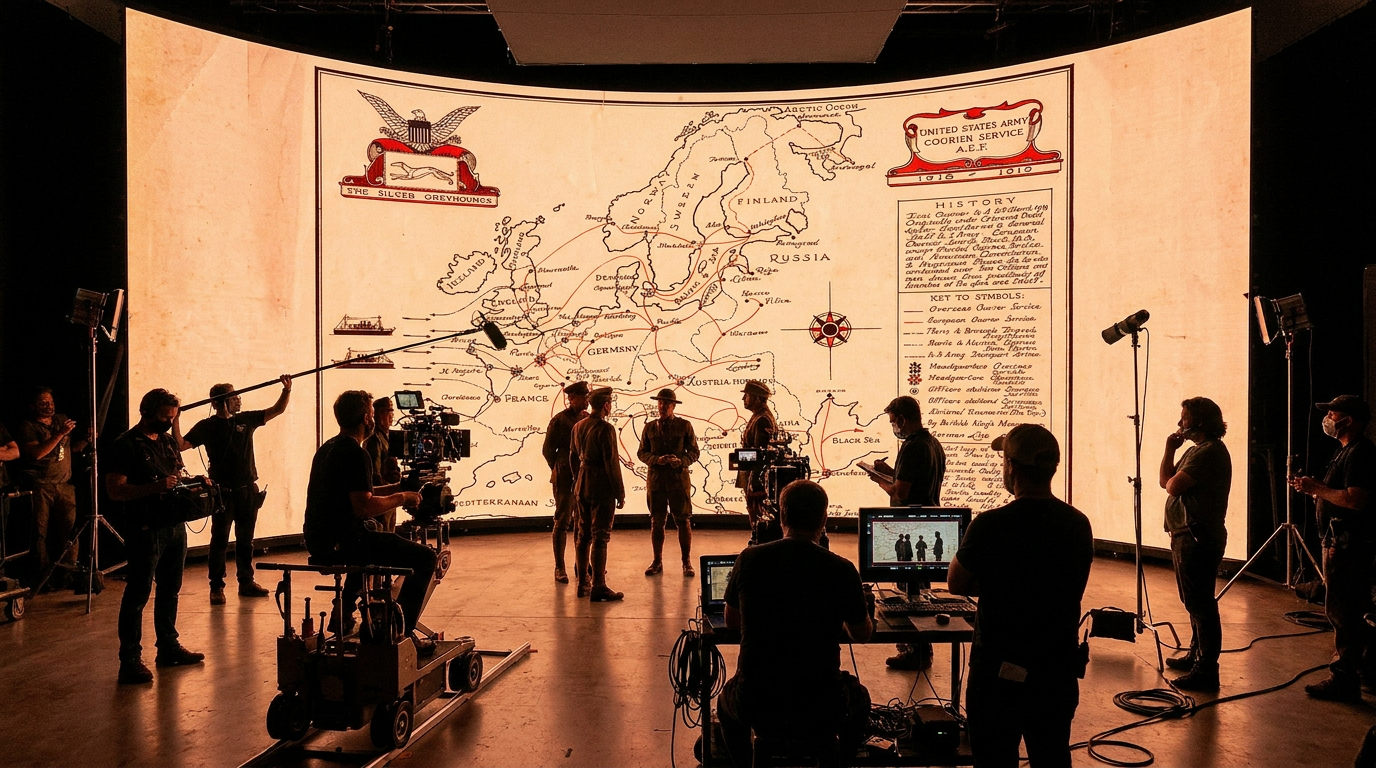
At the heart of this creative revolution is the "LED volume"—a physical soundstage surrounded by towering, high-resolution LED screens. Instead of acting in front of a blank green screen and forcing performers to imagine their surroundings, actors stand inside a glowing, real-time 3D environment. These digital worlds are rendered live by powerful video game engines, most notably Epic Games' Unreal Engine. As the camera moves on the physical set, the perspective of the digital background shifts in perfect synchronization, creating a seamless illusion of depth and space that was previously impossible to achieve outside of a computer.[7]
The software powering this revolution has its roots in an entirely different industry. Epic Games' Unreal Engine was originally designed to render fast-paced, interactive video games. However, its ability to calculate complex lighting, physics, and textures in real-time made it the perfect engine for virtual production. Instead of waiting hours or days for a single frame of computer-generated imagery to render on a server farm, Unreal Engine generates photorealistic environments instantaneously. This real-time rendering allows the digital background to react to the physical camera's movements with zero latency, maintaining the illusion of a three-dimensional world.[9]

This method, known across the industry as virtual production, solves one of the most expensive and time-consuming problems in traditional visual effects: lighting. In a standard green screen shoot, the green light bounces onto the actors, requiring tedious digital removal later. In an LED volume, the screens emit actual light from the digital environment. If a scene takes place during a vibrant alien sunset, the LED walls cast warm, authentic amber reflections directly onto the actor's skin and the physical props. This interactive lighting creates a level of visual coherence that grounds the digital world in reality.[7]
The financial implications for independent filmmakers are staggering. A $1 million independent film can now realistically allocate just $50,000 for visual effects that would have cost ten times that amount only a few years ago. By rendering the digital world directly on the set, filmmakers are able to capture "final pixel" shots directly in-camera. This drastically reduces the need for expensive post-production fixes, manual rotoscoping, and complex compositing. The budget is spent on the screen during the actual shoot, rather than being drained by months of digital touch-ups in a dark editing bay.[6][7]
The financial implications for independent filmmakers are staggering.
Artificial intelligence is further accelerating this collapse in production costs. Companies like Wonder Dynamics have developed sophisticated AI tools that automate the integration of live-action footage with computer-generated characters. Tye Sheridan, the actor and co-founder of Wonder Dynamics, recently noted at SXSW London that these tools were built specifically to bridge the gap between Hollywood scale and indie market realities. By automating the heavy lifting of motion capture and lighting matching, AI allows small teams to execute complex visual effects without requiring a massive crew of specialized technicians.[3][8]

The democratization of this technology extends far beyond the borders of Hollywood, reshaping global production hubs. In Nigeria, the prolific Nollywood film industry is leapfrogging traditional production infrastructure entirely. With average production budgets hovering between $25,000 and $75,000, Lagos-based studios are increasingly utilizing modular LED setups. These smaller, affordable volumes allow Nigerian filmmakers to simulate historical African settings, sprawling fantasy worlds, and international locations without ever needing to board an airplane or secure expensive travel visas. If Nollywood can achieve Hollywood-adjacent visual quality at a fraction of the cost, it fundamentally rewrites the economics of global content production, making diverse stories globally competitive.[5]
Beyond the creative and financial benefits, virtual production offers a massive leap forward in environmental sustainability. Traditional location shooting requires flying dozens of crew members, actors, and tons of heavy equipment across the globe, resulting in a massive carbon footprint. By bringing the locations to a single soundstage, independent productions drastically reduce their travel emissions and logistical waste. A crew can shoot a scene set in the snowy Alps in the morning and a sequence in the Sahara Desert in the afternoon, all without ever leaving a warehouse in London or Los Angeles.[1][4]
However, virtual production is not a magic wand that instantly makes filmmaking easier; it requires a massive philosophical shift in how movies are constructed. In traditional independent filmmaking, directors often rely on the comforting mantra of "we'll fix it in post," delaying difficult visual decisions until the editing phase. Virtual production completely eliminates that luxury. The workflow demands intense, rigorous pre-production. The "Virtual Art Department" must design, build, light, and lock the 3D environments weeks or months before the physical cameras ever roll. Industry veterans describe this high-stakes prep phase as "threading the eye of the needle."[2]

Every major creative decision—from the placement of a digital mountain to the exact color temperature of the virtual sun—must be finalized upfront. This can be deeply daunting for directors who are accustomed to finding their movie organically in the editing room. Yet, once the production actually steps onto the LED stage, that exhaustive preparation pays massive dividends. Directors regain total environmental control. They can change the time of day, move entire city blocks, or adjust the digital weather with the simple swipe of an iPad, granting them unprecedented creative freedom during the actual shoot.[2][7]
You don't even need a multi-million-dollar studio to start learning this workflow. Independent creators are pioneering "guerrilla" virtual production setups, sometimes referred to as the "Costco Hack." By using large, consumer-grade 4K televisions or renting small, modular LED panels, filmmakers can create "micro-volumes" in their own garages. Combined with affordable consumer tracking devices like HTC Vive trackers, these modest setups allow indie directors to shoot tight close-ups, car process shots, and insert elements with the exact same real-time rendering math used on massive Hollywood stages. The skills learned in a garage are entirely transferable to a professional volume.[2][7]

As modular LED stages become cheaper to rent and AI-driven software grows more intuitive, the barrier to entry for high-concept filmmaking will only continue to fall. The industry is rapidly moving away from the idea that spectacular visuals are the exclusive domain of massive corporate studios. The result is a new, empowering era of cinematic storytelling. A filmmaker's ambition is no longer strictly constrained by their bank account, but rather by their imagination and their willingness to embrace the real-time tools of the future.[1][4]
How we got here
2019
Lucasfilm pioneers large-scale LED volume technology on the set of The Mandalorian.
2023
AI tools like Wonder Studio launch, automating complex VFX workflows for smaller teams.
2025
Modular, low-cost LED stages become widely available, sparking a wave of indie adoption.
2026
Global markets like Nollywood aggressively adopt virtual production to bypass traditional infrastructure.
Viewpoints in depth
Independent Creators
Focusing on creative liberation and the leveling of the playing field.
For independent directors and producers, virtual production represents the ultimate democratization of storytelling. They argue that for too long, the barrier to entry for science fiction, fantasy, and historical genres was artificially high, gatekept by the massive budgets required for traditional VFX. By embracing real-time rendering and AI tools, indie creators believe they can now compete directly with major studios on visual fidelity, allowing audiences to judge films based on the quality of the narrative rather than the size of the budget.
Technology Innovators
Focusing on workflow integration and the evolution of filmmaking tools.
Software developers and VFX engineers view virtual production not just as a cost-saving measure, but as a fundamental evolution of the cinematic art form. They emphasize that tools like Unreal Engine and AI-driven compositing software are designed to remove technical friction, allowing directors to see their final vision immediately. This camp argues that shifting the VFX workload from post-production to pre-production creates a more collaborative, iterative, and ultimately healthier working environment for digital artists.
Global Production Markets
Focusing on leapfrogging traditional infrastructure to build local industries.
International film hubs, particularly in regions like Nigeria's Nollywood, see virtual production as a strategic tool for global competitiveness. Rather than spending decades and billions of dollars attempting to replicate Hollywood's physical studio infrastructure, these markets are leapfrogging directly to digital volumes. By simulating international locations and high-end environments locally, they argue that virtual production allows diverse, culturally specific stories to reach global streaming audiences with the high production values those viewers expect.
What we don't know
- How quickly traditional directors will adapt to making all visual decisions in pre-production rather than the editing room.
- Whether the proliferation of AI generation tools will lead to copyright disputes over the 3D assets used in virtual environments.
- The long-term economic impact on the traditional post-production VFX industry as more work shifts to the physical set.
Key terms
- LED Volume
- A physical soundstage surrounded by massive, high-resolution screens that display real-time 3D environments.
- Virtual Production
- A filmmaking method that combines physical production with real-time CGI, allowing visual effects to be captured in-camera.
- Unreal Engine
- A powerful real-time 3D creation tool originally designed for video games, now widely used to render photorealistic film backgrounds.
- Final Pixel
- The concept of capturing the finished visual effect directly through the camera lens on set, eliminating the need for later compositing.
- Previs
- Short for previsualization; the process of visualizing complex scenes in 3D before physical shooting begins.
Frequently asked
Do I need a massive budget to use an LED volume?
No. While pioneered by big studios, smaller 'micro-volumes' and modular LED setups are now highly accessible to independent productions.
Does virtual production eliminate visual effects artists?
No, but it shifts their work. VFX artists now build 3D environments during pre-production rather than fixing green screens in post-production.
How does AI fit into this workflow?
AI tools are being used to automate tedious tasks like rotoscoping, lighting matching, and generating background textures, which further drives down costs.
Sources
Source coverage
9 outlets
3 viewpoints surfaced









[1]Factlen Editorial TeamTechnology Innovators
Synthesis by Factlen editorial team
Read on Factlen Editorial Team →[2]No Film SchoolIndependent Creators
Virtual Production: How the Same Tech in 'The Mandalorian' is Empowering Indie Filmmakers
Read on No Film School →[3]The AnklerTechnology Innovators
The AI Making Indie Sci-Fi Budgets Possible
Read on The Ankler →[4]British CinematographerGlobal Production Markets
Why 2025 will be the year for virtual production technology
Read on British Cinematographer →[5]EnvisioningGlobal Production Markets
LED Volume Virtual Production for African Cinema
Read on Envisioning →[6]Filmmaking StuffIndependent Creators
AI in VFX: How to Make Your Indie Film Look Expensive
Read on Filmmaking Stuff →[7]Hitem3DTechnology Innovators
Virtual Production Explained: How LED Volumes and Real-Time VFX Are Changing Filmmaking
Read on Hitem3D →[8]postPerspectiveTechnology Innovators
SXSW London Explores AI for Content Creators and Indie Filmmakers
Read on postPerspective →[9]Raindance Film FestivalIndependent Creators
Starpost: Unreal Engine For Indie Filmmakers
Read on Raindance Film Festival →

More in entertainment
See all 6 stories →Pixar Animation
'Toy Story 5' Premieres to Critical Acclaim as Pixar Tackles the Screen-Time Era
0 sources

Toy Story 5
Toy Story 5 Premieres With Taylor Swift Original Song, Tackling the Modern Dilemma of Screen Time
0 sources

Awards History
The EGOT Explained: How Entertainment's Ultimate Crown is Actually Won
0 sources

Game Accessibility
Gaming Giants Unite to Launch Universal Accessibility Standard Across All Consoles
0 sources

Every angle. Every day.
Get entertainment stories with full source coverage and perspective breakdowns delivered to your inbox.