
How Veterans Treatment Courts Are Transforming the Justice System
By replacing punitive sentencing with intensive, judicially supervised rehabilitation, Veterans Treatment Courts are dramatically lowering recidivism rates and helping former servicemembers reclaim their lives.
By Factlen Editorial Team
- Judicial Advocates
- Judges and court officials who champion therapeutic jurisprudence over punitive sentencing.
- Veterans Health & Support
- Organizations focused on the moral obligation to treat service-related trauma.
- Criminology & Policy Analysts
- Researchers who study the data behind alternative sentencing and highlight potential flaws.
What's not represented
- · Civilian defendants with trauma who do not have access to specialized courts
- · Victims of crimes committed by veterans who may prefer traditional punitive justice
Why this matters
Traditional courts often trap traumatized veterans in a cycle of incarceration and addiction. By addressing the root causes of criminal behavior, problem-solving courts save taxpayer money, improve public safety, and fulfill a moral obligation to those who served.
Key points
- Veterans Treatment Courts (VTCs) divert former servicemembers from traditional punitive sentencing into judicially supervised rehabilitation programs.
- Participants must attend regular court hearings, undergo mandatory counseling, and submit to frequent drug testing.
- Graduates often see their criminal charges reduced or dismissed entirely, avoiding lifelong employment barriers.
- Studies show VTC participants have a recidivism rate of roughly 14%, compared to 23% to 46% in traditional courts.
- Despite their success, VTCs currently operate in only 14% of U.S. counties, limiting access for many veterans.
The transition from military to civilian life is fraught with complex challenges, and for a significant minority of veterans, the invisible wounds of war—such as post-traumatic stress disorder (PTSD), traumatic brain injury (TBI), and severe depression—pave a direct path to the criminal justice system. Without targeted intervention, these veterans often attempt to self-medicate with illicit drugs or alcohol to numb their psychological pain. This coping mechanism frequently leads to arrests for substance abuse, property crimes, or public altercations, trapping individuals who once served their country in a downward spiral of legal trouble and personal despair.[1]
For decades, the traditional court system processed these individuals through a standard, rigidly punitive model. Judges handed down fines, probation, or jail time, addressing the immediate symptom—the crime itself—while entirely ignoring the underlying root cause of the behavior. Unsurprisingly, this approach yielded dismal results for both the veterans and the communities they lived in. The Bureau of Justice Statistics has historically tracked exceptionally high recidivism rates for incarcerated individuals, with untreated veterans cycling in and out of cell blocks at alarming frequencies, costing taxpayers millions while failing to rehabilitate the offender.[5]
Recognizing this systemic failure, the legal system has increasingly turned to a radically different model: the Veterans Treatment Court (VTC). Categorized as a type of "problem-solving court," VTCs abandon the adversarial nature of traditional justice in favor of a concept known as therapeutic jurisprudence. Instead of simply punishing the offender and moving on to the next case, these specialized dockets aim to rehabilitate the individual through intensive, judicially supervised treatment programs that address the specific traumas associated with military service.[2][6]
The concept was born in 2008 in Buffalo, New York. Judge Robert Russell, who was presiding over a standard drug court at the time, noticed that a veteran defendant who was completely unresponsive to civilian court staff suddenly stood at attention and engaged respectfully when addressed by a bailiff with a military background. Realizing that veterans respond uniquely to military structure, discipline, and peer camaraderie, Judge Russell carved out a dedicated docket specifically for former servicemembers, laying the groundwork for a national movement.[6]

Today, the mechanism of a Veterans Treatment Court is highly structured and rigorous. When a veteran is arrested, usually for a non-violent misdemeanor or a low-level felony, they may be offered the option to divert their case to a VTC. Participation is strictly voluntary, as it requires a significant commitment of time and effort. If the veteran accepts the diversion, they must typically plead guilty or agree to a deferred prosecution, entering a demanding program that generally lasts between 12 and 24 months.[3]
Once enrolled, the veteran's daily life is closely monitored by the court. The VTC model requires frequent appearances before the judge—often bi-weekly in the early phases of the program—along with mandatory, consistent attendance at substance abuse counseling or mental health therapy sessions. To ensure compliance and sobriety, participants are subjected to frequent, randomized testing for drugs and alcohol, creating a strict framework of accountability that mirrors the discipline they experienced in the armed forces. This intensive supervision is designed to catch relapses early and adjust treatment plans immediately, rather than waiting for a new arrest to trigger an intervention.[4][6]
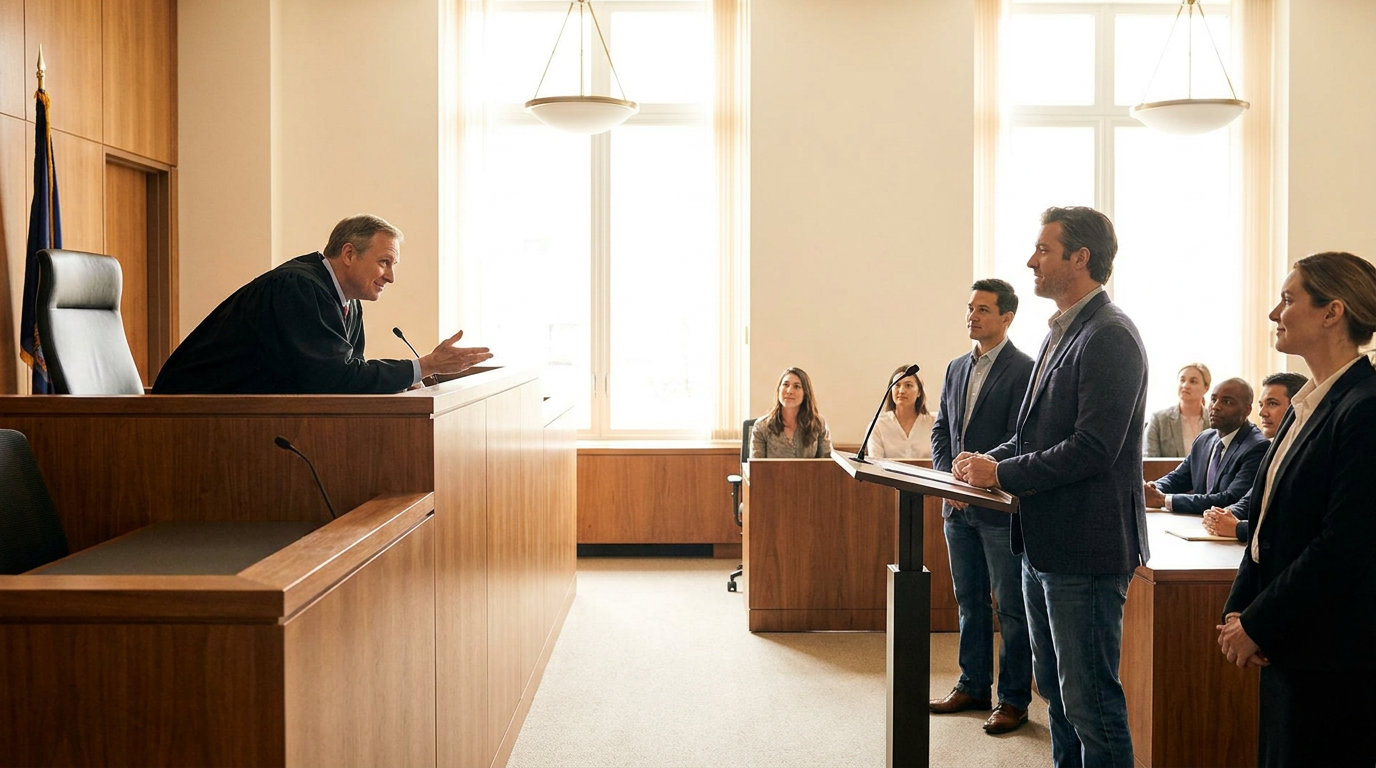
The courtroom dynamic in a Veterans Treatment Court is fundamentally different from a traditional criminal trial. The judge steps down from the traditional role of an impartial arbiter of punishment and acts more like a strict but encouraging coach. The prosecution and defense attorneys, rather than fighting over a conviction or sentence length, collaborate as part of a unified treatment team. This team also includes social workers, probation officers, and mental health professionals who meet regularly to discuss each participant's progress and setbacks.[6]
The courtroom dynamic in a Veterans Treatment Court is fundamentally different from a traditional criminal trial.
A cornerstone of the VTC model is its seamless integration with the Department of Veterans Affairs (VA). Through the Veterans Justice Outreach program, courts connect participants directly to VA medical care, housing assistance, and disability benefits that they may have previously struggled to access or didn't even know they were entitled to receive. By bringing the VA directly into the courtroom, the VTC acts as a one-stop-shop, removing the bureaucratic hurdles that often prevent struggling veterans from getting the help they desperately need.[5]
Perhaps the most unique and effective element of the VTC is the volunteer mentor program. Participants are paired with fellow veterans who have successfully navigated the transition to civilian life and understand the unique culture of the military. These mentors provide vital peer support, accountability, and a shared understanding of combat trauma that civilian social workers simply cannot replicate. They ensure the participant shows up to appointments, stays on track with their sobriety, and has someone to call during moments of crisis.[6]
The incentives for completing the grueling program are substantial and life-changing. Veterans who successfully graduate from a VTC often have their original criminal charges significantly reduced or entirely dismissed, allowing them to avoid the lifelong stigma and employment barriers associated with a criminal conviction. Conversely, the stakes for failure are incredibly high. If a participant repeatedly violates the rules, fails drug tests, or drops out of the program, they are transferred back to the traditional court system to face standard sentencing, which often includes immediate incarceration.[1][6]
The statistical evidence supporting the efficacy of Veterans Treatment Courts is striking. Studies indicate that while recidivism rates for veterans processed through traditional courts range from 23% to 46%, only about 14% of veterans who complete a VTC program experience a new arrest within a year. This dramatic reduction in reoffending represents a massive cost savings for taxpayers, who no longer have to foot the bill for repeated incarcerations, and a significant boost to overall public safety. By breaking the cycle of addiction and crime, these courts transform individuals from liabilities in the justice system back into productive members of their communities.[4]

Beyond simply keeping veterans out of jail, the holistic benefits of the program are highly measurable. A 2024 report from the Michigan Supreme Court tracking problem-solving courts across the state found that unemployment among VTC graduates dropped by an astounding 82%. National studies similarly show that participants experience vastly improved housing stability, better social functioning, and a significant reduction in the severity of their PTSD symptoms, proving that the therapeutic model heals the whole person rather than just addressing the criminal charge.[2][5]
Despite these overwhelming successes, the model is not without its critics and inherent uncertainties. Some criminologists and policy analysts argue that the staggering success rates of VTCs may be artificially inflated by a practice known as 'cherry-picking.' Because many courts strictly exclude violent offenders or those with the most severe, intractable addictions, they are inherently selecting the participants who are already the most likely to succeed, potentially skewing the data and leaving the most difficult cases behind in the traditional system.[5]
Furthermore, the intense supervision required by VTCs can sometimes paradoxically backfire on the participants. A comprehensive national study of over 22,000 justice-involved veterans found that while VTC participants had better housing and employment outcomes overall, they were occasionally more likely to face new incarcerations for technical violations—such as a failed drug test or a missed appointment—simply because they were being monitored so much more closely than those on standard, low-level probation. This hyper-vigilance means that minor slip-ups, which are a normal part of the addiction recovery process, can quickly escalate into jail time if the court is not flexible.[5]

Access also remains a critical and unresolved hurdle. While the number of Veterans Treatment Courts has grown exponentially from a single docket in 2008 to over 460 operational courts nationwide today, they still exist in only about 14% of U.S. counties. This creates a deeply inequitable geographic lottery, where a veteran's access to life-saving treatment and charge dismissal depends entirely on the specific zip code in which they happened to be arrested, rather than the merits of their service or the severity of their trauma.[1][7]
To address this disparity, organizations like the Council on Criminal Justice have launched major initiatives to expand alternative sentencing options at both the state and federal levels. The U.S. Sentencing Commission has also begun providing technical assistance and training to federal districts looking to implement their own problem-solving courts, signaling a broader institutional shift toward embracing therapeutic jurisprudence at the highest levels of the American legal system. These efforts aim to standardize the VTC model and secure the necessary funding to ensure that every veteran, regardless of their location, has access to the specialized care they need to reintegrate successfully.[1][3]
Ultimately, the continued expansion of Veterans Treatment Courts represents a profound shift in how the justice system views culpability, trauma, and rehabilitation. By recognizing that some criminal behavior is inextricably linked to the psychological wounds of military service, these courts offer a model of justice that prioritizes healing over retribution. They ensure that those who served their country are not simply discarded by the society they protected, but are instead given the structured support necessary to reclaim their lives and their dignity.[7]
How we got here
1985–2000
The number of veterans incarcerated in state and federal prisons rises by more than 53%.
2004
The Department of Veterans Affairs establishes the Veterans Justice Outreach program to connect justice-involved veterans with services.
2008
Judge Robert Russell establishes the nation's first Veterans Treatment Court in Buffalo, New York.
2022
The Council on Criminal Justice launches the Veterans Justice Commission to assess and expand alternatives to incarceration.
2024
Over 460 Veterans Treatment Courts are officially operational across the United States.
Viewpoints in depth
Judicial Advocates
Judges and court officials who champion therapeutic jurisprudence over punitive sentencing.
This camp argues that the traditional criminal justice system fundamentally fails veterans by treating the symptoms of their trauma—such as substance abuse and erratic behavior—as standard criminality. By shifting to a problem-solving model, judicial advocates believe courts can actively restore lives, reduce the backlog of repeat offenders, and save taxpayer money that would otherwise be spent on endless cycles of incarceration.
Veterans Health & Support
Organizations focused on the moral obligation to treat service-related trauma.
Veterans advocacy groups emphasize the social contract between the nation and its servicemembers. They argue that if military service inflicts the psychological and physical wounds that lead to criminal behavior, the government has a strict moral duty to provide comprehensive treatment. For this camp, Veterans Treatment Courts are not just a legal alternative; they are a necessary fulfillment of the promise to care for those who bore the battle.
Criminology & Policy Analysts
Researchers who study the data behind alternative sentencing and highlight potential flaws.
While acknowledging the successes of VTCs, policy analysts and criminologists often point to the data's nuances. They raise concerns about 'cherry-picking,' noting that courts frequently exclude violent offenders, which may artificially inflate success rates. Furthermore, they question the equity of creating a two-tiered justice system where a veteran receives treatment for trauma-induced crimes, while a civilian with similar trauma from non-military experiences faces standard incarceration.
What we don't know
- Whether the high success rates of VTCs would hold up if the courts expanded to accept violent offenders.
- How quickly federal funding will scale to bring VTCs to the 86% of U.S. counties that currently lack them.
Key terms
- Problem-Solving Courts
- Specialized dockets within the justice system that seek to address the underlying causes of criminal behavior, such as addiction or mental illness, rather than simply punishing the offense.
- Therapeutic Jurisprudence
- A legal philosophy that focuses on the law's impact on emotional life and psychological well-being, treating the court as a potential agent of healing.
- Veterans Justice Outreach (VJO)
- A Department of Veterans Affairs program that provides outreach and linkage to medical and psychological services for justice-involved veterans.
- Recidivism
- The tendency of a convicted criminal to reoffend and re-enter the criminal justice system after serving their initial sentence.
Frequently asked
Who is eligible for a Veterans Treatment Court?
Eligibility varies by jurisdiction, but most courts target veterans charged with non-violent misdemeanors or felonies who have a diagnosed substance use disorder or mental health condition related to their military service.
What happens if a veteran fails the program?
If a participant repeatedly violates the rules, fails drug tests, or drops out, their case is transferred back to the traditional criminal court docket, where they face standard sentencing, including potential incarceration.
Are these courts available everywhere?
No. While there are over 460 Veterans Treatment Courts nationwide, they currently operate in only about 14% of U.S. counties, creating a geographic disparity in access to these diversion programs.
Sources
Source coverage
7 outlets
3 viewpoints surfaced






[1]Council on Criminal JusticeCriminology & Policy Analysts
Veterans Justice Commission Policy Roadmap
Read on Council on Criminal Justice →[2]Michigan Supreme CourtJudicial Advocates
Supreme Court annual report shows these programs continue to lower recidivism, unemployment rates
Read on Michigan Supreme Court →[3]U.S. Sentencing CommissionJudicial Advocates
Federal Problem-Solving Courts
Read on U.S. Sentencing Commission →[4]American Addiction CentersVeterans Health & Support
Veterans Treatment Court: How It Works & Benefits
Read on American Addiction Centers →[5]National Institutes of HealthCriminology & Policy Analysts
Veterans Treatment Courts: A National Study of Participant Outcomes
Read on National Institutes of Health →[6]Military.comVeterans Health & Support
Veterans Treatment Courts Explained
Read on Military.com →[7]Factlen Editorial TeamCriminology & Policy Analysts
Synthesis by Factlen editorial team
Read on Factlen Editorial Team →
Every angle. Every day.
Get law justice stories with full source coverage and perspective breakdowns delivered to your inbox.