
How Vehicle-to-Home (V2H) Charging is Turning EVs into Massive Home Batteries
Bidirectional charging technology allows electric vehicles to power homes during outages and bypass peak electricity rates. In 2026, V2H is moving from a niche concept to a practical, money-saving reality for homeowners.
By Factlen Editorial Team
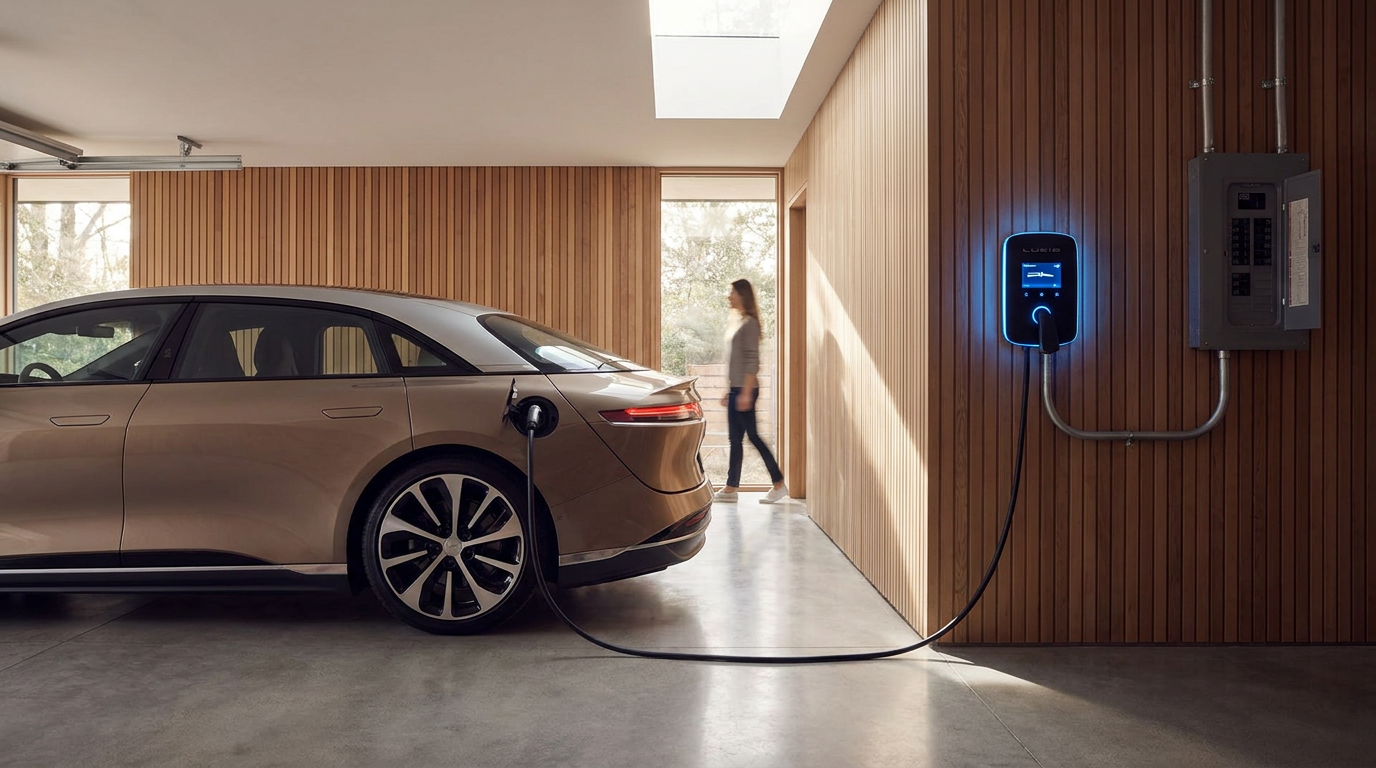
- Energy Independence Advocates
- Value V2H for its ability to maximize rooftop solar self-consumption and provide days of off-grid resilience during blackouts.
- Utility and Grid Operators
- View behind-the-meter V2H as a practical way to reduce peak evening strain on the macro grid without the regulatory complexities of full V2G export.
- Hardware Manufacturers
- Focused on driving down the $1,500–$8,000 installation costs and standardizing communication protocols to make bidirectional charging universal.
What's not represented
- · Renters who cannot install home charging infrastructure
- · Drivers with unpredictable daily mileage who cannot guarantee backup availability
Why this matters
For homeowners, V2H technology unlocks thousands of dollars in hidden value from an electric vehicle, offering days of blackout protection and slashing peak energy bills without the need to buy a separate, expensive home battery.
Key points
- Vehicle-to-Home (V2H) technology allows an electric vehicle to act as a massive backup battery for a house.
- A typical EV battery holds roughly ten times the energy of a standard residential wall battery.
- V2H can power a home for 3 to 10 days during a grid outage.
- Homeowners can save money by charging at night and using the EV to power the home during expensive peak hours.
- Installation requires a specialized bidirectional charger and an automatic transfer switch, costing up to $8,000.
- Unlike Vehicle-to-Grid (V2G), V2H does not require complex utility agreements because power stays behind the meter.
The average electric vehicle sitting in a driveway is hiding a secret: it is likely the largest battery the homeowner will ever own. While traditional EV charging is a one-way street—pulling power from the grid to fill the car—a technology known as Vehicle-to-Home (V2H) bidirectional charging is reversing the flow.[1][2]
In 2026, V2H is transitioning from a futuristic concept to a practical upgrade for energy-conscious households. By pairing a compatible EV with a specialized bidirectional charger, homeowners can tap into their vehicle's massive energy reserves to power their entire house.[3][5]
The sheer scale of an EV battery dwarfs traditional home storage solutions. A standard residential battery, like a Tesla Powerwall, holds roughly 13.5 kilowatt-hours (kWh) of energy. In contrast, modern electric vehicles carry anywhere from 60 to over 130 kWh.[1][2]
That massive capacity translates to serious resilience. During a grid outage, a fully charged EV can keep a typical home's lights, refrigerators, and essential circuits running for three to ten days, depending on usage and climate control needs.[1][2]

The mechanism behind V2H relies on sophisticated power electronics. Because EV batteries store energy as direct current (DC) and homes run on alternating current (AC), the bidirectional charger contains a heavy-duty inverter that seamlessly converts the power as it flows out of the vehicle.[1][6]
Safety is a critical component of this setup. A V2H installation requires an automatic transfer switch—a gateway that instantly isolates the home's electrical panel from the utility grid during a blackout. This prevents the EV from back-feeding power into neighborhood power lines, which could endanger utility workers repairing the grid.[1][7]
Beyond emergency backup, V2H offers compelling daily financial benefits through a practice called "peak shaving" or time-of-use arbitrage. Homeowners can charge their vehicles overnight when grid electricity is cheap and abundant.[3][4]
Beyond emergency backup, V2H offers compelling daily financial benefits through a practice called "peak shaving" or time-of-use arbitrage.
Then, during the late afternoon and evening when utility rates spike, the home automatically stops pulling from the grid and draws power from the EV instead. A recent study from the University of Michigan found that this strategy could save EV owners 40% to 90% on their charging costs over the vehicle's lifetime.[4]

For homes equipped with rooftop solar panels, V2H acts as a force multiplier. Instead of exporting excess solar energy to the grid for pennies during the day, homeowners can store that clean energy in their parked EV, effectively running their home on 100% self-generated solar power long after the sun goes down.[3][6]
Despite the clear advantages, V2H in 2026 still faces hurdles, primarily regarding cost and compatibility. The "holy grail" of any EV powering any home has not yet arrived, as both the car and the charger must speak the exact same digital language.[2][5]
Homeowners must have a vehicle that explicitly supports V2H—such as the Ford F-150 Lightning, Nissan Leaf, or select newer models from GM, Hyundai, and Kia. Furthermore, the specialized bidirectional chargers and required electrical panel upgrades do not come cheap.[2][5]
Installing a V2H system currently costs between $1,500 and $8,000, depending on the hardware and the home's existing electrical infrastructure. While this is significantly less than buying an equivalent array of stationary home batteries, it remains a substantial upfront investment.[1][5]
It is also important to distinguish V2H from its more complex sibling, Vehicle-to-Grid (V2G). While V2G allows homeowners to sell stored energy back to the utility company for a profit, it requires navigating a maze of utility regulations, interconnection agreements, and specialized tariffs.[1][6]
Because V2H keeps the power strictly "behind the meter" within the home's own wiring, it bypasses the bureaucratic red tape of V2G, making it far easier to deploy today without waiting for utility company approval.[6][7]

The industry is rapidly moving toward standardization to lower these barriers. Protocols like ISO 15118-20 are embedding bidirectional communication standards into new EVs and chargers, ensuring that future hardware from different manufacturers will seamlessly talk to each other.[6]
As charger prices continue to fall and more automakers unlock bidirectional software in their fleets, V2H is poised to become a standard feature of the modern smart home. What was once just a way to get from point A to point B is quietly becoming the cornerstone of residential energy independence.[2][7]
How we got here
Pre-2024
Bidirectional charging was largely limited to niche models like the Nissan Leaf using the CHAdeMO charging standard.
2024–2025
Major automakers like Ford and GM introduced bidirectional capabilities in flagship EVs, bringing the tech to the mainstream.
2026
V2H adoption accelerates as charger costs drop and standardized CCS protocols like ISO 15118-20 roll out across the industry.
Viewpoints in depth
Energy Independence Advocates
This group values V2H for its ability to maximize self-sufficiency and integrate with rooftop solar.
For energy independence advocates, V2H is the missing link in the residential renewable ecosystem. They argue that exporting excess daytime solar power to the grid for minimal compensation is inefficient. By storing that solar energy in an EV and discharging it at night, homeowners can effectively run their lives on 100% self-generated clean energy. This camp also heavily prioritizes the blackout resilience V2H provides, viewing the EV as a quiet, zero-emission alternative to traditional gas generators.
Utility and Grid Operators
Grid managers view behind-the-meter V2H as a practical way to reduce peak evening strain.
Utility operators are increasingly supportive of V2H because it solves a major grid problem without creating new regulatory headaches. When thousands of homes switch to EV battery power during the 5 PM to 9 PM peak window, it drastically reduces the overall strain on the macro grid. Because V2H keeps the power "behind the meter" (powering the home rather than exporting to the street), utilities do not have to manage the complex, two-way power flows and financial compensation models required by full Vehicle-to-Grid (V2G) systems.
Hardware Manufacturers
The industry is focused on driving down installation costs and standardizing communication protocols.
Hardware manufacturers acknowledge that the current $1,500 to $8,000 installation cost is a barrier to mass adoption. Their primary focus in 2026 is scaling production to lower the price of bidirectional inverters and transfer switches. Furthermore, they are heavily invested in rolling out the ISO 15118-20 standard, which ensures that a charger built by one company can seamlessly communicate with an EV built by another, ending the era of brand-locked proprietary ecosystems.
What we don't know
- How quickly the cost of bidirectional chargers will reach parity with standard one-way Level 2 chargers.
- Whether automakers will honor long-term battery warranties if an EV is heavily used for daily home energy arbitrage.
Key terms
- Bidirectional Charging
- Technology that allows electricity to flow both into an EV's battery from the grid, and back out of the battery to power external loads.
- V2H (Vehicle-to-Home)
- A specific type of bidirectional charging where an EV's battery is used to power a household's electrical panel.
- V2G (Vehicle-to-Grid)
- Exporting stored EV energy back to the utility grid, often for financial compensation, which requires complex utility agreements.
- V2L (Vehicle-to-Load)
- Plugging standalone appliances or tools directly into an EV's built-in electrical outlets, without connecting to a home's panel.
- Automatic Transfer Switch
- A safety device that automatically disconnects a home from the utility grid during an outage so the EV can provide backup power without back-feeding the neighborhood lines.
Frequently asked
Can any electric vehicle power my home?
No. Both the electric vehicle and the home charger must specifically support bidirectional V2H charging. While adoption is growing, it is not yet a universal feature in 2026.
How long can an EV power a house during a blackout?
Depending on the vehicle's battery size and the home's energy usage, a fully charged EV can typically power a household for 3 to 10 days.
Will using V2H degrade my car's battery faster?
While all battery use causes some wear, modern smart energy management systems limit deep discharges and micro-cycling to protect the battery's long-term lifespan.
Sources
Source coverage
7 outlets
3 viewpoints surfaced







[1]NuWatt EngineeringHardware Manufacturers
Bidirectional EV Charging & V2H in 2026: Can Your EV Replace a Home Battery?
Read on NuWatt Engineering →[2]Energy Solutions IntelligenceHardware Manufacturers
Bidirectional EV Charging 2026: Which Cars Can Power Your Home and the Grid?
Read on Energy Solutions Intelligence →[3]American Solar Energy SocietyEnergy Independence Advocates
How Does Vehicle-to-Home Actually Work?
Read on American Solar Energy Society →[4]Engineers IrelandUtility and Grid Operators
Electric vehicle batteries could save homeowners thousands on utility bills
Read on Engineers Ireland →[5]CNETHardware Manufacturers
Bidirectional Charging and the Future: V2H Charging Explained
Read on CNET →[6]GetNeoChargeHardware Manufacturers
What you need for V2H at home (readiness checklist)
Read on GetNeoCharge →[7]Factlen Editorial TeamEnergy Independence Advocates
Synthesis by Factlen editorial team
Read on Factlen Editorial Team →
Every angle. Every day.
Get home stories with full source coverage and perspective breakdowns delivered to your inbox.