
How to Plan a Stress-Free EV Road Trip in 2026
With the widespread adoption of the NACS charging standard and advanced route-planning apps, electric vehicle road trips have transitioned from a logistical challenge to a predictable routine. Here is the definitive guide to long-distance EV travel in 2026.
By Factlen Editorial Team
- EV Adopters & Enthusiasts
- Advocate for the benefits of electric travel and the use of modern routing tools.
- Automotive Industry Analysts
- Focus on the market impact of NACS standardization and infrastructure growth.
- Pragmatic Commuters
- Highlight the remaining learning curve and edge cases of EV travel.
What's not represented
- · Rural residents living far from major charging corridors
- · Drivers who frequently tow heavy trailers or boats
Why this matters
As electric vehicles become mainstream, understanding how to efficiently navigate long distances saves hours of travel time and eliminates range anxiety. Mastering the modern charging network allows drivers to unlock the full potential of their EVs for cross-country travel.
Key points
- The adoption of the NACS standard has opened tens of thousands of reliable chargers to all EV drivers.
- Charging from 20% to 80% is significantly faster than trying to charge to 100%.
- Stopping more frequently for shorter charges reduces overall travel time.
- Dedicated route-planning apps like ABRP are essential for optimizing long journeys.
- High highway speeds and cold weather noticeably reduce an electric vehicle's effective range.
The electric vehicle road trip used to be an extreme sport. Early adopters navigated a fragmented landscape of broken chargers, incompatible plugs, and complex spreadsheets just to cross state lines without getting stranded. But in 2026, the era of "range anxiety" has largely given way to range confidence. As public charging infrastructure has matured and battery technology has steadily improved, taking an electric vehicle on a long-distance journey is no longer a daunting logistical puzzle. Instead, it has simply become a predictable, stress-free road trip, provided drivers understand a few core principles of modern electric mobility.[5][7]
This shift is the result of two massive industry changes: the standardization of charging hardware across North America and the maturation of route-planning software. Today, taking an EV on a 1,000-mile journey requires a slightly different mindset than driving a traditional gasoline car, but it no longer requires a leap of faith. Drivers who understand how to leverage the latest charging networks and digital tools find that electric road trips can actually be more relaxing than their combustion-engine counterparts, thanks to the quiet ride and naturally paced rest stops.[5][7]
The most significant catalyst for this new era of seamless travel is the widespread adoption of the North American Charging Standard (NACS). Originally developed by Tesla as a proprietary connector for its own vehicles, the elegant plug design was eventually opened to the broader automotive industry and formally standardized as SAE J3400. This regulatory and engineering consensus ended years of format wars, creating a unified hardware ecosystem that benefits all electric vehicle drivers regardless of the badge on their steering wheel.[4]
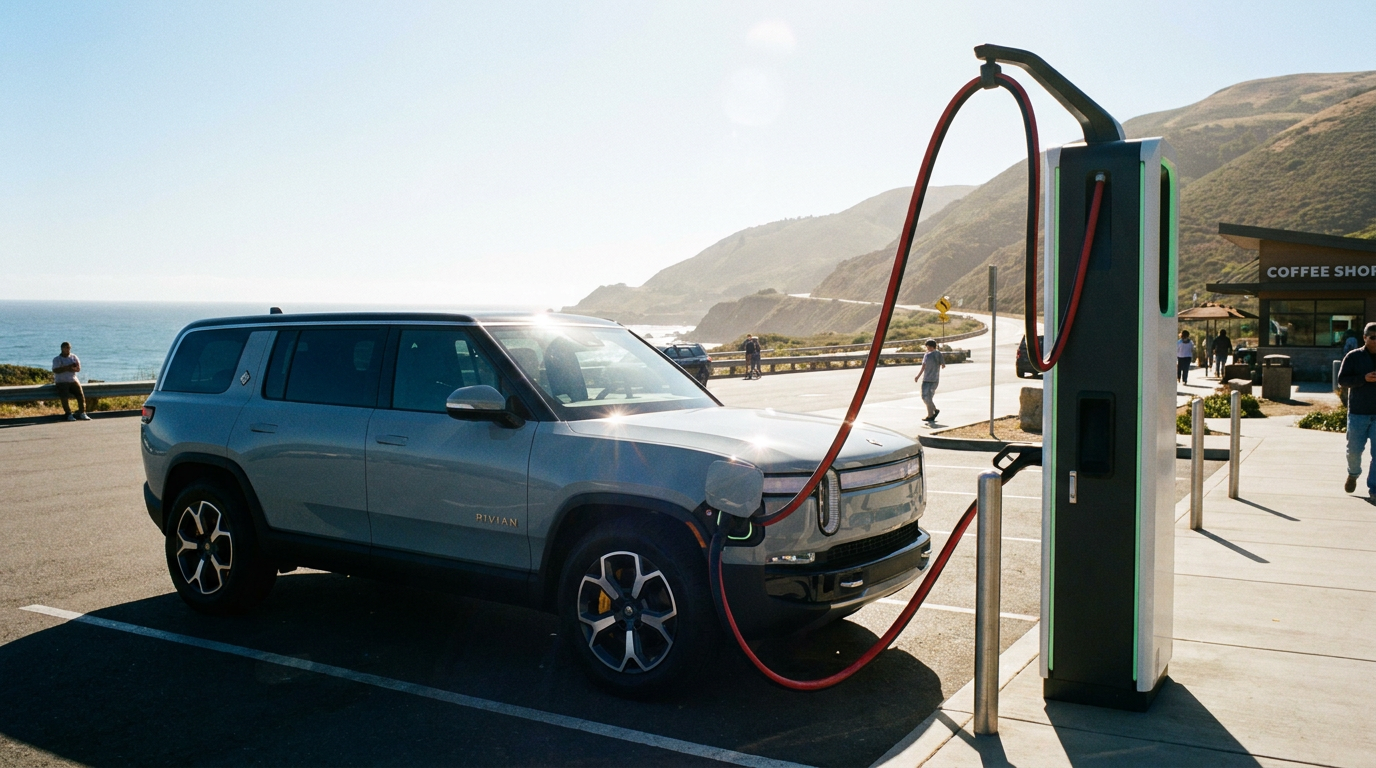
By 2026, almost every major automaker—from Ford and General Motors to Rivian and Hyundai—has secured access to Tesla's vast Supercharger network. This single industry-wide agreement unlocked tens of thousands of reliable, high-speed charging stalls globally for non-Tesla drivers, fundamentally changing the math of route planning. Highway corridors that were previously charging deserts for certain brands are now easily navigable, effectively eliminating the primary bottleneck that kept many families from taking their electric vehicles on cross-country vacations. The sheer density of available fast chargers means drivers can now focus on their destination rather than their dashboard.[1][4]

For drivers of older electric vehicles equipped with the Combined Charging System (CCS) port, accessing this newly expanded network requires a manufacturer-approved NACS-to-CCS adapter. These adapters are simple to use and easily stow in a glovebox or frunk. However, the industry is moving rapidly toward native integration. Many new 2026 models are rolling off assembly lines with NACS ports built directly into the vehicle, eliminating the need for extra hardware entirely and allowing drivers to simply pull up, plug in, and charge.[1][4]
Even with abundant chargers available, the mechanics of "refueling" an electric vehicle dictate a specific strategy that differs entirely from the traditional gas station model. The most common mistake new EV drivers make on road trips is attempting to charge their battery to 100 percent at every single fast-charging stop. While this instinct makes perfect sense when filling a liquid fuel tank, it is highly inefficient for a lithium-ion battery pack on a tight travel schedule. Understanding the physics of how batteries accept power is the key to minimizing wait times.[6]
This inefficiency comes down to the physics of the "charging curve." Electric vehicle batteries accept power fastest when they are relatively empty, acting much like a dry sponge soaking up water. As the battery fills up, the vehicle's internal battery management software intentionally slows the flow of electricity. This throttling is a necessary safety mechanism designed to prevent the battery cells from overheating and to protect the pack's long-term chemical health. As a result, the charging speed drops precipitously once the battery reaches a certain threshold, turning a rapid charge into a slow trickle.[6]
As the battery fills up, the vehicle's internal battery management software intentionally slows the flow of electricity.
The sweet spot for fast charging on a road trip is between 20 percent and 80 percent state of charge. Many modern electric vehicles can surge from 10 percent to 80 percent in just 20 to 30 minutes when connected to a high-powered DC fast charger. However, pushing that same battery from 80 percent to a full 100 percent can take an additional 40 minutes or more. Waiting for that final 20 percent is the primary cause of unnecessary delays on long journeys.[6]

Consequently, the golden rule of electric vehicle road tripping is to stop more frequently for shorter durations. Two 20-minute charging stops will almost always get you to your destination faster than one grueling 60-minute session waiting for a full battery. By riding the fastest part of the charging curve and unplugging as soon as the speed tapers off, drivers can maintain a high average travel speed and keep their journey moving efficiently. This "splash and dash" approach is the hallmark of an experienced EV traveler.[6]
To execute this strategy perfectly, drivers rely on a modern software stack. While built-in vehicle navigation systems have improved dramatically in recent years, experienced electric vehicle travelers often utilize a "three-app strategy" to guarantee a seamless trip. This combination of specialized routing engines, community-driven verification tools, and native vehicle software ensures that drivers are never caught off guard by a broken charger, an occupied station, or an unexpected detour. Relying on the right digital tools transforms route planning from a guessing game into a precise science.[2][3]
The brain of the operation is A Better Routeplanner (ABRP). Unlike standard mapping applications that simply draw a line from point A to point B, ABRP is a dedicated electric vehicle routing engine. Users input their specific vehicle model, starting charge level, and final destination. The app then calculates the optimal charging stops, factoring in complex variables like elevation changes, real-time weather conditions, and the specific charging curve of the car. It tells drivers exactly where to stop and precisely how many minutes to charge at each location to minimize total travel time.[2][3]

The verification layer of the strategy is PlugShare. Because non-Tesla public charging networks can still suffer from occasional maintenance issues or communication faults, savvy drivers use PlugShare to check recent user check-ins. Verifying that a specific charger was successfully used by another driver just an hour ago provides ultimate peace of mind before committing to a stop. The app's community-driven reviews also highlight crucial amenities like nearby restrooms, coffee shops, and restaurants, allowing travelers to choose the most comfortable places to spend their 20-minute charging breaks.[3]
Finally, the execution layer is the vehicle's built-in navigation system. Once the route is planned, entering the next charging stop into the car's native system is crucial. This action triggers "pre-conditioning," a vital feature where the car automatically warms or cools the battery to the optimal temperature as you approach the station. Proper pre-conditioning ensures the battery is primed to accept power at the maximum possible speed the moment you plug in, shaving precious minutes off every stop. Skipping this step can result in sluggish charging speeds, especially in extreme weather.[6][7]
Beyond charging logistics, drivers must also manage how speed and environment impact their overall range. Aerodynamic drag affects electric vehicles much more noticeably than internal combustion vehicles. Because EVs are so inherently efficient, the energy required to push through the air at high speeds represents a massive drain on the battery. Cruising at 80 mph instead of 60 mph can slash a vehicle's real-world range by 20 to 30 percent, forcing more frequent charging stops. Dialing back the cruise control by just a few miles per hour can dramatically extend the distance between plugs.[6]

Weather also plays a critical role in range management. Cold temperatures increase the internal resistance of the battery and require significant energy to heat the cabin, which can noticeably reduce the car's range during winter road trips. Using the vehicle's smartphone app to pre-condition the cabin while the car is still plugged in at home can mitigate this penalty. By warming the interior using grid power before departure, the car can dedicate its battery capacity entirely to driving rather than heating, preserving precious miles for the highway.[6]
Ultimately, mastering the electric vehicle road trip requires a simple mindset shift. Instead of viewing charging as an inconvenience, veteran drivers treat it as a scheduled break. Syncing 20-minute charging sessions with natural stops for meals, bathroom breaks, or stretching turns a long drive into a more relaxed and sustainable adventure. The forced pauses encourage safer driving habits and reduce highway fatigue. With the right tools, a unified charging network, and a basic understanding of battery physics, the 2026 EV road trip is no longer an exercise in anxiety—it is simply the new normal of modern travel.[5][7]
How we got here
Late 2022
Tesla publishes its connector design, inviting other automakers to adopt it as the North American Charging Standard (NACS).
Spring 2024
Ford and Rivian become the first major non-Tesla automakers to gain access to the Supercharger network via adapters.
2025
Major automakers begin transitioning their factory assembly lines to include native NACS ports on new vehicles.
2026
NACS is formalized as SAE J3400, and cross-network compatibility becomes the standard for North American EV travel.
Viewpoints in depth
EV Adopters & Enthusiasts
Focus on the seamless experience, tech tools, and environmental benefits of electric travel.
For veteran EV drivers, the road trip experience has never been better. They argue that the combination of ABRP, PlugShare, and the expanded NACS network has entirely eliminated range anxiety. This camp views the required 20-minute charging stops not as a burden, but as a feature that forces healthy breaks, reduces driver fatigue, and makes the overall journey more enjoyable and sustainable.
Automotive Industry Analysts
Focus on standardization, NACS adoption, and infrastructure growth.
Industry analysts point to the standardization of the NACS plug as the watershed moment for North American EV adoption. By consolidating around a single, reliable hardware standard, automakers have removed the primary friction point for consumers. Analysts note that while the transition period involving adapters can be slightly clunky, the move to native NACS ports in 2026 models represents the final step in normalizing electric road trips.
Pragmatic Commuters
Focus on the learning curve, edge cases in rural areas, and time management.
More cautious consumers and pragmatic commuters acknowledge the massive improvements in infrastructure but emphasize that EV road trips still require active management. They point out that traveling through extremely rural corridors, towing heavy loads, or driving in sub-zero temperatures still presents real logistical challenges. For this group, the 'three-app strategy' is a necessity, not a luxury, highlighting that the ecosystem still demands a more engaged driver than a traditional gas vehicle.
What we don't know
- How quickly all public charging stations will upgrade to support native 'Plug and Charge' technology without requiring apps or credit card swipes.
- The exact timeline for when rural and highly remote highway corridors will achieve the same charger density as major interstates.
Key terms
- NACS (North American Charging Standard)
- The charging connector originally developed by Tesla, now adopted by most major automakers as the industry standard (SAE J3400).
- CCS (Combined Charging System)
- The previous standard fast-charging connector for non-Tesla EVs, which can now access NACS stations via an adapter.
- Charging Curve
- The rate at which an EV battery accepts power, which is fastest at low states of charge and slows significantly as the battery approaches 100%.
- Pre-conditioning
- The process where an EV automatically warms or cools its battery to the optimal temperature before arriving at a fast charger, maximizing charging speed.
- Regenerative Braking
- A system that recovers kinetic energy when the driver lifts off the accelerator, feeding power back into the battery and extending range.
Frequently asked
Do I need an adapter to use Tesla Superchargers?
If you drive a non-Tesla EV built before 2025 with a CCS port, you will need an automaker-approved NACS-to-CCS adapter. Many 2026 models come with native NACS ports built-in.
Why shouldn't I charge to 100% on a road trip?
EV batteries charge rapidly up to 80%, but the charging speed slows to a crawl for the final 20% to protect the battery chemistry. Stopping more frequently for shorter charges is faster overall.
Does driving fast reduce my EV's range?
Yes. Aerodynamic drag increases exponentially with speed. Driving at 80 mph can reduce your effective range by 20% to 30% compared to driving at 60 mph.
Sources
Source coverage
7 outlets
3 viewpoints surfaced







[1]InsideEVsEV Adopters & Enthusiasts
All The Non-Tesla EVs That Can Use Tesla Superchargers In 2026
Read on InsideEVs →[2]Green Car ReportsEV Adopters & Enthusiasts
These apps provide the route-planning smarts some EVs lack
Read on Green Car Reports →[3]The GuardianPragmatic Commuters
Driving an EV for the first time: what Australians need to know about charging, costs and batteries
Read on The Guardian →[4]GreenCarsAutomotive Industry Analysts
NACS Charging in 2026: A Practical Guide for EV Drivers
Read on GreenCars →[5]SkywellPragmatic Commuters
EV Range Anxiety Explained | Is It Still a Problem in 2026?
Read on Skywell →[6]CarsaPragmatic Commuters
Range anxiety: is it still a real problem for used EV owners in 2026?
Read on Carsa →[7]Factlen Editorial TeamAutomotive Industry Analysts
Synthesis by Factlen editorial team
Read on Factlen Editorial Team →
Every angle. Every day.
Get automotive stories with full source coverage and perspective breakdowns delivered to your inbox.