
How the Revival of Indigenous 'Good Fire' is Combating the Megafire Crisis
After a century of disastrous fire suppression policies, Western governments are turning to ancient Indigenous cultural burning practices to restore ecosystems and prevent catastrophic wildfires.
By Factlen Editorial Team
- Indigenous Fire Practitioners
- View fire as a living relative and essential tool for cultural resurgence, ecological balance, and spiritual connection to the land.
- Government Land Managers
- Focus on integrating traditional knowledge with Western fire suppression to reduce hazardous fuel loads and protect communities from megafires.
- Climate & Conservation Scientists
- Emphasize the measurable benefits of low-intensity burning for biodiversity protection and greenhouse gas emission abatement.
What's not represented
- · Private timber companies
- · Air quality regulators
Why this matters
As climate change accelerates the frequency of devastating megafires, integrating Traditional Ecological Knowledge offers a proven, scalable solution to protect communities, restore biodiversity, and drastically reduce greenhouse gas emissions.
Key points
- For over 60,000 years, Indigenous peoples have used low-intensity 'cool burns' to manage landscapes and promote biodiversity.
- Colonial governments outlawed these practices in the 19th and 20th centuries, leading to a massive buildup of hazardous forest fuels.
- Unlike Western hazard-reduction fires, cultural burns are slow-moving, protect the tree canopy, and create a mosaic of habitats.
- Reintroducing traditional fire management in Northern Australia has cut destructive late-season bushfires by 50%.
- Cool burns prevent massive greenhouse gas emissions by stopping the high-intensity megafires that release stored carbon.
- Western governments are increasingly partnering with Indigenous fire bosses to integrate Traditional Ecological Knowledge into modern climate strategies.
As megafires consume millions of acres globally each year, Western land managers are confronting a difficult reality: a century of aggressive fire suppression has fundamentally backfired. By treating all fire as an enemy to be extinguished, modern forestry policies have allowed vast quantities of dead wood, brush, and invasive species to accumulate across the world's woodlands. When ignitions inevitably occur in these overloaded environments, they spawn catastrophic, high-intensity infernos that destroy entire communities and sterilize the soil. The solution to this modern crisis, paradoxically, requires putting more fire back onto the landscape.[8]
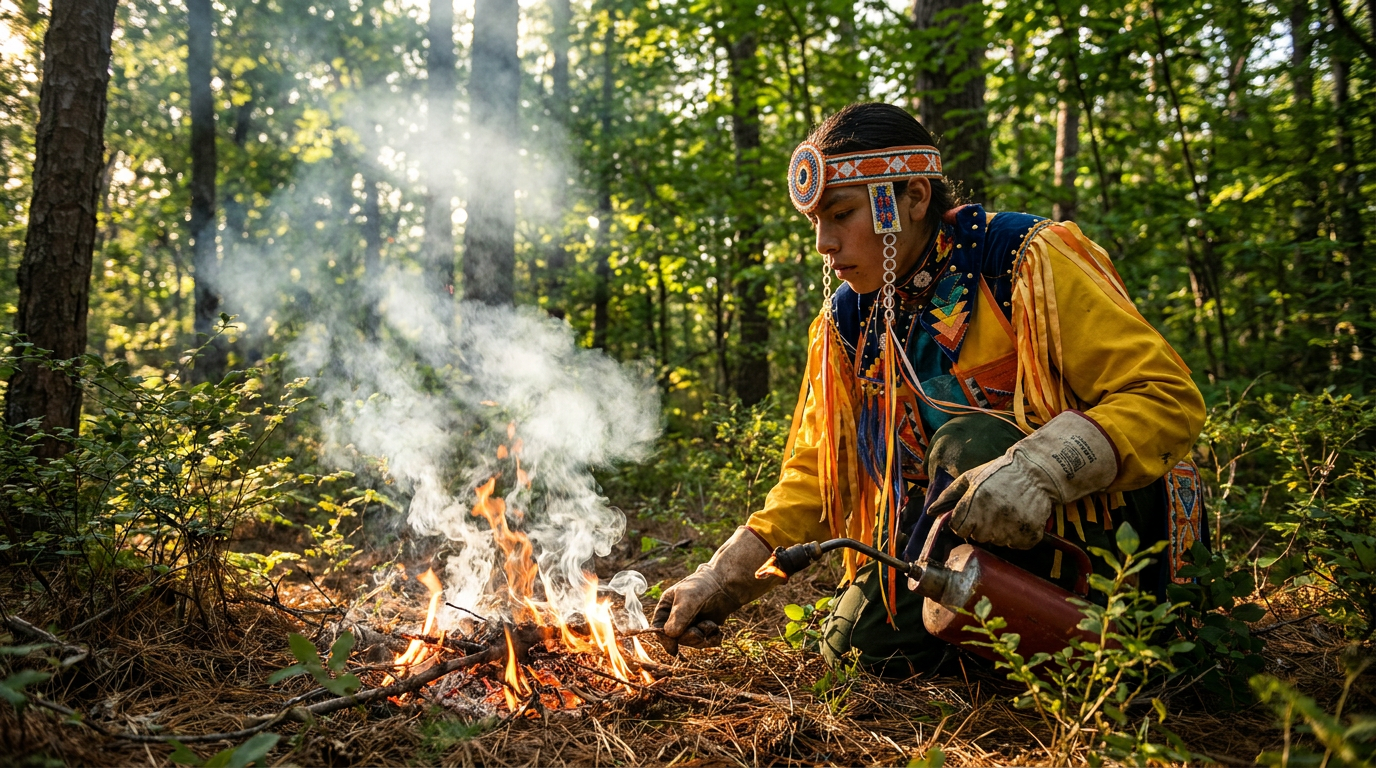
Across North America and Australia, a profound ecological and cultural shift is underway to do exactly that. Governments and conservationists are increasingly turning to the revitalization of "cultural burning," an ancient Indigenous practice of intentionally applying low-intensity fire to the land. From the Karuk and Yurok tribes in California to the Tsilhqot'in Nation in British Columbia and Aboriginal communities in Australia, Indigenous fire practitioners are reclaiming their ancestral role as stewards of the ecosystem, proving that humans can be a restorative force in nature rather than just a destructive one.[3][4]
This relationship with fire is not new; it is one of the oldest land management techniques on Earth. For more than 60,000 years, Indigenous peoples have operated as keystone species in their respective environments, utilizing fire to actively shape ecosystems. Rather than leaving the landscape to the chaotic whims of lightning strikes, traditional fire bosses carefully curated the land, ensuring the abundance of culturally significant plants, creating clearings for wildlife, and preventing the massive conflagrations that dominate today's headlines.[5][8]
To understand the revival, it is crucial to distinguish cultural burning from the standard "prescribed burns" conducted by government forestry agencies. While both involve intentionally setting fires, they differ vastly in intent, scale, and execution. Western prescribed burns are typically hazard-reduction exercises, designed to burn as much accumulated fuel as possible in a short window to protect nearby property. Cultural burning, by contrast, is a holistic, Indigenous-led practice aimed at achieving specific ecological, spiritual, and cultural objectives.[7][8]
The hallmark of a cultural burn is its temperature. Often referred to as "cool burns," these fires are lit during highly specific seasonal windows—typically in the early dry season or spring, when the soil, lower vegetation, and ambient humidity still hold significant moisture. Because the conditions are carefully chosen, the fires move slowly, sometimes at a mere walking pace. They generate a fraction of the heat of a hazard-reduction burn, allowing practitioners to safely walk alongside the flames and guide their path.[5][8]
Crucially, cool burns are designed to protect the forest canopy. By keeping the flames low to the ground, the upper tiers of the trees remain completely intact. This is a vital ecological calculation: the preserved canopy continues to provide essential shade for the forest floor, offers a safe haven for vulnerable animals escaping ground predators, and retains the seeds necessary for future generations of growth. The slow pace of the fire also ensures that insects, reptiles, and small mammals have ample time to flee.[5]

The physical result of this meticulous process is a "mosaic" landscape. Rather than a uniformly scorched earth, a cultural burn leaves behind a patchwork of burnt and unburnt areas. This mosaic breaks up continuous stretches of highly flammable vegetation, acting as a natural buffer that stops late-season, high-intensity wildfires in their tracks. When a megafire hits a culturally burned mosaic, it drops from the canopy to the ground, loses its momentum, and starves for fuel.[5][7]
The benefits of good fire extend far beyond hazard reduction into deep ecological renewal. The chemical reactions triggered by low-intensity ash return vital nutrients to the soil without destroying its microbial life. This nutrient flush stimulates the germination of dormant native seeds and encourages the prolific growth of culturally significant flora. In California, for example, cultural burns are essential for the health of the California black oak, clearing competing brush so the trees can thrive and produce the acorns that have sustained local tribes for millennia.[6][8]
Wildlife populations also experience dramatic rebounds in the wake of good fire. By clearing out choked underbrush, cultural burns open up foraging pathways and stimulate the growth of fresh, nutritious plant shoots. Following the reintroduction of cultural burns by the Yurok Tribe in Northern California, the region has seen a marked resurgence of black-tailed deer and elk. Similarly, in the tropical savannas of Northern Australia, cool burns have proven essential for protecting the habitats of endangered species like the rainbow-colored Gouldian finch.[2][6]
Wildlife populations also experience dramatic rebounds in the wake of good fire.
If cultural burning is so effective, why did it ever stop? The answer lies in the history of colonization. As European settlers expanded across North America and Australia in the 19th and 20th centuries, they brought with them a deep-seated fear of fire and a desire to protect lucrative timber resources. Colonial governments systematically outlawed Indigenous fire practices, viewing any intentional burning as a threat to industry and an act of vandalism, while simultaneously forcibly removing Indigenous peoples from their traditional lands.[3][6]
In California, the 1850 Act for the Government and Protection of Indians was among the first state laws to explicitly criminalize cultural burning, with historical accounts noting that early rangers sometimes shot Indigenous people found setting fires. This suppression was codified federally with the 1911 Weeks Act, which effectively banned both cultural and prescribed burns across the United States. Similar policies were enforced in Canada and Australia, severing a millennia-old relationship between Indigenous peoples and the land.[6][8]

This strict "no-burn" mandate created the crisis we face today. By removing the natural and cultural fire cycles that kept ecosystems in balance, a century's worth of dead wood, dense thickets, and invasive grasses were allowed to accumulate unchecked. Today, land managers are fighting fires in forests that have unnatural, explosive fuel loads. The very policies designed to protect the forests ultimately transformed them into ticking time bombs, highly vulnerable to the exacerbating effects of climate change and prolonged droughts.[3][7]
Beyond saving homes and habitats, the revival of cultural burning is emerging as a surprisingly powerful climate solution. When forests and savannas burn in uncontrolled, high-intensity megafires, they release massive amounts of stored carbon dioxide into the atmosphere, creating a dangerous feedback loop that accelerates global warming. By preemptively clearing ground fuel with cool burns, Indigenous fire managers prevent these massive, late-season emissions, keeping the majority of the carbon safely locked in the woody vegetation and soil.[2][8]
The climate math is already being proven at scale. In the Northern Territories of Australia, where Aboriginal fire and land management practices have been heavily reintegrated, destructive late-season bushfires have been cut in half. As of recent years, dozens of Indigenous-owned savanna fire projects are operating across millions of hectares. By burning early in the dry season, these projects successfully abate roughly one million tonnes of greenhouse gas emissions every single year.[1][2]

These carbon savings are not just ecological victories; they are economic engines for cultural resurgence. The emissions prevented by Aboriginal fire management are quantified and sold as carbon credits on the open market. Since their inception, these programs have generated tens of millions of dollars, with the revenue flowing directly back into Indigenous communities. This funding supports the hiring of Indigenous rangers, facilitates the transfer of traditional knowledge from Elders to youth, and finances further land management operations.[2]
Recognizing these undeniable successes, Western governments are finally beginning to change course and dismantle the bureaucratic barriers to good fire. In the United States, the federal government recently issued formal guidance to elevate and include Traditional Ecological Knowledge (TEK) in federal environmental decision-making. This shift, championed by Indigenous leaders within the Department of the Interior, is slowly opening doors for greater tribal co-management of public lands and easing the restrictions on cultural burns.[3]
Similar policy shifts are occurring internationally. The provincial government of British Columbia has formally recognized the distinction between cultural burning and prescribed fire, committing to co-develop new fire frameworks in partnership with First Nations. In Australia, states hit hardest by catastrophic bushfires have formally accepted recommendations to drastically increase cultural burning as a core component of their official fire management strategies, partnering directly with Indigenous fire alliances.[1][7]
Despite this progress, significant hurdles remain. Indigenous fire practitioners still face a labyrinth of red tape, including complex permitting requirements, liability concerns, and strict air-quality regulations that often force the cancellation of planned burns. Furthermore, because many tribes lack jurisdiction over their ancestral territories, they must navigate cumbersome approval processes with multiple overlapping federal and state agencies just to care for their traditional homelands.[1][8]

Yet, the momentum of the cultural fire movement is undeniable. From the Karuk and Chumash in California to the Ngunnawal people in Australia, a new generation of fire bosses is reclaiming their ancestral knowledge. Community workshops and cross-cultural training programs are proliferating, bridging the gap between Western fire science and Traditional Ecological Knowledge. These partnerships are proving that effective climate adaptation requires listening to those who have successfully stewarded the land for millennia.[4][6]
Ultimately, the revival of cultural burning is about much more than mitigating wildfire risk or sequestering carbon. It is a profound act of cultural resurgence, sovereignty, and healing. By returning good fire to the landscape, Indigenous communities are healing the land, and in doing so, they are healing themselves. As the world searches for solutions to an escalating climate crisis, the smoke rising from these cool burns offers a powerful signal of hope and a roadmap for living in balance with fire.[8]
How we got here
Pre-1800s
Indigenous peoples globally use cultural burning for tens of thousands of years to manage landscapes and promote biodiversity.
1850
California passes the Act for the Government and Protection of Indians, one of the first laws effectively criminalizing Indigenous fire practices.
1911
The U.S. Weeks Act establishes a policy of total fire suppression, leading to a century of hazardous fuel buildup in forests.
2012
Australia launches carbon credit programs that fund Aboriginal savanna fire management, proving the climate benefits of traditional burning.
2022
The U.S. government formally issues guidance to include Traditional Ecological Knowledge in federal environmental decision-making.
2026
Provincial and state governments increasingly co-develop fire management frameworks with Indigenous fire bosses to combat escalating megafires.
Viewpoints in depth
Indigenous Fire Practitioners
View fire as a living relative and essential tool for cultural resurgence, ecological balance, and spiritual connection to the land.
For Indigenous fire bosses and traditional knowledge keepers, fire is not merely a hazard to be managed, but a living entity and a vital tool for caring for 'Country.' Practitioners emphasize that cultural burning is deeply tied to sovereignty, ceremony, and the intergenerational transfer of knowledge. They argue that removing fire from the landscape was a profound disruption of the natural order, and that returning 'good fire' is essential for restoring both the physical health of the ecosystem and the spiritual wellbeing of their communities. The focus is on holistic healing rather than just fuel reduction.
Government Land Managers
Focus on integrating traditional knowledge with Western fire suppression to reduce hazardous fuel loads and protect communities from megafires.
State and federal forestry agencies approach the revival of cultural burning primarily through the lens of risk mitigation and public safety. Facing a catastrophic escalation in megafires, these agencies recognize that a century of total fire suppression has failed. They value cultural burning and Indigenous partnerships as highly effective methods for reducing the massive fuel loads that threaten rural communities and infrastructure. While increasingly respectful of the cultural significance, their primary metrics for success remain acres treated, fuel reduced, and lives and property protected from uncontrolled infernos.
Climate & Conservation Scientists
Emphasize the measurable benefits of low-intensity burning for biodiversity protection and greenhouse gas emission abatement.
The scientific and conservation communities highlight the empirical data supporting traditional fire management. Ecologists point to the dramatic recovery of biodiversity—from native grasses to large herbivores—in areas treated with cool burns. Meanwhile, climate scientists focus on the carbon math: by preventing high-intensity megafires that vaporize entire forests, low-intensity cultural burns keep carbon sequestered in the soil and woody biomass. For this camp, the integration of Traditional Ecological Knowledge is a crucial, evidence-based strategy for climate adaptation and global emissions reduction.
What we don't know
- How quickly bureaucratic hurdles, such as air-quality permits and liability laws, can be reformed to allow cultural burning at a continental scale.
- The exact long-term impact of climate-driven droughts on the safe seasonal windows available for conducting cool burns.
- How funding models like Australia's carbon credit system can be successfully adapted for North American tribal nations.
Key terms
- Cultural Burning
- The intentional, Indigenous-led application of low-intensity fire to the landscape to achieve cultural, spiritual, and ecological objectives.
- Traditional Ecological Knowledge (TEK)
- The evolving body of knowledge, practices, and beliefs regarding the relationship of living beings to their environment, handed down through generations by Indigenous peoples.
- Cool Burn
- A slow-moving, low-temperature fire that clears ground fuel while protecting the tree canopy and allowing wildlife time to escape.
- Megafire
- An extraordinarily large and destructive wildfire, typically burning more than 100,000 acres, often fueled by decades of suppressed undergrowth.
- Mosaic Burning
- A fire management technique that creates a patchwork of burnt and unburnt areas, breaking up continuous fuel loads and providing diverse habitats.
Frequently asked
What is the difference between a cultural burn and a prescribed burn?
Cultural burns are Indigenous-led, holistic, low-intensity 'cool' fires aimed at ecological and cultural health, whereas prescribed burns are often Western agency-led hazard reduction fires designed to quickly eliminate fuel.
Why was cultural burning banned?
During the 19th and 20th centuries, colonial governments viewed all fire as destructive. They outlawed Indigenous burning practices to protect timber resources and as a means of suppressing Indigenous culture.
How does cultural burning help fight climate change?
By clearing ground fuel with low-intensity fires, practitioners prevent the massive, uncontrolled megafires that release huge amounts of stored carbon into the atmosphere.
What is a 'cool burn'?
A slow-moving, low-temperature fire lit during damp seasons that clears underbrush without igniting the forest canopy or sterilizing the soil.
Sources
Source coverage
8 outlets
3 viewpoints surfaced








[1]The WorldClimate & Conservation Scientists
What Aboriginal Australians can teach us about managing wildfires
Read on The World →[2]The Nature ConservancyClimate & Conservation Scientists
Indigenous fire management benefits biodiversity and reduces climate emissions
Read on The Nature Conservancy →[3]The RevelatorIndigenous Fire Practitioners
Indigenous-led prescribed fire is helping to restore depleted lands
Read on The Revelator →[4]The NarwhalIndigenous Fire Practitioners
How Indigenous communities are bringing back cultural burning
Read on The Narwhal →[5]Australian MuseumClimate & Conservation Scientists
Cultural burning
Read on Australian Museum →[6]National Wildlife FederationGovernment Land Managers
A mixed history of support for cultural burning
Read on National Wildlife Federation →[7]Government of British ColumbiaGovernment Land Managers
Introduction to Cultural Burning and Prescribed Fire
Read on Government of British Columbia →[8]Factlen Editorial TeamIndigenous Fire Practitioners
Synthesis by Factlen editorial team
Read on Factlen Editorial Team →

Every angle. Every day.
Get culture stories with full source coverage and perspective breakdowns delivered to your inbox.