
How the New Universal 'Content Credentials' Standard Actually Works to Verify Digital Media
A massive cross-industry rollout of C2PA digital watermarking is giving internet users a built-in 'nutrition label' for images and video. Here is the evidence on how well it resists tampering and whether it actually changes how people consume news.
By Factlen Editorial Team
- Provenance Advocates
- Argue that cryptographic metadata is the only scalable way to restore trust in digital media and combat deepfakes.
- Security Skeptics
- Warn that metadata can be stripped and that omission attacks create a false sense of absolute truth.
- Regulatory Bodies
- View machine-readable watermarking as a mandatory compliance baseline to protect citizens from AI manipulation.
What's not represented
- · Independent Creators
- · Historical Archivists
Why this matters
As AI-generated media becomes indistinguishable from reality, this open-source standard is the first systemic defense that puts verification directly in your browser, allowing you to instantly check the origin of a political photo or breaking news video.
Key points
- The C2PA standard embeds cryptographically signed metadata into digital files at the moment of creation.
- Major camera manufacturers and tech platforms are integrating the standard ahead of strict EU AI Act deadlines in late 2026.
- While the signatures are secure, the metadata can be stripped via screenshots, prompting the use of invisible pixel watermarks as backups.
- Forensic experts warn that verified media can still be used to mislead through 'omission attacks' where contradictory context is deleted.
By mid-2026, the internet has quietly undergone a fundamental infrastructure upgrade designed to restore trust in the digital ecosystem. After years of losing the technological arms race against increasingly sophisticated AI-generated deepfakes, the technology industry has pivoted from trying to detect synthetic media after the fact to proving the authenticity of real media at the moment of creation. This paradigm shift is powered by the Coalition for Content Provenance and Authenticity (C2PA), an open technical standard that acts as a digital "nutrition label" for images, video, and audio, allowing users to see exactly where a piece of media originated.[1][7]
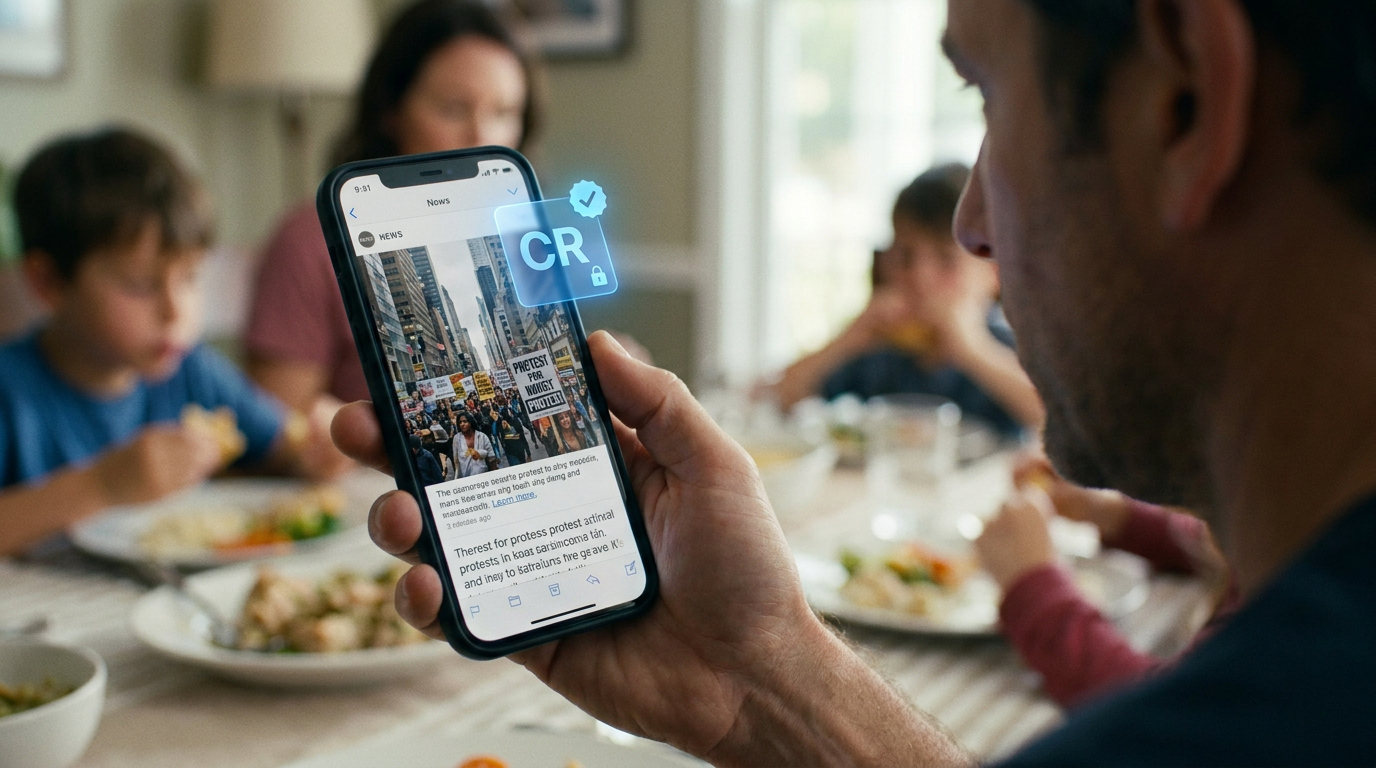
The scale of the rollout is unprecedented. Major smartphone manufacturers and professional camera brands like Sony, Nikon, and Leica have begun integrating C2PA signing directly into their hardware. Simultaneously, platforms including Meta, LinkedIn, and Google have updated their interfaces to display these "Content Credentials" to users. When a user clicks a small "CR" icon overlaid on an image, a drop-down panel reveals exactly who captured the photo, what device was used, and whether any artificial intelligence was involved in its editing or generation.[1][7]
The core mechanism relies on public key cryptography rather than visual watermarks. When a photographer presses the shutter on a C2PA-compliant camera, the device generates a cryptographic hash of the image data and signs it using a secure hardware key. This creates a tamper-evident manifest embedded within the file's metadata. If the image is subsequently opened in editing software like Adobe Photoshop, the software appends a new signed assertion detailing exactly what edits were made, creating an unbroken, mathematically verifiable chain of custody.[1][5]
The urgency behind this adoption is largely driven by new regulatory mandates, most notably the European Union's AI Act. Under Article 50 of the legislation, which takes full effect in August 2026, creators and platforms deploying AI-generated content are legally required to ensure their outputs are machine-readable and detectable. A simple text overlay stating "Made with AI" is no longer legally sufficient; compliance now requires robust, cryptographically signed metadata.[2][3]

This regulatory pressure has forced generative AI companies to bake provenance standards into their models by default, fundamentally altering how synthetic media is distributed. Systems from OpenAI, Google, and Adobe now automatically attach C2PA credentials to their synthetic outputs, ensuring that the origin of the image is permanently recorded. For corporate compliance officers, newsrooms, and digital publishers, these invisible signatures have transitioned from a niche technical feature to a mandatory shield against liability in jurisdictions enforcing strict AI transparency laws.[1][3]
However, the evidence regarding the system's absolute security presents a more complicated picture, highlighting the ongoing cat-and-mouse game of digital forensics. While the cryptographic signatures themselves are virtually impossible to forge without the original hardware keys, the metadata carrying them is inherently fragile. Security researchers note that simple, everyday actions—such as taking a screenshot of an image, re-encoding a video for a different platform, or passing a file through certain non-compliant messaging apps—can strip the C2PA manifest entirely, leaving the file untethered from its verified history.[5]
To combat this fragility, the industry has adopted a "multi-layered" approach. Alongside the C2PA metadata, companies are deploying pixel-level invisible watermarking, such as Google's SynthID. These imperceptible patterns are woven directly into the pixels or audio waveforms of the content. If a user screenshots an AI-generated image, stripping the C2PA metadata, the embedded SynthID watermark survives, allowing platforms to perform a "soft binding" lookup in a global registry to reattach the provenance data.[3][7]
To combat this fragility, the industry has adopted a "multi-layered" approach.
Despite these technical workarounds, forensic experts warn of deeper architectural vulnerabilities, most notably the "Completeness Problem." C2PA is designed to verify the history of a specific file, but it cannot prove what is missing. If a human rights observer takes one hundred photographs of a conflict zone but selectively deletes twenty images that contradict their preferred narrative, the remaining eighty photographs will still carry perfectly valid, cryptographically secure C2PA signatures.[4]

This dynamic creates a risk of "omission attacks," where bad actors use verified, authentic media to construct a highly misleading narrative. Because the individual assets carry a cryptographic seal of approval, viewers may be lulled into a false sense of absolute truth, failing to question the broader context or what might have been intentionally left out of the frame. C2PA certifies the history of the pixels, not the truth of the event.[4][5]
There is also the looming challenge of the "legacy gap." The internet currently hosts billions of images, videos, and audio clips created before 2026 that carry no cryptographic provenance. As C2PA credentials become the gold standard for trust, researchers worry about a bifurcated information ecosystem. Authentic historical footage or citizen journalism captured on older, non-compliant devices might be unfairly dismissed as synthetic simply because it lacks a modern digital signature.[5][7]
Despite these technical limitations, early evidence suggests that the presence of provenance labels significantly alters user behavior and restores a baseline of trust. Studies tracking consumer sentiment in 2026 indicate that over 90% of internet users actively want clear disclosures about how the digital content they consume was made. When users are presented with verifiable provenance data alongside an image, their likelihood of correctly evaluating the veracity of a news source increases measurably, demonstrating that transparency tools can effectively combat the psychological impact of misinformation.[6]

The psychological impact of the "CR" badge is becoming a central focus for media literacy organizations. Rather than demanding that users become forensic experts capable of spotting the subtle artifacts of an AI generation, the C2PA standard offloads the verification burden to the browser. Users are being trained to look for the credential icon in the same way they learned to look for the padlock icon indicating a secure HTTPS website connection two decades ago.[7]
The ultimate success of the Content Credentials rollout will depend heavily on ubiquitous platform integration and standardized user experiences. While major social networks have begun reading and displaying the metadata, enforcement and visibility remain highly uneven across the web. Some platforms still compress images in ways that inadvertently destroy the cryptographic signatures, while others bury the provenance information behind multiple clicks and hidden menus, drastically reducing its utility for the average scrolling user who rarely stops to investigate a post.[5][7]
Looking ahead, the coalition is working aggressively to expand the standard beyond static visual media into more complex digital environments. Draft specifications are currently addressing real-time video streaming, spatial computing environments, and the increasingly urgent threat of complex audio deepfakes. As voice cloning technology becomes highly accessible and dangerous, embedding hardware-level signatures into microphones, podcasting equipment, and audio recording software represents the next critical frontier for the provenance movement to secure.[1][7]
The era of trusting digital media implicitly is over, replaced by an ecosystem that requires cryptographic proof. While Content Credentials cannot solve the deeper societal issues of polarization and confirmation bias, they provide a necessary, standardized vocabulary for transparency. By forcing the digital supply chain to show its work, the technology offers a pragmatic middle ground between unchecked synthetic media and a paralyzed, zero-trust internet.[6][7]
How we got here
2021
The C2PA coalition is founded by Adobe, Microsoft, Intel, and others to draft a provenance standard.
2024
Major camera manufacturers like Sony and Leica begin testing hardware-level cryptographic signing.
2025
Generative AI platforms begin attaching Content Credentials to synthetic outputs by default.
August 2026
The EU AI Act's Article 50 transparency requirements take effect, forcing widespread compliance.
Viewpoints in depth
Provenance Advocates
Argue that cryptographic metadata is the only scalable way to restore trust in digital media.
Proponents of the C2PA standard argue that the era of relying on human intuition or AI classifiers to detect deepfakes is over. Because generative AI models improve continuously, detection tools are locked in a losing arms race. By shifting the paradigm to 'proving reality' at the point of capture, advocates believe we can establish a baseline of trust. They point to consumer surveys showing overwhelming demand for transparency, arguing that a standardized 'nutrition label' for media empowers users to make informed decisions without needing to be forensic experts.
Security Skeptics
Warn that metadata can be stripped and that omission attacks create a false sense of absolute truth.
Cybersecurity researchers and forensic experts acknowledge the utility of C2PA but warn against treating it as a silver bullet. Their primary concern is the 'Completeness Problem'—the reality that cryptographic signatures only verify the history of the pixels present, not the truth of the event depicted. Skeptics argue that bad actors will simply use verified, authentic media out of context, or selectively delete photos that contradict their narrative. They fear that the presence of a verification badge might lull the public into a false sense of security, causing them to stop questioning the broader context of what they are viewing.
Regulatory Bodies
View machine-readable watermarking as a mandatory compliance baseline to protect citizens from AI manipulation.
For government agencies and international regulators, particularly the European Commission, digital provenance is viewed through the lens of consumer protection and liability. Regulators argue that the sheer volume of synthetic media necessitates a machine-readable standard to enforce transparency laws like the EU AI Act. From this perspective, C2PA and invisible watermarking are not just best practices, but mandatory infrastructure required to insulate platforms from liability and protect democratic processes from high-volume disinformation campaigns.
What we don't know
- How platforms will handle the 'legacy gap' of billions of older, unverified images without unfairly flagging them as suspicious.
- Whether the standard can be effectively adapted to secure real-time, two-way audio and video communications against deepfake impersonation.
Key terms
- C2PA
- The Coalition for Content Provenance and Authenticity, an open standard for embedding cryptographic metadata into digital media.
- Content Credentials
- The consumer-facing brand name and 'CR' icon used to display C2PA provenance data to users on social media and news sites.
- Cryptographic Hash
- A unique, mathematically generated string of characters that acts as a secure digital fingerprint for a specific file.
- Omission Attack
- A manipulation tactic where bad actors selectively delete context or specific files while presenting the remaining, cryptographically verified files as the complete truth.
- SynthID
- An invisible watermarking technology that embeds imperceptible patterns directly into the pixels or audio waveforms of AI-generated content.
Frequently asked
Does a Content Credential mean the photo is real?
Not necessarily. It proves how the photo was made and whether AI was used, but it does not guarantee the event depicted actually happened or wasn't staged.
What happens if someone takes a screenshot of a verified image?
Taking a screenshot strips the standard C2PA metadata. However, newer 'soft binding' techniques use invisible pixel watermarks to help platforms reattach the lost credentials.
Are older photos on the internet going to be flagged as fake?
No, but they will lack the new verification badges. Researchers warn this could create a 'legacy gap' where older, authentic media is viewed with more suspicion simply because it predates the standard.
Sources
Source coverage
7 outlets
3 viewpoints surfaced







[1]Coalition for Content Provenance and AuthenticityProvenance Advocates
C2PA Technical Specification v2.2
Read on Coalition for Content Provenance and Authenticity →[2]European CommissionRegulatory Bodies
Code of Practice on Transparency of AI-Generated Content
Read on European Commission →[3]Tech Plus TrendsRegulatory Bodies
EU Regulatory Reality Check: AI Watermarking in 2026
Read on Tech Plus Trends →[4]VeritasChainSecurity Skeptics
The Completeness Problem: C2PA's Achilles Heel
Read on VeritasChain →[5]CREST ResearchSecurity Skeptics
Synthetic Media and the Shift to Provenance-Based Transparency
Read on CREST Research →[6]Adobe Trust CenterProvenance Advocates
Authenticity in the Age of AI: Consumer Trust Study
Read on Adobe Trust Center →[7]Factlen Editorial TeamProvenance Advocates
Synthesis by Factlen editorial team
Read on Factlen Editorial Team →

More in news politics
See all 9 stories →US-Iran Deal
U.S. and Iran Sign Agreement to End War; Vance Lashes Out at Israeli Critics
7 sources

U.S.-Iran Deal
U.S. and Iran Sign 14-Point Agreement to End War, Sparking Fierce Backlash from Israel
6 sources

U.S.-Iran Relations
Vance Rebukes Israeli Critics of U.S.-Iran Peace Agreement, Warning Against Alienating 'Only Powerful Ally'
8 sources

Cognitive Defense
The Science of 'Prebunking': How Psychological Inoculation is Defeating Misinformation
6 sources

Every angle. Every day.
Get news politics stories with full source coverage and perspective breakdowns delivered to your inbox.