
How the Middle East is Quietly Becoming a Global Clean Energy Powerhouse
The MENA region added a record 15 gigawatts of renewable capacity in 2025, leveraging ultra-cheap solar and massive battery storage to transition from petrostates to green energy hubs.
By Factlen Editorial Team
- Gulf State Policymakers
- Viewing renewable energy as the ultimate tool for economic diversification and post-oil survival.
- Energy Market Analysts
- Focusing on the unprecedented cost reductions and the shift toward hybrid grid systems.
- Global Climate Watchdogs
- Warning that renewable additions must actively displace fossil fuels, not just supplement them.
What's not represented
- · Local communities affected by the massive land use of gigawatt-scale solar and wind farms
- · Fossil fuel industry workers facing long-term transition risks
Why this matters
The Middle East is leveraging its vast capital and unparalleled solar resources to transform from a fossil-fuel hub into the world's primary supplier of clean energy. This shift not only promises to drive down the global cost of green technologies but also fundamentally redraws the geopolitical energy map for the post-oil era.
Key points
- The MENA region added 15 GW of new renewable energy capacity in 2025, entering an exponential growth phase.
- Saudi Arabia tripled its installed capacity in a single year, while the UAE solidified its early-mover advantage.
- Solar power costs in the region have plummeted to a world-record low of $0.0135 per kilowatt-hour.
- A massive boom in battery storage is underway, with Saudi Arabia adding 10,400 MWh to ensure 24/7 clean power.
- The ultimate goal is exporting green hydrogen, led by the $8.4 billion NEOM mega-project coming online in 2026.
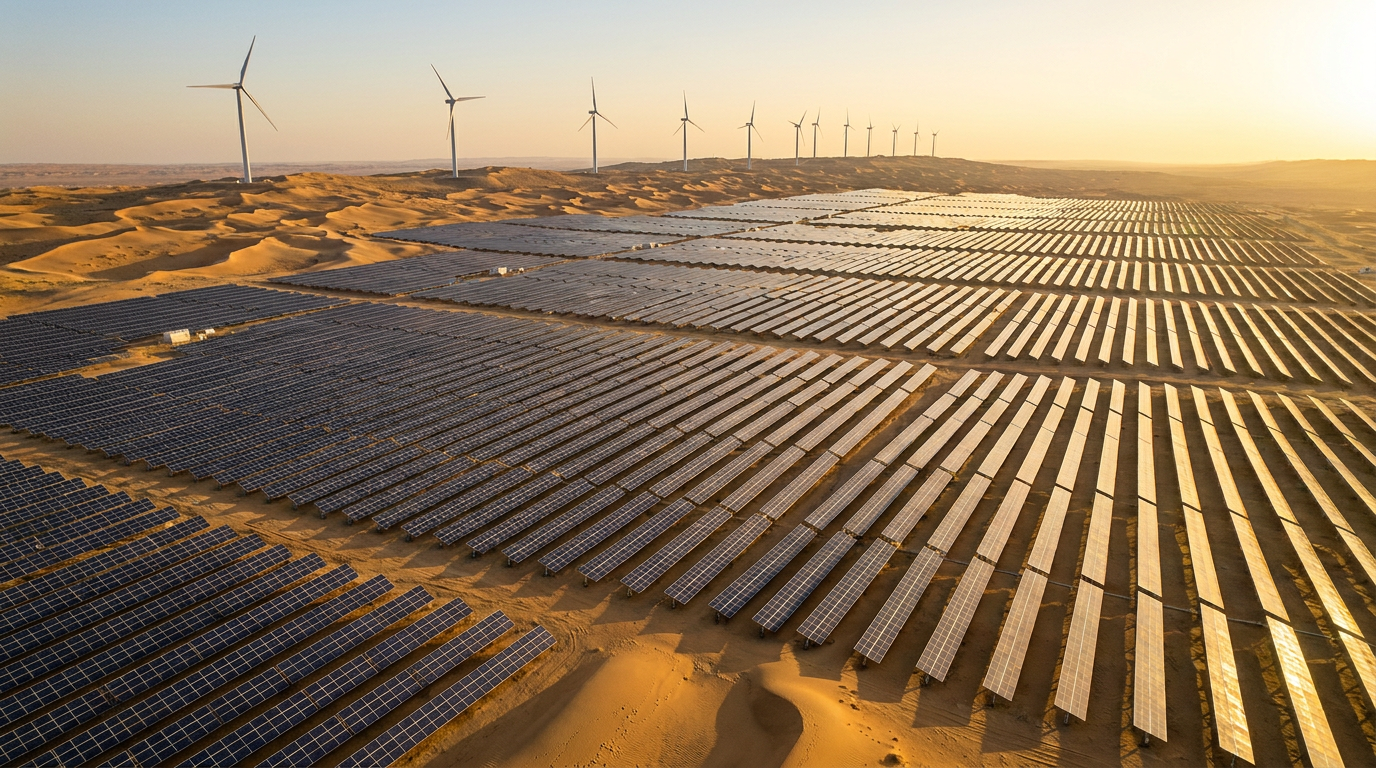
The Middle East is globally synonymous with fossil fuels, but a quiet revolution reached a definitive tipping point in 2025. The region has officially entered an exponential phase of renewable energy deployment, adding a staggering 15 gigawatts of clean power capacity in a single year. This unprecedented acceleration marks a departure from the slow, pilot-scale projects of the past decade, signaling that the Gulf states are now building out green infrastructure at a pace that rivals the world's most aggressive climate leaders. Energy planners and government officials are no longer treating renewables as a niche experiment; they are treating them as the foundational bedrock of the region's twenty-first-century economic survival.[1][3]
This 44 percent year-over-year surge brings the Middle East and North Africa region's total operational renewable capacity to 43.7 gigawatts. Saudi Arabia alone tripled its installed capacity to 11.7 gigawatts in just twelve months, setting a blistering pace for its neighbors. Meanwhile, the United Arab Emirates solidified its position as an early mover, boasting 7.5 gigawatts of operational clean power and committing to triple its total capacity by the end of the decade. Other nations, including Oman and Qatar, also doubled their renewable footprints as massive, gigawatt-scale solar parks finally came online.[1][2]

The driving force behind this sudden acceleration is not solely environmental altruism or international climate pressure—it is pure, unadulterated economics. The region is currently witnessing what industry analysts call the "one cent revolution." Because the cost of solar photovoltaic technology has plummeted by more than 90 percent over the last decade, the financial calculus for power generation has fundamentally flipped. Building new solar farms is now significantly cheaper than burning the oil and gas that these nations pull directly from their own soil.[7]
This economic advantage is supercharged by the region's unique geography. Thanks to some of the highest Global Horizontal Irradiance levels on the planet, a solar panel installed in the Arabian Peninsula produces roughly double the electricity of the exact same panel installed in central Europe. This geological lottery win has driven the Levelized Cost of Electricity to historic, world-beating lows, allowing the Middle East to produce the cheapest electrons anywhere on Earth.[7]
The sheer scale of this cost advantage was demonstrated when the Al Dhafra Solar PV project in the United Arab Emirates reached full commercial operation. The massive 2-gigawatt facility secured a world-record low tariff of just $0.0135 per kilowatt-hour. At these rock-bottom prices, solar power is no longer just competitive with natural gas and oil; it fundamentally undercuts them. This makes renewable energy the default, undeniable choice for any new baseload power generation across the Gulf.[5]

However, the region's ambitions extend far beyond daytime solar generation. To build a truly resilient grid and power the heavy industry required for economic diversification, energy planners are shifting away from a "solar-only" approach. They are now embracing a sophisticated "solar plus wind" strategy. While solar panels provide the world's cheapest electricity during the day, they leave a massive generation gap when the sun sets—a gap that must be filled to keep modern economies running.[7]
Wind energy provides a crucial counterbalance to solar, generating power during the night and early morning hours when solar output drops to zero. Projects like Saudi Arabia's 400-megawatt Dumat Al Jandal wind farm have proven that the region's coastal and desert wind shears can achieve capacity factors approaching 40 percent. This is significantly higher than typical solar installations, proving that onshore wind is a highly viable and necessary component of the Middle East's clean energy matrix.[7]
Yet, even combined wind and solar cannot guarantee the 24/7 uninterrupted power required by modern grids and industrial facilities. This intermittency challenge has triggered a massive, parallel boom in Battery Energy Storage Systems. In 2025, energy storage transitioned from a costly, niche experiment to a central, non-negotiable pillar of the regional grid architecture. Saudi Arabia emerged as a global top-tier storage market, bringing four standalone battery projects online that total a massive 10,400 megawatt-hours of capacity.[1][2]
Yet, even combined wind and solar cannot guarantee the 24/7 uninterrupted power required by modern grids and industrial facilities.
Across the broader region, operational storage capacity reached approximately 25 gigawatt-hours and is projected to multiply sixfold by the end of the decade. Falling battery capital costs—now hovering around $73 to $75 per kilowatt-hour in the Gulf—are making round-the-clock renewable energy a financial reality. By pairing cheap solar with massive battery banks, these nations are effectively smoothing out the intermittency curve, ensuring that clean power is available exactly when it is needed.[2]

The ultimate endgame for this massive buildout of cheap, continuous clean electricity is not just domestic consumption; it is the creation of a lucrative new export commodity: green hydrogen. As the world scrambles to decarbonize hard-to-abate sectors like steelmaking, global shipping, and heavy aviation, the Middle East is aggressively positioning itself as the primary global supplier of the fuels of the future.[4][7]
Green hydrogen is produced by using renewable electricity to split water into hydrogen and oxygen via a process called electrolysis. Because the Middle East boasts the world's cheapest solar and wind power, it is uniquely positioned to produce green hydrogen at a fraction of the cost of European or Asian competitors. Analysts estimate that the region can produce green hydrogen for roughly half the cost of European facilities, giving it an insurmountable competitive moat.[4][7]
The crown jewel of this export strategy is the $8.4 billion NEOM Green Hydrogen Project in Saudi Arabia. Scheduled to begin full-scale production in 2026, the facility is a marvel of modern engineering. It integrates 4 gigawatts of dedicated solar and wind energy to power massive electrolyzers, producing an astonishing 600 tonnes of carbon-free hydrogen every single day.[6]
Because pure hydrogen is notoriously difficult and expensive to transport over long distances, this output will be converted into 1.2 million tonnes of green ammonia annually. Green ammonia is a stable, easily transportable compound that can be shipped globally using existing maritime infrastructure. Similar mega-projects are rapidly advancing in Oman's Duqm port and the United Arab Emirates' Ruwais industrial hub, creating a network of clean energy export terminals.[6]

Despite the staggering momentum, the transition is not without friction. The green hydrogen sector is currently entering what experts call a "rationalization phase." While there are over 120 active hydrogen projects in the regional pipeline, high financing costs and a lack of confirmed, long-term international buyers have delayed final investment decisions for many. Only the most heavily capitalized and strategically located projects are currently breaking ground.[1]
Furthermore, the region's renewable rollout remains heavily dependent on imported technology. Up to 85 percent of the solar photovoltaic modules used in Gulf mega-projects originate from Chinese manufacturers. While this reliance has kept capital costs incredibly low, it exposes the region's energy transition to global supply chain bottlenecks, shipping vulnerabilities in the Strait of Hormuz, and broader geopolitical trade tensions.[7]
There is also the broader climate paradox that shadows these developments. While the Middle East and North Africa region is aggressively building out clean energy, it remains the undisputed epicenter of global fossil fuel production. Climate watchdogs emphasize that true decarbonization requires these new renewable electrons to actively replace domestic oil and gas consumption, rather than simply freeing up more hydrocarbons to be exported and burned elsewhere.[4][7]
Nevertheless, the sheer scale and speed of the 2025 buildout mark a permanent, structural shift in the global energy landscape. The Middle East is leveraging its vast sovereign wealth, centralized decision-making capabilities, and unparalleled solar resources to future-proof its economies for a post-oil world. They are not waiting for the end of oil; they are actively building the system that will replace it.[3][7]
By transforming from traditional petrostates into modern "electro-states," these nations are ensuring their long-term economic survival. Even as the global energy mix fundamentally changes over the coming decades, the center of gravity for global energy production appears destined to remain firmly anchored in the desert.[7]
How we got here
2020
The MENA region's installed renewable capacity sits at roughly 14 GW, growing at a slow, pilot-scale pace.
2023
The UAE hosts the COP28 climate summit, accelerating regional commitments to triple renewable energy capacity by 2030.
November 2024
The 2 GW Al Dhafra Solar PV project in the UAE reaches full commercial operation, setting a record-low tariff.
2025
The region enters an exponential growth phase, adding 15 GW of new capacity in a single year and deploying massive battery storage.
2026
The $8.4 billion NEOM Green Hydrogen Project in Saudi Arabia is scheduled to begin full-scale production.
Viewpoints in depth
Gulf State Policymakers
Viewing renewable energy as the ultimate tool for economic diversification and post-oil survival.
For regional governments, the transition is fundamentally about economic security rather than just climate altruism. By harnessing their natural geographic advantages—abundant sunshine and vast empty land—policymakers aim to transform their nations from petrostates into 'electro-states.' They argue that dominating the emerging green hydrogen market is essential to maintaining their geopolitical influence and export revenues as global demand for traditional fossil fuels eventually peaks and declines.
Energy Market Analysts
Focusing on the unprecedented cost reductions and the shift toward hybrid grid systems.
Market analysts emphasize that the Middle East has cracked the code on ultra-low-cost renewables, driving solar tariffs down to the 'one cent' threshold. However, they point out that the real breakthrough in 2025 was the massive deployment of Battery Energy Storage Systems (BESS) and the integration of wind power. Analysts argue that this shift from simple daytime solar to 24/7 baseload clean energy is what makes the region's green hydrogen export ambitions financially viable.
Global Climate Watchdogs
Warning that renewable additions must actively displace fossil fuels, not just supplement them.
While environmental organizations applaud the staggering pace of the MENA region's clean energy buildout, they maintain a critical caveat. Watchdogs argue that true decarbonization only happens if these new renewable electrons replace the domestic burning of oil and gas. They express concern that some regional strategies use solar power to meet growing domestic demand simply to free up more hydrocarbons for export, which does not reduce global greenhouse gas emissions.
What we don't know
- Whether the global market will be willing to pay the premium required for green hydrogen once mega-projects like NEOM come online.
- How vulnerable the region's rapid buildout is to supply chain disruptions, given its heavy reliance on imported Chinese solar modules.
- If the massive influx of renewable energy will actually lead to a proportional decrease in domestic fossil fuel consumption.
Key terms
- Global Horizontal Irradiance (GHI)
- The total amount of shortwave radiation received from above by a surface horizontal to the ground, used to measure solar power potential.
- Levelized Cost of Electricity (LCOE)
- A metric that measures the average net present cost of electricity generation for a power plant over its lifetime, allowing comparison across different energy technologies.
- Capacity Factor
- The ratio of a power plant's actual electrical energy output over a given period to its maximum possible output if it had operated at full capacity continuously.
- Battery Energy Storage System (BESS)
- Large-scale battery installations that store excess electricity generated by renewable sources for use during periods of high demand or low generation.
- Green Hydrogen
- Hydrogen fuel produced by using renewable electricity to split water into hydrogen and oxygen, resulting in zero carbon emissions.
- Green Ammonia
- A compound of nitrogen and green hydrogen that is easier to liquefy and transport globally than pure hydrogen, often used as a carrier fuel.
Frequently asked
Why is the Middle East investing so heavily in renewable energy?
The region is leveraging its massive solar and wind resources to produce ultra-cheap electricity, aiming to diversify its economies away from oil and become a global hub for green hydrogen exports.
How cheap is solar power in the Middle East?
Due to exceptionally high solar irradiance, projects like the Al Dhafra Solar PV in the UAE have achieved world-record low tariffs of around $0.0135 per kilowatt-hour, making it significantly cheaper than fossil fuels.
What is the NEOM Green Hydrogen Project?
It is an $8.4 billion mega-project in Saudi Arabia that will use 4 gigawatts of solar and wind power to produce 600 tonnes of carbon-free hydrogen daily starting in 2026.
How do they solve the problem of solar power not working at night?
The region is adopting a 'solar plus wind' strategy, as wind often blows at night, and is heavily investing in massive Battery Energy Storage Systems (BESS) to store daytime solar energy.
Sources
Source coverage
7 outlets
3 viewpoints surfaced







[1]SolarQuarterEnergy Market Analysts
MENA Crosses 43.7 GW Milestone As Region Accelerates Toward A Renewable Energy Future
Read on SolarQuarter →[2]Renewables NowEnergy Market Analysts
MENA's installed renewables hit 43.7 GW after record growth in 2025
Read on Renewables Now →[3]Dii Desert EnergyEnergy Market Analysts
MENA Energy Outlook 2026: Renewables, Hydrogen and Energy Storage Insights
Read on Dii Desert Energy →[4]International Energy AgencyGlobal Climate Watchdogs
Global Hydrogen Review 2024
Read on International Energy Agency →[5]MasdarGulf State Policymakers
Dii MENA Energy Outlook 2026 Report Unveiled During ADSW
Read on Masdar →[6]P&S IntelligenceEnergy Market Analysts
Middle East Renewable Energy Market Size, and Growth Report, 2032
Read on P&S Intelligence →[7]Factlen Editorial TeamEnergy Market Analysts
Synthesis by Factlen editorial team
Read on Factlen Editorial Team →
Every angle. Every day.
Get world stories with full source coverage and perspective breakdowns delivered to your inbox.