
How the Global Repair Café Movement is Rewiring Our Relationship with Broken Things
A grassroots network of over 4,000 community repair groups is teaching people how to fix their electronics and clothing, sparking a cultural shift against disposable consumption.
By Factlen Editorial Team
- Community Fixers
- View repair as a vital tool for building social cohesion, sharing skills, and rejecting a disposable culture.
- Right to Repair Advocates
- Focus on legislative action to break repair monopolies and force manufacturers to design durable, fixable products.
- Electronics Manufacturers
- Argue that restricting repair access is necessary to protect intellectual property, ensure cybersecurity, and maintain consumer safety.
What's not represented
- · Local independent repair shop owners whose businesses are affected by manufacturer monopolies.
Why this matters
As the cost of living rises and electronic waste reaches critical levels, learning to repair everyday items offers immediate financial relief while building local community resilience and reducing environmental impact.
Key points
- The Repair Café movement has grown to over 4,000 global locations since its inception in 2009.
- Volunteers successfully repair between 60% and 80% of the items brought to them.
- The collaborative process teaches valuable maintenance skills and combats social isolation.
- Data collected at these events is used to lobby for 'Right to Repair' legislation.
- Manufacturers argue that restricting repairs is necessary for safety and cybersecurity.
- Repairing items provides significant economic relief for households facing high living costs.
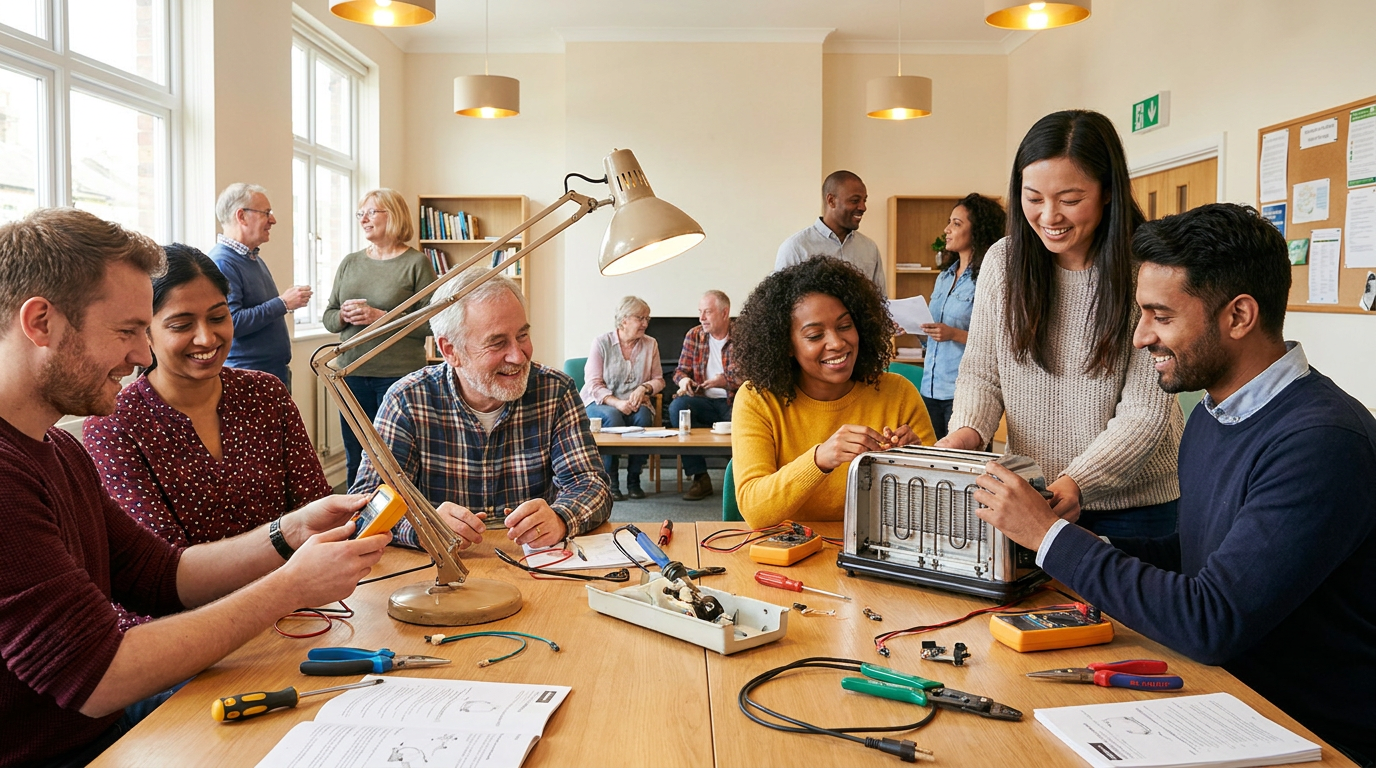
A Saturday morning in a local community hall often looks like a chaotic triage center for household goods. Tables are strewn with blunt knives, malfunctioning sound mixers, balky zippers, and beloved but broken lamps. Volunteers armed with toolboxes, multimeters, and sewing machines lean over the items, not in isolation, but shoulder-to-shoulder with the people who brought them. This is not a commercial repair shop or a recycling drop-off. It is a Repair Café, a grassroots gathering space that is quietly pushing back against the global economy's reliance on disposable goods.[2][7]
In a consumer landscape defined by one-day delivery and planned obsolescence, the easiest choice is almost always to throw a broken item away and buy a replacement. Fast fashion has reduced the lifespan of clothing to a handful of wears, while consumer electronics are frequently designed with proprietary screws and glued casings that actively discourage tampering. Yet, a growing cultural shift is challenging this cycle of waste. By treating repair as a collaborative, community-driven act, citizens are reclaiming agency over their possessions and redefining what it means to consume.[3][7]
The concept was pioneered in 2009 by Dutch environmentalist Martine Postma, who hosted the first Repair Café in an Amsterdam theater foyer. She wanted to test a simple hypothesis: if a free, accessible space was provided, would people bring their broken things, and would neighbors with technical skills show up to help them? The experiment was a resounding success, leading to the creation of the Repair Café International Foundation. What began as a single local initiative has since exploded into a highly organized global movement.[1][2]
Today, the scale of community repair is staggering. By 2026, the network has grown to encompass roughly 4,000 active Repair Cafés operating across more than 40 countries. From solar-powered repair hubs in Berlin to pop-up events in Cape Town and university campuses in the United States, these volunteer-led groups are collectively fixing an estimated 850,000 items every year. The movement has evolved from a niche environmental project into a robust material safety net for millions of people.[2]

The mechanism of a Repair Café is deliberately distinct from traditional service models. Visitors do not drop off their broken toasters or torn jackets to be picked up later. Instead, the process is entirely collaborative. When a visitor arrives, they are matched with a volunteer "fix-pert" who has the relevant skills. The owner sits with the volunteer, watching the diagnostic process, learning how the item works, and often participating directly in the physical repair itself.[1][7]
This collaborative structure serves a dual purpose. Practically, it demystifies the inner workings of everyday household items, transferring valuable maintenance skills from experts to laypeople. Socially, it fosters profound community cohesion. As people work together over a stripped wire or a jammed gear, they share stories, drink tea, and build relationships that bridge generational and socioeconomic divides. Researchers have noted that these environments offer significant mental health benefits, combating social isolation while providing a low-pressure sense of accomplishment.[1][7]
The success rate of these grassroots clinics is remarkably high. Data collected from global events indicates that volunteers successfully repair between 60% and 80% of the items brought through the doors. The interventions range from simple fixes—like restringing beads on sentimental jewelry or rewiring an antique fan—to complex electronic troubleshooting. Even when an item is deemed completely beyond repair, the owner leaves with a clear understanding of why it failed and how to responsibly recycle the remaining components.[1][2]

The success rate of these grassroots clinics is remarkably high.
The urgency behind this movement is driven by an escalating global waste crisis. The world generates tens of millions of metric tons of electronic waste annually, with a significant portion handled in regions lacking adequate management infrastructure. A modern smartphone, for instance, contains over 70 distinct components utilizing more than 60 different metals. When these devices are prematurely discarded due to a single failing part, the environmental toll of extracting and processing replacement materials is immense.[3]
Economic pressures have also accelerated the appeal of community repair. In an era marked by persistent inflation and high living costs, the financial burden of constantly replacing household goods has become unsustainable for many families. Repair Cafés offer a direct economic reprieve. By extending the life of a winter coat, a vacuum cleaner, or a laptop, consumers can bypass the retail cycle entirely, finding robust material wealth already existing within their local communities.[2][7]
Beyond fixing individual items, the movement is generating a powerful dataset that is reshaping consumer advocacy. Since 2017, volunteers have been logging their interventions into an online database known as the RepairMonitor. This tool tracks what products break most frequently, which specific components fail, and whether the design of the item hindered the repair process. With hundreds of thousands of entries, the RepairMonitor has become a vital repository of real-world intelligence on product durability.[1][4]

This data is not sitting idle; it is being weaponized in the legislative arena. The grassroots fixing community has naturally aligned with the "Right to Repair" movement, a global advocacy effort demanding that manufacturers make their products easier to fix. Armed with empirical evidence of planned obsolescence and artificial repair barriers, advocates are lobbying governments to mandate the public availability of spare parts, diagnostic software, and repair manuals.[4][5]
The legislative push has encountered fierce resistance from major technology and appliance manufacturers. Industry lobbying groups argue that restricting repair access to authorized service networks is essential for maintaining consumer safety, protecting proprietary intellectual property, and ensuring cybersecurity. Manufacturers contend that modern devices are highly complex and that allowing untrained individuals or independent shops to bypass software locks could result in dangerous malfunctions, battery fires, or severe data breaches.[3][6]
Despite this opposition, the Right to Repair movement is securing landmark victories. The European Union has introduced sweeping eco-design regulations requiring certain appliances to be repairable with standard tools and mandating that spare parts remain available for up to a decade. In the United States, a wave of state-level legislation has forced manufacturers to open their repair ecosystems, while federal lawmakers continue to debate bipartisan bills aimed at standardizing access to diagnostic data across industries.[3][5]

These policy shifts represent a fundamental renegotiation of the relationship between consumers and the products they buy. For decades, the prevailing economic model has treated the end-user as a passive consumer of sealed, disposable goods. The Right to Repair framework, bolstered by the hands-on activism of Repair Cafés, insists that ownership includes the inherent right to open, understand, modify, and maintain a product indefinitely.[5][7]
Ultimately, the most profound impact of the community repair movement may be cultural rather than strictly environmental or legislative. It is actively changing how people perceive the material world. A broken speaker or a finicky zipper is no longer viewed as an annoyance destined for the landfill, but as a solvable puzzle. By resurrecting beloved objects and sharing the knowledge required to do so, these local groups are proving that a more resilient, less wasteful society is entirely within reach.[2][7]
How we got here
2009
Martine Postma hosts the first Repair Café in an Amsterdam theater foyer.
2011
The Repair Café International Foundation is established to support local groups globally.
2017
The RepairMonitor online database is launched to track global repair data and product durability.
2024
The European Union adopts sweeping eco-design regulations mandating repairability for consumer appliances.
2026
The global network surpasses 4,000 active locations, fixing hundreds of thousands of items annually.
Viewpoints in depth
Community Fixers
View repair as a vital tool for building social cohesion, sharing skills, and rejecting a disposable culture.
For the volunteers running these events, the act of fixing is deeply social. They argue that modern consumerism has isolated people from the material reality of the objects they use every day. By opening up a toaster or a laptop in a public, collaborative setting, they aim to demystify technology and empower individuals. Furthermore, they emphasize the mental health benefits of the space—providing a low-pressure environment where neighbors can connect, share stories, and experience the tangible satisfaction of solving a physical problem together.
Right to Repair Advocates
Focus on legislative action to break repair monopolies and force manufacturers to design durable, fixable products.
Advocacy groups view the grassroots data collected by Repair Cafés as ammunition in a broader legislative war. They argue that manufacturers deliberately design products to fail or be unfixable—using proprietary screws, gluing batteries, and withholding diagnostic software—to force consumers into buying replacements. Their goal is to pass laws at the state, federal, and international levels that mandate open access to spare parts and repair manuals, arguing that true ownership of a product must include the right to maintain it.
Electronics Manufacturers
Argue that restricting repair access is necessary to protect intellectual property, ensure cybersecurity, and maintain consumer safety.
Industry representatives and tech giants caution against the unregulated opening of complex modern devices. They argue that smartphones, medical equipment, and modern appliances contain sensitive components that, if improperly handled by untrained individuals, could lead to dangerous malfunctions, such as lithium-ion battery fires. Additionally, they raise concerns that mandating open access to diagnostic software could create vulnerabilities that malicious actors might exploit, thereby compromising user data and broader cybersecurity networks.
What we don't know
- How pending federal Right to Repair legislation in the U.S. will ultimately balance consumer access with manufacturer cybersecurity concerns.
- Whether the long-term availability of spare parts mandated by the EU will significantly alter the design language of future consumer electronics.
Key terms
- Planned Obsolescence
- The practice of designing products with a limited useful lifespan so they will become obsolete and require replacement.
- E-waste
- Electronic waste, encompassing discarded electrical or electronic devices, which often contain hazardous materials.
- Circular Economy
- An economic system aimed at eliminating waste and the continual use of resources through reuse, sharing, and repair.
- RepairMonitor
- A global online database where volunteers log data on broken items, repair success rates, and common product faults.
- Right to Repair
- A legislative movement advocating for consumers' legal rights to access spare parts, tools, and manuals to fix their own devices.
Frequently asked
Are Repair Cafés free to attend?
Yes, the events are free, though voluntary donations are highly encouraged to help cover the costs of venue hire, tools, and materials.
Can I just drop my broken item off?
No. Repair Cafés are collaborative spaces. You are expected to sit with the volunteer, watch the process, and learn how the repair is done.
What happens if my item cannot be fixed?
Volunteers will diagnose the issue. If it requires specialized parts or tools they don't have, they will advise you on the next steps or how to responsibly recycle the item.
What are the most commonly repaired items?
Lamps, small kitchen appliances, clothing, bicycles, and consumer electronics are among the most frequently brought items.
Sources
Source coverage
7 outlets
3 viewpoints surfaced







[1]Repair Café International FoundationCommunity Fixers
About the Repair Café International Foundation and the Global Network
Read on Repair Café International Foundation →[2]The Washington PostElectronics Manufacturers
Broken speaker? Finicky zipper? Anticonsumerist Repair Cafes urge you to fix it instead of pitch it
Read on The Washington Post →[3]Earth.OrgRight to Repair Advocates
Reclaiming Control: How You Can Join the Right to Repair Movement
Read on Earth.Org →[4]The Centre for Sustainable DesignRight to Repair Advocates
Loading Legacy Repair Data into RepairMonitor to Inform Policymakers
Read on The Centre for Sustainable Design →[5]U.S. PIRGRight to Repair Advocates
Right to Repair: Giving consumers the power to fix their own stuff
Read on U.S. PIRG →[6]Consumer Technology AssociationElectronics Manufacturers
Industry Perspective on Repair, Cybersecurity, and Consumer Safety
Read on Consumer Technology Association →[7]Factlen Editorial TeamCommunity Fixers
Synthesis by Factlen editorial team
Read on Factlen Editorial Team →



Every angle. Every day.
Get culture stories with full source coverage and perspective breakdowns delivered to your inbox.