
How the Fediverse and ActivityPub Are Rebuilding the 'Cozy Web'
As users retreat from algorithmic feeds, the decentralized ActivityPub protocol is bridging independent communities with major platforms like Threads, ending the era of social media lock-in.
By Factlen Editorial Team
- Decentralization Advocates
- Value user ownership, privacy, and algorithm-free feeds, viewing the Fediverse as an escape from Big Tech.
- Mainstream Tech Platforms
- View open protocols as a feature to enhance interoperability while maintaining massive scale and user convenience.
- Fediverse Pragmatists
- Focus on the practical realities, technical hurdles, and cultural friction of bridging massive corporate platforms with small indie servers.
- Factlen Editorial
- Synthesizes the technological and cultural shifts driving the transition toward a user-centric internet.
What's not represented
- · Creators reliant on algorithmic virality
- · Advertisers navigating decentralized spaces
Why this matters
For the first time in the modern social media era, users are gaining the ability to own their social connections and move between platforms without losing their friends, fundamentally shifting power away from tech monopolies.
Key points
- Users are increasingly retreating from public, algorithm-driven platforms in favor of smaller, high-trust digital spaces known as the 'Cozy Web'.
- The Fediverse solves the fragmentation of the Cozy Web by allowing independent platforms to communicate via the ActivityPub protocol.
- ActivityPub acts like email for social media, enabling a user on a text-based app to seamlessly follow and interact with a user on a photo-sharing app.
- Meta's integration of ActivityPub into Threads has bridged a massive 400-million-user platform with the independent, decentralized web.
- This interoperability gives users true portability, allowing them to move between platforms without losing their network of friends and followers.
The era of the "public square" internet is quietly fracturing. For over a decade, digital life was defined by massive, centralized platforms where users broadcasted their lives to the largest possible audience. But as algorithmic feeds became saturated with sponsored content and organic reach plummeted to a mere 3% or 4% for many creators, a profound psychological shift began.[7]
Users are increasingly retreating from the exhaustion of the engagement era, seeking out what digital theorists call the "Cozy Web"—smaller, high-trust, unindexed spaces like group chats, Discord servers, and niche forums where human connection supersedes viral reach.[7][8]
Yet, the Cozy Web has historically come with a significant structural flaw: fragmentation. When users abandon a major legacy platform to find a quieter digital neighborhood, they are forced to leave their entire network of friends, followers, and connections behind.[2]
This phenomenon, known as social graph lock-in, has long been the ultimate defensive moat for Big Tech, keeping users tethered to platforms they no longer enjoy simply because the cost of starting over is too high.[2][8]
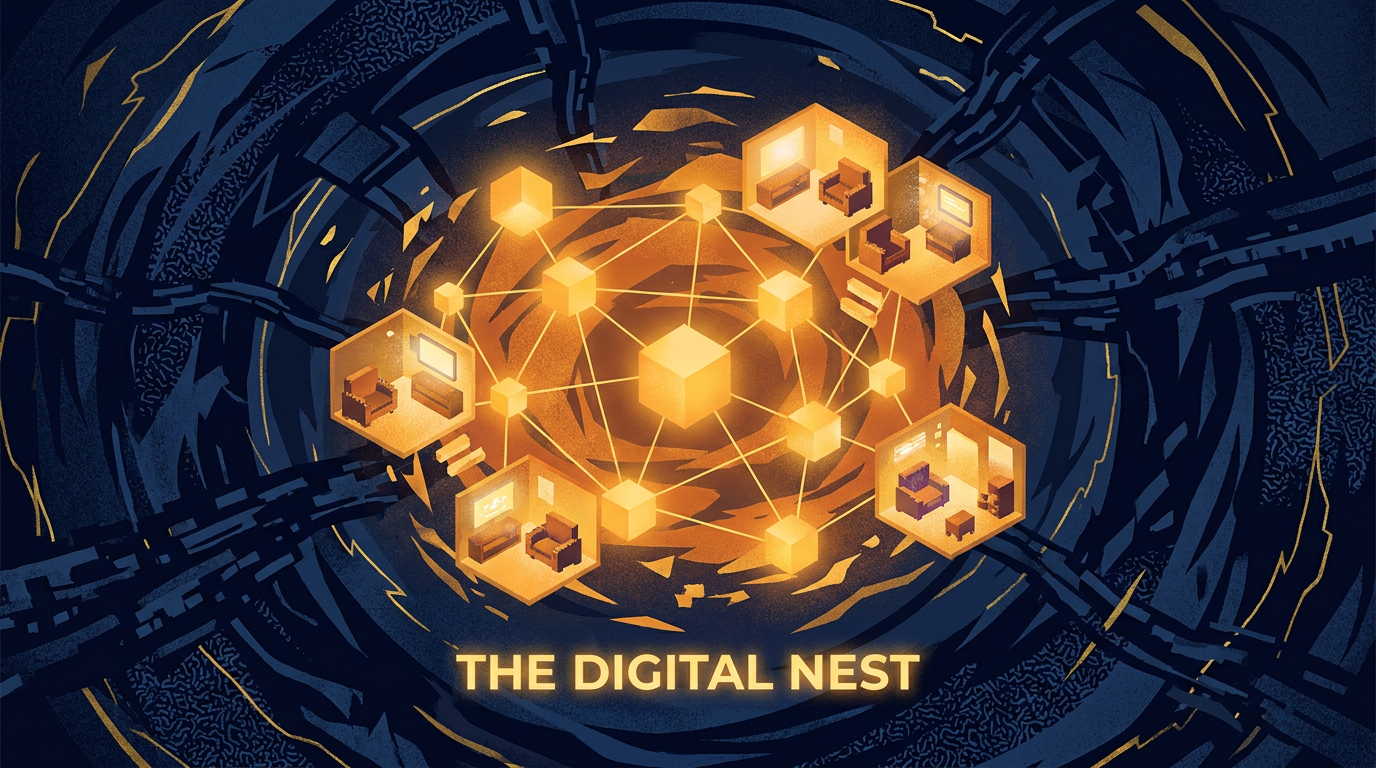
A quiet architectural revolution is now solving this exact problem, promising to combine the intimacy of the Cozy Web with the connectivity of the global internet. The solution lies in a rapidly maturing ecosystem known as the "Fediverse"—a portmanteau of "federation" and "universe."[1]
Rather than a single app or website, the Fediverse is a sprawling collection of independent, interoperable social media platforms that can all seamlessly talk to one another.[1][8]

The engine powering this interoperability is ActivityPub, a decentralized social networking protocol. Ratified as an official standard by the World Wide Web Consortium (W3C) in 2018, ActivityPub provides the technical scaffolding for platforms to exchange posts, likes, and follows across entirely different applications.[5]
Much like how email protocols allow a Gmail user to send a message to an Outlook user without a second thought, ActivityPub establishes a common language for social media servers.[1][8]
In practice, this creates a radically user-centric web experience. A user can set up an account on Mastodon, a text-based microblogging platform, and use that exact same account to follow a friend who posts photos on Pixelfed, or watch videos hosted on PeerTube.[1][6]
When the friend posts a photo of their dinner on Pixelfed, it appears directly in the Mastodon user's timeline, where they can like and comment on it natively. The ecosystem even extends to long-form writing and forums, with platforms like Lemmy and WordPress offering ActivityPub integrations.[1][6]
When the friend posts a photo of their dinner on Pixelfed, it appears directly in the Mastodon user's timeline, where they can like and comment on it natively.
For years, the Fediverse was a thriving but niche subculture. Its registered user count peaked around 12 million during the massive social media migrations of late 2022 and early 2023, populated largely by open-source advocates and users explicitly seeking an ad-free, algorithm-free environment.[1][3]
Because anyone can host their own server—known as an "instance"—communities can set their own ground rules, moderation policies, and cultural norms without answering to a central corporate authority.[1]
The trajectory of the decentralized web changed permanently in July 2023, when Meta launched its microblogging app, Threads, and made an unprecedented promise: the platform would eventually support ActivityPub.[2][4]
It was a watershed moment. Never before had a trillion-dollar tech giant committed to opening its walled garden to a decentralized protocol, allowing its users to interact with the broader indie web.[2][3]
Meta's integration of ActivityPub has been a deliberate, phased rollout. It began as a read-only proof of concept in late 2023, allowing a handful of test accounts to be followed from Mastodon.[3][4]
By early 2024, an opt-in beta allowed adult Threads users with public profiles to push their posts out to the Fediverse. The bridge became truly bidirectional in late 2024 and 2025, enabling Threads users to follow Fediverse accounts and view their posts directly within a dedicated feed in the Threads app.[3][4]
The scale of this integration is staggering. By late 2025, Threads boasted over 400 million monthly active users. Connecting a platform of that magnitude to a decentralized network of roughly 12 million users represents a massive stress test for the ActivityPub protocol, fundamentally altering the gravity of the Fediverse.[3][8]

This convergence has not been without friction. The cultural differences between a massive corporate platform and independent, community-funded servers are stark. Some Fediverse instance administrators have chosen to preemptively block federation with Threads, citing concerns over data privacy, content moderation mismatches, and the sheer volume of traffic a platform like Meta generates.[1][3]
However, because of the decentralized nature of the network, these decisions are made at the community level; users on instances that block Threads are always free to migrate their accounts to instances that welcome the connection.[1][8]
Technical hurdles also remain. Translating features across platforms with different product philosophies is complex. For example, how a quote-tweet is rendered, how algorithmic suggestions are handled, and how content warnings are displayed can vary wildly between Threads and a platform like Mastodon.[3][4]

Despite these growing pains, the successful bridging of Threads and the Fediverse proves that decentralized social media is no longer a theoretical experiment—it is a viable, scalable future. It validates the core premise of ActivityPub: that users should have the freedom to choose their preferred interface, algorithm, and community guidelines without sacrificing their ability to communicate with the rest of the world.[2][6][8]
The implications for the future of the internet are profoundly optimistic. As more platforms adopt open protocols, the era of being trapped in a toxic digital environment simply to stay in touch with friends is coming to an end. Users are gaining the ultimate leverage: true portability.[2][7]
If a platform changes its rules, degrades its user experience, or floods its feed with unwanted ads, users can simply pack up their social graph and move to a better provider. This shift forces social media companies to compete on the actual quality of their software and the health of their communities, rather than relying on the hostage-taking mechanics of network effects.[2][8]
Ultimately, the rise of the Fediverse and the mainstreaming of ActivityPub represent a maturation of digital culture. We are moving toward an internet that is both vast and intimate—a landscape where the global connectivity of Big Tech can coexist seamlessly with the high-trust, human-scale neighborhoods of the Cozy Web.[7][8]

How we got here
Jan 2018
The World Wide Web Consortium (W3C) officially publishes ActivityPub as a recommended standard for decentralized networking.
Late 2022
Millions of users migrate to Mastodon following the acquisition of Twitter, bringing mainstream attention to the Fediverse.
Jul 2023
Meta launches Threads and announces its commitment to eventually support the ActivityPub protocol.
Mar 2024
Threads launches its public beta for ActivityPub, allowing opted-in users to push their posts to the broader Fediverse.
Late 2025
Bidirectional federation matures, allowing Threads' 400 million users to seamlessly follow and interact with independent Fediverse accounts.
Viewpoints in depth
Decentralization Advocates
The internet must return to its open, user-controlled roots.
This camp argues that the 'walled garden' era of social media was a historical anomaly that exploited users for data and ad revenue. They champion ActivityPub because it fundamentally shifts power back to the individual. In their view, the ability to host your own server, set your own moderation rules, and own your social graph is the only way to protect digital communities from the whims of corporate algorithms and billionaire owners.
Mainstream Tech Platforms
Interoperability is the next evolution of consumer tech, but scale requires compromise.
For massive platforms like Meta, adopting ActivityPub is a strategic move to future-proof their networks and appease regulators demanding interoperability. However, they argue that the vast majority of users still prioritize convenience, algorithmic discovery, and seamless onboarding over ideological purity. They view federation as a powerful feature to offer power users, while maintaining the centralized infrastructure necessary to serve hundreds of millions of people reliably.
Fediverse Pragmatists
Bridging the indie web and Big Tech is technically possible but culturally fraught.
Administrators of independent instances and technical observers sit in the middle, focusing on the friction of integration. They point out that a platform with 400 million users fundamentally alters the gravity of a network built for 12 million. This camp is deeply concerned with how moderation, privacy, and product features (like quote-tweets or content warnings) translate across the protocol boundary, noting that technical compatibility does not automatically equal cultural compatibility.
What we don't know
- It remains unclear how independent, community-funded servers will financially sustain themselves as traffic from massive platforms like Threads increases.
- We do not yet know if other major legacy platforms, such as TikTok or X, will ever face enough consumer or regulatory pressure to adopt open protocols.
- The long-term cultural impact of mixing algorithm-driven corporate networks with chronological, community-moderated spaces is still unfolding.
Key terms
- ActivityPub
- An open, decentralized social networking protocol standard that allows different platforms to interoperate and share content.
- Fediverse
- A portmanteau of 'federation' and 'universe,' referring to the ecosystem of interconnected, independent social media servers.
- Instance
- An independent server hosting a specific community within the Fediverse, complete with its own rules and moderation policies.
- Social Graph
- The map of a user's connections, friends, and followers across a social network.
- Social Graph Lock-in
- The phenomenon where users feel trapped on a platform they dislike because leaving would mean losing all their digital connections.
Frequently asked
What exactly is the Fediverse?
The Fediverse is a collection of independent social media platforms that can communicate with each other. Instead of one company controlling the network, anyone can set up a server, and users on different servers can seamlessly interact.
How does ActivityPub work?
ActivityPub is an open, standardized protocol created by the W3C. It acts as a common language that allows different social media platforms to send and receive posts, likes, and follows, much like how email protocols allow Gmail and Outlook to communicate.
Can I use my Mastodon account to talk to Threads users?
Yes. Because both platforms support ActivityPub, Mastodon users can follow opted-in Threads users, and Threads users can follow Mastodon accounts, with posts and replies crossing between the two apps.
What is the 'Cozy Web'?
The 'Cozy Web' refers to smaller, private, or high-trust digital spaces—like group chats, Discord servers, and niche forums—where users retreat to escape the noise, algorithms, and public scrutiny of massive legacy social networks.
Sources
Source coverage
8 outlets
4 viewpoints surfaced








[1]The HustleDecentralization Advocates
What the hell is the fediverse?
Read on The Hustle →[2]Popular ScienceMainstream Tech Platforms
What Threads joining the 'Fediverse' means for you
Read on Popular Science →[3]Federated MindFediverse Pragmatists
Fediverse meets the 'Meta'-verse: The Threads Rollout
Read on Federated Mind →[4]MetaMainstream Tech Platforms
Threads has entered the fediverse
Read on Meta →[5]WikipediaFediverse Pragmatists
ActivityPub
Read on Wikipedia →[6]All Things OpenDecentralization Advocates
Understanding ActivityPub and the Fediverse
Read on All Things Open →[7]TrustGrid AnalyticsDecentralization Advocates
From Scroll To Soul: Why Gen Z Is Abandoning Big Social For The Cozy Web
Read on TrustGrid Analytics →[8]Factlen Editorial TeamFactlen Editorial
Synthesis by Factlen editorial team
Read on Factlen Editorial Team →

Every angle. Every day.
Get culture stories with full source coverage and perspective breakdowns delivered to your inbox.