
How the Cruise Industry is Engineering the Zero-Emission Ship
Facing a 2050 net-zero mandate, cruise lines are overhauling ship architecture with solid oxide fuel cells, retractable solar sails, and advanced carbon capture.
By Factlen Editorial Team
- Maritime Engineers & Shipbuilders
- Focused on the technical realities of scaling new powerplants and ensuring fuel flexibility.
- Cruise Operators & Industry Groups
- Balancing massive capital expenditure with regulatory compliance and infrastructure bottlenecks.
- Sustainability Analysts
- Pressuring the industry to move past fossil LNG quickly and eliminate methane slip.
What's not represented
- · Port City Residents
- · Alternative Fuel Producers
Why this matters
The cruise industry operates some of the largest moving structures on Earth, historically relying on highly polluting heavy fuel oil. The engineering breakthroughs required to decarbonize these floating cities—from massive fuel cells to robotic sails—will eventually trickle down to transform the entire global shipping and logistics sector.
Key points
- The cruise industry has committed to achieving net-zero carbon emissions by 2050, requiring a complete overhaul of ship propulsion.
- Liquefied Natural Gas (LNG) is currently being used as a transitional fuel to eliminate sulfur oxides and reduce nitrogen emissions.
- New vessels are testing solid oxide fuel cells (SOFC) to generate electricity through chemical reactions rather than combustion.
- Future ship designs, like Hurtigruten's Sea Zero, incorporate massive battery banks and retractable solar sails to cut energy use by 50 percent.
- Over half of the global fleet is now equipped to plug into onshore power grids, eliminating localized emissions while docked.
A modern cruise ship is effectively a floating city, requiring massive amounts of energy to propel thousands of tons of steel through the ocean while simultaneously powering hotel operations, desalination plants, and entertainment complexes. For decades, this immense energy demand was met by burning heavy fuel oil, making the maritime sector a significant contributor to global carbon emissions. But facing an industry-wide mandate to reach net-zero emissions by 2050, cruise lines are currently undergoing the most radical architectural and engineering overhaul in their history.[1][5]
The engineering challenge is deeply compounded by the sheer lifespan of a commercial vessel. A cruise ship built today is designed to sail for 25 to 30 years, meaning naval architects must design engine rooms for sustainable fuels—like green methanol or liquid hydrogen—that do not yet exist at a commercial scale. To bridge this gap, the industry is building "fuel-flexible" ships, installing adaptable engines and modular power grids that can seamlessly swap fuel sources as global infrastructure matures.[5][7]
In the immediate term, the industry has turned to Liquefied Natural Gas (LNG) as its primary transitional fuel. Currently, 19 ships—representing roughly 13 percent of the global fleet's capacity—use LNG for primary propulsion. Compared to traditional marine gas oil, LNG virtually eliminates local air pollutants, dropping sulfur oxides and fine particulate matter to zero while reducing nitrogen oxides by up to 85 percent.[1][6]
However, LNG is still a fossil fuel, and it carries the specific environmental risk of "methane slip"—small amounts of unburned methane escaping into the atmosphere, which acts as a highly potent greenhouse gas. Engine manufacturers are rapidly refining combustion cycles to push slip values below one percent. More importantly, the LNG engines installed today require zero mechanical modifications to run on bio-LNG or synthetic LNG once those carbon-neutral alternatives become widely available in the 2030s.[1][6]

To move away from combustion entirely, maritime engineers are looking to fuel cells. MSC Cruises recently launched the MSC World Europa, the first contemporary cruise ship to feature a solid oxide fuel cell (SOFC) demonstrator. Operating on LNG, the 50-kilowatt unit produces electricity and heat through a quiet electrochemical reaction rather than burning the fuel. This process yields a 30 percent reduction in greenhouse gases compared to a standard LNG engine, without producing any localized emissions.[3]
The success of these early pilots is paving the way for massive scaling. Through the EU-funded HELENUS project, researchers are developing a 500-kilowatt SOFC module designed to be retrofitted into existing vessels, with the ultimate goal of scaling to 20-megawatt systems capable of full propulsion. Meanwhile, upcoming luxury vessels are being outfitted with 6-megawatt hydrogen fuel cells, which will allow them to shut down their main engines entirely and operate with zero emissions while docked in port.[3][7]
The success of these early pilots is paving the way for massive scaling.
While some operators focus on fuel cells, others are radically redesigning the ship's exterior. Norway's Hurtigruten is advancing its "Sea Zero" project, an initiative to launch the world's most energy-efficient cruise ship by 2030. Rather than relying on a single new fuel, Sea Zero treats the entire vessel as an integrated energy-harvesting system, aiming to cut total energy consumption by up to 50 percent compared to current ships.[2]
The centerpiece of the Sea Zero design is a massive 60-megawatt-hour battery bank—entirely cobalt-free—that will serve as the ship's primary power source. Because Hurtigruten operates primarily along the Norwegian coast, the ship is designed to sail silently and emission-free between ports, recharging its batteries using Norway's clean hydroelectric grid whenever it docks.[2]
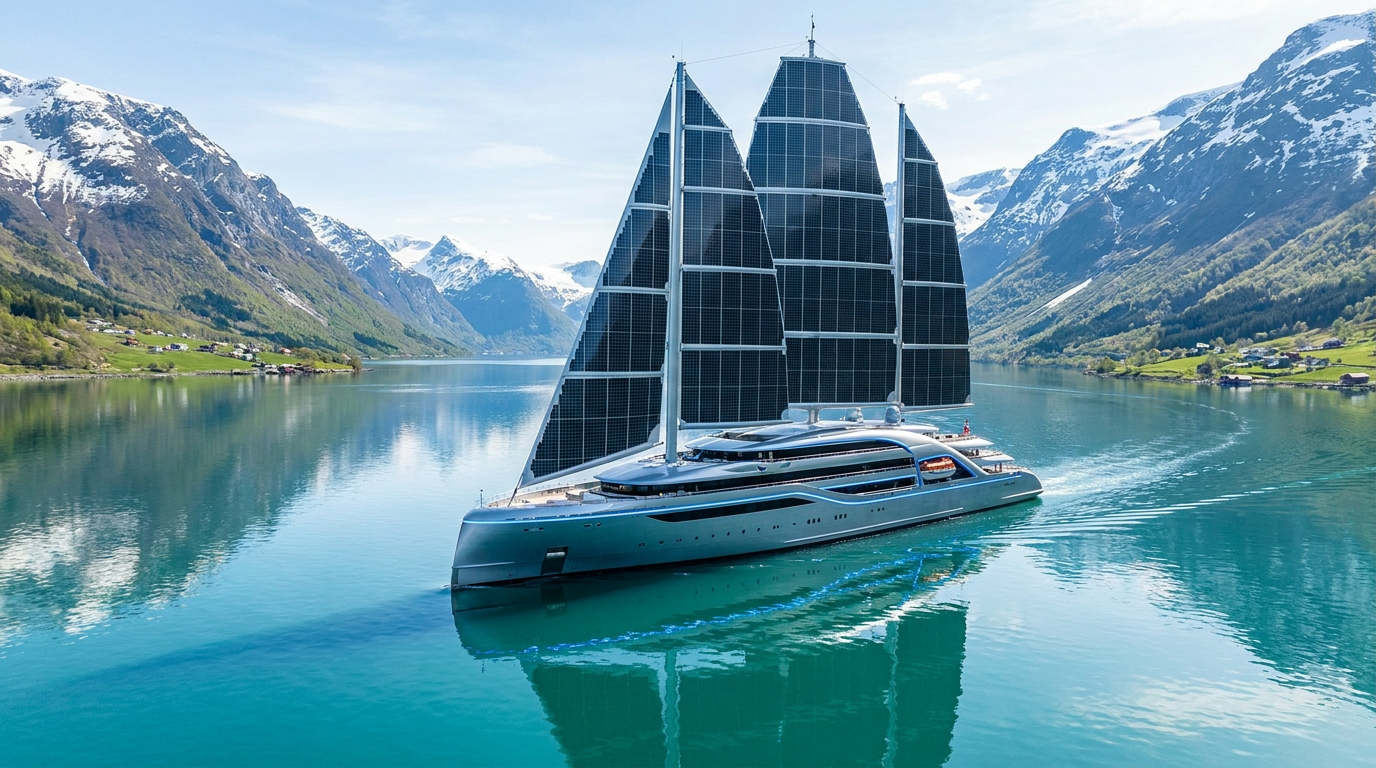
To extend the range of those batteries, the Sea Zero vessel will feature three retractable, autonomous wing rigs. These high-tech sails will reach 50 meters high when fully extended and will be covered in 1,500 square meters of solar panels. By harnessing both wind propulsion and the 24-hour summer sunshine of the Arctic Circle, the sails alone are projected to reduce the ship's energy consumption by 10 to 15 percent.[2]
For the hundreds of ships already on the water, retrofitting entirely new propulsion systems is often physically impossible. Instead, researchers are testing onboard carbon capture. The LNGameChanger project, a collaboration between Havila Voyages and the Norwegian research institute SINTEF, is developing a system to trap carbon dioxide directly from the exhaust of existing LNG engines. If successful, this technology could allow current fleets to achieve near-zero emissions without waiting decades for fleet turnover.[4]

When ships are not sailing, they still require massive amounts of power for hotel operations. To eliminate the localized smog that historically plagued port cities, the industry is rapidly adopting "cold ironing," or onshore power supply. Ships plug directly into the local electrical grid, allowing them to turn off their engines entirely. Today, 147 ships—representing 52 percent of the global fleet—are equipped for shore power, a 167 percent increase since 2018.[1][6]
Beyond the engine room, engineers are hunting for micro-efficiencies that compound into massive energy savings. Modern hulls are coated in advanced anti-fouling paints and equipped with air lubrication systems, which pump a continuous carpet of microscopic bubbles beneath the ship to reduce hydrodynamic drag. Inside, AI-driven weather routing optimizes sailing paths, while microbial digesters break down food waste, and smart HVAC systems recover ambient heat to warm the ship's water supply.[1][2]

The ultimate barrier to a fully zero-emission cruise industry is no longer just shipboard technology, but global infrastructure. A ship designed to run on green methanol or liquid hydrogen is useless if the ports it visits cannot supply those fuels. The maritime sector is currently lobbying governments and energy providers to accelerate the production and distribution of renewable marine fuels, which currently represent a fraction of global energy output.[5][7]
The cruise ship of 2050 will likely not rely on a single silver-bullet technology. Instead, it will be a highly optimized hybrid ecosystem. By combining the ancient mechanics of wind and solar with next-generation fuel cells, massive battery banks, and synthetic fuels, the industry is proving that the heaviest forms of travel can eventually be decoupled from carbon emissions.[7]
How we got here
2018
Only 25 percent of the global cruise fleet was equipped to use onshore power.
2022
MSC World Europa launches as the first contemporary cruise ship with a solid oxide fuel cell demonstrator.
2023
Hurtigruten unveils the Sea Zero project, aiming for a fully emission-free ship.
2030
Target launch date for the first generation of true zero-emission cruise vessels.
2050
The deadline for the entire global cruise industry to achieve net-zero carbon emissions.
Viewpoints in depth
Maritime Engineers & Shipbuilders
Focused on the technical realities of scaling new powerplants and ensuring fuel flexibility.
For naval architects, the transition to net-zero is primarily a sequencing problem. Because ships built today will operate for decades, engineers are prioritizing 'fuel-flexible' engine designs that can burn transitional LNG today and seamlessly switch to synthetic fuels tomorrow. They emphasize that there is no single silver bullet; the future of maritime propulsion will require a complex, integrated hybrid of fuel cells, battery banks, and wind assistance to offset the lower energy density of next-generation green fuels.
Environmental Advocates
Pressuring the industry to move past fossil LNG quickly and eliminate methane slip.
While acknowledging the reduction in localized smog, environmental groups remain highly critical of the industry's reliance on Liquefied Natural Gas (LNG). They point out that LNG is still a fossil fuel, and the 'methane slip' from unburned gas can trap significantly more heat in the atmosphere than carbon dioxide over a 20-year period. These advocates are pushing operators to bypass LNG entirely and accelerate direct investments into true zero-emission technologies like green hydrogen, ammonia, and large-scale wind propulsion.
Cruise Operators & Planners
Balancing massive capital expenditure with regulatory compliance and infrastructure bottlenecks.
Cruise executives face the dual challenge of funding multibillion-dollar fleet renewals while navigating a fragmented global energy market. Their primary concern is the lack of shoreside infrastructure; a ship designed to run on green methanol cannot operate if the ports it visits do not supply it. Operators are heavily lobbying governments and energy conglomerates to scale up the production and distribution of alternative marine fuels, arguing that the maritime sector cannot decarbonize in a vacuum.
What we don't know
- Which alternative fuel—green methanol, liquid hydrogen, or e-ammonia—will ultimately become the global standard for the maritime industry.
- How quickly major international ports can build the massive infrastructure required to supply next-generation fuels at scale.
- Whether experimental onboard carbon capture systems can be miniaturized enough to be economically viable on existing passenger ships.
Key terms
- Solid Oxide Fuel Cell (SOFC)
- A device that produces electricity and heat through an electrochemical reaction rather than combustion, significantly reducing emissions.
- Cold Ironing
- The process of a ship shutting down its main engines while docked and plugging into the local electrical grid for power.
- Methane Slip
- The escape of unburned methane gas from an engine into the atmosphere, a challenge specific to LNG-powered vessels.
- Air Lubrication
- A system that pumps a continuous layer of microscopic air bubbles beneath a ship's hull to reduce friction and save fuel.
- Bio-LNG
- Liquefied natural gas produced from organic waste rather than fossil fuels, allowing ships to operate carbon-neutrally using existing engines.
Frequently asked
Can a cruise ship run entirely on batteries?
Currently, batteries are only used for short, emission-free port entries or coastal sailing. The energy density required to power a massive ship across an ocean still requires liquid fuels.
Why are cruise lines using LNG if it's a fossil fuel?
LNG is a transitional fuel that virtually eliminates local air pollutants like sulfur and nitrogen oxides. Crucially, LNG engines can seamlessly switch to carbon-neutral bio-LNG once it becomes available.
What happens to the older ships that burn heavy fuel?
Older vessels are being retrofitted with advanced exhaust scrubbers, shore power connections, and experimental carbon capture systems to reduce their footprint until they are retired.
When will we see the first zero-emission cruise ship?
Several lines, including Hurtigruten and Ponant, are developing zero-emission prototypes slated to launch by 2030, utilizing a mix of wind, solar, and fuel cells.
Sources
Source coverage
7 outlets
3 viewpoints surfaced







[1]Cruise Lines International Association (CLIA)Cruise Operators & Industry Groups
Global Cruise Industry Environmental Technologies and Practices Report
Read on Cruise Lines International Association (CLIA) →[2]Hurtigruten NorwayMaritime Engineers & Shipbuilders
Sea Zero: Pioneering the World's Most Energy-Efficient Cruise Ship
Read on Hurtigruten Norway →[3]MSC CruisesMaritime Engineers & Shipbuilders
MSC World Europa and the Future of Fuel Cells
Read on MSC Cruises →[4]SINTEFMaritime Engineers & Shipbuilders
LNGameChanger: Carbon Capture for Maritime Vessels
Read on SINTEF →[5]AFARSustainability Analysts
Can Cruising Really Be Net Zero by 2050?
Read on AFAR →[6]Travel Agent CentralCruise Operators & Industry Groups
CLIA: Cruise Lines Progressing Toward Net Zero Emissions by 2050
Read on Travel Agent Central →[7]Factlen Editorial TeamSustainability Analysts
Synthesis by Factlen editorial team
Read on Factlen Editorial Team →
Every angle. Every day.
Get travel stories with full source coverage and perspective breakdowns delivered to your inbox.