
How the Cruise Industry is Engineering the Zero-Emission Ship
Driven by strict new 2026 mandates in Norway's fjords, the cruise industry is rapidly deploying hydrogen fuel cells, green methanol, and massive battery hybrids to replace fossil fuels.
By Factlen Editorial Team
- Cruise Operators
- Shipping companies balancing massive capital investments in unproven technologies with the need to future-proof their fleets.
- Environmental Regulators
- Governments and international bodies using strict access bans and carbon taxes to force the maritime industry to innovate.
- Maritime Analysts
- Industry observers tracking the economic viability, market growth, and environmental efficacy of the new fuel landscape.
- Port Authorities
- Municipalities tasked with building the multi-billion dollar infrastructure required to safely store and supply next-generation fuels.
What's not represented
- · Shipyard Workers and Engineers
- · Local Residents of Port Cities
Why this matters
The maritime shipping sector is a massive contributor to global carbon emissions. The technologies being pioneered and funded by the cruise industry today—like green methanol and hydrogen fuel cells—will eventually scale to decarbonize the global cargo supply chain that delivers our everyday goods.
Key points
- Norway's 2026 mandate bans greenhouse gas-emitting ships from entering its World Heritage fjords.
- LNG remains the dominant alternative fuel but faces new EU methane taxes.
- Green methanol is emerging as the preferred liquid fuel replacement due to its ease of storage.
- Viking will launch the world's first hydrogen fuel cell cruise ship in late 2026.
- Ports are rapidly expanding shore power to allow docked ships to plug into local electrical grids.
The cruise industry has long served as a high-profile target for climate advocates, symbolizing carbon-intensive leisure. But in 2026, the sector is undergoing a profound mechanical transformation [8]. The era of incremental efficiency—swapping out incandescent bulbs and eliminating plastic straws—has given way to a fundamental reimagining of how massive floating cities are propelled through the water [2]. Driven by a combination of strict new government mandates, shifting consumer expectations, and breakthroughs in maritime engineering, the industry is finally moving away from heavy fuel oil [5]. This year marks the deployment of technologies that were considered experimental just half a decade ago, turning the world's oceans into a testing ground for next-generation decarbonization [8].[2][5][8]
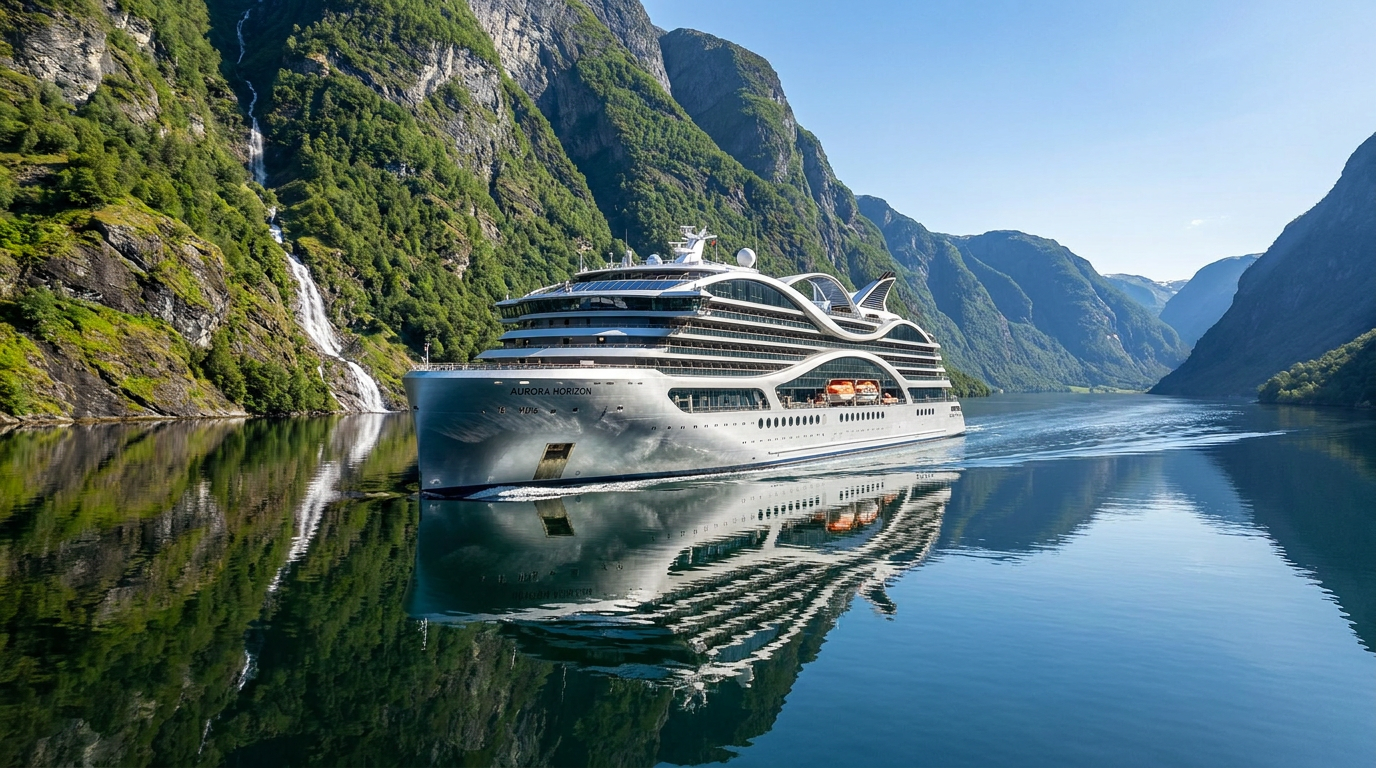
The primary catalyst for this rapid acceleration is not voluntary corporate goodwill, but a hard regulatory deadline in Scandinavia [8]. Starting January 1, 2026, the Norwegian Maritime Authority will enforce a strict zero-emission mandate for all passenger vessels entering the country's UNESCO World Heritage fjords, including the iconic Geirangerfjord and Nærøyfjord [1, 5]. Ships that emit greenhouse gases will simply be barred from entry [1]. For an industry that relies heavily on the breathtaking vistas of the Norwegian coast to sell high-margin expedition tickets, the mandate forced an immediate and expensive pivot [5].[1][5][8]
The stakes in Norway are a microcosm of the broader global challenge. The Geirangerfjord alone receives roughly 800,000 visitors annually, with cruise tourism generating millions for the local economy [5]. However, the sheer volume of massive vessels burning conventional marine fuels in narrow, steep-sided waterways had created localized air quality crises, with authorities warning of hazardous pollution levels during peak summer months [5]. The 2026 mandate was designed to preserve the pristine environment, but it effectively served as a starting gun for a global maritime engineering race [8].[5][8]
Powering a modern cruise ship is an engineering hurdle of staggering proportions. A 200,000-ton vessel carrying 5,000 passengers requires immense energy not just for propulsion, but to sustain the "hotel load"—the continuous operation of HVAC systems, desalination plants, commercial kitchens, and entertainment venues [5]. Historically, the only economical way to generate this much power was by burning heavy fuel oil, a dense, cheap, and highly polluting byproduct of petroleum refining [5]. Replacing it requires fuels that can deliver comparable energy without the carbon footprint [8].[5][8]

For the past decade, the industry's primary stepping stone has been Liquefied Natural Gas (LNG). Among the new ships scheduled for delivery in 2026, nearly 65 percent are designed to run on alternative fuels, with LNG leading the orderbook [3, 4]. LNG significantly improves local air quality by cutting sulfur and nitrogen oxide emissions to near zero, while reducing overall carbon dioxide emissions by up to 25 percent compared to traditional marine diesel [2, 3]. It has provided a crucial bridge, allowing operators to immediately clean up their exhaust profiles while waiting for zero-emission technologies to mature [8].[2][3][4][8]
However, LNG is increasingly viewed as a temporary fix rather than a final destination. The primary environmental drawback of LNG engines is "methane slip"—the release of unburned methane gas into the atmosphere during combustion [3]. Because methane is a far more potent greenhouse gas than carbon dioxide over a 20-year period, this slip can negate many of the fuel's climate benefits [8]. Recognizing this, the European Union has officially added methane to its Emissions Trading System starting in 2026, meaning cruise operators will now face a steep carbon price for their methane emissions [3].[3][8]
With the regulatory window for fossil LNG closing, the industry is rapidly coalescing around green methanol as the most viable immediate successor [6]. Green methanol is produced by combining captured carbon dioxide with green hydrogen generated from renewable energy [7]. Unlike LNG, which must be cryogenically cooled to negative 260 degrees Fahrenheit, methanol is a liquid at room temperature [8]. This makes it vastly easier and cheaper to store, transport, and pump using slightly modified versions of existing maritime infrastructure [6].[6][7][8]
The financial commitment to this new fuel is staggering. The global market for green methanol ships is projected to surge past $7.5 billion in 2026, driven heavily by commercial shipping and early-adopter cruise lines [7]. Operators like TUI Cruises have already commissioned methanol-ready vessels like the Mein Schiff 7, while Norwegian Cruise Line has modified its upcoming 2027 and 2028 deliveries to accommodate methanol propulsion [6]. These dual-fuel engines allow ships to burn conventional fuel today and seamlessly switch to green methanol as the global supply chain scales up [7].[6][7]

The transition is also reshaping regional cruise routes. The Port of Seattle, in collaboration with maritime partners, is currently advancing a "Green Corridor" project aimed at deploying four green methanol-powered cruise ships on the lucrative Alaska route by 2032 [4]. This initiative serves as a pilot program to prove the efficacy of the fuel in a rigorous, high-traffic environment [4]. By establishing a dedicated route, ports and operators can guarantee the demand necessary to justify building expensive new bunkering facilities [8].[4][8]
This initiative serves as a pilot program to prove the efficacy of the fuel in a rigorous, high-traffic environment [4].
Yet, methanol is not without its engineering compromises. It possesses roughly half the energy density of heavy fuel oil, meaning ships must dedicate twice as much onboard volume to fuel storage to achieve the same range [4]. Furthermore, methanol burns with a nearly invisible flame and is highly toxic if inhaled or ingested, requiring cruise lines to install advanced fire detection systems and overhaul their onboard safety protocols to protect crew and passengers [4].[4]
For operators unwilling to compromise on true zero-emission operations, hydrogen represents the ultimate, albeit most difficult, frontier [2]. In late 2026, Viking is scheduled to launch the Viking Libra, a vessel that will make maritime history as the world's first cruise ship powered by a hydrogen-based hybrid propulsion system [2, 3]. Currently under construction in Italy, the ship bypasses combustion entirely in favor of advanced electrochemical technology [3].[2][3]
The Viking Libra relies on proton exchange membrane (PEM) fuel cells [2]. In these systems, liquid hydrogen and oxygen are fed into a fuel cell where they react across a membrane to generate electricity, producing nothing but pure water vapor and heat as exhaust [8]. The system on the Libra is designed to generate up to six megawatts of electrical power, enough to sustain both the ship's propulsion and its massive hotel load during zero-emission operations in sensitive environments like the Norwegian fjords [2, 3].[2][3][8]

Other operators are experimenting with Solid Oxide Fuel Cells (SOFC), which operate at much higher temperatures and offer greater fuel flexibility [6]. MSC Cruises successfully integrated a 150-kilowatt SOFC demonstrator on the MSC World Europa, proving that the technology can efficiently generate electricity from LNG today, with the capability to run on green hydrogen or ammonia in the future [3]. While currently too small to propel a mega-ship, these pilot programs are critical stepping stones toward scaling fuel cell architecture [3].[3][6]
For shorter durations, advanced battery storage is finally reaching a scale capable of moving mountains of steel. Norwegian engineering firm Ulstein has developed the ZED system, a comprehensive power suite that integrates massive battery banks, energy recovery systems, and solar panels [5]. This technology allows large cruise ships to shut down their internal combustion engines entirely and glide silently through protected fjords on battery power for a full 24 hours, easily satisfying the new 2026 Norwegian mandates [5].[5]
Some expedition lines are looking backward to move forward, resurrecting wind power with a high-tech twist. Selar, a French expedition cruise line launching in 2026, is outfitting its 36-guest Captain Arctic with five 35-meter-high sails [2]. These sails are not just for catching the wind; they are coated in 20,000 square feet of solar panels, allowing the vessel to harvest both kinetic and solar energy simultaneously to achieve "close-to-zero" emissions in polar waters [2].[2]

Beyond propulsion, sustainability is being engineered into the very fabric of ship operations. Carnival Corporation recently deployed over 600 biodigesters across its fleet, utilizing aerobic digestion to break down food waste and achieving a 44 percent reduction in total food waste compared to 2019 levels [3]. Other vessels are utilizing air lubrication systems, which pump a carpet of microscopic bubbles under the ship's hull to reduce friction with the water, cutting fuel consumption by up to 10 percent regardless of what fuel is burning in the engine room [3, 8].[3][8]
The ultimate bottleneck for the 2026 green cruising revolution is not the ships themselves, but the ports that serve them [8]. A hydrogen-powered ship is useless without a port capable of safely storing and pumping liquid hydrogen [4]. This chicken-and-egg dilemma requires unprecedented coordination between cruise lines, municipal governments, and energy providers to build out a global network of alternative fuel bunkering stations [8].[4][8]
In the interim, ports are heavily investing in "cold ironing," or shore power [3]. Major hubs along the North American West Coast, including Seattle, San Francisco, and Los Angeles, now offer massive electrical hookups that allow docked ships to plug directly into the local grid [3]. By shutting down their diesel generators while in port, ships can reduce their localized emissions by up to 80 percent, providing immediate relief to coastal communities while the broader fuel transition plays out [3, 4].[3][4]

The financial reality of this transition is steep. Green methanol and liquid hydrogen currently cost significantly more than conventional marine fuels, and the capital expenditure required to build fuel-cell-equipped ships is immense [4, 8]. Industry analysts expect these costs to eventually trickle down to the consumer, likely resulting in higher ticket prices, particularly for luxury and expedition itineraries [8]. However, early booking data suggests that a growing demographic of eco-conscious travelers is willing to pay a premium for guilt-free exploration [5].[4][5][8]
The cruise industry of 2026 is unrecognizable from the sector that existed a decade ago [8]. Forced by the unyielding deadlines of the Norwegian fjords and the European Union, operators have stopped debating the necessity of decarbonization and started pouring billions into the mechanics of it [1, 3]. While the perfect, universally available zero-emission fuel does not yet exist, the launch of hydrogen, methanol, and battery-hybrid vessels this year proves that the era of the sustainable mega-ship has officially left the drawing board and entered the water [2, 8].[1][2][3][8]
How we got here
2021
Mardi Gras becomes the first cruise ship in North America powered by LNG, kicking off the alternative fuel transition.
Oct 2025
Hurtigruten operates the first climate-neutral cruise along the Norwegian coast using advanced biofuels and shore power.
Jan 2026
Norway's mandate takes effect, banning greenhouse gas-emitting ships from the Geirangerfjord and Nærøyfjord.
Late 2026
Viking is scheduled to launch the Viking Libra, the world's first hydrogen-powered cruise ship.
2030
The European Union fully phases in its expanded Emissions Trading System, heavily taxing maritime methane and carbon emissions.
Viewpoints in depth
Environmental Regulators
Governments are using strict access bans to force the maritime industry to innovate faster than voluntary targets would allow.
Regulatory bodies like the Norwegian Maritime Authority and the European Union have concluded that voluntary corporate sustainability goals are insufficient to meet global climate targets. By implementing hard deadlines—such as Norway's 2026 fjord ban and the EU's inclusion of maritime methane in its Emissions Trading System—regulators are artificially accelerating the market. This approach forces operators to either invest heavily in unproven zero-emission technologies or face immediate financial penalties and loss of access to lucrative tourist destinations.
Cruise Operators
Cruise lines are balancing massive capital investments in unproven technologies with the need to future-proof their fleets.
For the cruise lines, the transition represents a multi-billion dollar gamble. Ships have a lifespan of roughly 30 years, meaning a vessel ordered today must remain compliant with environmental regulations well into the 2050s. Operators are hedging their bets by ordering "dual-fuel" or "methanol-ready" engines that can burn conventional fuels today and switch to green alternatives as the supply chain matures. The primary concern is that they might invest heavily in a technology—like liquid hydrogen—only to find that global ports fail to build the necessary bunkering infrastructure to support it.
Port Authorities
Ports face a multi-billion dollar infrastructure challenge to safely store and supply next-generation volatile fuels.
Port operators are caught in a classic chicken-and-egg dilemma. They are hesitant to spend hundreds of millions of dollars building specialized storage tanks for green methanol or liquid hydrogen until there is a guaranteed fleet of ships to buy it. Conversely, cruise lines are hesitant to build the ships until the ports guarantee the fuel. Initiatives like the Pacific Northwest Green Corridor are attempting to break this deadlock by securing long-term commitments from both sides, ensuring that if the ports build the infrastructure, the ships will come.
Climate Advocates
Environmental groups welcome the zero-emission pilots but warn against the industry's continued reliance on LNG as a crutch.
While climate organizations celebrate milestones like the hydrogen-powered Viking Libra, they remain highly critical of the industry's broader reliance on Liquefied Natural Gas. Advocates argue that while LNG reduces visible smog and sulfur, the "methane slip" inherent in the combustion process makes it a false climate solution. They are pushing for regulators to close loopholes that allow LNG to be classified as a green fuel, demanding that the industry move directly to true zero-emission technologies like green methanol, hydrogen, and battery power.
What we don't know
- Whether the global supply of green methanol can scale fast enough to meet the maritime industry's surging demand.
- How much of the multi-billion dollar research and development costs will ultimately be passed on to passengers via higher ticket prices.
- If smaller, less-capitalized cruise lines will be able to afford the transition or if they will be forced to consolidate or exit the market.
Key terms
- Green Methanol
- A liquid fuel produced by combining captured carbon dioxide with hydrogen generated from renewable energy, resulting in net-zero emissions.
- Methane Slip
- The unintentional release of unburned methane gas into the atmosphere from an engine's exhaust, which contributes heavily to global warming.
- PEM Fuel Cell
- A device that generates electricity through an electrochemical reaction between hydrogen and oxygen, producing only water and heat as byproducts.
- Shore Power (Cold Ironing)
- The process of plugging a docked ship into a port's electrical grid so it can shut down its diesel engines while loading and unloading.
- Biodigester
- An onboard machine that uses microorganisms to break down food waste into liquid, significantly reducing the volume of garbage a ship produces.
- Hotel Load
- The massive amount of electricity required to run a cruise ship's non-propulsion systems, including air conditioning, kitchens, and lighting.
Frequently asked
Will green fuels make cruise tickets more expensive?
Yes, in the short term. Green methanol and hydrogen are currently much more expensive to produce than heavy fuel oil, and operators are expected to pass some of these costs to passengers.
Is hydrogen safe to use on a passenger ship?
Hydrogen requires advanced safety protocols because it is highly flammable, but modern fuel cell ships are designed with double-walled piping, advanced leak detection, and specialized ventilation to ensure passenger safety.
Why is LNG considered a bridge fuel?
LNG burns much cleaner than traditional diesel, eliminating sulfur and reducing carbon dioxide, but it still relies on fossil fuels and can leak methane, meaning it cannot achieve true zero emissions.
What happens if a ship cannot meet Norway's 2026 mandate?
Ships that emit greenhouse gases will simply be denied entry into the protected World Heritage fjords, forcing operators to either upgrade their vessels or reroute their itineraries.
Sources
Source coverage
8 outlets
4 viewpoints surfaced








[1]Engine OnlineEnvironmental Regulators
Norway confirms zero-emission requirement for cruise ships in fjords
Read on Engine Online →[2]Mundy AdventuresCruise Operators
Sustainable cruising technology developments 2025-2026
Read on Mundy Adventures →[3]Cruise West CoastMaritime Analysts
What's actually changing in cruise ship sustainability in 2026
Read on Cruise West Coast →[4]Port of SeattlePort Authorities
Pacific Northwest to Alaska Green Corridor project
Read on Port of Seattle →[5]Business NorwayCruise Operators
Norwegian shipowners are now launching brand-new, zero-emission cruise ships
Read on Business Norway →[6]Riviera Maritime MediaCruise Operators
2026 in passenger shipping: a buoyant, multi-fuel orderbook
Read on Riviera Maritime Media →[7]Fortune Business InsightsMaritime Analysts
Green Methanol Ships Market Size, Share & Industry Analysis
Read on Fortune Business Insights →[8]Factlen Editorial TeamMaritime Analysts
Synthesis by Factlen editorial team
Read on Factlen Editorial Team →
Every angle. Every day.
Get travel stories with full source coverage and perspective breakdowns delivered to your inbox.