
How the Blended-Wing Body is Redesigning the Future of Commercial Flight
Aerospace startups and major airlines are advancing a radical 'flying wing' aircraft design that promises to cut fuel consumption by 50% and revolutionize the passenger cabin.
By Factlen Editorial Team
- Aerospace Innovators
- Argue that incremental engine improvements are no longer enough to reach net-zero, necessitating a complete airframe redesign.
- Commercial Airlines
- Focus on the dual benefit of slashing the industry's highest operating cost while simultaneously solving the passenger comfort crisis.
- Aviation Researchers
- View the BWB's internal volume as the necessary geometric enabler for zero-carbon liquid hydrogen propulsion.
- Military & Defense
- Prioritize the architecture's potential for massive payload capacity, shorter runway usage, and extended strategic range.
What's not represented
- · Airport Infrastructure Operators
- · Aviation Regulators (FAA)
Why this matters
For 70 years, commercial air travel has been defined by cramped, cylindrical cabins and incremental fuel improvements. The blended-wing body represents the first fundamental redesign of the passenger jet in generations, promising to slash aviation emissions in half while completely reimagining passenger comfort and cabin space.
Key points
- The blended-wing body merges the fuselage and wings, turning the entire airframe into a lifting surface.
- JetZero aims to fly a full-scale demonstrator by 2027, backed by a $235 million U.S. Air Force contract.
- The design promises a 50% reduction in fuel consumption compared to conventional tube-and-wing aircraft.
- Airlines like Delta and United are partnering to develop the commercial variant, which features a wide, auditorium-style cabin.
For more than seven decades, commercial aviation has been defined by a single, ubiquitous silhouette: the tube-and-wing. From the dawn of the jet age to the modern Boeing 787 and Airbus A350, engineers have bolted long wings and heavy engines onto cylindrical fuselages. But as the industry faces mounting pressure to reach net-zero emissions by 2050, the aerodynamic limits of that traditional shape have largely been exhausted.[3][7]
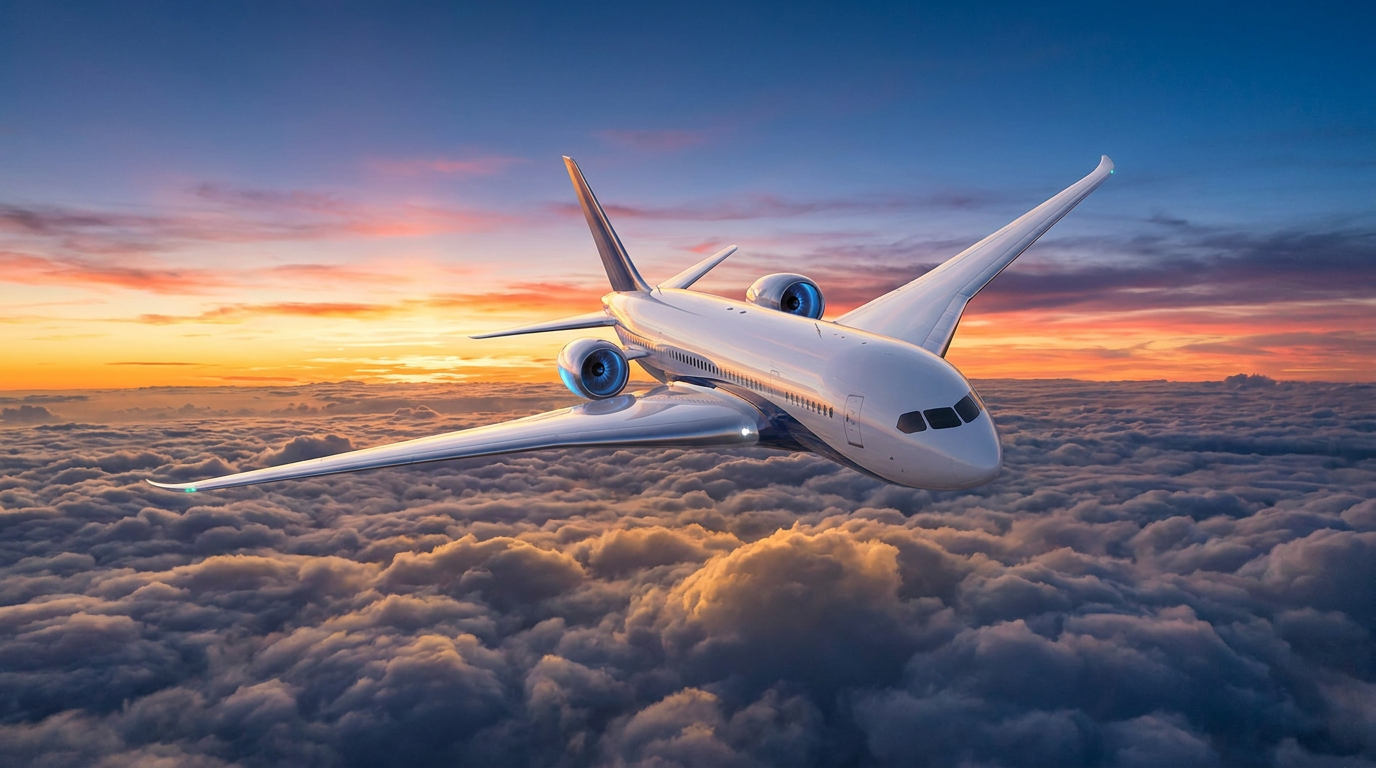
Enter the blended-wing body (BWB), a radical architectural departure that merges the fuselage and the wings into a single, smooth, manta-ray-like flying wing. While the concept has existed in military research and subscale NASA testing for decades, it is now hurtling toward commercial reality.[4][7]
At the forefront of this shift is JetZero, a California-based aerospace startup that recently secured over $175 million in Series B funding to accelerate its Z4 demonstrator program. Backed by a mix of venture capital, airlines, and the U.S. military, the company is building a full-scale BWB aircraft slated to take its first flight in 2027.[3]
The mechanical premise of the blended-wing body is elegantly simple: eliminate the dead weight. In a conventional aircraft, the wings generate all the lift, while the cylindrical fuselage is essentially aerodynamic baggage that creates drag. In a BWB design, the entire airframe acts as a lifting surface.[3][4]
By flattening the body into a triangular shape that seamlessly tapers into the wings, engineers can drastically reduce the aircraft's wetted area—the total surface exposed to the airflow. JetZero claims this configuration delivers at least a 30 percent improvement in aerodynamic efficiency compared to the most advanced tube-and-wing airliners flying today.[2][3]

That aerodynamic leap translates directly into unprecedented fuel savings. The Z4 is projected to consume up to 50 percent less fuel than current mid-market aircraft like the Boeing 767 or Airbus A330, while carrying the same payload and flying the same distance. For an industry operating on razor-thin margins and facing volatile jet fuel prices, cutting consumption in half is a generational holy grail.[2][5]
The U.S. military recognized this potential early. In 2023, the U.S. Air Force awarded JetZero a $235 million contract to develop the demonstrator, eyeing the BWB architecture for its next-generation aerial refueling tankers.[1][4]
The Air Force's current tanker fleet has struggled with availability and modernization delays. A BWB tanker, dubbed the KC-Z4, could carry significantly more fuel, operate from shorter runways due to its high-lift design, and fly further into contested airspace. Retired military pilots have described the platform's potential range and payload capabilities as a "quantum leap" for joint force operations.[1]
The Air Force's current tanker fleet has struggled with availability and modernization delays.
But the commercial sector is equally aggressive in its pursuit of the technology. Major carriers are not just waiting for the demonstrator to fly; they are actively shaping its development. United Airlines has already signed a conditional purchase agreement for up to 200 of the commercial variants, provided the 2027 flight tests meet performance milestones.[4]
Delta Air Lines has also formalized a partnership with JetZero, offering its operational expertise through its Sustainable Skies Lab. Delta is consulting on everything from turnaround times at the gate to the radical reinvention of the passenger cabin.[5]
Because the BWB lacks a narrow, cylindrical tube, the interior passenger experience will be fundamentally different. The cabin is wide and flattened, resembling a theater or an auditorium rather than a long hallway. This geometry allows for stadium-style seating, dedicated overhead storage for every passenger, and wider aisles that promise to eliminate the claustrophobia of modern air travel.[4][5]

Concept images shared by JetZero and Delta even feature a triangular island or lounge bar in the center of the cabin. Airline executives have noted that the sheer volume of the interior provides flight crews with the space to deliver a "white glove" service experience previously impossible on mid-range international flights.[4]
Beyond immediate fuel savings with conventional jet engines, the blended-wing body is increasingly viewed as the necessary stepping stone to zero-carbon aviation. Achieving true net-zero flight will likely require hydrogen propulsion, but liquid hydrogen presents a massive volumetric challenge.[6][7]
Liquid hydrogen produces no carbon dioxide, but it requires cryogenic storage tanks that are roughly four times larger than conventional jet fuel tanks. Fitting these bulky, insulated spheres into a traditional tube-and-wing aircraft severely cuts into passenger and cargo space.[6]

The BWB's cavernous internal volume solves this geometry problem. Recent feasibility studies by engineers at Washington University in St. Louis and NASA have confirmed that the BWB architecture can easily accommodate cryogenic liquid hydrogen tanks while maintaining a 180-passenger capacity and a 2,800-nautical-mile range.[6]
Despite the immense promise, the path to commercial certification is fraught with engineering and regulatory hurdles. The massive wingspan required for the BWB—spanning up to 56 meters—must be carefully managed to ensure compatibility with existing airport gates and taxiways, a constraint that forced Boeing to develop folding wingtips for its 777X.[2][4]
Pressurizing a non-cylindrical cabin also presents a novel structural challenge. Cylinders naturally distribute internal pressure evenly, which is why traditional fuselages are round. A flattened, triangular cabin requires advanced composite materials and internal tension structures to prevent the airframe from ballooning at high altitudes.[7]

Furthermore, to achieve its maximum efficiency, the massive wing area of the BWB requires the aircraft to cruise at altitudes above 41,000 feet to reduce parasitic drag. Current high-bypass turbofan engines, which are highly efficient at lower altitudes, experience thrust loss in that regime, forcing engineers to carefully balance engine selection and aerodynamic performance.[2]
If JetZero and its partners can navigate these technical headwinds, the late 2020s could mark the end of the tube-and-wing monopoly. By fundamentally changing the shape of flight, the aviation industry may finally have a viable blueprint for making air travel both radically more comfortable and environmentally sustainable.[3][5][7]
How we got here
1990s
NASA and McDonnell Douglas begin early subscale testing of blended-wing body concepts.
2007–2013
NASA and Boeing successfully fly the subscale X-48 blended-wing demonstrator over 120 times.
August 2023
The U.S. Air Force awards JetZero a $235 million contract to build a full-scale BWB demonstrator.
Early 2026
JetZero secures $175 million in Series B funding to accelerate the Z4 program toward execution.
2027
Target date for the first flight of the full-scale JetZero Z4 demonstrator.
2030
Anticipated entry into service for the first commercial passenger variants.
Viewpoints in depth
Aerospace Innovators
Startups and engineers argue that the tube-and-wing design has reached its aerodynamic limit.
For decades, the aviation industry has relied on incremental improvements to jet engines to eke out single-digit efficiency gains. Innovators in the BWB space argue that this approach has hit a wall. To achieve the massive emissions reductions required by 2050 climate mandates, they believe the industry must abandon the 70-year-old cylindrical fuselage paradigm entirely and embrace airframes that inherently generate lift rather than drag.
Commercial Airlines
Carriers see the BWB as a dual solution to volatile fuel costs and passenger dissatisfaction.
Airlines operate in a hyper-competitive environment where fuel is often the single largest operating expense. Cutting fuel burn by up to 50% fundamentally rewrites the economics of long-haul routes. Simultaneously, airline executives view the BWB's wide, non-tubular cabin as a generational opportunity to solve the passenger comfort crisis, allowing for faster boarding times, dedicated overhead bins, and a sense of spaciousness that modern jets cannot provide.
Aviation Researchers
Scientists view the BWB architecture as the necessary geometric enabler for zero-carbon hydrogen flight.
While battery-electric flight is viable for small, short-range planes, mid-market commercial aviation requires the energy density of liquid hydrogen to achieve zero emissions. Researchers point out that liquid hydrogen requires four times the storage volume of conventional Jet-A fuel. Because traditional tube-and-wing planes cannot easily accommodate these massive cryogenic tanks without sacrificing passenger capacity, researchers argue the BWB's cavernous internal volume is the only practical geometry for the future of sustainable flight.
What we don't know
- How easily the massive 56-meter wingspan will integrate into existing airport gates and taxiways.
- Whether the novel composite structures required to pressurize a non-cylindrical cabin will meet stringent FAA safety and evacuation standards.
- How current high-bypass engines will perform at the extreme altitudes required to maximize the BWB's aerodynamic efficiency.
Key terms
- Blended-Wing Body (BWB)
- An aircraft design where the fuselage and wings are merged into a single, continuous aerodynamic shape, allowing the entire airframe to generate lift.
- Wetted Area
- The total surface area of an aircraft that is exposed to the outside airflow, which directly contributes to aerodynamic drag.
- Cryogenic Storage
- Heavily insulated tanks designed to store materials at extremely low temperatures, required to keep hydrogen in a liquid state for aviation fuel.
- Parasitic Drag
- The aerodynamic resistance caused by the aircraft's shape and skin friction as it moves through the air, separate from the drag created by generating lift.
Frequently asked
When will blended-wing aircraft fly commercially?
JetZero plans to fly a full-scale demonstrator in 2027, with the first commercial passenger variants targeted for service around 2030.
Why haven't we built blended-wing planes before?
While the military has used flying wings for stealth bombers, commercial adoption was delayed by the complexities of pressurizing a non-cylindrical cabin and ensuring the wide wingspan fits into existing airport gates.
How does this help the environment?
By generating lift across the entire airframe, the design cuts fuel consumption by up to 50%. Furthermore, its large internal volume makes it the ideal shape to carry zero-carbon liquid hydrogen fuel in the future.
Will the passenger experience be different?
Yes. Because the aircraft isn't a narrow tube, the cabin will be much wider, allowing for stadium-style seating, wider aisles, and potentially central lounge areas, significantly reducing the feeling of claustrophobia.
Sources
Source coverage
7 outlets
4 viewpoints surfaced







[1]Air & Space Forces MagazineMilitary & Defense
JetZero's Blended-Wing Tanker Could Bring 'Quantum Leap' to Air Force
Read on Air & Space Forces Magazine →[2]Aviation International NewsAerospace Innovators
JetZero Advances Blended-Wing-Body Aircraft for Middle of the Market
Read on Aviation International News →[3]Aerospace Global NewsAerospace Innovators
Fresh capital accelerates JetZero's all-wing aircraft programme
Read on Aerospace Global News →[4]AIAAAviation Researchers
JetZero's Blended-Wing-Body Demonstrator Could Change Air Travel
Read on AIAA →[5]Delta Air LinesCommercial Airlines
Delta Air Lines partners with JetZero on revolutionary, more sustainable aircraft
Read on Delta Air Lines →[6]Washington University in St. LouisAviation Researchers
Hydrogen-powered blended wing body could transform commercial air travel
Read on Washington University in St. Louis →[7]Factlen Editorial TeamAviation Researchers
Synthesis by Factlen editorial team
Read on Factlen Editorial Team →
Every angle. Every day.
Get automotive stories with full source coverage and perspective breakdowns delivered to your inbox.