
How the 100% Domestic Content Mandate is Rewriting the US EV Charger Supply Chain
As Congress rescinds $879 million in federal EV infrastructure funding, a new Department of Transportation mandate requires all federally subsidized chargers to be built entirely with US-made components.
By Dev Anand

Share this story
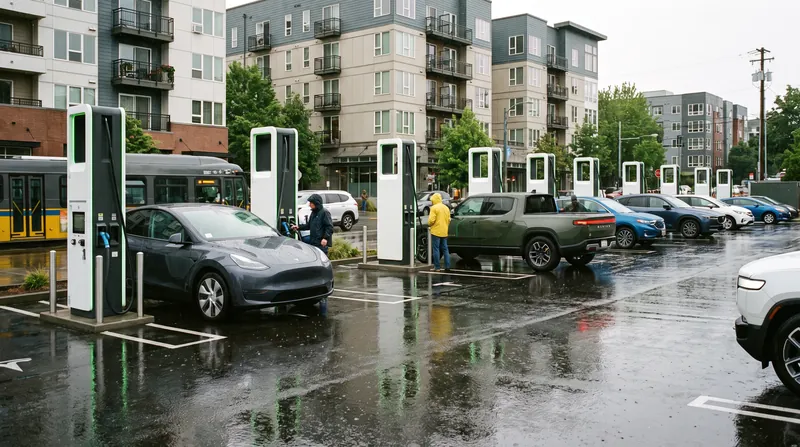
The United States is fundamentally restructuring how it builds and funds electric vehicle infrastructure. In a dual policy shift that redefines the economics of the charging industry, the federal government is simultaneously pulling back direct subsidies and mandating that any remaining federally funded chargers be built entirely with American components.[1]
The pivot centers on the National Electric Vehicle Infrastructure (NEVI) program, a $5 billion initiative launched in 2021 to subsidize the construction of direct-current fast chargers (DCFC) along major highway corridors. Designed to cover up to 80 percent of a project's installation and hardware costs, NEVI was intended to spur a rapid, nationwide rollout. However, a recent 2026 congressional budget resolution rescinded $879 million in unspent NEVI funds, redirecting the capital toward traditional highway and bridge repairs.
At the same time, the Department of Transportation (DOT) has proposed eliminating the existing "Buy America" waivers that allowed EV chargers to contain up to 45 percent foreign-made components. Under the new directive announced by Transportation Secretary Sean P. Duffy, all chargers purchased or installed using Federal Highway Administration funds must achieve 100 percent domestic material content.[1]
The administration's rationale for the 100 percent mandate is rooted in industrial policy and national security. Federal officials argue that the domestic EV supply chain has had sufficient time to mature since the initial 55 percent threshold was set in 2023. By forcing a complete localization of the supply chain, the DOT aims to accelerate US manufacturing capacity, create domestic jobs, and prevent taxpayer dollars from subsidizing foreign adversaries.[1]
Cybersecurity is also a primary driver of the policy shift. Modern EV chargers are highly networked, internet-connected devices that communicate directly with both the vehicle and the broader electrical grid. The DOT has explicitly cited the need to protect American infrastructure from foreign-made internal components that could harbor software vulnerabilities or backdoor access points.[1]
However, achieving a 100 percent domestic supply chain presents immediate logistical hurdles for hardware manufacturers. While the heavy steel enclosures and iron pedestals are relatively easy to source from US foundries, the complex internal electronics—such as specialized inverters, microcontrollers, and cooling systems—have historically relied on globalized supply chains.
Industry analysts note that forcing a rapid shift to fully domestic sourcing will likely increase the upfront manufacturing cost of each charging unit. With NEVI funding simultaneously shrinking, site hosts and charging network operators will have to absorb a larger share of these elevated hardware costs, fundamentally altering the return-on-investment calculus for new stations.
The funding clawbacks are already forcing state transportation departments to recalculate their infrastructure roadmaps. States like Connecticut, which had planned to use the second phase of its NEVI allocation to build chargers in rural and urban "charging deserts," are now monitoring the rescissions closely. Without the 80 percent federal cost-share, deploying chargers in areas with lower EV adoption rates becomes financially difficult.
The slow pace of the initial NEVI rollout made the program politically vulnerable to these cuts. Despite the $5 billion commitment in 2021, bureaucratic delays, complex state-level procurement rules, and stringent technical requirements meant that only a fraction of the promised stations were operational by early 2026. Free-market advocates argue that this sluggish deployment proves that federal subsidies misallocate resources and reward bureaucratic planning over actual consumer demand.
Conversely, electrification proponents warn that pulling the plug on federal funding just as states finalize their procurement pipelines will stall momentum. They argue that a reliable, ubiquitous charging network is a prerequisite for mass EV adoption, and that abandoning the federal push cedes the global transition entirely to overseas competitors.
As federal subsidies contract, the burden of expanding the charging network is shifting decisively to the private sector and local utilities. Private charging networks, which operate outside the NEVI framework and are therefore exempt from the 100 percent domestic content mandate, are increasingly focusing their capital on high-utilization corridors where the business case is already proven.
To bridge the financial gap left by the NEVI cuts, site hosts are increasingly turning to utility "make-ready" programs. In many states, local power companies offer substantial rebates to cover the cost of grid connections, transformers, and trenching—often the most expensive parts of a charging installation—allowing operators to deploy private capital more efficiently.
Ultimately, the dual forces of funding cuts and strict domestic mandates are forcing the US EV charging industry to mature rapidly. The era of heavily subsidized, globally sourced infrastructure is ending, replaced by a landscape that prioritizes supply chain security and private-market viability over sheer deployment speed.
Key points
- Congress rescinded $879 million in unspent NEVI funding in the 2026 budget.
- The DOT proposed raising the domestic content requirement for federally funded chargers from 55% to 100%.
- The mandate aims to boost US manufacturing and protect against cybersecurity vulnerabilities.
- Hardware manufacturers face challenges sourcing complex internal electronics entirely from domestic suppliers.
Open questions
- How quickly US manufacturers can scale up production of specialized internal electronic components to meet the 100% mandate.
- Whether the increased hardware costs will deter site hosts from applying for the remaining NEVI funds.
- How states will adjust their infrastructure plans for rural areas without the full anticipated federal cost-share.
Timeline
Nov 2021
The $5 billion NEVI program is established to fund a nationwide EV charging network.
Feb 2023
The FHWA issues a waiver requiring federally funded chargers to contain at least 55% domestic content.
Feb 2026
Congress passes a budget bill rescinding $879 million in unspent NEVI funds.
Feb 2026
The DOT proposes modifying the Buy America waiver to require 100% domestic content for federally funded chargers.
- Domestic Manufacturing Advocates
- Argue that strict domestic content rules protect national security and boost US industrial capacity.
- Electrification Proponents
- Warn that funding cuts and strict mandates will delay necessary infrastructure and hurt EV adoption.
- Free Market Proponents
- Believe private capital, not federal subsidies, should drive the charging network.
Perspectives this story doesn't cover
- Hardware Manufacturers
- Local Utility Companies
Sources
Source coverage
1 outlets
3 viewpoints surfaced

- [1]U.S. Department of TransportationDomestic Manufacturing Advocates
Implementing Buy America will support American innovation, strengthen domestic manufacturing
Read on U.S. Department of Transportation →
More in Automotive & Transportation
See all →EV Price War
Ford CEO Warns Chinese EVs Will Breach US Market, Details New Affordable EV Strategy
6 sources
AV Regulation
NHTSA Grants First Commercial Robotaxi Exemption to Zoox, Launches Effort for National AV Safety Standard
4 sources
Autonomous Vehicles
UN Approves First Global Standard for L4 Autonomous Driving Systems, Clearing Path for Mass Deployment
7 sources
AV Regulation
How the 2026 SELF DRIVE Act Aims to Rewrite US Autonomous Vehicle Law
1 sources
Comments
Every angle. Every day.
Get Automotive & Transportation stories with full source coverage and perspective breakdowns, free every day.