
How Acoustic Engineers Tuned the Bugatti Tourbillon's 9,000-RPM V16 to Clear Global Noise Regulations
To keep the naturally aspirated V16 street-legal under strict new urban noise laws, Bugatti and Cosworth used frequency-canceling resonators that silence the exhaust for regulators while preserving the engine's wail for the driver.
By Tao Yang

Share this story
In short
- The Bugatti Tourbillon's 8.3-liter V16 engine revs to 9,000 rpm, requiring complex acoustic engineering to meet global noise laws.
- UN ECE R51.03 Phase 3 regulations cap pass-by noise at 74 decibels during a 50 km/h acceleration test.
- Engineers use Helmholtz resonators in the titanium exhaust to cancel out specific low-frequency drones via phase cancellation.
The homologation track at exactly 50 kilometers per hour in third gear. This is the precise moment a modern hypercar lives or dies. If the trackside microphones register more than 74 decibels during a wide-open throttle pass, the vehicle cannot be legally registered in Europe, Japan, or increasingly, major North American cities.[2]
Bugatti faced this exact hurdle with the new Tourbillon. By dropping the heavily muffled quad-turbo W16 engine of the Chiron era for a naturally aspirated 8.3-liter V16 developed with Cosworth, the automaker brought back a 9,000-rpm scream. But engineering that sound to pass 2026 noise regulations required acoustic manipulation that dictates exactly what the owner hears from the driver's seat.[1]
The regulations, specifically UN ECE R51.03 Phase 3, do not grant exemptions for a car's top speed or its $4 million price tag. They are designed to measure and curtail urban noise pollution. For a hypercar buyer, the threat is no longer just a failed annual inspection; it is the proliferation of automated noise cameras in neighborhoods like Knightsbridge or Beverly Hills that issue immediate citations and impound orders for non-compliant vehicles.[2][3]
To solve this, acoustic engineers do not simply stuff the exhaust with fiberglass; they tune the frequencies. The Tourbillon's V16 uses a cross-plane crankshaft, which naturally produces a complex, overlapping firing order. "Engineers spent thousands of hours making the Tourbillon's 9,000-rpm engine sound as great as possible, while still meeting regulatory standards," the development team confirmed, noting that balancing emotion with legality was "not an easy task."[1]
They achieved this using Helmholtz resonators built directly into the titanium exhaust tract. A Helmholtz resonator works on the same principle as blowing over the neck of an empty glass bottle. When exhaust gases rush past a specifically sized chamber, the air inside vibrates at a frequency that perfectly cancels out the offending drone.[3]
This phase-cancellation allows the high-pitched, emotional frequencies—the mechanical wail that buyers are actually paying for—to pass through untouched while the official decibel meter reads a legal limit. Active exhaust valves play the final regulatory role. Below 4,000 rpm and 50 km/h, the valves route gases through a dense matrix of sound-deadening baffles to ensure compliance during city driving.[1][3]
The moment the vehicle clears the homologation speed parameters and enters open-road conditions, the engine control unit opens the bypass valves. This reduces backpressure and allows the full, uninhibited acoustic profile to reach the cabin and the surrounding environment.[1]
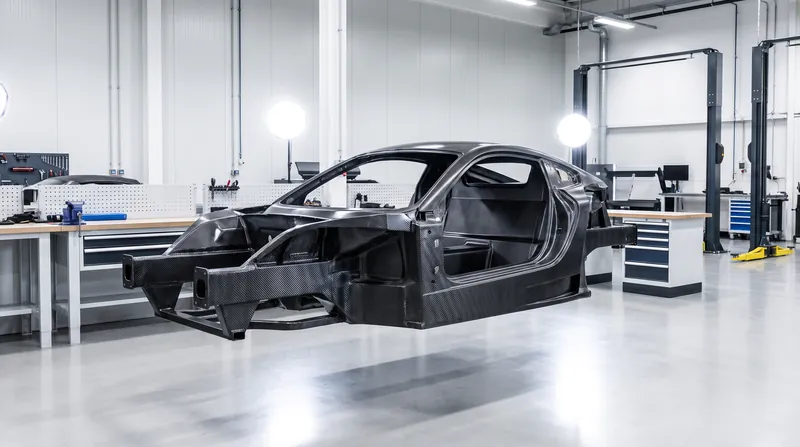
Because modern luxury cabins are heavily insulated to meet refinement expectations, engineers also use structural resonance to transmit the engine's character directly into the carbon-fiber monocoque. Solid engine mounts and tuned intake runners vibrate the firewall, effectively turning the chassis itself into a speaker for the driver.
This acoustic engineering ensures that the Tourbillon remains legally viable in a regulatory environment that is increasingly hostile to internal combustion. The true engineering triumph of the modern hypercar is not making a massive V16 engine loud; it is the surgical precision required to make it legal.[1][3]
Jargon, explained
- Homologation
- The official approval process a vehicle must pass to be legally certified for sale and use on public roads.
- Helmholtz Resonator
- An acoustic chamber attached to an exhaust pipe that uses trapped air to vibrate and cancel out specific sound frequencies.
- UN ECE R51.03
- The United Nations regulation that sets the strict legal limits for the amount of noise a passenger vehicle can emit.
- Cross-Plane Crankshaft
- An engine design where the crank pins are arranged at 90-degree intervals, producing a complex, rumbling exhaust sound.
- Phase Cancellation
- An acoustic phenomenon where two sound waves of the same frequency align out of sync, effectively silencing each other.
Common questions
Why did Bugatti switch from a W16 to a V16?
Bugatti replaced the quad-turbo W16 with a naturally aspirated V16 developed by Cosworth to reduce weight, integrate a hybrid system, and deliver a higher-revving, more emotional driving experience.
How loud is the Bugatti Tourbillon?
While capable of producing a massive mechanical wail at 9,000 rpm, the exhaust is engineered to stay below the legal limit of 74 decibels during urban acceleration tests.
What happens if a car fails the pass-by noise test?
If a vehicle exceeds the regulated decibel limits during homologation, it cannot be legally registered for public road use in jurisdictions enforcing those standards.
Competing readings
Acoustic Engineers
Focusing on the technical challenge of frequency phase cancellation.
For powertrain engineers, noise regulations are no longer solved by simply adding larger mufflers, which create unacceptable backpressure and choke engine performance. Instead, they view the exhaust tract as a musical instrument that must be tuned to cancel out specific, heavily regulated low frequencies. By using Helmholtz resonators and active valving, they can surgically remove the drone that triggers trackside microphones while allowing the high-frequency mechanical wail to pass through unimpeded.
Urban Regulators
Targeting the reduction of overall city noise pollution.
Municipalities and international regulatory bodies like the UN ECE view high-performance vehicles as a primary source of urban noise pollution. Their testing protocols, specifically the 50 km/h pass-by test, are designed to mimic a vehicle accelerating away from a traffic light in a dense city center. For regulators, the goal is not to ban sports cars, but to ensure that their acoustic footprint in populated areas is indistinguishable from a standard family sedan, enforcing compliance through automated acoustic cameras.
Hypercar Collectors
Prioritizing the emotional experience and legal usability of the vehicle.
Buyers spending millions on a naturally aspirated V16 are purchasing an emotional, acoustic experience that electric vehicles cannot replicate. However, their primary concern is usability. A hypercar that fails noise homologation cannot be registered for street use, relegating it to track-only status. Collectors rely on this advanced acoustic engineering to ensure they can drive their investments through London, Monaco, or Los Angeles without facing immediate impoundment or fines.
- Acoustic Engineers
- Focusing on the technical challenge of frequency phase cancellation.
- Urban Regulators
- Targeting the reduction of overall city noise pollution.
- Hypercar Collectors
- Prioritizing the emotional experience and legal usability of the vehicle.
Perspectives this story doesn't cover
- Local residents living near popular hypercar cruising routes.
- Aftermarket exhaust manufacturers who bypass these factory restrictions.
Sources
Source coverage
3 outlets
3 viewpoints surfaced



- [1]The DriveAcoustic Engineers
Tuning the Bugatti Tourbillon’s V16 Exhaust Sound Took a Lot of Work. It Was Worth It
Read on The Drive → - [2]UN Economic Commission for EuropeUrban Regulators
UN Regulation No. 51 - Noise Emissions for M and N Categories
Read on UN Economic Commission for Europe → - [3]Factlen Editorial TeamHypercar Collectors
Synthesis by Factlen editorial team
Read on Factlen Editorial Team →

More in Automotive & Transportation
See all →Suspension Tech
Solenoid Valves Vary Multi-Chamber Air Spring Volume to Modulate Dynamic Stiffness Without Altering Ride Height
6 sources

Auto Industry Crisis
German Auto Workers at BMW, Mercedes, and Porsche Join Volkswagen Protests Against Mass Job Cuts
5 sources

Auto Industry
Volkswagen Takes €6 Billion Writedown on Porsche Stake Amid Sales and Margin Declines
4 sources

Carbon Fiber Tech
The Anisotropy of Carbon Fiber: How Fiber Orientation Dictates Strength and Stiffness in Different Directions
7 sources
Comments
Every angle. Every day.
Get Automotive & Transportation stories with full source coverage and perspective breakdowns, free every day.