
How Sodium-Ion Batteries Are Rewriting the Rules of Electric Vehicles
Mass-produced electric vehicles powered by abundant, cold-resistant sodium-ion batteries have officially hit the road in 2026, offering a cheaper alternative to lithium.
By Factlen Editorial Team
- Battery Manufacturers
- Focus on scaling production, reducing raw material costs, and capturing the affordable EV market.
- Resource Analysts
- Emphasize the geopolitical and economic relief of moving away from scarce lithium, cobalt, and copper.
- Climate & Adoption Advocates
- Highlight how cheaper, cold-resistant batteries will accelerate EV adoption in developing nations and northern climates.
What's not represented
- · Lithium mining industry representatives facing potential demand shifts
- · Consumers in extreme cold climates testing the first generation of these vehicles
Why this matters
By replacing expensive, heavily mined lithium with cheap, globally abundant sodium, automakers can drastically lower the sticker price of electric vehicles. Furthermore, sodium's immunity to freezing temperatures solves one of the biggest pain points for EV owners in northern climates.
Key points
- The first mass-produced passenger EVs powered by sodium-ion batteries hit the market in early 2026.
- Sodium is 1,000 times more abundant than lithium, drastically lowering raw material costs.
- Sodium cells retain 90% of their capacity at -40°C, solving winter range loss for EV drivers.
- The batteries use cheap aluminum foil instead of expensive copper for current collectors.
- While cheaper and safer, sodium batteries are heavier and offer less total range than premium lithium packs.
- Automakers plan to use sodium for affordable city cars while reserving lithium for long-range luxury vehicles.
For the past decade, the electric vehicle revolution has been tethered to a single, temperamental element: lithium. While lithium-ion batteries have successfully powered millions of cars, they rely on expensive, geographically concentrated minerals and suffer notorious performance drops in freezing weather. But in early 2026, the automotive industry crossed a major threshold. The world's first mass-produced passenger vehicles powered entirely by sodium-ion batteries began rolling into dealerships, signaling a fundamental shift in how the world stores energy.[1][5]
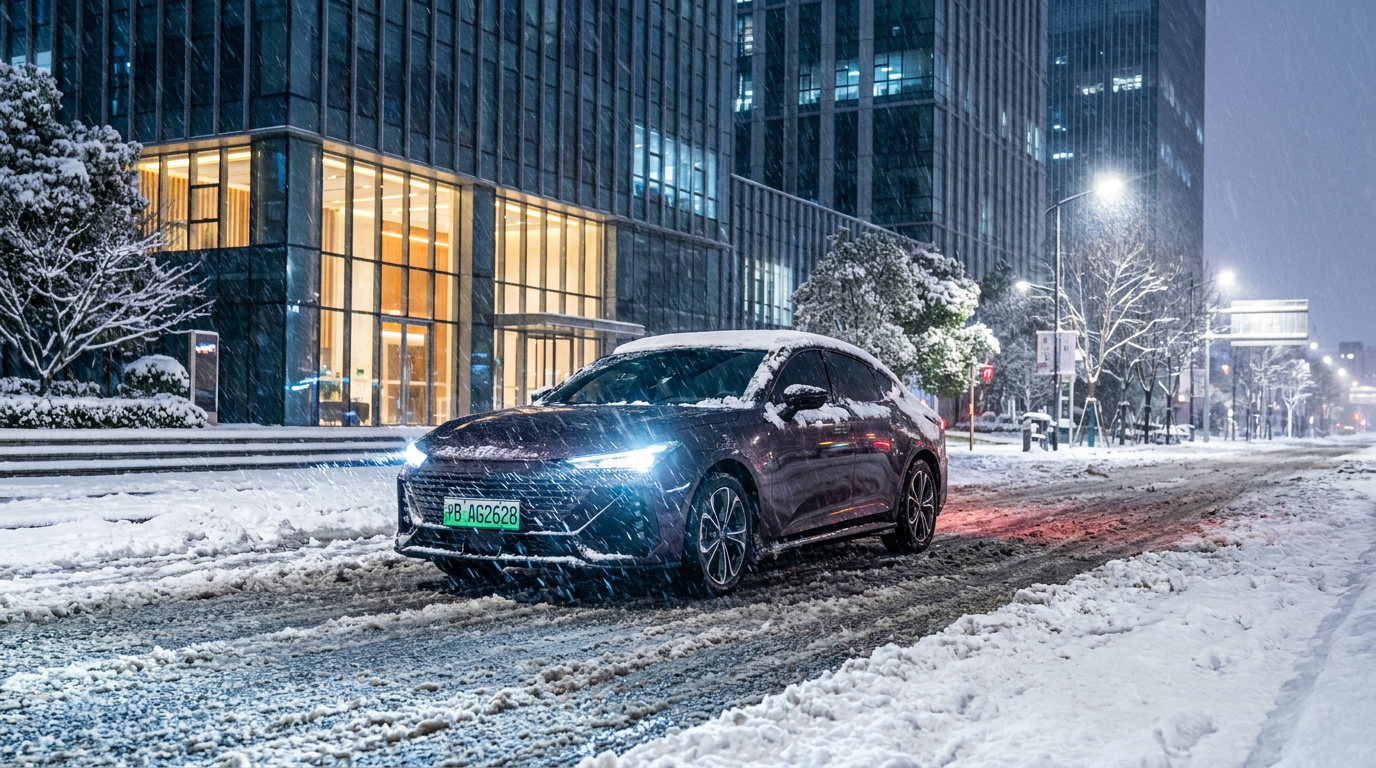
The most visible proof of this transition arrived in February 2026, when Chinese automaker Changan, in partnership with battery giant CATL, launched the Nevo A06 sedan. Powered by CATL's new "Naxtra" sodium-ion cells, the vehicle proved that the technology had finally graduated from laboratory prototypes to commercial scale. Shortly after, BAIC Group unveiled its own sodium-powered prototype, and global manufacturing capacity for the chemistry surged past 370 gigawatt-hours.[1][6]
To understand why this matters, it helps to look inside the cell. A sodium-ion battery operates on a "rocking chair" mechanism that is virtually identical to its lithium counterpart. The battery consists of a positive electrode (the cathode) and a negative electrode (the anode), separated by a liquid or gel electrolyte and a physical barrier called a separator. When the battery charges, an external power source forces positively charged sodium ions out of the cathode, through the electrolyte, and into the anode, where they are stored.[4][5]
When the driver presses the accelerator, the process reverses. The sodium ions flow back to the cathode, releasing electrons that travel through the vehicle's external circuit to power the electric motor. Because the fundamental architecture is so similar to lithium-ion, battery manufacturers have been able to adapt their existing gigafactories to produce sodium cells without having to invent entirely new manufacturing equipment.[4]

However, swapping lithium for sodium requires crucial material changes. Sodium ions are physically larger and heavier than lithium ions. Because they are too bulky to fit neatly into the graphite anodes traditionally used in lithium batteries, engineers use "hard carbon"—a disordered carbon structure that can easily accommodate the larger sodium ions. Furthermore, sodium does not alloy with aluminum, allowing manufacturers to replace expensive copper current collectors with cheap, lightweight aluminum foil on both sides of the battery.[5]
The economic implications of these material swaps are staggering. Sodium is the sixth most abundant element in the Earth's crust—roughly 1,000 times more plentiful than lithium—and can be easily extracted from seawater or rock salt. By eliminating the need for lithium, copper, and often controversial minerals like cobalt and nickel, sodium-ion technology insulates automakers from volatile commodity markets and fragile supply chains.[4][5][7]
Beyond cost, sodium-ion chemistry possesses a unique superpower that is reshaping the EV map: extreme cold-weather resilience. Traditional lithium-ion batteries become sluggish in freezing temperatures, leading to slower charging times and severe range degradation. In contrast, sodium-ion cells thrive in the cold. During winter testing in Inner Mongolia, where temperatures plummeted to minus 30 degrees Celsius, sodium-powered SUVs navigated icy test tracks with minimal range loss.[2][5]
Beyond cost, sodium-ion chemistry possesses a unique superpower that is reshaping the EV map: extreme cold-weather resilience.
The data backs up the real-world testing. CATL reports that its Naxtra cells retain approximately 90 percent of their usable capacity even at a punishing minus 40 degrees Celsius. Furthermore, the batteries can still accept a fast charge when frozen solid. For drivers in Canada, Scandinavia, and the northern United States, this eliminates the "winter range anxiety" that has historically deterred EV adoption in colder climates.[1][3][5]
Charging speeds are also seeing dramatic improvements. Because sodium ions have lower solvation energy—meaning they detach from the electrolyte more easily than lithium ions—they can move rapidly across the battery's internal interfaces. BAIC Group's latest prismatic sodium cells boast a 4C ultra-fast charging capability, allowing the battery pack to fill in approximately 11 minutes. This brings the EV refueling experience remarkably close to the time it takes to pump a tank of gas.[1][6]
If sodium is cheaper, faster to charge, and better in the cold, why hasn't it replaced lithium entirely? The primary trade-off is energy density—the amount of energy a battery can store relative to its weight, measured in watt-hours per kilogram (Wh/kg). Because sodium is a heavier element, sodium-ion batteries are inherently bulkier than lithium-ion batteries holding the same amount of charge.[4][5]
Currently, CATL's mass-produced sodium cells achieve an energy density of about 175 Wh/kg. While this is a massive leap from early prototypes, it still trails behind the 200 to 210 Wh/kg offered by standard Lithium Iron Phosphate (LFP) batteries, and falls well short of the 250+ Wh/kg delivered by premium Nickel Manganese Cobalt (NMC) cells used in long-range luxury EVs. A sodium-powered vehicle will generally max out around 350 to 400 kilometers of range, compared to the 600-kilometer ranges achievable with high-end lithium packs.[1][5][7]

Despite the density gap, safety testing has proven to be a major victory for the new chemistry. Sodium-ion batteries are highly thermally stable and less prone to the runaway fires that occasionally plague lithium packs. In early 2026, CATL's Naxtra cells became the first sodium-ion batteries to pass China's rigorous GB 38031-2025 national EV traction battery safety standard. Additionally, sodium batteries can be safely discharged to zero volts for transportation, a feat that would permanently destroy a lithium-ion cell.[1][3][5]
Industry analysts do not expect sodium to kill lithium; rather, the two will divide the market. Lithium-ion will remain the undisputed champion for heavy-duty trucks and premium, long-range passenger cars where maximizing space and minimizing weight is critical. Sodium-ion, meanwhile, is poised to dominate the market for affordable city cars, delivery fleets, electric scooters, and stationary grid storage.[2][5]

To bridge the gap, some manufacturers are developing "AB" battery packs that physically mix sodium and lithium cells within the same vehicle. In this hybrid setup, the lithium cells provide the necessary long-range energy density, while the sodium cells act as a cold-weather buffer and fast-charging anchor, managed seamlessly by the vehicle's software.[5]
As 2026 unfolds, the transition from promise to product is complete. With over $20 billion in global manufacturing investments and major automakers committing to the chemistry, sodium-ion technology is no longer a futuristic concept. By breaking the industry's total dependence on lithium, sodium is making electric mobility cheaper, safer, and accessible to regions previously left out in the cold.[1][2][6]
How we got here
2023–2024
Battery giants like CATL and BYD announce breakthroughs in sodium-ion cell chemistry and begin building dedicated pilot factories.
Late 2025
Global announced investment in sodium-ion manufacturing capacity crosses $20 billion, with shipments reaching 9 GWh.
February 2026
CATL and Changan unveil the Nevo A06, the world's first mass-produced passenger EV equipped with a sodium-ion battery.
March 2026
CATL's Naxtra sodium-ion cells officially pass China's updated national EV battery safety standard (GB 38031-2025).
Mid 2026
Sodium-powered passenger vehicles begin arriving at dealerships, targeting the affordable, short-range, and cold-climate markets.
Viewpoints in depth
Battery Manufacturers
Focus on scaling production, reducing raw material costs, and capturing the affordable EV market.
For companies like CATL and BAIC, sodium-ion technology is an industrial pressure-release valve. By shifting a portion of their production away from lithium, they can insulate themselves from the volatile price swings of critical minerals like cobalt and nickel. Their primary goal in 2026 is achieving economies of scale. Manufacturers emphasize that because sodium cells can be built on slightly modified lithium-ion assembly lines, the capital expenditure required to pivot is relatively low. They view sodium not as a niche experiment, but as the foundational chemistry for the next billion affordable city cars and two-wheelers globally.
Resource Analysts
Emphasize the geopolitical and economic relief of moving away from scarce lithium, cobalt, and copper.
Supply chain experts and resource economists view the rise of sodium as a geopolitical game-changer. Lithium extraction is highly concentrated in a few regions—primarily South America and Australia—and processing is heavily dominated by China. Sodium, however, can be sourced from seawater or rock salt anywhere on the planet. Analysts point out that the material savings go beyond just the active ions; the ability to use hard carbon instead of refined graphite, and aluminum foil instead of expensive copper, fundamentally rewrites the bill of materials for an EV. This widespread abundance drastically lowers the barrier to entry for domestic battery manufacturing across Europe and the Americas.
Climate & Adoption Advocates
Highlight how cheaper, cold-resistant batteries will accelerate EV adoption in developing nations and northern climates.
Environmental advocates and mobility experts argue that the EV transition has historically been skewed toward wealthy buyers in temperate climates. Sodium-ion batteries directly address the two biggest hurdles to mass adoption: sticker price and winter reliability. By eliminating the severe range degradation that plagues lithium batteries in freezing temperatures, sodium makes EVs practical for drivers in Canada, Scandinavia, and the northern United States. Furthermore, the lower production costs allow automakers to profitably sell entry-level vehicles, democratizing zero-emission transport for lower-income demographics and emerging markets.
What we don't know
- How quickly the cost per kilowatt-hour will drop once global gigafactories reach full scale.
- Whether sodium-ion energy density can eventually be pushed past 200 Wh/kg to directly threaten standard LFP lithium batteries.
- How the long-term degradation and cycle life of mass-produced hard carbon anodes will hold up after a decade of real-world driving.
Key terms
- Energy Density (Wh/kg)
- A measurement of how much energy a battery can store relative to its weight; higher density means a lighter battery for the same driving range.
- Hard Carbon
- A disordered form of carbon used as the negative electrode (anode) in sodium batteries, chosen because its structure can accommodate the large size of sodium ions.
- Cathode and Anode
- The positive (cathode) and negative (anode) terminals of a battery; ions flow between them to store and release electricity.
- Electrolyte
- The liquid or gel medium inside a battery that allows ions to travel back and forth between the cathode and anode.
- LFP (Lithium Iron Phosphate)
- A popular, durable type of lithium-ion battery commonly used in standard-range EVs, which sodium-ion batteries are now beginning to rival in performance.
Frequently asked
What is a sodium-ion battery?
It is a rechargeable battery that uses sodium ions to store and release energy, functioning much like a lithium-ion battery but using cheaper, more abundant materials.
Will sodium replace lithium in all EVs?
No. Lithium-ion will still be used for premium, long-range vehicles due to its higher energy density, while sodium-ion will dominate affordable city cars and cold-climate markets.
Why are sodium batteries better for winter?
Sodium-ion chemistry is highly resilient to freezing temperatures, retaining about 90 percent of its capacity at minus 40 degrees Celsius and allowing for fast charging even when frozen.
Are sodium-ion EVs cheaper to buy?
Yes. Because sodium is 1,000 times more abundant than lithium and the batteries do not require expensive copper or cobalt, the overall cost of the vehicle's battery pack is significantly reduced.
Sources
Source coverage
7 outlets
3 viewpoints surfaced







[1]Battery-Tech NetworkBattery Manufacturers
2025–2026: Sodium-Ion Moves Into Production Reality
Read on Battery-Tech Network →[2]The Japan TimesClimate & Adoption Advocates
Sodium-ion batteries emerge as a breakthrough for EVs in extreme cold
Read on The Japan Times →[3]ElectrekBattery Manufacturers
CATL is bringing sodium-ion batteries to EVs in 2026
Read on Electrek →[4]The Battery Show AsiaResource Analysts
How Do Sodium-Ion Batteries Work?
Read on The Battery Show Asia →[5]EleportResource Analysts
Sodium-ion vs lithium-ion: The 2026 EV battery market explained
Read on Eleport →[6]Latam MobilityClimate & Adoption Advocates
Sodium-Ion Batteries: The Affordable EV Revolution
Read on Latam Mobility →[7]EV CentralBattery Manufacturers
CATL pushes ahead with 600km sodium-ion battery mass production
Read on EV Central →
Every angle. Every day.
Get transportation stories with full source coverage and perspective breakdowns delivered to your inbox.