
How Small Language Models Are Moving AI From the Cloud to Your Pocket
Advances in model quantization and mobile silicon are allowing capable AI to run entirely on-device, offering zero-latency responses and absolute data privacy.
By Factlen Editorial Team

- Privacy & Security Advocates
- Value on-device processing because data never leaves the hardware, eliminating the risk of cloud data breaches.
- Hardware & Edge Engineers
- Focus on the technical constraints of deploying AI, emphasizing RAM bottlenecks, thermal throttling, and quantization trade-offs.
- Enterprise AI Strategists
- View small language models as a critical cost-saving measure that reduces API dependency and enables offline capabilities.
What's not represented
- · Cloud Infrastructure Providers
- · Legacy Hardware Users
Why this matters
By running AI directly on your phone or laptop, your most sensitive data—from health records to personal messages—never has to be sent to a corporate server. This shift makes daily AI tools faster, cheaper, and fundamentally private.
Key points
- Small Language Models (SLMs) allow capable AI to run entirely on smartphones and laptops.
- Quantization compresses massive models to fit within the strict memory limits of consumer hardware.
- On-device processing ensures absolute data privacy, as sensitive information never leaves the device.
- Local AI eliminates network latency, enabling instantaneous responses and offline functionality.
- Modern operating systems use a hybrid approach, handling simple tasks locally and complex tasks in the cloud.
For the past three years, interacting with artificial intelligence meant sending your thoughts, questions, and data to a distant server farm. You typed a query, it traveled thousands of miles to be processed by a massive model, and the answer made the long journey back. But in 2026, a quiet revolution is taking place directly inside your pocket. The era of the cloud-only AI is making way for the Small Language Model (SLM)—a highly optimized neural network designed to run entirely on your smartphone or laptop.[1][6]
Small Language Models represent a fundamental rethinking of how AI should be deployed. Unlike frontier Large Language Models (LLMs) that boast hundreds of billions or even over a trillion parameters, SLMs typically operate in the range of 1 to 8 billion parameters. They are not simply scaled-down toys; they are purpose-built engines trained on highly curated data to deliver impressive reasoning capabilities without requiring a data center.[3][7]
To understand how this is possible, one must look at the physical constraints of consumer hardware. At its core, a language model is an enormous collection of numbers—parameters—that encode everything the system has learned about language and logic. By default, these numbers are stored at full 32-bit precision. A model with 7 billion parameters stored this way requires roughly 28 gigabytes of memory just to load.[1][5]
Most smartphones and laptops do not have 28 gigabytes of unified memory to spare for a background AI process. This is where the mathematical magic of "quantization" comes in. Quantization is a compression technique that reduces the numerical precision of the model's weights from 32-bit floating-point numbers to smaller formats, such as 8-bit or 4-bit integers.[4][5]

Think of quantization like compressing a massive RAW photograph into a JPEG. While you technically lose some granular data, the human eye—or in this case, the end user reading the text—rarely notices the difference. By applying 4-bit quantization, that same 7-billion parameter model shrinks from a 28-gigabyte behemoth to a nimble 4-gigabyte file, allowing it to fit comfortably within the RAM of a modern smartphone.[1][5]
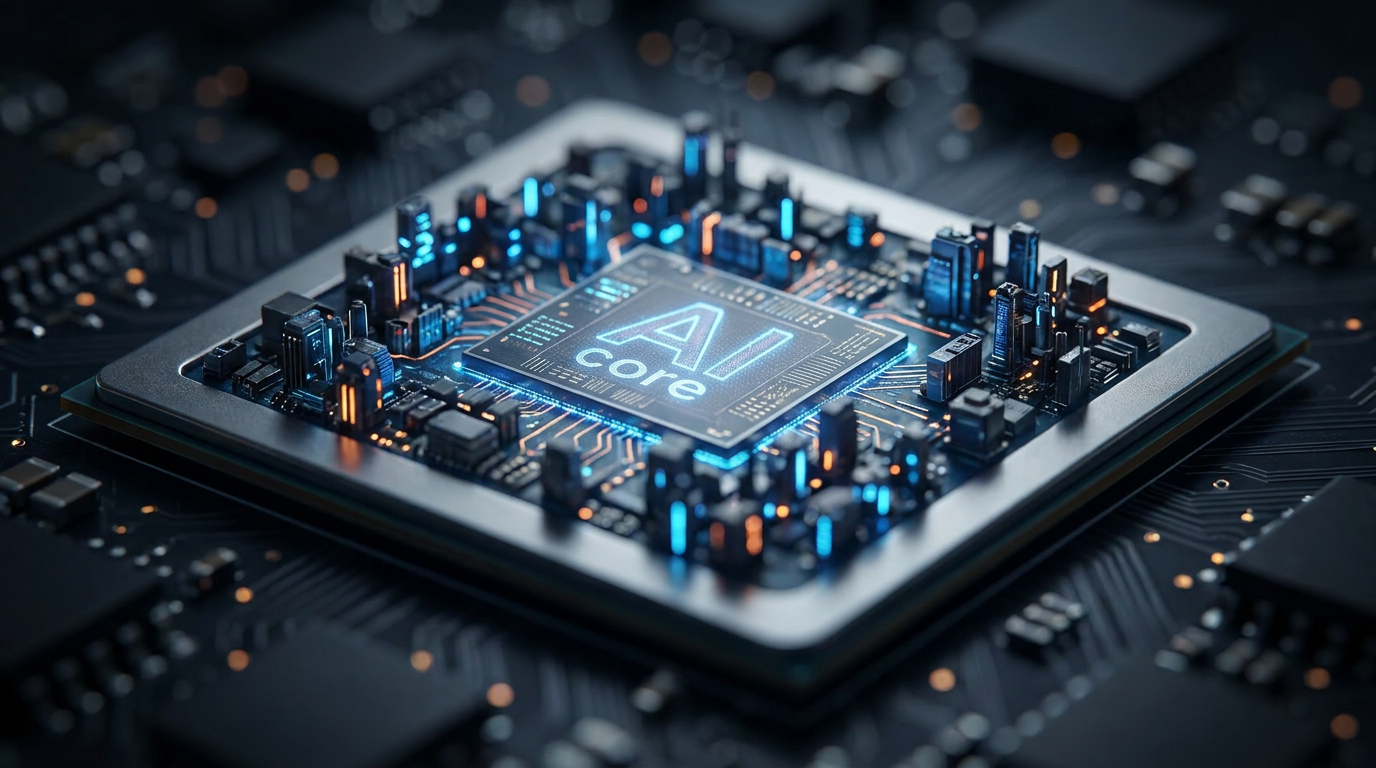
But fitting the model into memory is only half the battle; the device must also run the calculations quickly enough to be useful. This is why 2026 has seen a massive shift in mobile silicon architecture. Modern processors now feature dedicated Neural Processing Units (NPUs) capable of hitting 45 trillion operations per second (TOPS). These chips are specifically designed to chew through quantized AI math while sipping battery power, rather than draining it.[4][6]
The most profound benefit of this on-device architecture is privacy. When an AI model runs locally, your data never leaves your physical hardware. For healthcare professionals analyzing patient symptoms, or for everyday users summarizing confidential financial documents, this is a transformative shift. There are no API calls, no server logs, and no third-party data processing agreements required.[1][6]
The most profound benefit of this on-device architecture is privacy.
Beyond privacy, local execution entirely eliminates network latency. Cloud-based AI inherently suffers from a 200 to 800-millisecond delay as data travels back and forth across the internet. When the model lives on the device's NPU, that latency drops to zero. This instantaneous response is what makes real-time voice translation and seamless text prediction feel like a natural extension of the operating system.[6][7]
Furthermore, on-device AI works completely offline. Whether you are on an airplane without Wi-Fi or in a remote area with poor cellular reception, the intelligence remains fully accessible. This offline capability is rapidly shifting SLMs from a luxury consumer feature to a critical infrastructure component for enterprise applications and field workers.[6][7]

The landscape of these compact models has matured rapidly. Microsoft's Phi-3.5 Mini, packing just 3.8 billion parameters, routinely matches the benchmark performance of much larger models from previous years. Google's Gemma 2B and Meta's Llama 3 8B offer developers open-weight foundations to build highly specialized local applications, while Apple Intelligence utilizes a proprietary ~3-billion parameter model integrated directly into iOS.[3][4][7]
Despite these advances, SLMs are not a complete replacement for their massive cloud-based counterparts. They have a lower capability ceiling, particularly when it comes to broad world knowledge, complex multi-step reasoning, or creative coding tasks. Because they have fewer parameters, they simply cannot memorize as much factual information as a trillion-parameter frontier model.[1][7]
To solve this, the industry has widely adopted a hybrid routing architecture. When a user asks their phone to proofread an email or summarize a local document, the on-device SLM handles the task instantly and privately. However, if the user asks a complex question requiring deep reasoning or external knowledge, the operating system seamlessly routes the request to a secure cloud model, such as Apple's Private Cloud Compute.[1][2]

Deploying these models at scale still presents significant engineering hurdles. The most pressing bottleneck is memory bandwidth. While a 4-bit quantized model might fit into 4GB of RAM, the system still needs overhead to run the operating system and other apps. Industry consensus in 2026 dictates a strict 6GB RAM floor for effective mobile AI, leaving older devices entirely locked out of the revolution.[4]
Battery impact also remains a tangible concern under sustained load. While NPUs are highly efficient for quick tasks like text summarization, asking an on-device model to continuously generate long-form content or process live audio for extended periods will induce thermal throttling and drain the battery. Engineers must constantly balance the desire for maximum intelligence against the strict thermal realities of a passively cooled smartphone.[4][6]

Ultimately, the rise of Small Language Models represents a maturation of the generative AI boom. We are moving past the brute-force era of throwing massive compute at every problem, and entering an era of precision engineering. By bringing capable, private, and instantaneous AI directly to the edge, the technology is finally becoming woven into the invisible fabric of our daily computing.[1][6][7]
How we got here
2023
Large Language Models like GPT-4 dominate, requiring massive cloud infrastructure to operate.
Early 2024
Open-weight models like Llama 3 and Gemma prove that smaller parameter counts can achieve high reasoning scores.
Late 2024
Apple and Google integrate highly optimized, proprietary small models directly into their mobile operating systems.
2026
On-device AI becomes standard, powered by advanced quantization techniques and dedicated mobile Neural Processing Units.
Viewpoints in depth
Privacy & Security Advocates
Champions of data sovereignty who view local AI as the ultimate protection against cloud breaches.
For privacy advocates and security researchers, the shift to on-device AI is the most important development in the generative AI era. When data is sent to a cloud server, it becomes vulnerable to interception, corporate logging, and mass data breaches. By processing sensitive information—such as medical symptoms, financial documents, or personal messages—entirely on the local silicon, SLMs provide a mathematical guarantee of privacy. This architecture allows highly regulated industries like healthcare and finance to adopt AI tools without violating strict data compliance laws.
Hardware & Edge Engineers
Technologists focused on the physical constraints of running complex math on passively cooled devices.
Engineers tasked with deploying these models view the landscape through the lens of strict hardware starvation. They emphasize that while parameter counts grab headlines, the true bottlenecks are memory bandwidth and thermal limits. A model might be intelligent, but if it requires 8GB of RAM on a device that only has 6GB, it is useless. Furthermore, these engineers constantly battle thermal throttling; asking a smartphone to run heavy AI inference for extended periods generates significant heat, forcing the processor to slow down and draining the battery rapidly. For this camp, quantization and NPU optimization are mandatory, not optional.
Enterprise AI Strategists
Business leaders who see small models as a way to drastically cut API costs and improve reliability.
From a business perspective, relying exclusively on frontier cloud models is prohibitively expensive for routine tasks. Enterprise strategists argue that using a trillion-parameter model to simply summarize an email is a massive waste of compute and money. By shifting these high-volume, low-complexity tasks to on-device SLMs, companies can slash their recurring API bills. Additionally, the ability for these models to function offline ensures that enterprise applications remain reliable for field workers, travelers, and users in low-connectivity environments, fundamentally improving the user experience.
What we don't know
- How quickly older, low-RAM devices will be phased out to support the new 6GB memory floor required for on-device AI.
- Whether open-source small models will be able to match the deep hardware integration of proprietary models from Apple and Google.
Key terms
- Small Language Model (SLM)
- An AI model with a reduced parameter count (typically under 8 billion) optimized to run on consumer hardware.
- Quantization
- A mathematical compression technique that reduces the precision of an AI model's internal numbers to save memory and increase speed.
- Neural Processing Unit (NPU)
- A specialized hardware chip designed specifically to accelerate artificial intelligence calculations efficiently without draining battery life.
- Parameters
- The internal numeric weights a neural network learns during training, which represent its 'knowledge' and logic capabilities.
- Inference
- The process of a trained AI model generating a response, prediction, or text based on new input data.
Frequently asked
What is a Small Language Model (SLM)?
An SLM is an artificial intelligence model with fewer parameters (typically 1 to 8 billion) designed to run efficiently on consumer hardware like phones and laptops, rather than requiring massive cloud servers.
How does quantization work?
Quantization is a compression technique that reduces the precision of the numbers inside an AI model (e.g., from 32-bit to 4-bit). This drastically shrinks the model's file size and memory footprint with minimal loss in reasoning quality.
Does on-device AI drain my phone's battery?
For quick tasks like text summarization or translation, dedicated Neural Processing Units (NPUs) handle the math very efficiently. However, sustained heavy use can still cause battery drain and thermal throttling.
Can I use these models without an internet connection?
Yes. Because the model's weights are stored directly on your device's storage and run on its local processor, on-device AI functions completely offline.
Sources
Source coverage
7 outlets
3 viewpoints surfaced






[1]Factlen Editorial Team
Synthesis by Factlen editorial team
Read on Factlen Editorial Team →[2]Apple Security ResearchPrivacy & Security Advocates
Private Cloud Compute: A new frontier for AI privacy in the cloud
Read on Apple Security Research →[3]arXivEnterprise AI Strategists
Phi-3 Technical Report: A Highly Capable Language Model Locally on Your Phone
Read on arXiv →[4]AI Dev DayHardware & Edge Engineers
The Reality of On-Device SLM Deployment in 2026
Read on AI Dev Day →[5]Hardware CornerHardware & Edge Engineers
What Quantization Means for Local LLMs
Read on Hardware Corner →[6]AI MindPrivacy & Security Advocates
Edge AI: Computing Where It Matters
Read on AI Mind →[7]Knolli AIEnterprise AI Strategists
What are Small Language Models (SLMs) & How do They Differ from Large Language Models?
Read on Knolli AI →
More in ai
See all 5 stories →On-Device AI
How Local AI Replaced the Cloud: Running Frontier Models on Your Laptop
0 sources

Enterprise AI
The Rise of Small Language Models: How Enterprises Are Running AI Locally in 2026
0 sources

Drug Discovery
New AI Model Accelerates Molecular Simulations 10,000-Fold, Slashing Drug Discovery Timelines
0 sources

Every angle. Every day.
Get ai stories with full source coverage and perspective breakdowns delivered to your inbox.