
How Small Language Models Are Moving AI From the Cloud to Your Phone
A new generation of highly compressed AI models is allowing smartphones to process complex tasks locally. By running directly on-device, Small Language Models promise zero latency, offline functionality, and absolute data privacy.
By Factlen Editorial Team

- Privacy Advocates
- Focus on data sovereignty and zero-trust architectures.
- Enterprise Developers
- Focus on cost reduction and offline reliability.
- Hardware Engineers
- Focus on silicon optimization and thermal management.
- Factlen Editorial
- Focus on the synthesis of the trend and its democratizing impact.
What's not represented
- · Cloud Infrastructure Providers
- · Regulatory Agencies
Why this matters
By moving artificial intelligence from remote cloud servers directly onto your smartphone, Small Language Models guarantee that your personal data never leaves your device, while enabling AI features to work instantly and completely offline.
Key points
- Small Language Models (SLMs) are highly compressed AI systems designed to run locally on consumer devices.
- On-device processing eliminates network latency and allows AI features to function completely offline.
- By keeping data on the device, SLMs provide a structural guarantee of user privacy.
- Mathematical techniques like quantization compress model weights to fit within smartphone memory limits.
- Hybrid architectures route simple tasks to the local SLM and complex tasks to secure cloud servers.
For the past four years, the artificial intelligence boom has been defined almost entirely by massive scale. The prevailing industry wisdom dictated that true machine intelligence required data centers the size of football fields, racks of power-hungry graphics processing units, and models boasting hundreds of billions of parameters. Under this paradigm, every prompt sent from a smartphone had to travel to a remote server, be processed in the cloud, and return to the user. This mandatory round trip cost money, consumed vast amounts of energy, and raised profound privacy concerns for users who were forced to transmit their personal data across the internet just to utilize basic AI features.
But in 2026, the underlying architecture of artificial intelligence is undergoing a radical inversion. Instead of sending user data up to the cloud, the technology industry is effectively shrinking the cloud down to fit into the user's pocket. This dramatic shift is being driven by the rapid maturation of Small Language Models (SLMs)—highly compressed, hyper-efficient neural networks that are specifically designed to run entirely on edge devices like smartphones, laptops, and internet-of-things sensors. By moving the computation to the edge, developers are fundamentally changing how humans interact with machine intelligence.[2][6]
The appeal of on-device artificial intelligence solves three structural problems that have consistently plagued cloud-based systems: latency, availability, and privacy. When a language model runs locally on a smartphone's silicon, there is absolutely no network round-trip required. Responses are generated in milliseconds, making real-time applications like live voice translation, instant text summarization, and dynamic autocorrect feel entirely seamless. Furthermore, because the model lives directly on the device, it functions perfectly in airplane mode, deep underground in a subway system, or in rural regions with highly unreliable internet connectivity.[2][5]
However, the most significant catalyst for the widespread adoption of Small Language Models is the growing demand for data sovereignty. When a user asks a cloud-based AI to summarize a sensitive legal document, analyze a medical record, or draft a deeply personal email, that data must physically leave the device. Even with strict enterprise agreements, the transmission of proprietary data to third-party servers carries inherent risk. On-device processing guarantees that sensitive information never touches a network cable. The data is processed exactly where it is generated, fundamentally altering the security paradigm for regulated industries.[5][6]

To understand how a complex language model can possibly fit onto a consumer smartphone, it is necessary to examine the mathematics of model compression. A standard frontier Large Language Model (LLM) might contain well over 100 billion parameters—the internal mathematical weights that dictate how the neural network processes language. Running a model of that immense size requires massive amounts of Video RAM (VRAM), far exceeding the physical capacity of any consumer device. Small Language Models, by contrast, are intentionally constrained, typically ranging from 500 million to 7 billion parameters.[4][6]
But simply reducing the parameter count is not enough to make these models viable on mobile hardware. The true mathematical breakthrough enabling the current wave of mobile AI is a technique known as quantization. In a traditional neural network, each parameter is stored as a high-precision 16-bit or 32-bit floating-point number. Quantization mathematically compresses these weights down to 8-bit or even 4-bit integers. While this slightly reduces the mathematical precision of the model, researchers have found that 4-bit quantization preserves the vast majority of the model's reasoning capabilities while drastically slashing its memory footprint.[3][4]
The practical impact of quantization cannot be overstated. A neural network that once required 16 gigabytes of RAM to operate can suddenly run comfortably on a device with just 4 to 6 gigabytes of available memory. This aggressive compression is exactly what allows modern smartphones to load an entire language model into their unified memory architecture without crashing the operating system, starving other background applications of resources, or draining the device's battery in a matter of minutes.[3][4]

A neural network that once required 16 gigabytes of RAM to operate can suddenly run comfortably on a device with just 4 to 6 gigabytes of available memory.
The second major technique driving the performance of Small Language Models is a process called knowledge distillation. Rather than training a small model from scratch on raw, unstructured internet data, engineers use a massive, highly capable Large Language Model as a "teacher." The teacher model generates high-quality responses, logical reasoning steps, and perfectly structured outputs, which are then used to train the smaller "student" model. The student learns to mimic the sophisticated behavior of the teacher, effectively absorbing its advanced capabilities into a fraction of the computational space.[7]
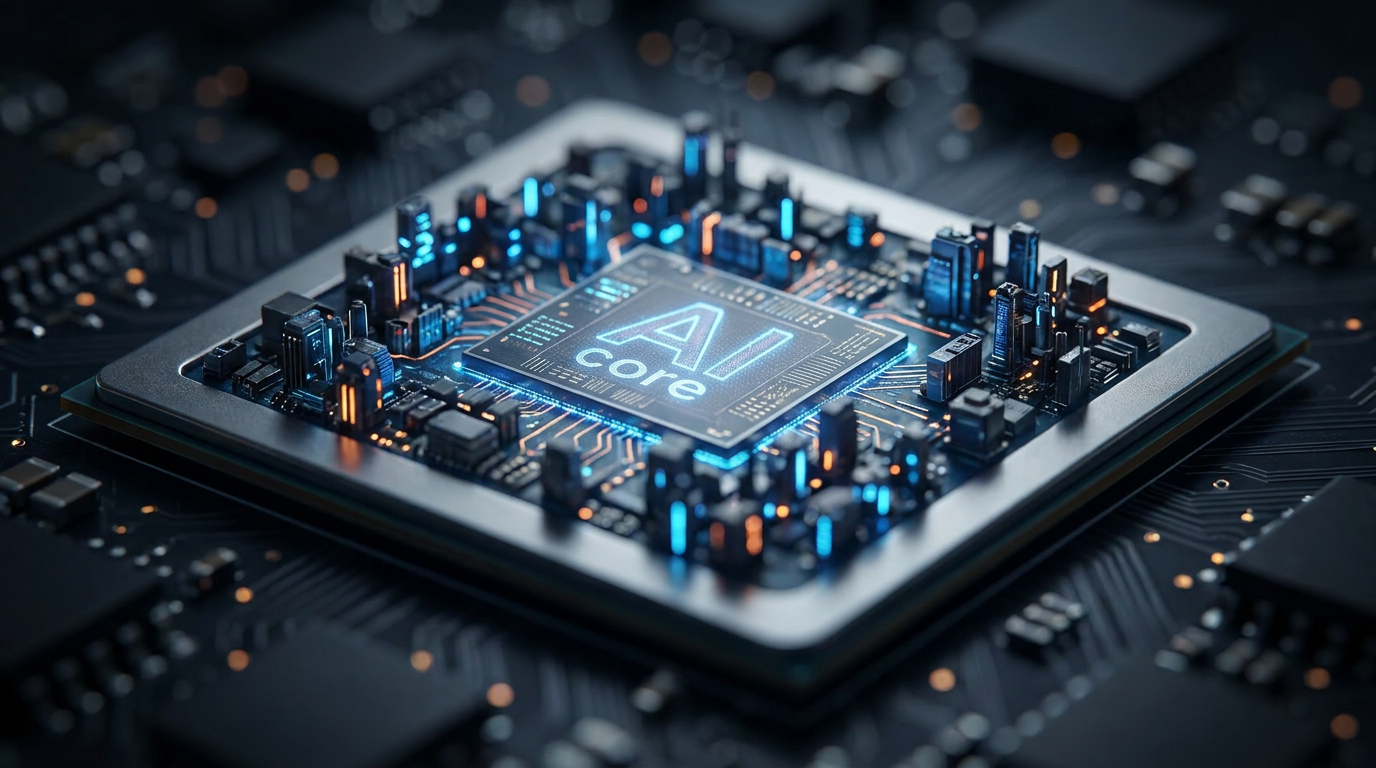
Hardware manufacturers have spent the last several years quietly preparing their silicon for this exact software evolution. Modern mobile processors from companies like Apple, Qualcomm, and Google now feature highly advanced, dedicated Neural Processing Units (NPUs). Unlike general-purpose CPUs, which handle sequential tasks, or GPUs, which are optimized to render graphics, NPUs are specifically architected to execute the dense matrix multiplication math required by neural networks at incredibly high speeds while drawing very little power from the battery.[1][4]
The tangible results of this hardware and software convergence are now shipping directly to consumers. Google's Gemini Nano operates locally on recent Pixel and Samsung flagship devices, utilizing the Android AICore service to provide offline summarization, smart replies, and audio transcription. Because the model is integrated deeply at the operating system level, it can interact securely with native applications without requiring third-party developers to bundle massive, redundant AI models into their individual app downloads from the store.[2][5]
Apple has taken a similar, highly integrated approach with the rollout of Apple Intelligence. The company relies heavily on proprietary, on-device models that have been optimized specifically to run on the Apple Neural Engine. By processing the vast majority of user requests locally on the hardware, Apple ensures that deeply personal context—such as reading a user's private text messages to find a flight time or scanning a photo library—never leaves the physical confines of the iPhone.[3][5]
Despite their impressive efficiency and speed, Small Language Models are not artificial general intelligence, and they cannot completely replace their massive cloud-based counterparts for all tasks. Because they possess significantly fewer parameters, SLMs inherently contain less "world knowledge." They are exceptionally good at manipulating text that is directly provided to them—summarizing a long document, rewriting an email for tone, or extracting action items—but they struggle with deep factual recall, complex logical reasoning, and advanced software coding tasks.[4][6]
To bridge this capability gap without sacrificing the benefits of edge computing, the technology industry is coalescing around hybrid architectures. When a user issues a prompt, an intelligent on-device orchestrator evaluates the complexity of the request. If the task is relatively simple—like proofreading a paragraph or setting a contextual alarm—the local SLM handles it instantly and privately. If the task requires deep reasoning or broad knowledge, the system seamlessly routes the request to a larger, more capable cloud-based model.[2][4]

This hybrid approach is perfectly exemplified by Apple's Private Cloud Compute architecture, which acts as a secure, cryptographically verifiable fallback for requests that exceed the iPhone's local processing capabilities. By offloading only the most complex 15 to 20 percent of tasks to the cloud, technology companies can drastically reduce their massive server costs while simultaneously maintaining a fast, highly private, and deeply integrated experience for the vast majority of the user's daily digital interactions.[2][6]
Beyond the immediate improvements to user experience and data privacy, the shift toward edge computing carries profound environmental implications. The immense energy required to train and continuously run massive cloud-based LLMs has caused a surge in data center power consumption, straining local electrical grids and increasing carbon emissions. By distributing the daily inference workload across billions of consumer devices that are already plugged in and charging, the AI industry can significantly curb its centralized energy footprint and operate more sustainably.[1][6]

As we move deeper into 2026, the fundamental definition of what constitutes a "smart" device is changing. The era of the smartphone serving merely as a thin client—a glass portal to a distant server—is rapidly coming to an end. Equipped with highly optimized Small Language Models and dedicated neural silicon, our everyday devices are becoming genuinely intelligent agents in their own right, capable of understanding context, fiercely protecting user privacy, and operating entirely on their own terms.[7]
How we got here
Early 2023
Massive cloud-based Large Language Models dominate the industry, requiring vast data centers to process user requests.
Late 2023
Researchers begin successfully applying quantization techniques, proving that models can be compressed with minimal loss of reasoning ability.
Early 2024
Open-weight models like Meta's Llama 3 8B demonstrate that smaller parameter counts can achieve highly practical results.
Mid 2024
Apple and Google announce deep OS-level integration of on-device models via Apple Intelligence and Gemini Nano.
2026
Small Language Models become the standard for mobile applications, enabling offline, zero-latency AI processing.
Viewpoints in depth
Privacy Advocates
Focus on data sovereignty and zero-trust architectures.
For privacy advocates, the shift to edge AI is the most important development since end-to-end encryption. They argue that the cloud-based AI era normalized the mass extraction of deeply personal context—from private messages to health inquiries. By processing data locally, SLMs return control to the user, ensuring that corporate servers cannot log, train on, or accidentally leak sensitive information.
Enterprise Developers
Focus on cost reduction and offline reliability.
From a business perspective, cloud AI is expensive and unpredictable. Enterprise developers champion SLMs because they eliminate the recurring API costs associated with sending millions of queries to cloud providers. Furthermore, on-device models provide guaranteed uptime for mission-critical applications, ensuring that software continues to function even when a device loses cellular or Wi-Fi connectivity.
Hardware Engineers
Focus on silicon optimization and thermal management.
Hardware engineers view the SLM revolution as a triumph of specialized silicon. They emphasize that running neural networks on mobile devices is an exercise in strict hardware starvation. Their focus is on optimizing Neural Processing Units (NPUs) and memory bandwidth to execute billions of calculations per second without overheating the device or draining the battery.
What we don't know
- How quickly hardware manufacturers can increase mobile RAM to support even larger on-device models.
- Whether open-weight SLMs will eventually match the deep reasoning capabilities of today's largest cloud models.
- How battery technology will evolve to handle the sustained power draw of continuous local AI inference.
Key terms
- Small Language Model (SLM)
- A highly compressed artificial intelligence model designed to operate on consumer devices with limited memory and processing power.
- Edge Computing
- The practice of processing data locally on the device where it is generated, rather than relying on a remote cloud server.
- Quantization
- A technique that compresses an AI model by reducing the mathematical precision of its parameters, drastically lowering its memory footprint.
- Neural Processing Unit (NPU)
- A specialized hardware chip designed specifically to accelerate the complex mathematics required by machine learning algorithms.
- Knowledge Distillation
- A training method where a smaller AI model learns to mimic the behavior and outputs of a much larger, more capable model.
Frequently asked
What is a Small Language Model (SLM)?
An SLM is a compact AI system, typically containing between 1 billion and 7 billion parameters, designed to run efficiently on consumer hardware like smartphones rather than massive cloud servers.
How does on-device AI protect my privacy?
Because the AI model runs entirely on your device's local processor, your prompts, messages, and documents are never sent over the internet to a third-party server.
Can an SLM do everything a large cloud model can do?
No. While SLMs are excellent at text summarization, translation, and drafting, they lack the deep factual knowledge and complex reasoning capabilities of massive cloud models.
What is quantization?
Quantization is a mathematical compression technique that shrinks the size of an AI model's weights (often from 16-bit to 4-bit), allowing it to fit within the limited memory of a smartphone.
Sources
Source coverage
7 outlets
4 viewpoints surfaced






[1]arXivHardware Engineers
Evaluating the Efficiency of Small Language Models on Edge Devices
Read on arXiv →[2]GitHub PagesPrivacy Advocates
The Reality of On-Device AI in 2026
Read on GitHub Pages →[3]AI Dev DayHardware Engineers
The Reality of On-Device SLM Deployment in 2026
Read on AI Dev Day →[4]UnimonEnterprise Developers
Advances in Quantization and Small Language Models
Read on Unimon →[5]WaraclePrivacy Advocates
Apple's Integration of SLMs in Mobile Architecture
Read on Waracle →[6]Ruh AIEnterprise Developers
Small Language Models: Comprehensive Guide 2026
Read on Ruh AI →[7]Factlen Editorial TeamFactlen Editorial
Synthesis by Factlen editorial team
Read on Factlen Editorial Team →
More in ai
See all 5 stories →On-Device AI
How Local AI Replaced the Cloud: Running Frontier Models on Your Laptop
0 sources

Enterprise AI
The Rise of Small Language Models: How Enterprises Are Running AI Locally in 2026
0 sources

Drug Discovery
New AI Model Accelerates Molecular Simulations 10,000-Fold, Slashing Drug Discovery Timelines
0 sources

Every angle. Every day.
Get ai stories with full source coverage and perspective breakdowns delivered to your inbox.