
How Small Language Models Are Moving AI From the Cloud to Your Laptop
Highly capable, compact AI models are now running locally on everyday devices in 2026. This shift is eliminating subscription costs, guaranteeing absolute privacy, and democratizing access to artificial intelligence.
By Factlen Editorial Team
- Open-Source Advocates
- Champion local models as a way to democratize AI access, eliminate subscription costs, and guarantee absolute user privacy.
- Enterprise IT Leaders
- Focus on the compliance, cost-reduction, and data sovereignty benefits of keeping AI computation within internal networks.
- Global Development Advocates
- View lightweight, offline-capable AI as a crucial tool for bridging the digital divide in regions with limited internet infrastructure.
What's not represented
- · Cloud Service Providers facing potential revenue disruption from local AI adoption.
- · Hardware manufacturers balancing battery life constraints with increasing on-device AI demands.
Why this matters
By running AI locally on your own hardware, you eliminate recurring cloud subscription fees and ensure your personal data never leaves your device. This shift makes powerful AI tools accessible, private, and entirely under your control.
Key points
- Small Language Models (SLMs) under 14 billion parameters can now run efficiently on standard consumer laptops and smartphones.
- Local execution guarantees absolute data privacy, as user prompts and documents never leave the device.
- Advanced compression techniques allow these models to operate on as little as 2 to 4 gigabytes of RAM.
- Top-tier 2026 SLMs are achieving benchmark scores that rival massive, cloud-dependent models on specific reasoning tasks.
For the past several years, the artificial intelligence narrative has been dominated by massive, cloud-based behemoths. These models required vast data centers, expensive subscription fees, and a constant internet connection to function. But in 2026, a quiet revolution is happening directly on the devices we already own.[7]
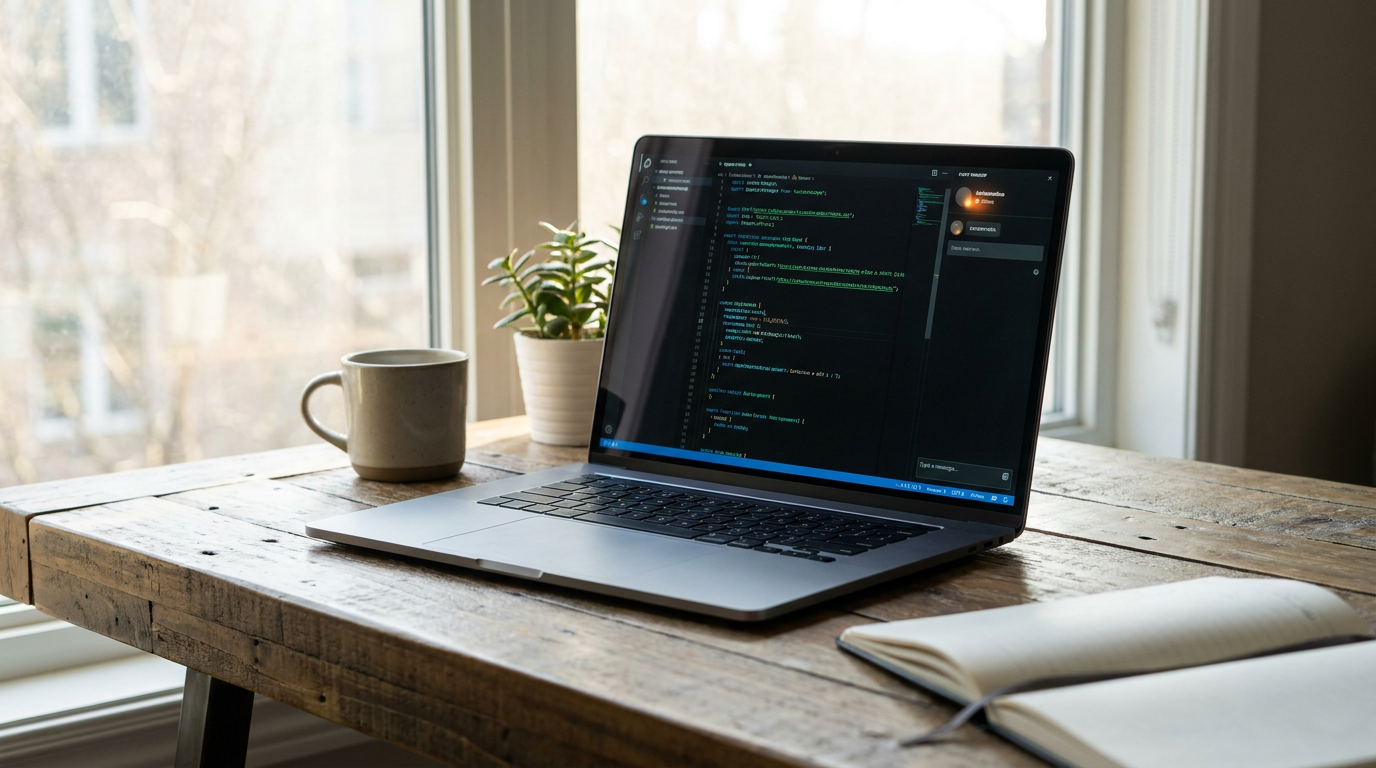
The tech industry is witnessing the rapid maturation of Small Language Models (SLMs). Unlike their trillion-parameter counterparts, SLMs are compact AI systems typically containing between 1 billion and 14 billion parameters. They are specifically designed to run efficiently on consumer hardware, from standard laptops to modern smartphones.[1][3]
This shift represents a fundamental democratization of artificial intelligence. Instead of paying recurring monthly fees to cloud providers, users can now download highly capable models for free and run them entirely on their own hardware. The result is an AI experience that is faster, cheaper, and entirely private.[2][4]
The technical leap making this possible relies heavily on a process called "quantization." Quantization compresses the mathematical weights of a neural network, allowing a highly capable AI to fit into just 2 to 4 gigabytes of RAM. This means a model that once required a rack of servers can now run comfortably on an everyday laptop.[5][6]

Additionally, developers are using "distillation," a technique where massive frontier models are used to teach and refine smaller models. This transfers advanced reasoning and instruction-following behaviors into much smaller architectures without requiring brute-force computational scale.[6]
The performance of these compact models has shattered previous expectations. Microsoft's Phi-4 family, for instance, has proven that high-quality training data can beat raw scale. The 14-billion parameter version of Phi-4 recently scored 84.8% on the MMLU benchmark, rivaling or even beating massive cloud models on complex graduate-level science tasks.[1]
The open-source ecosystem is driving this innovation at breakneck speed. Meta's Llama 3.2 offers 1B and 3B parameter variants that excel at fast dialogue and multilingual support, while Google's Gemma 3 family provides highly efficient multimodal capabilities. Hugging Face's SmolLM3 is also pushing the boundaries of what fully open models can achieve on constrained hardware.[1][2][5]

The open-source ecosystem is driving this innovation at breakneck speed.
For everyday users, the most immediate and profound benefit of SLMs is absolute privacy. When an AI runs locally on a laptop or smartphone, the user's prompts, documents, and personal data never leave the device. There is no data harvesting, no cloud storage, and no risk of a third-party breach.[2][4]
This local-first approach solves a major headache for enterprises, legal firms, and healthcare providers handling sensitive information. By keeping data strictly on-device or within internal networks, organizations bypass the severe compliance risks associated with sending confidential data to external AI providers.[4]
Speed is another massive advantage of the SLM revolution. Because local models eliminate the need to send data across the internet to a server and wait for a response, they can achieve sub-100-millisecond latency. This enables truly real-time applications, from instant voice translation to predictive typing that feels instantaneous.[1][3]
The hardware industry has rapidly adapted to support this localized AI trend. Modern smartphones, like the Pixel 9 and the latest iPhones, alongside laptops equipped with dedicated Neural Processing Units (NPUs), are purpose-built to handle these AI workloads efficiently. This hardware acceleration ensures that running an AI locally does not drain the device's battery or overheat the system.[1][5]
In enterprise environments, developers are increasingly adopting a "hybrid routing" architecture. In this setup, a fast, free local SLM handles up to 95% of routine tasks—like summarizing emails, drafting replies, or basic coding—while only escalating the most complex 5% of queries to a larger, paid cloud model. This slashes operational costs dramatically.[1][3][6]

Beyond the corporate world, SLMs are playing a crucial role in global development. Frugal AI approaches allow advanced digital tools to be deployed in regions with poor or non-existent internet connectivity. A teacher in a remote village or a healthcare worker in an off-grid clinic can now access powerful AI assistants entirely offline.[4]
Crucially, deploying these models is no longer restricted to software engineers. Open-source platforms like Ollama and LM Studio have made running local AI practically frictionless. Users can now download and run a sophisticated language model with a single command or a simple desktop application interface.[2][5]
As 2026 unfolds, the trajectory of artificial intelligence is clear. The future is not solely about building the largest possible centralized brains; it is equally about distributing smart, efficient, and private intelligence to the very edges of the network, empowering users exactly where they are.[1][7]
How we got here
Late 2022
The launch of ChatGPT popularizes large, cloud-dependent language models, setting the industry standard for centralized AI.
Early 2024
Open-source communities begin aggressively compressing models, proving that smaller parameter counts can still yield useful results.
Mid 2025
Major tech companies release highly capable compact models, such as Meta's Llama 3 and Microsoft's early Phi series, optimized for edge devices.
Spring 2026
Models like Phi-4 and Gemma 3 reach performance parity with massive cloud models on specific benchmarks, triggering widespread local adoption.
Viewpoints in depth
The Open-Source Community
Advocates for decentralized AI that prioritizes user privacy and eliminates subscription gatekeeping.
Open-source developers view Small Language Models as the ultimate democratizing force in technology. By stripping away the need for massive data centers, SLMs ensure that AI capabilities are not monopolized by a handful of tech giants. This camp argues that true data sovereignty is only possible when the user physically controls the hardware processing their information, making local models the only ethical path forward for personal AI.
Enterprise IT Leaders
Focuses on the dramatic cost reductions and compliance benefits of running AI internally.
For corporate IT departments, the appeal of SLMs is primarily financial and legal. Cloud-based LLMs introduce unpredictable API costs and severe data compliance risks, especially in heavily regulated industries like healthcare and finance. Enterprise leaders favor a hybrid approach, where 90% of daily AI tasks—like document summarization and internal search—are handled by free, local SLMs, reserving expensive cloud compute only for the most complex analytical workloads.
Global Development Advocates
Champions lightweight AI as a tool to bridge the digital divide in resource-constrained regions.
Organizations focused on global equity highlight that cloud-dependent AI inherently excludes populations without reliable, high-speed internet. Small Language Models solve this by operating entirely offline. Development advocates are deploying these frugal AI systems to power educational tutors, agricultural advisors, and medical diagnostic aids in remote areas, proving that cutting-edge technology does not require cutting-edge infrastructure to be effective.
What we don't know
- How cloud providers will adjust their pricing models as local AI eats into their enterprise API revenue.
- The long-term impact of continuous local AI processing on the battery lifespan of mobile devices.
- Whether future regulatory frameworks will treat locally run, open-source models differently than centralized, corporate-controlled AI.
Key terms
- Small Language Model (SLM)
- An AI system with fewer parameters (typically under 14 billion) designed to run efficiently on everyday consumer hardware rather than massive data centers.
- Quantization
- A compression technique that reduces the mathematical precision of an AI model's weights, allowing it to use significantly less memory without losing much capability.
- Edge Computing
- Processing data locally on the device where it is generated (like a smartphone or laptop) rather than sending it across the internet to a cloud server.
- Neural Processing Unit (NPU)
- A specialized hardware chip built into modern computers and phones specifically designed to accelerate artificial intelligence tasks efficiently.
Frequently asked
Do I need an internet connection to use an SLM?
No. Once the model is downloaded to your device, it runs entirely offline. This guarantees privacy and allows you to use AI in areas with zero connectivity.
Can my current laptop run these models?
Most likely, yes. Modern SLMs are highly compressed through quantization and can run comfortably on laptops with as little as 8GB of RAM.
Are small models as smart as cloud-based AI?
For general, sprawling knowledge, massive cloud models still hold an edge. However, for specific tasks like coding, summarizing documents, and drafting emails, top-tier SLMs now match or exceed the performance of larger models.
Is it difficult to install a local AI?
Not anymore. Open-source tools like Ollama and LM Studio have turned the installation process into a simple, one-click download, much like installing a standard desktop app.
Sources
Source coverage
7 outlets
3 viewpoints surfaced






[1]Local AI MasterOpen-Source Advocates
What Are Small Language Models? Why SLMs Matter in 2026
Read on Local AI Master →[2]First AI MoversEnterprise IT Leaders
A practical guide to fast, private, on-device AI
Read on First AI Movers →[3]CogitxGlobal Development Advocates
Edge / On-Device SLMs: Classification and Impact
Read on Cogitx →[4]Development GatewayGlobal Development Advocates
Frugal AI and the Rise of Small Language Models
Read on Development Gateway →[5]Machine Learning MasteryOpen-Source Advocates
Top 7 Small Language Models You Can Run on a Laptop
Read on Machine Learning Mastery →[6]BentoMLEnterprise IT Leaders
Running open-source LLMs in production: The SLM advantage
Read on BentoML →[7]Factlen Editorial TeamGlobal Development Advocates
Synthesis by Factlen editorial team
Read on Factlen Editorial Team →

More in ai
See all 5 stories →On-Device AI
How Local AI Replaced the Cloud: Running Frontier Models on Your Laptop
0 sources

Enterprise AI
The Rise of Small Language Models: How Enterprises Are Running AI Locally in 2026
0 sources

Drug Discovery
New AI Model Accelerates Molecular Simulations 10,000-Fold, Slashing Drug Discovery Timelines
0 sources

Every angle. Every day.
Get ai stories with full source coverage and perspective breakdowns delivered to your inbox.