
How Sloped Airbags and Dry Slopes Are Revolutionizing Snowboarding Progression
The introduction of sloped airbags and dry-slope facilities has transformed freestyle snowboarding, allowing athletes to safely master high-risk tricks year-round. While some purists argue it changes the sport's organic nature, the technology has become essential infrastructure for Olympic-level progression.
By Factlen Editorial Team
- Progression Advocates
- Coaches and modern athletes who view airbags as essential safety tools that allow the sport to evolve without career-ending injuries.
- Traditionalists
- Purist riders who believe tricks should be learned organically on snow and view synthetic training as a shortcut.
- Facility Operators
- Developers focused on democratizing access to winter sports by building year-round, urban-accessible dry slopes.
What's not represented
- · Medical professionals specializing in long-term joint impact from synthetic landings
- · Environmental advocates monitoring the water and material usage of massive synthetic slope facilities
Why this matters
By removing the fear of catastrophic injury, sloped airbags are allowing athletes to safely push the boundaries of human flight, while urban dry-slope facilities are making winter sports accessible to people who live far from the mountains.
Key points
- Sloped airbags allow snowboarders to safely practice high-risk tricks by matching the angle of a real snow jump.
- The technology uses dual-chamber air systems and low-friction topsheets to simulate the feel of landing on snow.
- Coaches now rely on a three-step progression model: trampoline, airbag, and finally actual snow.
- While traditionalists prefer organic on-snow learning, airbags have become essential for Olympic-level progression and injury prevention.
The ceiling of freestyle snowboarding has been shattered. Tricks that were considered video-game fantasies a decade ago—like frontside 2160s and quad corks—are now standard fare at elite competitions.[6]
But pushing the human body to rotate four times while flipping off a massive jump comes with a severe physical toll. For years, the only way to learn these maneuvers was through trial and error on hard-packed snow, a process that frequently ended in concussions, blown knees, and shortened careers.[1]
Today, the landscape of winter sports has been fundamentally altered by a piece of infrastructure that doesn't require winter at all: the sloped training airbag.[2]
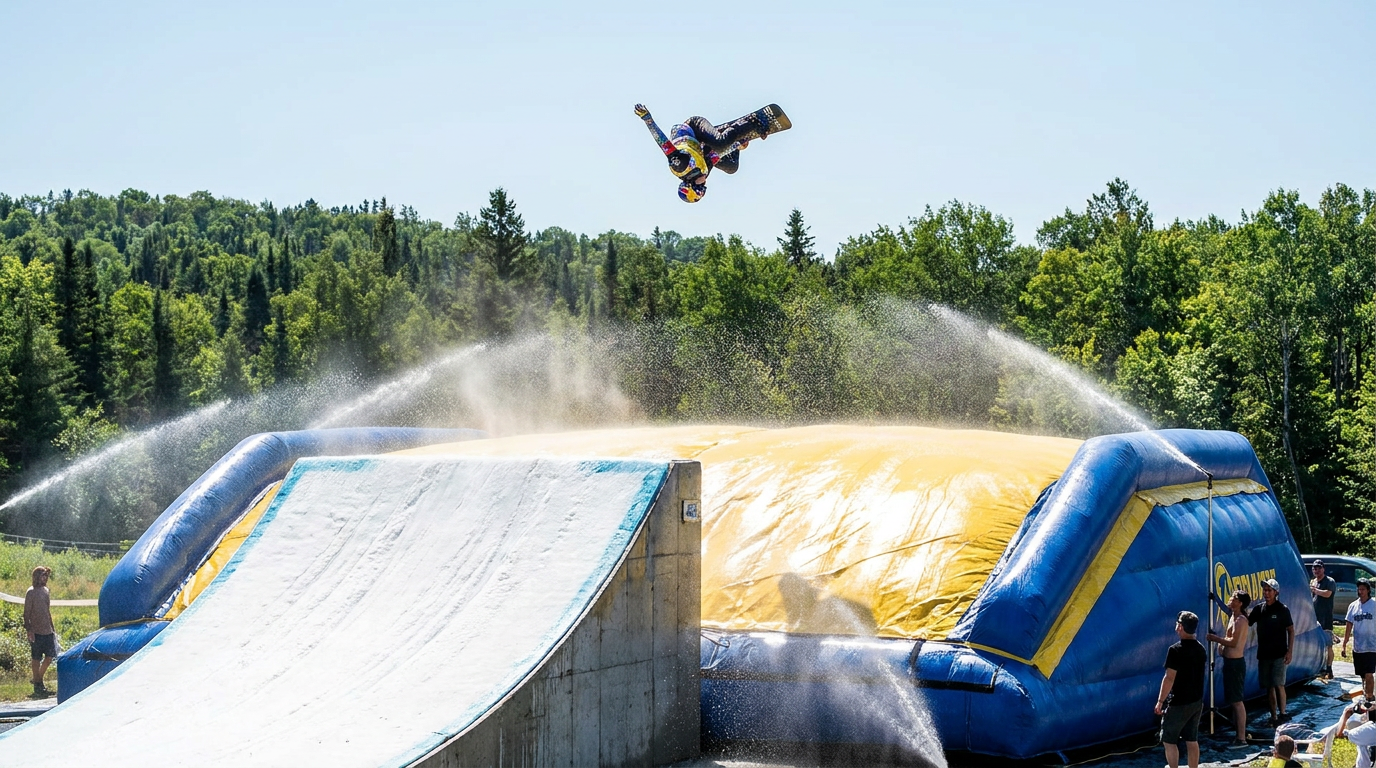
Unlike the flat, stunt-style airbags of the early 2000s—where riders would launch into the air and sink safely onto their backs—modern sloped airbags are highly engineered synthetic mountains.[3]

They are built to match the exact pitch and transition of a real snow jump. This critical design shift allows athletes to land on their boards and ride away, perfectly simulating the biomechanics of a real trick without the punishing impact of a crash.[2]
The technology relies on a specialized synthetic topsheet, often lubricated by a sprinkler system. This creates a low-friction surface that mimics the glide of snow, preventing the board's edges from catching upon landing and allowing for a smooth exit.[5]
Beneath the surface, dual-chamber air systems allow facility operators to adjust the firmness. Beginners can practice on a softer setting that absorbs heavy falls, while Olympic athletes can dial up the pressure to replicate the firm, unforgiving nature of a competition halfpipe or slopestyle course.[2][5]
Beneath the surface, dual-chamber air systems allow facility operators to adjust the firmness.
This technology has formalized what coaches now call the "Three-Step Progression Model." Athletes first learn the spatial awareness of a new rotation on a trampoline, breaking down the fundamentals in a highly controlled environment.[1]

Next, they take the trick to the airbag, strapping into their snowboards and launching off a dry-slope ramp. Here, they can attempt a dangerous new rotation dozens of times in a single afternoon, failing safely until the muscle memory is locked in.[1][6]
Only after the trick is perfected on the airbag does the athlete attempt it on actual snow. This methodical approach removes the guesswork and the fear, allowing riders to commit fully to new movements without the hesitation that often causes injuries.[1]
The results are undeniable. Nations that invested heavily in airbag infrastructure early on, particularly Japan and Canada, have seen their athletes dominate the podiums in recent Olympic cycles, pushing the sport's boundaries at an unprecedented pace.[4]

However, the rise of the airbag has sparked a philosophical debate within the snowboarding community. Traditionalists argue that the sport is losing its organic connection to the mountain.[4]
Purists like multi-time Olympic medalists Mark McMorris and Jamie Anderson have previously expressed a preference for learning tricks organically on the snow, viewing airbags as a shortcut that removes the inherent risk and grit that defined early snowboarding.[4]
Conversely, modern competitors and coaches view airbags as essential safety equipment. They argue that as the sport demands increasingly dangerous acrobatics, expecting athletes to risk their lives on hard snow is irresponsible and unsustainable.[1][3]

Beyond elite training, these facilities are democratizing the sport. Dry slopes and airbag centers are opening in urban areas far from traditional ski resorts, lowering the financial and geographic barriers to entry for a new generation of riders.[6]
How we got here
Early 2000s
Flat stunt airbags are introduced, allowing riders to practice flips but forcing them to land on their backs.
2010s
The first sloped airbags are developed, matching the angle of snow jumps and allowing athletes to ride away from tricks.
2018
Airbag-trained athletes begin dominating international podiums, shifting the industry standard.
2025
Advanced dry-slope and airbag facilities expand globally, bringing elite winter sports training to urban, snowless environments.
Viewpoints in depth
Progression Advocates
Coaches and modern athletes who view airbags as essential safety tools.
For national team coaches and the current generation of elite competitors, airbags are a non-negotiable piece of infrastructure. They argue that as the sport demands increasingly dangerous acrobatics—such as triple and quad corks—expecting athletes to risk their lives on hard snow is irresponsible. By removing the fear of catastrophic injury, riders can commit fully to new movements, accelerating the sport's evolution while keeping athletes healthy.
Traditionalists
Purist riders who believe tricks should be learned organically on snow.
A vocal contingent of veteran snowboarders and purists view the proliferation of airbags with skepticism. They argue that the sport is losing its soul when tricks are perfected in a sterile, consequence-free environment before ever touching a mountain. For these riders, the inherent risk and the grit required to learn a trick on actual snow are fundamental parts of snowboarding's culture, and they view synthetic training as a shortcut.
Facility Operators
Developers focused on democratizing access to winter sports.
For those building and operating these facilities, the focus extends beyond Olympic medals to accessibility. By constructing dry slopes and airbag setups in urban areas and operating them year-round, they are lowering the geographic and financial barriers to entry. They view this infrastructure as a way to introduce freestyle snowboarding to demographics that would otherwise never have the opportunity to step on a board.
What we don't know
- Whether the International Ski and Snowboard Federation (FIS) will eventually regulate or cap the number of rotations allowed in competition due to safety concerns.
- How the proliferation of urban dry slopes will shift the geographic demographics of future Olympic snowboard teams.
Key terms
- Sloped Airbag
- An inflatable landing pad angled to mimic a mountain jump, allowing athletes to land on their feet rather than their backs.
- Dry Slope
- A synthetic surface made of specialized plastics that mimics the friction of snow, allowing skiing and snowboarding year-round.
- Quad Cork
- A highly advanced freestyle trick involving four off-axis flips, pushing the absolute limits of human aerial biomechanics.
- Topsheet
- The durable, low-friction outer layer of an airbag that allows a snowboard to glide smoothly upon landing.
Frequently asked
What is a sloped snowboard airbag?
It is a massive, inflatable cushion designed to match the exact landing angle of a snow jump, allowing riders to land on their board and ride away safely.
Do dry slopes feel like real snow?
While not identical, modern synthetic topsheets combined with water sprinklers closely mimic the low-friction glide of packed snow.
Why do some snowboarders dislike airbags?
Some traditionalists feel that learning tricks without the risk of falling on hard snow removes the grit and organic culture of the sport.
Can anyone use these airbag facilities?
Yes. While used by Olympians, many facilities offer adjustable pressure settings and smaller jumps specifically designed for beginners.
Sources
Source coverage
6 outlets
3 viewpoints surfaced






[1]BagjumpProgression Advocates
A Bridge Between Athlete and Snow: The Role of Airbags in Olympic Training
Read on Bagjump →[2]SunparkAirbagFacility Operators
Snowboard Jump Airbag: The Ultimate Tool for Safer and More Effective Progression
Read on SunparkAirbag →[3]WinSportProgression Advocates
WinSport Introduces State-of-the-Art Flat Bottom Internal Landing Airbag
Read on WinSport →[4]NBC OlympicsTraditionalists
How Olympic snowboarders stay in shape off the slopes
Read on NBC Olympics →[5]BigAirBagProgression Advocates
Snow Landing: Endless Progression, Maximum Safety
Read on BigAirBag →[6]Factlen Editorial TeamFacility Operators
Synthesis by Factlen editorial team
Read on Factlen Editorial Team →

More in sports
See all 6 stories →Women's Super League
Mary Earps Returns to Women's Super League in Statement Signing for London City Lionesses
7 sources

WSL Transfers
Mary Earps Returns to WSL in Statement Signing for London City Lionesses
7 sources

Combat Tech
The Science of the Strike: How Smart Gloves and Sensors Are Making Combat Sports Safer
9 sources
Women's Wrestling
How Women's Wrestling Became the Fastest-Growing Sport in America
6 sources

Every angle. Every day.
Get sports stories with full source coverage and perspective breakdowns delivered to your inbox.