
How Precision Fermentation Works: The Science of Brewing Dairy Without the Cow
By programming microbes to act as microscopic factories, scientists are producing molecularly identical dairy proteins that require 90% less land and generate 97% fewer emissions than traditional agriculture.
By Factlen Editorial Team
- Food Technology Innovators
- Advocates who argue that precision fermentation is the only mathematically viable way to feed a growing population sustainably.
- Environmental & Climate Scientists
- Researchers who emphasize the massive emissions reductions but warn about the technology's heavy energy demands.
- Market Analysts
- Financial experts focused on the massive growth projections, capital expenditure bottlenecks, and consumer adoption rates.
- Traditional Agriculture Sector
- Farming advocates who warn of severe economic disruption and question the cultural shift toward lab-brewed food.
What's not represented
- · Traditional dairy farmers facing economic disruption
- · Developing nations lacking the capital to build advanced bioreactor infrastructure
Why this matters
Precision fermentation is poised to fundamentally disrupt the global food supply chain. By decoupling protein production from animals, this technology offers a mathematically viable way to feed a growing global population while drastically reducing the agricultural methane emissions driving climate change.
Key points
- Precision fermentation uses programmed microbes to brew specific proteins, such as dairy whey, without using animals.
- The resulting proteins are molecularly identical to conventional dairy, offering the exact same taste, texture, and nutritional profile.
- The process requires up to 90% less land and generates 97% fewer greenhouse gas emissions than traditional dairy farming.
- To realize its full climate benefits, the massive bioreactors required for production must be powered by renewable energy.
- The technology is rapidly expanding beyond food into cosmetics, palm oil alternatives, and sustainable textiles.
For 10,000 years, humanity has relied on a highly effective but profoundly inefficient machine to produce dairy: the cow. While traditional agriculture has sustained global populations, the environmental toll of industrial livestock farming has become mathematically unsustainable. Livestock production currently accounts for roughly 14.5% of all human-caused greenhouse gas emissions, with dairy cattle contributing a massive share of the world's methane.[6]
Now, a quiet revolution in biotechnology is threatening to decouple our favorite foods from the animals that traditionally produce them. The technology is called precision fermentation, and it represents what some food scientists are calling the most significant shift in agriculture since the original domestication of livestock.[2]
Precision fermentation is not science fiction; it is already on supermarket shelves. Major food conglomerates and well-funded startups are currently using the technology to brew animal-free milk proteins, egg whites, and even the complex fats that give meat its flavor. The global market for these ingredients, valued at roughly $4.5 billion today, is projected to explode past $100 billion over the next decade.[3]
To understand precision fermentation, it helps to look at traditional fermentation. For centuries, humans have used microbes like yeast and bacteria to convert sugars into alcohol for beer, or lactic acid for yogurt. In these traditional processes, the microbes naturally produce a cocktail of byproducts based on their environment.[4]

Precision fermentation removes the biological guesswork. Instead of relying on a microbe's natural output, scientists program the microorganism to act as a microscopic, single-purpose factory. By identifying the specific genetic sequence that codes for a desired molecule—such as whey protein—researchers can insert that instruction directly into the DNA of a yeast or fungal cell.[1]
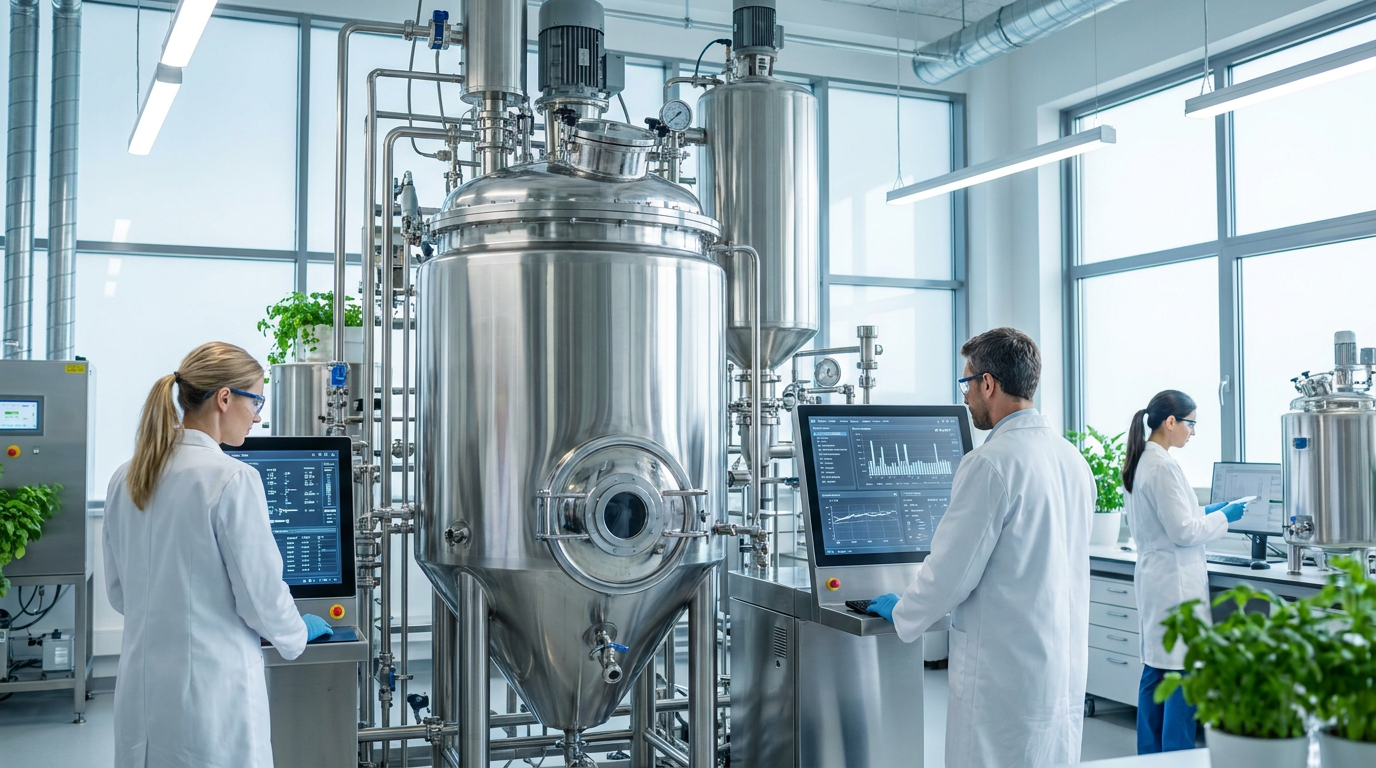
Once programmed, these microbes are placed into massive stainless-steel tanks known as bioreactors. Inside these controlled environments, the microbes are fed a steady diet of simple sugars, water, and basic nutrients. As they metabolize the sugars, they follow their new genetic instructions, pumping out the target protein in massive quantities.[5]
The final and most crucial step is purification. The fermentation broth is filtered to separate the newly created proteins from the microbes that produced them. The resulting ingredient is not a "plant-based alternative" or a synthetic imitation; it is molecularly identical to the protein produced by a cow or a chicken.[4]
The environmental implications of shifting protein production from animals to microbes are staggering. Lifecycle analyses of commercial precision fermentation facilities reveal that brewing dairy proteins in a tank requires up to 90% less land and 77% less water than conventional dairy farming.[2]

The environmental implications of shifting protein production from animals to microbes are staggering.
Most importantly, the process generates up to 97% fewer greenhouse gas emissions. Because microbes do not have digestive tracts, they do not burp methane—a greenhouse gas that is roughly 30 times more potent than carbon dioxide at warming the atmosphere over a century.[6]
However, the climate benefits come with a significant caveat: energy consumption. Bioreactors must be kept at precise temperatures and constantly stirred, a process that requires massive amounts of electricity. If a precision fermentation plant is powered by a coal-fired grid, its climate advantage evaporates. The technology only fulfills its environmental promise if it is paired with renewable energy infrastructure.[2]
While dairy proteins like whey and casein have been the primary focus, the applications for precision fermentation extend far beyond the milk aisle. The technology is already being used to produce heme, the iron-rich molecule that gives plant-based burgers their authentic "meaty" taste and ability to "bleed" on the grill.[1]
Beyond food, the industrial applications are equally disruptive. Companies are using programmed microbes to brew alternatives to palm oil, potentially easing the deforestation pressures in Southeast Asia. Others are producing animal-free collagen for cosmetics, and even bio-based polymers that can be spun into stretchy, sustainable textiles for the apparel industry.[5]

Despite the clear scientific success, the industry faces a massive bottleneck in physical infrastructure. Building a single commercial-scale fermentation facility can cost hundreds of millions of dollars. Currently, the global supply of food-grade bioreactors is vastly insufficient to meet the projected demand, forcing many startups to compete for limited contract manufacturing space.[2]
The financial sector has recognized the bottleneck, pouring billions in venture capital into the space. The U.S. market alone is expected to grow at a compound annual rate of over 46% through the next decade, driven by aggressive investments in biotechnology and shifting consumer preferences toward sustainable products.[3]
Regulatory frameworks are also racing to catch up with the science. In the United States, several precision-fermented proteins have already achieved "Generally Recognized as Safe" (GRAS) status from the FDA, allowing them to be used in commercial products. European regulators, known for stricter novel food laws, are also beginning to process approvals for animal-free dairy ingredients.[3][4]

The ultimate hurdle, however, will be consumer psychology. While early data suggests that younger demographics are highly receptive to technology-driven sustainability, convincing the broader public to consume "lab-brewed" proteins requires careful messaging. The industry must navigate the line between highlighting the high-tech sustainability of the process and reassuring consumers about the natural, identical quality of the food.[7]
If it succeeds, precision fermentation offers a profound upgrade to global food security. Because microbes can be brewed anywhere—from a desert in the Middle East to a dense urban center in Asia—the technology decouples protein production from arable land and favorable weather. It offers a way to feed a growing global population without requiring a corresponding expansion of agricultural footprint.[5]
We are witnessing the domestication of the microbe. Just as our ancestors learned to harness the cow and the chicken to build the modern world, the next era of human agriculture may be defined by our ability to harness the yeast cell—brewing the foods we love, without the environmental cost we can no longer afford.[2][7]
How we got here
1990
The FDA approves the first precision-fermented ingredient, chymosin (rennet), revolutionizing global cheesemaking.
2014
Perfect Day is founded, pioneering the use of precision fermentation specifically for animal-free dairy proteins.
2020
The first commercial precision-fermented ice cream hits the US market, proving consumer viability.
2024
Major multinational food conglomerates, including Nestlé, launch products utilizing animal-free whey.
2026
The global precision fermentation market surpasses $6 billion amid massive infrastructure investments.
Viewpoints in depth
Food Technology Innovators
Advocates argue that precision fermentation is the only mathematically viable way to feed a growing population.
This camp views the cow as an outdated technology. They argue that by domesticating microbes, humanity can decouple food production from arable land, weather patterns, and animal suffering. Their primary focus is on securing the massive capital expenditures required to build commercial-scale bioreactors, believing that once economies of scale are reached, precision-fermented proteins will be cheaper, cleaner, and safer than conventional animal agriculture.
Environmental & Climate Scientists
Researchers emphasize the massive emissions reductions but warn about the technology's energy demands.
Climate scientists celebrate precision fermentation's ability to eliminate agricultural methane—a potent greenhouse gas—and return millions of acres of farmland to natural ecosystems. However, they caution that bioreactors are incredibly energy-intensive. If the electricity powering these massive stainless-steel tanks comes from fossil fuels, the climate benefits are entirely negated. They argue the technology must be deployed in tandem with aggressive renewable energy expansion.
Traditional Agriculture Sector
Farming advocates warn of severe economic disruption and question the cultural shift toward lab-brewed food.
Representatives of the traditional agricultural economy view the rapid rise of precision fermentation as a profound threat to rural livelihoods. They argue that dairy farming is not just an industry, but a cultural heritage and a foundational element of rural economies worldwide. Furthermore, they often raise concerns about the hyper-consolidation of the food supply, warning that shifting protein production from millions of independent farms to a handful of Silicon Valley-backed biotechnology factories could create dangerous corporate monopolies.
What we don't know
- Whether the global renewable energy grid can expand fast enough to power thousands of new commercial bioreactors without relying on fossil fuels.
- How traditional dairy farming communities and agricultural economies will adapt to the disruption of animal-free protein production.
- The exact timeline for achieving true price parity with heavily subsidized conventional dairy products on a global scale.
Key terms
- Precision Fermentation
- The use of genetically programmed microorganisms to produce specific functional ingredients, such as proteins or fats, without relying on plants or animals.
- Bioreactor
- A large stainless-steel tank that provides a controlled environment—managing temperature, oxygen, and nutrients—for microorganisms to grow and multiply.
- Heme
- An iron-rich molecule found in blood and muscle that gives meat its distinct flavor and color, which can now be reproduced via fermentation for plant-based foods.
- Whey Protein
- A primary protein found in cow's milk, highly valued for its nutritional profile and texture, which is currently a major target for animal-free production.
- GRAS
- Stands for 'Generally Recognized as Safe,' a regulatory designation by the US FDA indicating that a food ingredient has been proven safe for human consumption.
Frequently asked
Is precision fermentation the same as lab-grown meat?
No. Lab-grown (cultivated) meat involves growing actual animal cells in a lab. Precision fermentation uses microbes like yeast to produce specific proteins or fats, which are then separated from the microbes entirely.
Are the final products genetically modified?
The microbes used in the process are genetically modified to produce the target protein. However, the final purified protein contains no microbial DNA and is molecularly identical to its natural counterpart.
Does this technology use animals at all?
No. The genetic sequence is simply downloaded from a digital database and synthesized. No animals are involved in the ongoing production process.
Are these products safe for vegans and people with dairy allergies?
They are entirely animal-free, making them suitable for vegans. However, because the proteins (like whey) are molecularly identical to cow's milk, they will still trigger dairy allergies.
Sources
Source coverage
7 outlets
4 viewpoints surfaced






[1]Good Food InstituteFood Technology Innovators
The Science of Fermentation
Read on Good Food Institute →[2]Institute of Food TechnologistsEnvironmental & Climate Scientists
Precision Fermentation: The Next Agricultural Revolution
Read on Institute of Food Technologists →[3]Fortune Business InsightsMarket Analysts
Precision Fermentation Market Size, Share & Industry Analysis
Read on Fortune Business Insights →[4]UK Food Standards AgencyMarket Analysts
Precision fermentation explained
Read on UK Food Standards Agency →[5]CargillFood Technology Innovators
What is fermentation and why does it matter?
Read on Cargill →[6]UN Food and Agriculture OrganizationEnvironmental & Climate Scientists
Livestock and the environment
Read on UN Food and Agriculture Organization →[7]Factlen Editorial TeamTraditional Agriculture Sector
Synthesis by Factlen editorial team
Read on Factlen Editorial Team →
Every angle. Every day.
Get guides stories with full source coverage and perspective breakdowns delivered to your inbox.