
How Nuclear Thermal Propulsion Could Cut Mars Travel Time in Half
Aerospace engineers are looking beyond traditional chemical rockets to nuclear fission, a technology that could double fuel efficiency and drastically reduce the time it takes to reach Mars.
By Factlen Editorial Team
- Aerospace Engineers
- Focus on specific impulse, payload capacity, and escaping the limits of chemical rockets.
- Radiation Safety Experts
- Emphasize the 'radiation paradox' where faster transit reduces cosmic ray exposure.
- Deep Space Advocates
- View nuclear propulsion as the only viable path to crewed Mars missions and outer solar system exploration.
What's not represented
- · Environmental watchdog groups concerned about launching nuclear material
- · Commercial spaceflight companies focused solely on chemical reusability
Why this matters
If humanity is ever going to establish a permanent presence on Mars or explore the outer solar system, we must overcome the speed limits of chemical rockets. Nuclear thermal propulsion offers the only currently viable physics to cut travel times in half, fundamentally changing the economics, safety, and feasibility of deep-space exploration.
Key points
- Chemical rockets have reached their theoretical efficiency limits, making crewed Mars missions slow and payload-constrained.
- Nuclear Thermal Propulsion (NTP) uses a fission reactor to heat liquid hydrogen, doubling the fuel efficiency of traditional rockets.
- By cutting Mars transit times from nine months to roughly four, NTP significantly reduces astronauts' exposure to dangerous cosmic radiation.
- To ensure safety, the nuclear reactor is launched in a deactivated "cold" state and only turned on once it reaches a safe orbit above Earth.
- Aerospace agencies are also developing Nuclear Electric Propulsion (NEP), which uses atomic energy to power highly efficient ion thrusters for cargo missions.
For decades, humanity’s exploration of the cosmos has been locked in a chemical trap known as the tyranny of the rocket equation. To travel faster and farther in space, a vehicle requires more fuel. However, adding more fuel increases the spacecraft's mass, which in turn requires even more fuel just to lift that additional weight. This vicious cycle dictates the strict limits of modern spaceflight, forcing engineers to build massive launch vehicles that are mostly propellant by weight, leaving only a tiny fraction of room for actual payload or crew.[7]
This fundamental limitation governs every interplanetary journey we undertake today. A conventional crewed trip to Mars, relying on the most advanced chemical rockets available, takes roughly seven to nine months. Because chemical engines consume their fuel so rapidly, the spacecraft cannot accelerate continuously. Instead, it fires its engines for a brief period to break free of Earth's orbit and then coasts for millions of miles, relying entirely on orbital mechanics and momentum to reach its destination.[7]
The bottleneck lies in the chemistry itself. Traditional rockets generate thrust by burning a liquid fuel, such as hydrogen or methane, in the presence of an oxidizer like liquid oxygen. The resulting explosive combustion creates a high-pressure exhaust that pushes the rocket forward. While this method provides the immense brute-force thrust needed to escape Earth's gravity, it is fundamentally constrained by the maximum energy density of chemical bonds. We have nearly reached the theoretical limits of what chemical combustion can achieve.[1][2]
To truly open the solar system to human exploration, aerospace engineers argue that we must abandon combustion entirely once we are in space. The most promising solution—currently undergoing intense study by the European Space Agency and various international aerospace partners—is Nuclear Thermal Propulsion (NTP). By replacing chemical fire with the immense power of the atom, engineers believe we can fundamentally rewrite the rules of interplanetary travel.[4][7]

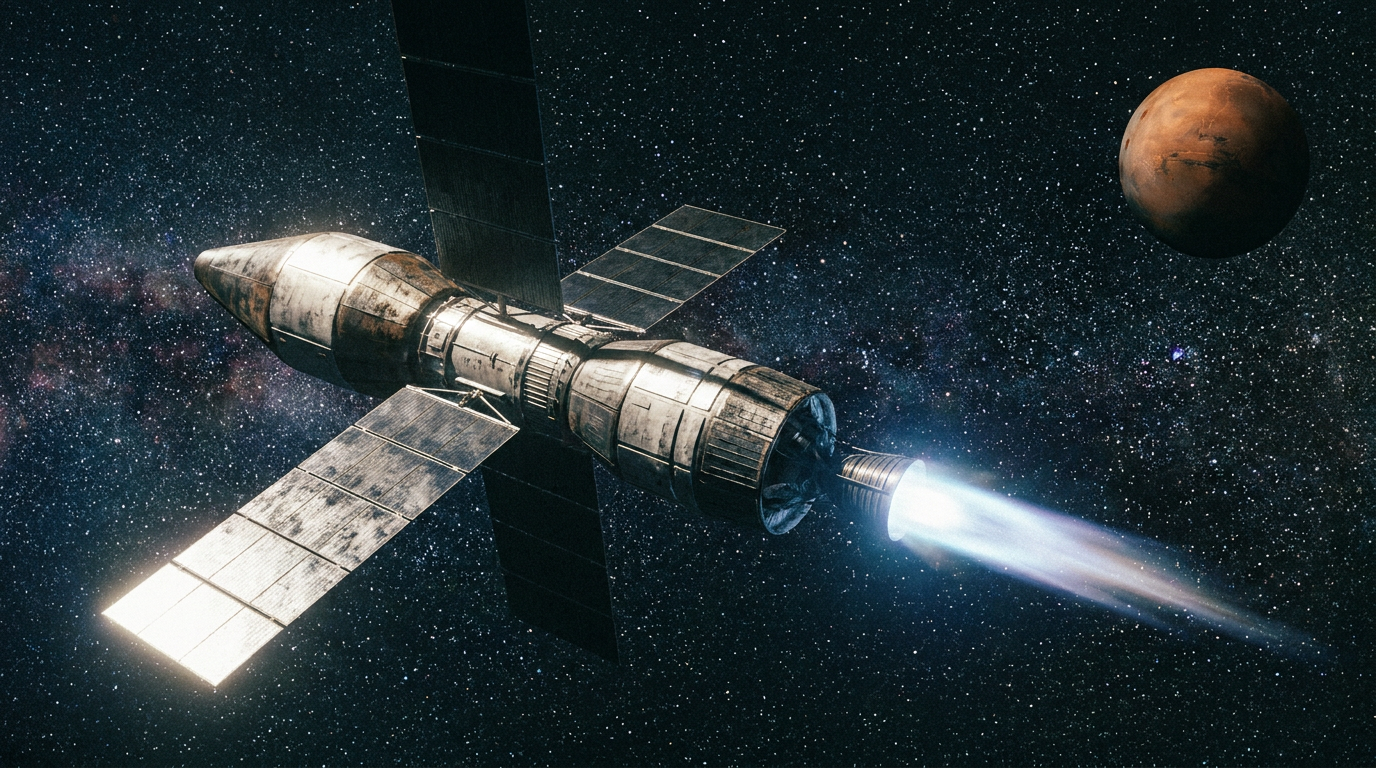
Instead of burning fuel with an oxidizer, a Nuclear Thermal Propulsion system utilizes a compact nuclear fission reactor. The concept is elegantly simple in theory, even if it is incredibly complex in execution. A single propellant, typically super-cooled liquid hydrogen, is pumped directly from the spacecraft's tanks into the heart of the nuclear reactor core. Because there is no combustion, the spacecraft does not need to carry heavy tanks of liquid oxygen, drastically reducing its overall mass.[2][5]
Inside the reactor core, the splitting of uranium atoms generates an immense, continuous supply of thermal energy. As the liquid hydrogen flows through the core's intricate channels, it absorbs this heat, rapidly warming to extreme temperatures exceeding 4,800 degrees Fahrenheit (roughly 2,650 degrees Celsius) in a fraction of a second. The materials inside the reactor must be engineered to withstand this blistering environment without melting or degrading.[1][5]
This sudden, extreme heat causes the hydrogen to expand violently, transforming from a cryogenic liquid into a highly pressurized gas. The gas is then funneled out through a traditional rocket nozzle at the rear of the spacecraft. As the gas expands and accelerates out of the nozzle, it produces a highly efficient, continuous thrust that pushes the spacecraft forward with remarkable force.[2][6]
The true performance leap of this technology is measured in a metric called "specific impulse" (Isp), which calculates how efficiently a rocket uses its propellant to generate thrust. The very best chemical engines in operation today max out at around 450 seconds of specific impulse. Nuclear thermal engines, by contrast, are projected to achieve a specific impulse of 900 seconds, effectively doubling the fuel efficiency of the spacecraft.[1][2]

This doubling of efficiency occurs because hydrogen is the lightest element in the universe. In a chemical rocket, the exhaust is primarily water vapor—a relatively heavy byproduct of burning hydrogen and oxygen. In an NTP system, the exhaust is pure, super-heated hydrogen gas. Because lighter gases can be accelerated to much higher velocities out of the nozzle, the spacecraft can achieve significantly higher top speeds while carrying far less total propellant mass.[2]
This doubling of efficiency occurs because hydrogen is the lightest element in the universe.
For a crewed mission to Mars, this leap in efficiency translates directly into unprecedented speed. A spacecraft equipped with a nuclear thermal engine could cut the transit time from the standard nine months down to just four or five months. This rapid transit capability allows for broader launch windows that are less dependent on perfect planetary alignments, and it provides the crucial ability to abort a mission and return to Earth if an emergency occurs.[4]
This increased speed also unlocks a surprising health benefit for deep-space explorers, often referred to by scientists as the radiation paradox. While flying aboard a spacecraft powered by a live nuclear reactor sounds inherently hazardous, radiation safety experts point out that the single greatest danger to astronauts is actually the ambient cosmic radiation of deep space.[4][7]
Space travelers are constantly bombarded by high-energy galactic cosmic rays and unpredictable solar flares, which can cause severe cellular damage over a nine-month journey. By cutting the travel time in half, a nuclear-powered spacecraft significantly reduces the crew's total cumulative exposure to this background radiation. The reactor itself is heavily shielded, with its radiation directed safely away from the crew cabin, making the faster nuclear journey objectively safer than a slower chemical one.[4]
Despite the safety of the transit, the protocols for launching these nuclear systems from Earth are strictly defined to prevent any environmental contamination. A nuclear thermal rocket would never be fired on the launch pad, nor would it be used to push a spacecraft through Earth's atmosphere. The brute force required to leave the ground will always remain the domain of traditional chemical rockets.[2]
Instead, the nuclear reactor is launched in a completely "cold" or deactivated state atop a conventional launch vehicle. During the violent ascent through the atmosphere, the specialized High-Assay Low-Enriched Uranium (HALEU) fuel remains largely inert and non-radioactive. This ensures that even in the event of a catastrophic launch failure, there is no risk of a nuclear meltdown or dangerous radioactive fallout.[2][4]

The propulsion system is only activated once the spacecraft reaches a designated "nuclear safe orbit"—typically an altitude above 700 kilometers. At this height, orbital mechanics provide a natural safety net. Even if the spacecraft were to suffer a total failure and become stranded, it would take more than 300 years for its orbit to decay. By the time the hardware finally re-entered Earth's atmosphere, any dangerous radioactivity would have safely dissipated.[3]
While Nuclear Thermal Propulsion provides the high thrust necessary to move heavy, crewed vehicles quickly, aerospace engineers are also developing a sibling technology for different mission profiles: Nuclear Electric Propulsion (NEP). While both systems rely on a fission reactor, they utilize the atomic energy in fundamentally different ways.[1]
In an NEP system, the nuclear reactor does not heat the propellant directly. Instead, it functions much like a traditional power plant on Earth, generating massive amounts of electricity. This electrical power is then used to drive highly efficient ion thrusters, which use electromagnetic fields to ionize and accelerate a heavy inert gas, such as xenon or krypton, out of the back of the spacecraft.[1][3]
Nuclear Electric Propulsion offers staggering fuel efficiency—often exceeding 3,000 to 5,000 seconds of specific impulse—but it produces very low continuous thrust. It cannot accelerate a massive crewed ship quickly, making it less ideal for human Mars missions. However, it is absolutely perfect for uncrewed cargo ferries or deep-space scientific probes that can afford to accelerate slowly and steadily over months or years, eventually reaching incredible top speeds.[6]

The engineering challenges for both nuclear systems remain formidable. The materials inside an NTP reactor must withstand extreme thermal stress, corrosive hydrogen environments, and intense radiation without degrading. Recent initiatives, such as the European Space Agency's "Alumni" project, are heavily focused on developing advanced ceramic-metal composites capable of surviving these punishing conditions for the duration of a multi-year mission.[4]
Despite these technical hurdles, the consensus among deep space advocates and aerospace engineers is clear. Chemical rockets were the necessary stepping stones that took humanity to the Moon, but they lack the energy density required to build a true interplanetary civilization. The power of the atom is what will ultimately break the chemical trap, carrying human explorers to Mars and opening the outer solar system to a new era of discovery.[7]
How we got here
1955–1972
The United States conducts extensive ground tests for the NERVA nuclear rocket program before plans for a Mars mission are deferred.
2023
NASA and DARPA announce the DRACO program to design and build an in-orbit nuclear thermal rocket demonstrator.
2025
The European Space Agency's 'Alumni' study concludes that nuclear thermal propulsion is highly feasible for long-term deep space development.
2026
Aerospace agencies increasingly focus on advanced ceramic-metal composites to solve the extreme thermal challenges of fission engines.
Viewpoints in depth
Aerospace Engineers
Focus on specific impulse, payload capacity, and escaping the limits of chemical rockets.
For propulsion engineers, the primary metric of success is specific impulse (Isp). Chemical rockets have effectively hit their theoretical ceiling at around 450 seconds, meaning any further gains in speed require exponentially larger fuel tanks. This camp views nuclear thermal propulsion not just as an upgrade, but as a fundamental paradigm shift. By doubling the Isp to 900 seconds, NTP allows spacecraft to carry heavier scientific payloads, robust crew habitats, and redundant safety systems that would otherwise be impossible to lift. They argue that without breaking the chemical trap, crewed missions to Mars will remain prohibitively dangerous and expensive.
Radiation Safety Experts
Emphasize the 'radiation paradox' where faster transit reduces cosmic ray exposure.
Health physicists and radiation experts approach the Mars problem through the lens of cumulative exposure. Deep space is saturated with galactic cosmic rays and unpredictable solar particle events that cannot be fully blocked by standard spacecraft shielding. While launching a nuclear reactor introduces local radiation risks, this camp argues that the 'radiation paradox' makes it the safer option. By cutting the transit time from nine months to four, the crew's total exposure to the cosmic background is drastically reduced. They emphasize that as long as the reactor is heavily shielded and launched 'cold,' the net health benefit to the astronauts far outweighs the localized risks of the engine.
Deep Space Advocates
View nuclear propulsion as the only viable path to outer solar system exploration.
Advocacy groups and long-term space strategists look beyond Mars. They point out that solar power becomes effectively useless past the orbit of Jupiter, making traditional deep-space probes reliant on decaying radioisotope generators that provide minimal power. This camp champions both Nuclear Thermal and Nuclear Electric Propulsion as the keys to unlocking the outer solar system. With high-efficiency nuclear engines, they envision a future of rapid cargo ferries, robust outposts on the moons of Saturn and Jupiter, and a true interplanetary economy that is no longer tethered to the slow, coasting trajectories dictated by chemical combustion.
What we don't know
- How long the advanced ceramic-metal composites inside the reactor can withstand the extreme heat and corrosive hydrogen before degrading.
- Whether international regulatory bodies will agree on a unified safety framework for launching large quantities of enriched uranium into orbit.
- The exact cost of scaling up High-Assay Low-Enriched Uranium (HALEU) production to support a fleet of interplanetary nuclear vessels.
Key terms
- Specific Impulse (Isp)
- A measure of how efficiently a rocket uses its propellant, calculated as the thrust produced per unit of fuel consumed.
- Nuclear Thermal Propulsion (NTP)
- A system that uses a nuclear fission reactor to heat a liquid propellant into a high-pressure gas to create thrust.
- Nuclear Electric Propulsion (NEP)
- A system that uses a nuclear reactor to generate electricity, which then powers ion thrusters to slowly accelerate a spacecraft.
- Fission
- The process of splitting heavy atomic nuclei, such as uranium, to release massive amounts of thermal energy.
- High-Assay Low-Enriched Uranium (HALEU)
- A specialized nuclear fuel that is enriched to between 5% and 20%, providing high energy density while remaining below weapons-grade thresholds.
Frequently asked
Is the rocket launching a live nuclear reactor?
No. The reactor is launched in a 'cold' or deactivated state atop a regular chemical rocket. It is only turned on once it reaches a safe orbit.
Will the nuclear engine expose astronauts to dangerous radiation?
The reactor is heavily shielded to protect the crew. Furthermore, by cutting the trip time in half, the engine actually reduces the astronauts' overall exposure to dangerous cosmic radiation in deep space.
Why can't we just use solar panels for deep space missions?
Solar energy becomes too weak past the orbit of Mars. For missions to the outer solar system, nuclear power is the only reliable, continuous energy source.
Sources
Source coverage
7 outlets
3 viewpoints surfaced




[1]NASAAerospace Engineers
Space Nuclear Propulsion Office
Read on NASA →[2]U.S. Department of EnergyRadiation Safety Experts
6 Things You Should Know About Nuclear Thermal Propulsion
Read on U.S. Department of Energy →[3]Australian Nuclear Science and Technology OrganisationRadiation Safety Experts
Nuclear propulsion in space
Read on Australian Nuclear Science and Technology Organisation →[4]Universe TodayDeep Space Advocates
ESA Studies Nuclear Propulsion for Deep Space
Read on Universe Today →[5]Lockheed MartinAerospace Engineers
(Nu)clear the Way: The Future of Nuclear Propulsion is Here
Read on Lockheed Martin →[6]World Nuclear NewsAerospace Engineers
BWXT to begin work on cislunar nuclear rocket engine and fuel
Read on World Nuclear News →[7]Factlen Editorial TeamDeep Space Advocates
Synthesis by Factlen editorial team
Read on Factlen Editorial Team →
Every angle. Every day.
Get transportation stories with full source coverage and perspective breakdowns delivered to your inbox.