
How North America is Rebuilding its Continental Wildlife Corridors
A boom in engineered wildlife crossings is drastically reducing highway collisions and reconnecting fragmented ecosystems across the continent.
By Factlen Editorial Team
- Conservation Biologists
- Focus on restoring genetic flow, preventing inbreeding, and ensuring species can migrate to survive climate change.
- Transportation Officials
- Focus on the economics of crash prevention, viewing crossings as highly effective public safety infrastructure.
- Indigenous & Rural Communities
- Focus on restoring traditional ecological networks and ensuring rural areas receive equitable infrastructure funding.
What's not represented
- · Commercial trucking industry
- · Private landowners adjacent to corridors
Why this matters
Wildlife-vehicle collisions cost Americans over $10 billion annually and cause hundreds of fatalities. The rapid expansion of wildlife crossings is a rare infrastructure win that saves human lives, saves taxpayer money, and rescues native species from genetic isolation.
Key points
- Wildlife-vehicle collisions cost the U.S. over $10 billion annually and cause roughly 200 human deaths.
- Engineered wildlife crossings paired with fencing reduce highway collisions by 80% to 97%.
- The Yellowstone to Yukon initiative has shrunk the gap between isolated grizzly populations from 150 miles to 45 miles.
- Prey species prefer wide, open overpasses, while predators often utilize concrete underpasses.
- Federal funding demand for wildlife crossings currently outpaces available grants by a factor of five.
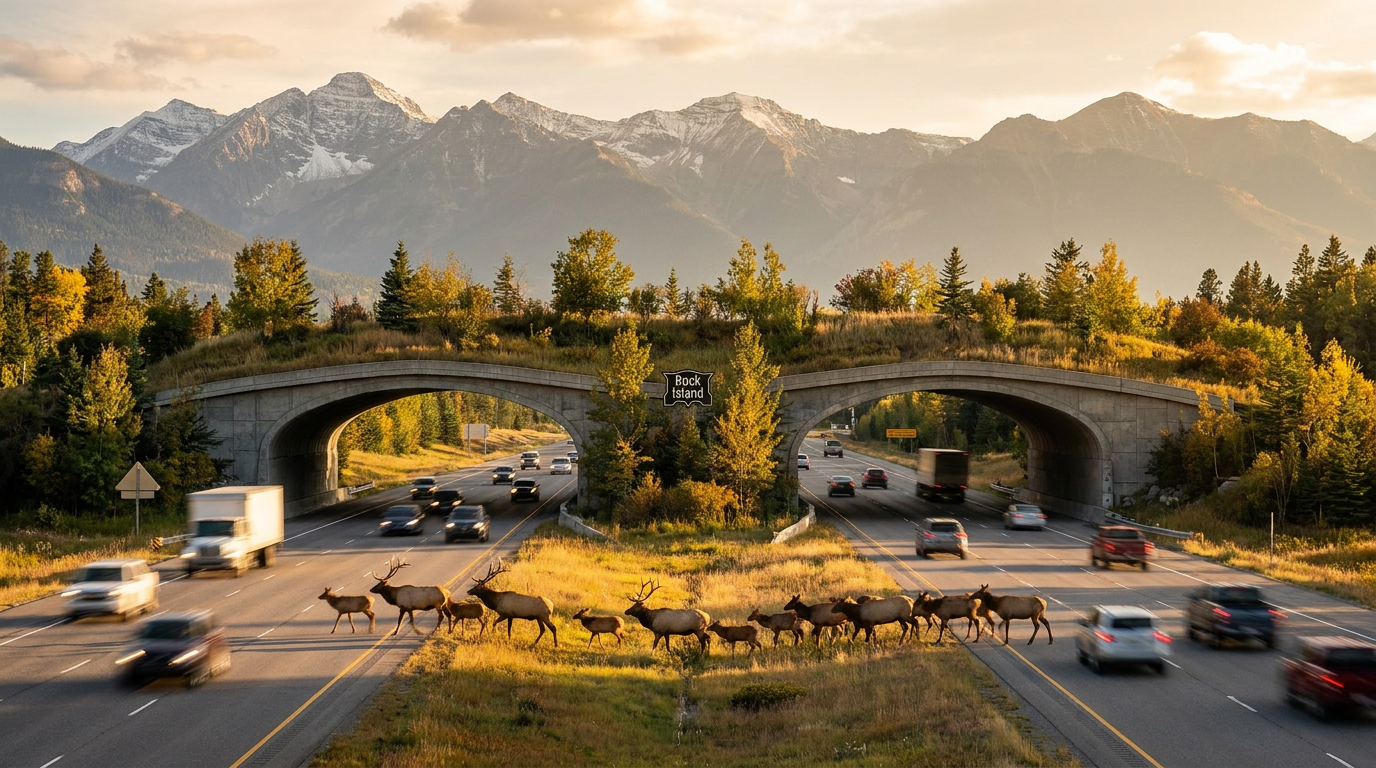
Across North America, a new kind of highway construction boom is taking place, but it isn't designed for cars. From the dense forests of the Canadian Rockies to the arid stretches of the American Southwest, engineers are building massive, vegetated bridges and cavernous underpasses dedicated entirely to wildlife. This continental push to restore "habitat connectivity" represents one of the most successful, yet quietly executed, conservation triumphs of the 21st century.[6]
For decades, the expansion of human infrastructure has sliced North America's wilderness into isolated islands. The United States alone is crisscrossed by more than four million miles of roads. For migratory species that have traversed these landscapes for millennia, highways act as lethal barriers. The result is a staggering toll: an estimated one to two million wildlife-vehicle collisions occur annually in the U.S., resulting in roughly 200 human fatalities, 26,000 injuries, and an economic burden exceeding $10 billion in property damage and medical costs.[1][3]
Beyond the immediate carnage of roadkill, the hidden cost of highways is genetic isolation. When animals cannot safely cross roads to find mates, populations become fragmented. Inbreeding weakens their resilience to disease and environmental changes. In the early 1990s, wildlife biologists realized that simply protecting isolated patches of land—like national parks—was insufficient. Animals, particularly apex predators like grizzly bears and wide-ranging ungulates like elk, need room to roam.[5][6]

Enter the Yellowstone to Yukon (Y2Y) Conservation Initiative, a visionary effort launched in 1993 to connect a 2,000-mile corridor stretching from Wyoming to the Canadian Arctic. At the time, grizzly bear populations in the lower 48 states were separated by 150 miles of hostile, human-dominated terrain. Today, thanks to a combination of land purchases, protected corridors, and highway mitigation, that gap has shrunk to just 45 miles.[2]
The mechanism of this reconnection relies heavily on engineered crossings. Across the Y2Y region alone, 204 wildlife crossing structures now span busy roadways. But building a successful crossing requires more than just pouring concrete; it requires behavioral psychology. Biologists have discovered that different species have distinct architectural preferences based on their evolutionary survival strategies.[2][6]
Prey animals, such as elk, moose, and pronghorn, are deeply averse to enclosed spaces where predators might hide. They overwhelmingly prefer wide, open overpasses planted with native vegetation that mimic the natural landscape and offer clear lines of sight. Conversely, predators like mountain lions and black bears are more comfortable using concrete underpasses and refurbished culverts to slip quietly beneath the asphalt.[5][6]

Prey animals, such as elk, moose, and pronghorn, are deeply averse to enclosed spaces where predators might hide.
The secret to making these structures work, however, is the fencing. A multi-million dollar overpass is virtually useless if animals can simply wander onto the highway a mile down the road. Engineers install miles of eight-foot-high exclusion fencing along the highway margins, effectively funneling wandering wildlife directly toward the safe passage.[1][5]
The evidence of their efficacy is overwhelming. When crossing structures are paired with adequate exclusion fencing, studies consistently show an 80% to 97% reduction in wildlife-vehicle collisions. In Banff National Park, a pioneer in highway mitigation, a series of overpasses and underpasses along the Trans-Canada Highway reduced collisions with deer and elk by 96%.[1][5]
The financial return on investment is equally compelling. While a vegetated overpass can cost upwards of $5 million to $10 million to construct, the savings accrue rapidly. According to data analyzed by The Pew Charitable Trusts, a single collision with a deer costs society roughly $19,000, while hitting an elk costs $73,000, and a moose collision can exceed $110,000. Over a structure's 70-year lifespan, a well-placed crossing in a high-traffic migration corridor can prevent thousands of accidents, effectively paying for itself multiple times over.[1]

Recognizing this dual benefit of human safety and ecological health, public funding has begun to catch up with the science. The U.S. Infrastructure Investment and Jobs Act (IIJA) established a first-of-its-kind $350 million pilot program specifically dedicated to wildlife crossings. The program allows states, municipalities, and tribal governments to apply for federal grants to mitigate collision hotspots.[3][4]
The demand for this funding has been explosive. During the initial application cycles, requests for funding outpaced the available federal dollars by a factor of five. States are also stepping up independently; Florida recently allocated $400 million to protect its statewide wildlife corridor, crucial for the endangered Florida panther, while New Mexico and Colorado have passed dedicated funding mechanisms for highway mitigation.[3][4]
Tribal nations are also playing a central role in this infrastructure boom, utilizing federal grants to restore traditional ecological networks. The Confederated Salish and Kootenai Tribes recently secured $8.6 million to construct overpasses across U.S. Highway 93 in Montana, a critical step in reducing grizzly bear mortality and restoring safe passage across their ancestral lands.[4]

Despite these successes, significant challenges remain. A global analysis of 120 wildlife overpasses found that many structures built in North America and Europe fall short of the optimal 50-meter width recommended by experts for large mammals, often due to budget constraints. Narrower bridges can create bottlenecks and deter more cautious species from crossing.[5]
Furthermore, the urgency of habitat connectivity is accelerating due to climate change. As global temperatures rise, plant and animal species are being forced to migrate toward the poles or to higher elevations to find suitable climates. If their escape routes are blocked by impenetrable highways and urban sprawl, localized extinctions will become inevitable. The race to build North America's wildlife corridors is no longer just about preventing car crashes; it is about engineering an escape hatch for the continent's biodiversity.[6]
How we got here
1993
The Yellowstone to Yukon (Y2Y) Conservation Initiative is launched to connect a 2,000-mile wildlife corridor.
2010s
Banff National Park's highway mitigation proves that overpasses and fencing can reduce wildlife collisions by up to 96%.
2021
The U.S. Infrastructure Investment and Jobs Act allocates a historic $350 million specifically for wildlife crossings.
2025
Y2Y reports the gap between isolated grizzly populations has shrunk from 150 miles to 45 miles.
2026
Federal grant demand for wildlife crossings outpaces available funding by a factor of five.
Viewpoints in depth
Conservation Biologists
Scientists emphasize that crossings are essential for long-term species survival, not just immediate safety.
For conservationists, the primary value of a wildlife overpass is genetic. When highways sever a landscape, small populations of animals become trapped. Over generations, this isolation leads to inbreeding, making the population highly susceptible to disease and environmental shocks. Biologists argue that as climate change forces species to migrate to new latitudes and elevations, establishing unbroken continental corridors is the only way to prevent mass localized extinctions.
Transportation Officials
Highway departments view wildlife crossings as highly cost-effective public safety infrastructure.
From a civil engineering perspective, wildlife crossings are a math equation that overwhelmingly favors construction. While a vegetated overpass requires a significant upfront capital investment—often between $5 million and $10 million—the societal cost of doing nothing is far higher. With a single moose collision costing upwards of $110,000 in vehicle damage, medical bills, and lost productivity, transportation officials note that a well-placed crossing pays for itself rapidly over its 70-year lifespan by virtually eliminating crash hotspots.
Indigenous Nations
Tribal governments see habitat connectivity as a restoration of traditional ecological balance and rural equity.
For many Indigenous communities, highway mitigation is a tool for restoring the natural movement of the landscape that existed long before asphalt. Tribal nations have been aggressive in securing federal grants to build crossings on ancestral lands, viewing the protection of culturally significant species like grizzly bears and elk as a sovereign priority. Furthermore, advocates note that funding these projects directs crucial infrastructure dollars into rural areas that are often overlooked in favor of urban development.
What we don't know
- Whether federal and state funding can scale fast enough to meet the massive backlog of identified collision hotspots.
- How rapidly shifting climate zones will alter traditional migration routes, potentially rendering some current crossings obsolete.
Key terms
- Habitat Connectivity
- The degree to which distinct patches of landscape are connected, allowing wildlife to move safely to find food, mates, and shelter.
- Wildlife Corridor
- A continuous swath of natural habitat that links larger protected areas, often requiring human-made crossings to bypass roads.
- Genetic Isolation
- A vulnerability that occurs when a small population of animals is cut off from others, leading to inbreeding and reduced resilience to disease.
- Ungulate
- A hooved mammal, such as a deer, elk, or moose, which typically requires large, open landscapes for seasonal migration.
Frequently asked
Do animals actually know to use the bridges?
Yes, but they are guided by miles of exclusion fencing along the highway that blocks other access points and funnels them directly toward the crossing.
Why not just build underpasses, which are cheaper?
Different species have different psychological needs. Prey animals like elk and moose prefer wide, open overpasses where they can see predators, while cougars and bears readily use underpasses.
How much does a wildlife-vehicle collision cost?
Beyond the human toll, the economic cost averages $19,000 for a deer collision and up to $110,000 for a moose, factoring in vehicle damage, medical costs, and lost productivity.
Is climate change affecting the need for corridors?
Yes. As temperatures rise, many species are being forced to migrate further north or to higher elevations to find suitable climates, making connected landscapes more critical than ever.
Sources
Source coverage
6 outlets
3 viewpoints surfaced






[1]The Pew Charitable TrustsTransportation Officials
Wildlife Crossings Save Lives, Cut Costs, and Protect Animals
Read on The Pew Charitable Trusts →[2]Yellowstone to Yukon Conservation InitiativeConservation Biologists
2025 Impact Report: Reconnecting Fragmented Landscapes
Read on Yellowstone to Yukon Conservation Initiative →[3]National Conference of State LegislaturesTransportation Officials
State Action on Wildlife Corridors and Crossings
Read on National Conference of State Legislatures →[4]The Wildlife SocietyIndigenous & Rural Communities
Demand for Wildlife Crossing Funds Triples Available Grants
Read on The Wildlife Society →[5]National Institutes of HealthConservation Biologists
Global evaluation of wildlife overpass dimensions and their compliance with expert design guidelines
Read on National Institutes of Health →[6]Factlen Editorial TeamIndigenous & Rural Communities
Synthesis by Factlen editorial team
Read on Factlen Editorial Team →
Every angle. Every day.
Get world stories with full source coverage and perspective breakdowns delivered to your inbox.